The preliminary German DWD national weather service results of the data for Germany this summer (June, July, August) are in. As expected, the summer was warmer than normal, but nothing really unusual.
Fudging the anomalies
The DWD reports, however, the temperature of the 2023 summer in Germany “was significantly above the multi-year average, every summer over the past 27 years.” To reach this conclusion, the DWD uses the 1961-1990 temperature reference period – a period we know was the among the very coolest over the 20th century.
“Once again, we can experience climate change live,” comments Uwe Kirsche, press spokesman for the German Weather Service (DWD).
The mean temperature for Germany in the summer of 2023 was 18.6 degrees Celsius (°C), meaning it was an unspectacular 1.0 degree over the mean of the 1991-2020 reference period. The temperature extremes ranged from a summer low of -0.7 °C recorded in Sohland an der Spree on June 3, to a high of 38.8 °C in Möhrendorf-Kleinseebach (Bavaria) recorded on July 15.
Summer weather was too lousy for the swimming pool
Millions of Germans, however were not convinced by the media reports of summer heat and many thought the summer on the whole was not even that warm.
For example, Hamburg’s online “Hamburger Abendblatt” here reports that the public swimming pool season this past summer was “a flop”, calling the summer, apart from June, “quite sad in terms of weather” and “that’s why there were so few visitors to the outdoor pools in the second half of the summer.”
The heat was mostly spread across southern Germany, while northern Germany saw near normal temperatures and above normal precipitation.
Wetter and sunnier than normal
In terms of precipitation, Germany’s 2023 summer saw 270 liters per square meter (l/m²) of precipitation a good 10 percent more than the average for the period 1991 to 2020 (241 l/m²).
With 720 hours of sunshine, Germany’s 2023 summer was sunnier than normal. Compared to 1991 to 2020 reference period (654 hours) it was about 10% sunnier than normal.
Given that Idalia turned out to be a bit of a damp squib, the Independent is rather shooting itself in the foot. It rather proves that the cost of US “climate disasters”, (I assume they mean weather disasters), have actually been pretty low this year!
The simple reality, that even the simpletons who read the Independent must know, is that by definition hurricanes tend to be much more costly than most other weather events. That is the nature of the beast.
The Australian Academy of Science (AAS) recently released a report Reef Futures Roundtable, which is ostensibly about the doomed Great Barrier Reef. However, the report only demonstrates that the AAS, Australia’s peak science body, has become not just unscientific, but anti-scientific. Perhaps unsurprisingly, it has also become astonishingly Woke.
The AAS report predictably concluded that the Great Barrier Reef
could already be ‘irreversibly’ damaged.
The fact that UNESCO has just declared it not endangered did not rate a mention, and neither did the latest two years of statistics showing the reef is at record high coral levels. Remarkably, the report does not contain a single fact or figure to support any of its claims about the reef – except the area of the reef is 340,000 square kilometres. There are no figures, no percentages.
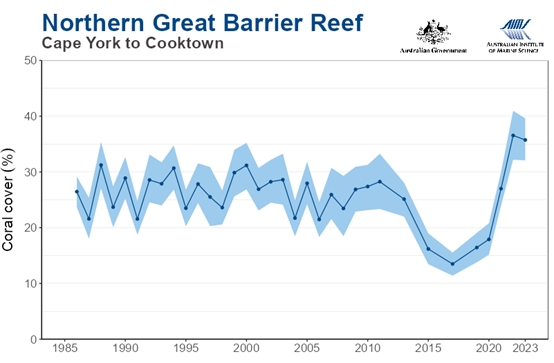
The recovery in the northern GBR actually started around 2017. Last year the coral declined slightly from 36.5% to 35.7%, and was easily within the margin of error calculated by the AIMS. Typhoon Tiffany passed through at the end of the previous reporting season, and could have been responsible for some loss. Central and Sounthern sections of GBR showed similar gains.
Nowhere does it mention that coral grows 30 per cent faster for every degree increase in water temperatures. Or that there is 100 per cent more coral on the reef today than in 2012. Or that just 1 per cent of the reef has the potential to be impacted by farm sediment, fertiliser or pesticides, even in the slightest way. Or that the sea level has fallen by 1 metre in the last 5,000 years.
The problem with this completely unanalytical approach
is seen in the ‘interventions’ it recommends to fix the reef.
Their impracticality is breathtaking. For example, it suggests ‘solar radiation management’ – shading the reef from the sun with man-made fog and clouds to prevent the water heating up and causing coral bleaching. The only number cited in the entire report – the area of the reef, which is as big as Germany – should have given them a hint that this is crazy. How are you going to make a cloud as big as Germany and keep it anchored over the reef for the whole summer over the next few hundred years? And you will also have to stop hot water flowing into the reef from the Coral Sea at the same time. That would require a dam 2,000 kilometres long and 100 metres high.
While a simple calculation is all that is required to reveal the absurdity of this idea, modern science is full of people who are almost completely non-quantitative and, as such, impractical and virtually useless as scientists.
Next there is rubble stabilisation. The supposed experts worry that the Great Barrier Reef will break up from climate change. Each of the 3,000 reefs is an almost solid lump of calcium carbonate rock (fragments of coral glued together over eons) a few kilometres wide and 100 metres high. How this is going to be broken up by some climate change magic is unexplained. But even if that were to happen, are they seriously suggesting we can wire it back together with steel reinforcing and concrete? Just do the calculation on how much concrete and steel this would entail.
The unscientific nature of the AAS report is largely a result of its anti-scientific approach. The report is actually a parody of wokeness and romantic mythology. This starts with the way the roundtable committees of ‘experts’, whom they questioned about the reef, were formed. Each roundtable had two chairs, a non-Indigenous chair, and a specially selected Aboriginal and Torres Strait Islander chair. The romantic mythology about the special knowledge of any person with Indigenous heritage pervades the entire document, and starts in the foreword by the head of the AAS.
As the Academy approached the task of planning this project it became immediately obvious that there was no separating nature and culture when it comes to the GBR. Land and sea cannot be separated. No priority can be selected on an ecological basis alone. Having a Traditional Knowledges co-Chair in each roundtable allowed for different sources of knowledge to be shared and to form a basis for a number of the observations featured in this report.
Having a diversity of ideas and scientific thought would have gone some of the way to curing the AAS of the groupthink which renders its report risible. And the views and experience of people from the coral islands of the Torres Straits and northern Great Barrier Reef could have been used to great effect. These people tend to be deeply practical about the reef – like almost all seafaring people who live and work on the reef. And practical people know you cannot bolt the reef, which is the size of Germany, down to the seafloor.
But selecting people for their ‘roundtables’ on the basis of their ethnicity
rather than their scientific or real-world experience
is a fundamentally anti-scientific approach.
But it gets worse. The dearth of statistics about the reef are made up for by an abundance of data on the gender identification of all those who participated in the ‘roundtables’. There is also the Indigenous percentage. And not just of those who participated, but also of those who were invited to participate but did not. One could quibble and point out that those claiming to be male or female added up to exactly 100 per cent in all categories, indicating a terrifying lack of diversity on the LGBQTI+++ spectrum. But there is no question, on the important matters for the Woke brigade, that this report is brimming with instructive statistics.
The AAS ascribes such importance to facts and figures on gender and race,
but not to scientific facts.
This demonstrates it is anti-science. Science is about evidence and logic. It does not matter whether one is male or female or whatever else, it is still impossible to make clouds as big as Germany for the next hundred years. That is called a fact, and facts do not vary with race, gender, or any ideology.
I have been saying for some time that many of our science institutions have become totally untrustworthy. By its wilful abandonment of quantitative analysis, the AAS has destroyed its reputation as a source of useful scientific advice. The media loves a bad news story – they should focus on what has happened to a once-esteemed organisation.
The Australian Academy of Science is now a joke.
Peter Ridd is an Adjunct Fellow at the Institute of Public Affairs.
Recently I watched an extraordinary netflix documentary which took us on a journey discovering the rich variety of reef life, including microscopic creatures not shown in videos before. It was highly educational and thoroughly delightful . . . until suddenly it wasn’t. Spoiler Alert: Puff returns as an adult to the reef where he was born after leaving it to mature in a mangrove marsh. Alas, he finds the coral dead and blackened, and the narrator warns us: Warming oceans kiiled the reef and we must change the way we live for the sake of Puff and the other reef creatures. There may have been more to the fire and brimstone ending, but I was so turned off that I turned it off.
Coral at the Great Barrier Reef (GBR) faces another year of exile from the climate scare headlines with news that the record levels reported in 2021-22 have been sustained in the latest annual period to May 2023. A small drop in the three main areas of the reef was well within margin of error territory, with the Australian Institute of Marine Science (AIMS) reporting that regional average hard coral cover in 2022-2023 was similar to last year at 35.7%. Most reefs underwent little change during the year.
In a recent and rather dramatic turn of events, the Rhode Island Fisherman’s Advisory Board (FAB) has made a bold statement by collectively resigning from the Rhode Island Ocean SAMP process. Their letter, addressed to Jeff Willis, the Executive Director of the Rhode Island Coastal Resources Management Council (CRMC), pulls no punches in its critique of the Council’s approach to offshore wind development.
“We, the undersigned members of the Rhode Island Fisherman’s Advisory Board (FAS), hereby resign and refuse to participate any longer in the Rhode Island Ocean SAMP process. It has become abundantly clear that the Rhode Island CRMC has made deference to offshore wind developers its top priority regardless of the requirements of the Ocean SAMP, the cost to the environment, or the impacts to Rhode Island’s fishing industry.”
This statement alone speaks volumes about the perceived shift in priorities of the CRMC. The FAB members believed that their role was to ensure that offshore wind projects conformed to the requirements and restrictions of the Ocean SAMP. However, their experience suggests otherwise:
“The Ocean SAMP process has been reduced to mere political theater, to which we refuse to lend any further credence by our presence.”
The FAB’s frustration is palpable. They detail the countless hours they’ve invested, providing the CRMC with expertise, data, science, research, and experience. Yet, they feel their efforts have been in vain:
“Concurrence decisions are made ahead of time regardless of any other considerations, FAB expertise rejected and ridiculed by the Council as ‘anecdotal’ while the developer is free to provide misinformation with impunity…”
The letter paints a picture of a process that has lost its way, with the FAB feeling sidelined and their expertise undervalued. They highlight the stark contrast between the strict regulations they face in the fishing industry and the leniency shown to offshore wind developers:
“It is apparent that the Council does not take its regulatory role seriously. As the seventh-most regulated industry in the nation, we in the fishing industry know what it is like to be held to strict regulatory standards, including environmental standards.”
The FAB’s concerns extend beyond mere procedural issues. They point to tangible environmental impacts, such as the “decimation of cod spawning grounds” and “significant long-term impacts on Rhode Island’s fishing industry.”
In a poignant conclusion, the FAB members express their unwillingness to be associated with what they view as the Council’s misguided decisions:
“We will not allow our names to be connected in any way to Council approvals now amounting to wholesale ocean destruction. Rhode Island is supposed to be the Ocean State, not the Windmill State.”


 Iowa Climate Science Education