Month: September 2023

Greenland Icecap – 2023

By Paul Homewood


image

http://polarportal.dk/en/greenland/surface-conditions/


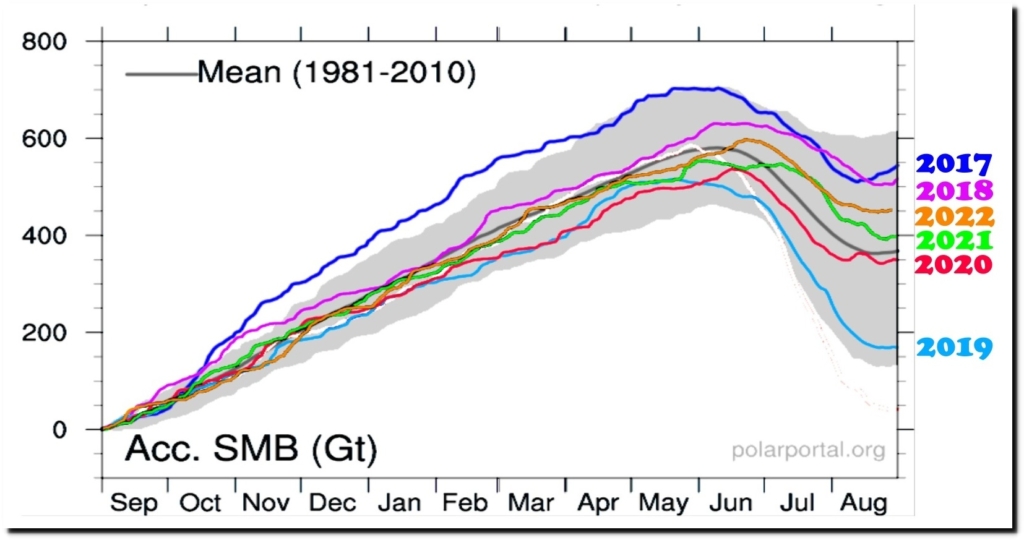
Summer is over in Greenland, and the SMB has finished above average once again.

This is the fifth of the last seven years to finish above average:

Courtesy of Tony Heller

http://web.archive.org/web/20221007180858/https://realclimatescience.com/2022/08/more-than-twice-as-fake-as-the-previous-model/


As always, please read the DMI explanatory note:

image

When calving and bottom melting are factored in, there is a net loss of ice. However this loss has been taking place since the end of the 19thC, following the Little Ice Age, the coldest era in Greenland since the Ice Age.

image

Annual average surface mass balance (blue line), marine mass balance (gray dashed), and their mass balance sum (black line).

https://essd.copernicus.org/preprints/essd-2021-131/essd-2021-131.pdf

The above chart runs to 2021, but I have updated it to include last year, and simplified the chart with a 10 year average:


image

https://dataverse.geus.dk/dataset.xhtml?persistentId=doi:10.22008/FK2/OHI23Z

As can be seen, the rate of loss in the last decade is similar to the 1930s, 50s and 60s. During the 1970s and 80s, Greenland’s climate grew much colder, and the ice mass loss almost stopped completely.

Significantly the rate of loss now is not accelerating, as you may have assumed from what the media have told you. On the contrary, the rate of loss has been slowing down since 2012.

The average annual loss between 2013 and 2022 was 184 Gt, which equates to 0.51mm sea level rise a year.

In short there is nothing alarming or unprecedented about the tiny amount of ice melt in Greenland.

via NOT A LOT OF PEOPLE KNOW THAT

https://ift.tt/dTVC1wz

September 2, 2023 at 03:57AM

Alarmists turn up heat with climate, weather ‘records’

Rather than citing actual temperatures, where according to the National Weather Service (NWS), Puerto Rico on the day referenced was 95 degrees — not 125 — since index measurements combine temperature and relative humidity.

The post Alarmists turn up heat with climate, weather ‘records’ appeared first on CFACT.

via CFACT

https://ift.tt/ZGrTucE

September 2, 2023 at 03:45AM

Clueless Marlow Thinks More Intermittent Energy Is The Answer To The Problems Of Intermittency!!!

By Paul Homewood


The clueless Ben Marlow is back to normal, with this utterly naive article:


 image

In the Marlow household, all it took was a couple of chillier nights for us to panic and swap the paper-thin summer duvets for something more robust, a move I instantly regretted after seeing the weather forecast for the next five days.

If your thoughts hadn’t yet turned to the prospect of donning the thermals once again, then they probably will after the National Grid announced plans to pay families to cut their electricity usage again this winter.

As a way of ensuring the lights stay on, it certainly beats firing up the country’s old coal power stations – the tactic so often previously employed. There’s a certain creativity to it too – not something you’d expected from an organisation that Octopus Energy boss Greg Jackson has accused of “a phenomenal failure to innovate”.

But more broadly, it’s another sticking plaster solution to the energy crisis, and a pretty primitive one at that.

There are several far more grown-up solutions National Grid and the Government could employ. But don’t hold your breath – if there’s one thing that the great energy crisis unleashed by Vladimir Putin has taught us, it’s that neither our political masters nor the regulator have the answers.

Bills are still obscenely high and we need to wean ourselves off oil and gas. Yet it’s becoming increasingly clear that the costs of reaching net zero risks being prohibitively high, and No 10 continues to rely on a price cap that is acting as much as a floor on household bills as it is a ceiling.

https://www.telegraph.co.uk/business/2023/09/02/paying-people-use-less-electricity-plaster-energy-crisis/

So far, so good!

But Marlow’s solution is to build more wind and solar, and spend £40 bn that we have not got on upgrading the grid infrastructure to distribute it:

If Claire Coutinho wants to be taken more seriously in the post than her predecessor, then she should start by trying to drag the Grid into the 21st century so that electricity supply can keep up with ballooning demand.

Lobbyists boast that the UK has one of the most resilient grids on the planet but if that’s the case, then why the need for such convoluted measures to reduce the threat of blackouts – measures that critics have dismissed as “a gimmick” and customers have complained has only saved them pennies?

Isn’t the very threat of the lights going out in an advanced economy pretty firm evidence that the Grid is “not fit for purpose”, as Octopus’s Jackson has also claimed?

If you’re still not convinced, then perhaps it’s worth remembering that it takes seven years on average to connect a wind farm to the grid, while there are parts of London where it is impossible to build more homes because there isn’t capacity to support them.

In 2022, National Grid committed to a £40bn spending program on critical infrastructure over the next four years. Heaven knows it’s needed. Britain is moving to a modern digital economy in which electricity demand is expected to soar threefold by the middle of the century.

Yet, parts of the system were built in the aftermath of the Second World War. We need new connections and more modern transmission infrastructure, such as pylons and underground copper cables, otherwise hopes for 50 gigawatts (GW) of new wind and 70GW of additional solar power by 2030 will remain nothing more than that.

Apparently Mr Marlow has not managed to work out that the looming blackouts will be the result of shutting down tranches of dispatchable coal power, not a lack of intermittent renewable energy.

The commenters on the article seem to recognise this better than Marlow. For instance:

The fundamental problem is that our political class are hopelessly incompetent, economically and scientifically illiterate and completely corrupt.

They have committed the country to net zero lunacy without any referendum or mandate which will result in economic suicide and our transition to third world status.

Anyone impartial with any sense that has looked into it can see that renewables are intermittent and therefore unable to ever provide the reliable base load power required for a 1st world nation. Energy storage on the scale required using batteries or hydrogen is not and will never be viable.

Therefore the only realistic solution is to focus on nuclear, gas and coal based power to provide reliable base load power at sensible cost.

The only conclusion one can reach is that our politicians are effectively captured by a hostile foreign entity and are deliberately trying to destroy the future of our nation and its people.

via NOT A LOT OF PEOPLE KNOW THAT

https://ift.tt/DHcdtUJ

September 2, 2023 at 03:28AM

New research looks at ‘stalled trend in Arctic Ocean sea ice loss since 2007’

Arctic sea ice [image credit: cbc.ca]

Not the often-quoted ‘rapid decline’ any more then. But what’s behind the stalled trend? The researchers point to a climate cycle known as the Arctic dipole, first proposed in 2006, which ‘reverses itself’, and should (they say) be about to do so again. Are declining solar cycles accompanied by greatly reduced geomagnetic activity (see here) in the same recent years another factor, or just coincidental?
– – –
New research by an international team of scientists explains what’s behind a stalled trend in Arctic Ocean sea ice loss since 2007, says Phys.org.

The findings indicate that stronger declines in sea ice will occur when an atmospheric feature known as the Arctic dipole reverses itself in its recurring cycle.

The many environmental responses to the Arctic dipole are described in a paper published online today in the journal Science. This analysis helps explain how North Atlantic water influences Arctic Ocean climate.

Scientists call it Atlantification.

The research is led by professor Igor Polyakov of the University of Alaska Fairbanks College of Natural Science and Mathematics. He is also affiliated with the International Arctic Research Center at UAF.

Co-authors include Andrey V. Pnyushkov, research assistant professor at the International Arctic Research Center; Uma S. Bhatt, atmospheric sciences professor at the UAF Geophysical Institute and UAF College of Natural Science and Mathematics; and researchers from Massachusetts, Washington state, Norway, and Germany.

“This is a multidisciplinary view on what’s going on in the Arctic and beyond,” Polyakov said of the new research. “Our analysis covered the atmosphere, ocean, ice, changing continents and changing biology in response to climate change.”

A wealth of data, including direct instrumental observations, reanalysis products and satellite information going back several decades, shows that the Arctic dipole alternates in an approximately 15-year cycle and that the system is probably at the end of the present regime.

In the Arctic dipole’s present “positive” regime, which scientists say has been in place since 2007, high pressure is centered over the Canadian sector of the Arctic and produces clockwise winds. Low pressure is centered over the Siberian Arctic and features counterclockwise winds.

This wind pattern drives upper ocean currents, with year-round effects on regional air temperatures, atmosphere-ice-ocean heat exchanges, sea-ice drift and exports, and ecological consequences.

The authors write that, “Water exchanges between the Nordic seas and the Arctic Ocean are critically important for the state of the Arctic climate system” and that sea ice decline is “a true indicator of climate change.”

In analyzing oceanic responses to the wind pattern since 2007, the researchers found decreased flow from the Atlantic Ocean into the Arctic Ocean through the Fram Strait east of Greenland, along with increased Atlantic flow into the Barents Sea, located north of Norway and western Russia.

The new research refers to these alternating changes in the Fram Strait and the Barents Sea as a “switchgear mechanism” caused by the Arctic dipole regimes.

The researchers also found that counterclockwise winds from the low-pressure region under the current positive Arctic dipole regime drive freshwater from Siberian rivers into the Canadian sector of the Arctic Ocean.

This westward movement of freshwater from 2007 to 2021 helped slow the overall loss of sea ice in the Arctic compared to 1992 through 2006. The freshwater layer’s depth increased, making it too thick and stable to mix with the heavier saltwater below. The thick layer of freshwater prevents the warmer saltwater from melting sea ice from the bottom.

The authors write that the switchgear mechanism regulating inflows of sub-Arctic waters has “profound” impacts on marine life. It can lead to potentially more suitable living conditions for sub-Arctic boreal species near the eastern part of the Eurasian Basin, relative to its western part.

“We are beyond the peak of the currently positive Arctic dipole regime, and at any moment it could switch back again,” Polyakov said. “This could have significant climatological repercussions, including a potentially faster pace of sea-ice loss across the entire Arctic and sub-Arctic climate systems.”

Source here.

via Tallbloke’s Talkshop

https://ift.tt/5qHAB84

September 2, 2023 at 03:27AM