By Jo Nova
On the precipice of a radical experiment with a national electricity grid
The AEMO (manager of the Australian grid) has finally released the major report on problems coming in the next ten years on our national grid, and it’s worse than they thought even six months ago. They euphemistically refer to the coming “reliability gaps”. They could have said “blackouts” instead, but a gap in reliability sounds so much nicer.
Bizarrely, the lead graph of the 175 page AEMO report goes right off the scale, mysteriously peaking in the unknown and invisible land off the top of the chart. And they’re not projecting troubles fifty years from now. Those cropped peaks of pain hit from 2027.
And even the pain we can see is apparently quite bad. Two states are already likely to breach “the interim reliability measure” in this coming summer. Ominously, just one day after releasing the report, the AEMO is calling for tenders for “reliability reserves” in South Australia and Victoria. Apparently, they want offers of industries ready to shut down who aren’t already on the list, and they want spare generation too — get this — even asking for “small onsite generators”. It’s that bad.
As the calm analyst Paul McArdle says:
“Based on current trajectory, we’re in for a world of pain ahead. …the AEMO projections are looking pretty dire.”
Consider figure 1: A decade of blackouts coming
Have you ever seen a graph like this that hides the peaks? In the “central scenario” of the cropped graph — “only” four states of Australia go off the charts. Imagine what the bad scenario looks like…
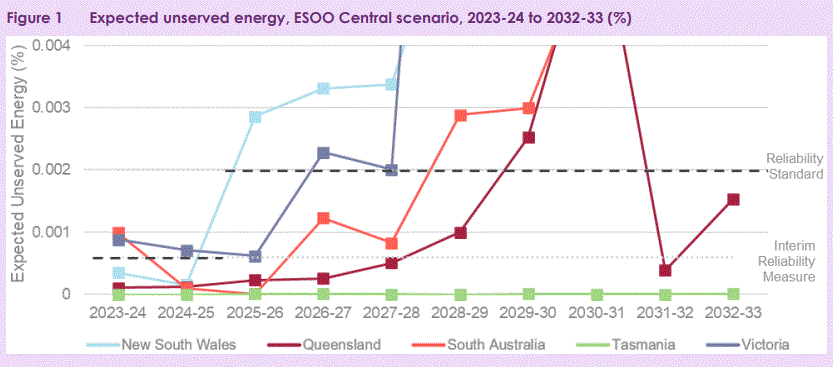
AEMO, ESOO, 2023. Figure 1 shows the reliability forecast and indicative reliability forecast for the 2023 ESOO Central scenario. This forecast considers only the sub-set of known developments that have demonstrated sufficient commitment towards commissioning in the NEM (those developments classified as committed or anticipated), including announced retirements, and allows for project delivery schedules that may be slower than proponents have advised based on observed development, approval and commissioning requirements.
Given that South Australia flew in diesel jet engines for back up generation at one point (General Electric aero-derivative turbines) — perhaps we can ask Qatar Airlines if they can plug some planes straight into our grid? (The government won’t let them fly in more passengers, in case it screws up Qantas profits, but that means they must have a few planes they can spare.)
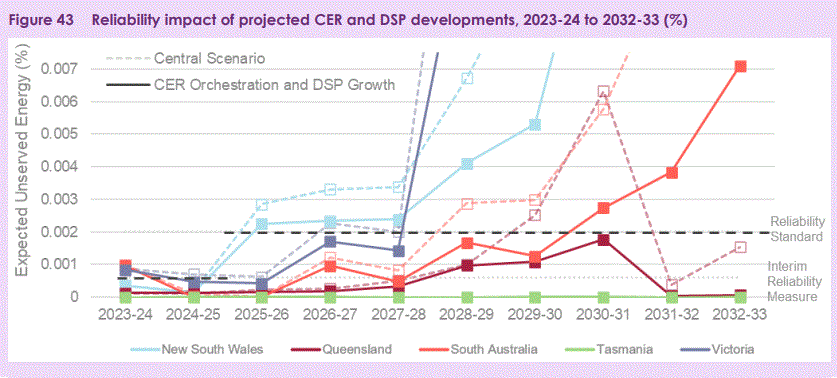
A leap to Figure 43 suggests those hidden peaks of Figure 1 might be quite high in NSW and Victoria. Figure 43 shows the same “Central Scenario” as Figure 1 — this time as dotted lines — and we are allowed to see a bit more of the graph. The y axis is the same Expected Unserved Energy (%) this time reaching up to 0.007%. But the NSW (blue) and Victorian (grey) lines are doing the Moonshot thing in 2027. They’re headed to infinity or some number the AEMO didn’t want to graph.
AEMO, ESOO, 2023,
The solid lines in Figure 43 are the slightly better scenarios that include contributions from CER or “Consumer Energy Resources” (that’s you!). This is what the future looks like with more help from things like solar panels on rooftops, home batteries, and Electric Vehicles. It’s also the best we can do with DSP assistance — which means Demand Side Participation — those people who participate by not demanding electricity. In normal English we would call them the customers who are paid to stay away or something. Get it?
Ten different ways to go without electricity
The AEMO doesn’t use the word blackout, but it has a dozen flavours of blackouts-by-another-name, many of them voluntary or subsidized and somewhat prearranged. It looks so much better on paper to say “DSP” but it means someone, somewhere going without electricity when they would otherwise have used it. DSP gets 146 mentions in the AEMO report, giving us some idea on how mini-blackouts are now an essential part of managing a very sick grid.
At a minimum DSP may just be an inconvenience — people have to program their washing machine and pool filter to run at lunchtime, which sounds fine until you have only one sunny day that week and you have six loads of washing. In a rich world without “reliability gaps” you would just run it, conveniently, from 5 to 10 pm the night before.
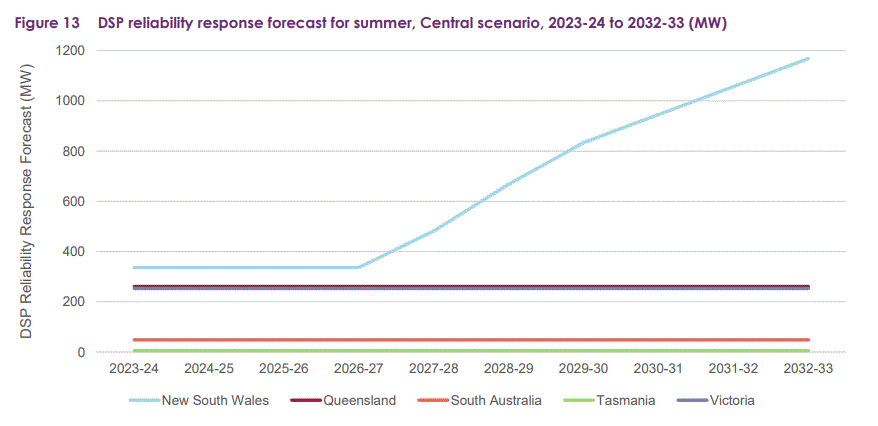
DSP is code for people willing (or dragged), in some sense, to have a voluntary mini-blackout — and the report notes the major factor driving an increase in DSP uptake is because electricity is now more expensive (what a great thing?). The AEMO notes: “These higher prices have led to more benefits to customers participating in DSP schemes or responding directly to market signals”. Table 5 lists the Negawatts of voluntary outages when prices rise to $1,000, $5,000 and $7,500 per megawatt hour…
Now that Alice lives in Downunder-land — more expensive electricity means customers get more “benefits” when they don’t use it. See how this works? Only the wealthy will have the convenience of electricity whenever they want it. The underclass will be cooking on barbeques, and getting up earlier each day to program the washing machine and set up the timers for the scooters.
Ominously the AEMO projects a lot more voluntary blackouts:
AEMO, ESOO, 2023
Drowning in complexity
The message in 42 tables and 100 figures is unspoken, but obvious — the Australian grid is drowning in complexity, there are so many moving unpredictable parts. The report models the various possibilities of low rain, low wind, low stocks of fossil fuels, droughts, heatwaves, and unexpected outages. They try to model some combinations and permutations of multiple troubles occurring simultaneously. Whether we get and can afford electricity now depends on ocean currents in the Pacific that no one can predict. We live in the land of drought and flooding rains, and we’re hoping the weather will be nice.
The AEMO brightly says that it can be managed, see Figure 2, if we just build 10,000 kilometers of high transmission lines through farmland and forests, and then finish all the wind farms and solar magic panels, along with lots more voluntary blackouts, “consumer investments” (home batteries) and dispatchable capacity (whatever could that be?)
The last thought is the predictions for South Australia:
There is an 84% chance under a “neutral/unknown climate outlook” that South Australia will have no blackouts this summer. But there is a 16% chance that some will occur, and these are most likely to be 1-3 hours long affecting 5 to 30% of the region (which means “of the state”, presumably). But there is a tiny chance they might lose half the state for as much as 16 hours (spread over four different nights, say). I bet they are praying they don’t get a hot windless week?
But even if they don’t have one blackout, more of people’s lives will be wasted paying electricity bills and reading articles on how to save electricity, how to reprogram the pool filter, how to charge the kids scooter, how to put out fires started by the scooter…
There’s a loss of quality of life that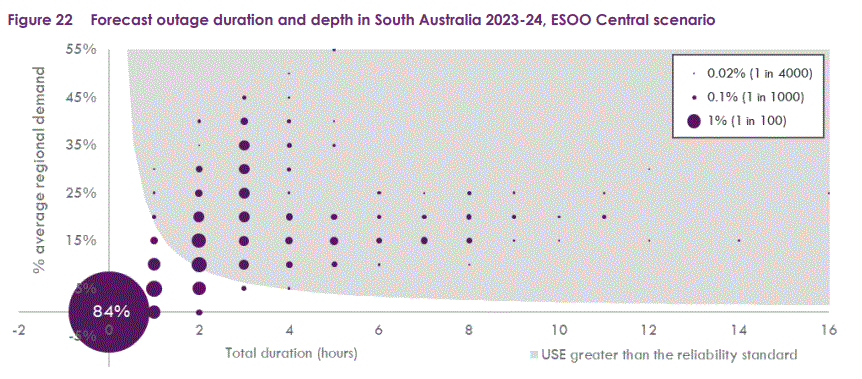
AEMO, ESOO, 2023,If that’s a neutral/unknown outlook, what does it look like for a long hot summer?For the data nerds: The text that officially goes with the graph above:
Figure 22 shows a bubble plot of the distribution of USE outcomes that are forecast in South Australia for the 2023-24 summer, under a neutral/unknown climate outlook. It includes the total outage duration and average depth in each simulation
-
-
- The remainder of simulations, which are collectively 16% probable, are represented by the other bubbles on
the chart. Should USE occur, it is most likely to occur for between one hour and three hours and be of an
average USE magnitude equivalent to between 5% and 30% of average regional demand. Within each event,
larger magnitudes of USE than the average may occur during the duration of the event.
- There is a very low probability for USE as deep as 55% of average regional demand, or as long as 16 total
hours, which may occur over multiple individual USE events, for example four different evenings. These
outcomes each represent the result of a single annual simulation, with an estimated probability of
approximately 1 in 4,000.
REFERENCES
The AEMO 2023 Electricity Statement of Opportunities (ESOO) report, a 10-year reliability outlook that signals development needs for each state in the National Electricity Market (NEM). August 31, 2023
AEMO — Interim Reliability Reserves Invitation to Tender 2023/24, Sept 1, 2023
0 out of 10 based on 0 rating




 Iowa Climate Science Education