Month: September 2023

The electric car debacle shows the top-down economics of net zero don’t add up

By Paul Homewood


h/t Paul Kolk


Blimey!! Ben Marlow has finally seen the light!


 image

Sadiq Khan’s controversial Ultra-Low Emissions Zone scheme for London was supposed to put the rocket-boosters under electric car demand.

With the Mayor pressing ahead with a highly-contentious scheme that forces non-compliant petrol and diesel car drivers to pay an eye-watering £12.50 a day to drive into the capital, the expectation was that hundreds of thousands of motorists would rush out to their nearest forecourt and snap up an electric version, triggering an explosion in sales of Nissan Leafs, Teslas and other battery-powered models.

There was a spike in registrations of electric vehicles in July but otherwise the electric car boom that politicians, manufacturers, and campaigners insist is around the corner, remains something of a myth.

True, sales are steadily increasing but not in the vast numbers that proponents of electrification anticipated or would like to see.

image

Proportion of cars on UK roads


In fact, it is becoming increasingly apparent that the car industry has misjudged the scale of demand quite badly. Vertu, which is one of Britain’s biggest car dealerships, has become the latest big name to admit that the sector is already suffering from a dramatic oversupply of battery-powered vehicles.

Indeed supply is outstripping demand to such an extent, that prices are tumbling rapidly.

The warning follows the extraordinary decision of German car titan Volkswagen in July to halt electric vehicle production at its sprawling Emden factory in north-west Germany and lay off a fifth of its 1,500 employees after sales of electric models fell 30pc short of forecasts.

Unwanted electric cars are piling up on American forecourts too leaving some dealers to refuse further deliveries until the backlog has eased.

One hopes politicians the world over are paying attention because what we are witnessing is another example of how the top-down economics of net zero increasingly don’t stack up: with the introduction of an entirely arbitrary 2030 ban on petrol and diesel cars, the Government is forcing manufacturers to churn out millions of vehicles, regardless of whether the market actually exists or not.

The deadline should be scrapped without further ado. This “cart before the horse” approach of trying to stimulate demand by creating supply is the wrong way round and almost never works in business.

Start-up Britishvolt tried something similar, promising to build a giant battery factory in Blythe, on the Northumbrian coast that would churn out enough batteries every year to power 300,000 cars.

Yet there was an even bigger flaw at the heart of its plans: it had failed to secure a single order – a situation that hadn’t changed by the time it ran out of money at the start of the year.

It’s hard to fault the intentions of the great net-zero crusade – a greener planet is something everyone should want to see. But far too much of it is built on hope rather than reality.


image 

The Government’s policy on wind energy has proved to be similarly divorced from fact. The Contracts for Difference scheme, which guarantees a fixed price for the electricity that is produced for 15 years, is an effective incentive during more benign times but when overheads are surging, as they are now, it quickly becomes an impediment to progress.

With ministers showing little willingness to bend on prices in the face of rampant cost increases, major projects are being ruthlessly abandoned.

The biggest setback has come off the Norfolk coast after Vattenfall announced it would shut down construction of its Boreas wind farm. The 1.4 gigawatt development was set to power around 1.5m homes but the Swedish energy outfit insists a 40pc surge in costs, driven by inflation, supply issues and rising wages means it is no longer viable.

Without more generous state subsidies others will surely follow suit, shattering Britain’s stated ambitions to nearly quadruple offshore wind capacity from 14GW currently to 50GW by the end of the decade.

Yet perhaps nothing underlines the Alice in Wonderland disconnection of ministers more than the campaign to force the population to green their homes with heat pumps.

Even a ban on the sale of new oil boilers from 2026 has failed to convince people to make the shift largely because the cost of converting your home can be huge, so too the disruption and upheaval from having one installed, while much of the technology suffers from several major flaws.

It might explain why, in spite of a Government scheme that pays bungs of between £5,000 and £6,000 per household, less than 14,000 vouchers have been claimed since it was launched in May last year.

Naive politicians aren’t the only ones. Virtuous investors have wasted huge sums on other ‘green’ innovations such as fake meat that have turned out to be busts.

Perhaps the venture capital industry has got better at picking winners, though that seems doubtful. At one stage it could hardly have been worse.

A study by the American academic Ben Gaddy in 2016 found that of the $25bn ploughed into so-called “clean-tech” ventures, 90pc were abject failures, and close to all of them could be considered poor investments.

Here in the UK, the problem is compounded by our willingness to remain silent as more productive hi-tech industries that Britain should be building its future on are auctioned off to the highest bidders.

The takeovers in quick succession of Cambridge-based biotech firm Abcam by an American rival and of Staffordshire drug IT specialist Instem by French private equity make a mockery of our ambition to be a life-sciences powerhouse. This country’s help-yourself attitude to opportunistic foreign raiders has to end.

Equally, perhaps the time has come to accept that the economics of net zero are more fantasy than reality. 

https://www.telegraph.co.uk/business/2023/09/01/electric-car-debacle-undermines-top-down-net-zero-economics/

It’s a pity Marlow and his likes were not banging the drum years ago, before we were lumbered with Net Zero nonsense.

via NOT A LOT OF PEOPLE KNOW THAT

https://ift.tt/BHkgGxi

September 1, 2023 at 04:15AM

Bloomberg Falsely Says Climate Change is Harming Crop Production, Reality Says Otherwise

From ClimateRealism

By Linnea Lueken

A recent post at Bloomberg, titled “Climate Change Is Helping Pests and Diseases Destroy Our Food,” claims that recent crop shortages are due to increases in pest infestations and disease because of climate change. This is false for multiple reasons. First, the crops listed are not seeing substantial declines outside of particular production regions, which is to be expected from agriculture some years.

Bloomberg contributor Mumbi Gitau writes that pests and disease “are exacerbating crop shortages that have sent prices for goods like cocoa, olive oil, and orange juice soaring.” Gitau also asserts that these shortages will “become even more prevalent as extreme weather events multiply.”

To be clear data show that extreme weather events are not getting more frequent or extreme, even amid the last hundred-plus years of warming. Climate Realism has covered this fact many times, herehere, and here, for just a few examples.

While the article covers several foods allegedly threatened by climate change which have mostly been covered by Climate Realism before, including cocoaolives, orange juice, grains, and tomatoes, the article places a bit more emphasis the first three, and so we will do likewise.

Beginning with cocoa, Gitau says “West Africa, home to two-thirds of global cocoa supply, has seen serious difficulties with its crop in recent seasons, causing wholesale prices to soar near historic highs this year.”

There are two main diseases attacking cocoa in West Africa, according to Gitau. The first is “black pod disease” – a fungal disease that is spread most easily in the wet conditions that parts of West Africa have seen. The other is swollen shoot virus, which is spread by pests that already live in warmer parts of the world, so there is no evidence modest warming is spread those pests to regions where they hadn’t previously existed.

Cocoa is typically grown in rainforests and warmer equatorial parts of the world, regions that are naturally susceptible to those diseases in the first place. Additionally, as explained in “Correct, CNN, Cocoa Prices Are Due to Natural Weather Conditions and Disease,” climate change is not necessary for these kinds of illnesses to break out in cocoa plantations. The International Cocoa Organization (ICCO) says on their website that “[a]verage yields for cocoa production are low due to extensive systems of cultivation, ageing tree populations, high incidence and poor control systems of pests and diseases, ageing farmer populations, shortage of affordable labour, lack of easily available inputs, poor extension services and above all, the use of poor/average quality planting material.”

Because so much of the world’s cocoa is produced in a limited geographical area, any disease or poor conditions that strike the region will have a disproportionate impact on the total supply. Despite this, the same Climate Realism shows that world production of cocoa has steadily increased over time, despite fluctuations in yield. In fact, both yield and production of cocoa beans in West Africa have shown an increasing trend over period of modest warming, according to data from the United Nations Food and Agriculture Organization (FAO). (See Figure below)

  • Cocoa bean production in West Africa alone has increased by 371 percent since 1961.
  • Yield has increased 87 percent since 1961, though it has flattened off since the 1990s.
  • Production records have been broken as recently as 2020, and have occurred 7 times from 2010 to 2021.

The article then says that olives, and olive oil, is threatened in Spain, “as drought has caused output to dwindle, more than doubling wholesale costs in the past year,” and by a plant-targeting bacterium that lives year around if winters aren’t cold enough to kill it off. Some famous, ancient trees in Italy are likewise threatened, but the report that Bloomberg links to as evidence blames “widespread agriculture abandonment” which allowed the insect that carries the disease to flourish and spread, whereas agricultural practices like tilling and cutting excess grass prevents the spread of the insect.

Although, according to U.N. FAO data, Italy’s production of olives has fallen off since it’s 2005 peak, Spain has meanwhile picked up the slack in a big way and is now the larger producer. (See figure below)

In Spain:

  • Olive production has increased 343 percent since 1961;
  • Yield has increased 61 percent;
  • All-time production records have been set as recently as 2018, and records have been set four times since 2010 alone.

Finally, regarding orange juice, Bloomberg says “hurricanes, frost, and diseases have decimated orange groves in Florida, pushing US orange juice futures to record highs this month.” They also say citrus greening disease, spread by an insect, is likewise causing shortages. However, again, these problems are already endemic to warm weather zones where oranges are produced. Also, although bad weather like hurricanes can destroy fruit orchards and cause problems for years afterwards, data shows that the modest recent rise in global average over more than a hundred years has not caused an increase in the number or severity of hurricanes, as demonstrated in numerous Climate Realism posts. In addition, there is no evidence rising temperatures have negatively impacted orange production.

While this article points to the United States for proof of production woes, the United States has been growing fewer oranges for decades as the country is outcompeted by Brazil, China, and Mexico.

Looking again at available production data from the U.N. FAO, worldwide the production and yield of oranges has been rising for decades, with an amazing production increase of 372 percent since 1961. (See figure below)

Orange juice prices can be better explained by looking at historic price data. (See figure below)

Prices have been going up along with energy costs and supply chain issues, with a historic upwards trend starting around the time of the COVID pandemic lockdowns, certainly made worse by weather like hurricane Ian, but not exclusively driven by it. And one must consider the fact that energy prices have risen, in large part due to climate policies imposed by the Biden administration, in Europe, and in other industrialized nations, which have increased the price the pesticides and fertilizers made using oil and gas. Oil and gas restrictions have increased the price of producing, transporting, storing, and selling cocoa, olive oil, and oranges at retail outlets.

It may be tempting to believe that crop failures in different parts of the world are indicative of some major global climate change impact, however, long-term data in weather trends, pest and crop disease patterns, and production show no such trends. A more likely factor for the “appearance” of a crop apocalypse is the advent of the internet and instantaneous worldwide news, allowing us for the first time ever to now can see much more of what afflicts different crops around the world, coinciding with the media’s adoption of a climate crisis narrative in which every bad thing that happens can trace its cause to climate change. Regional crop failures have always occurred, causing difficulties for producers and consumers, but there is no evidence recent isolated crop declines are more than temporary or due to long-term climate change. Bloomberg, ostensibly a business and economics focused publication, should be aware of this, and be able to explain the intricacies without resorting to climate alarm.

Linnea Lueken

Linnea Lueken is a Research Fellow with the Arthur B. Robinson Center on Climate and Environmental Policy. While she was an intern with The Heartland Institute in 2018, she co-authored a Heartland Institute Policy Brief “Debunking Four Persistent Myths About Hydraulic Fracturing.”


via Watts Up With That?

https://ift.tt/sigaAcQ

September 1, 2023 at 04:04AM

New book — Green Breakdown: The Coming Renewable Energy Failure

Do you think that wind, solar, and batteries can replace the energy that powers our modern industrialized society?

The post New book — Green Breakdown: The Coming Renewable Energy Failure appeared first on CFACT.

via CFACT

https://ift.tt/cNXdEBR

September 1, 2023 at 04:03AM

Did Idalia Really Have 125 MPH Winds?

By Paul Homewood

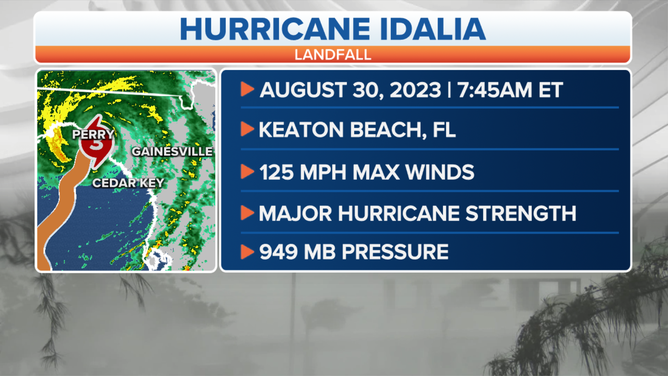
 Hurricane Idalia makes landfall in Florida

Regular readers will know that I have often queried the windspeeds claimed nowadays for hurricanes.

The problem stems from the fact that in the past windspeeds were estimated on the basis of central pressure. Certainly anemometers would never have been able to withstand the strongest winds; nor would they have been likely to have been in the exact location where winds were strongest.

In recent years however winds are estimated using satellite and aircraft dropsonde data.

The problem, however, is that consistently we find that windspeeds and central pressure do not reconcile in the same way as they did in the past.

Idalia came ashore with sustained winds, so we are told, of 125 mph, and a central pressure of 949 MB.

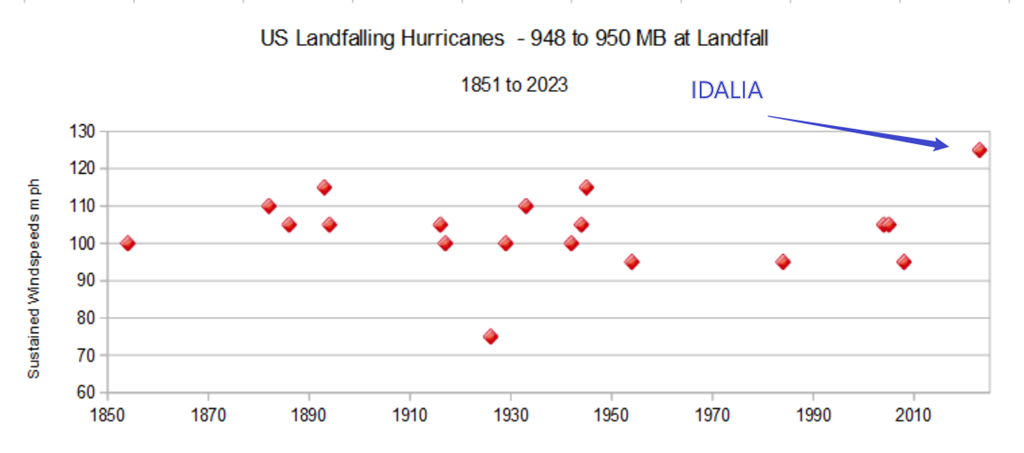
The chart below plots the windspeeds of all US landfalling hurricanes with central pressure of 948, 949 and 950 MB at landfall:

image

https://www.aoml.noaa.gov/hrd/hurdat/All_U.S._Hurricanes.html

As is instantly obvious, nearly all those historical hurricanes had estimated winds of between 100 and 115 mph. The oddity is the 1926 hurricane which was said to be only 75 mph, but had central pressure of 949 MB.

But sticking out like a sore thumb is Idalia, with winds of at least 10 mph higher than any others. This clearly cannot be right.

If it is true that Idalia really did have 125 mph winds, then clearly all of those hurricanes in the past have been grossly underestimated.

The figure of 125 mph came in this instance from a Hurricane Hunter aircraft, but it is worth noting that Keaton Beach, where landfall was made, the weather station there only recorded 61 mph:

image

https://www.nhc.noaa.gov/archive/2023/al10/al102023.update.08301145.shtml?

I’ll leave you with one last thought.

Two hurricanes in the 1920s utterly devastated Florida:

  • The 1926 Great Miami Hurricane

image

This storm razed much of  Miami to the ground, and is reckoned to be the costliest Atlantic hurricane of all time, at current prices, even more so than Katrina.

But according to the US National Hurricane Center, it also made landfall with winds of 125 mph just like Idalia, despite much lower central pressure of 930 MB.

image

  • 1928 Lake Okechobee

image

http://www.hurricanescience.org/history/storms/1920s/Okeechobee/

Two years later, Florida was hit by another catastrophic hurricane, which had already decimated Guadeloupe, destroying nearly every building there and killing over 1000 people.

Coastal South Florida saw catastrophic damage as well, the heaviest in Palm Beach County. Towns greatly affected were Jupiter, Delray, Lake Worth, Pompano, West Palm Beach and Palm Beach, all of which were impacted by the hurricane’s 3 m (10 ft) storm surge. In West Palm Beach, 1,711 homes were destroyed and 6,363 more were damaged. The greatest devastation occurred, however, along the south shore of Lake Okeechobee. There, the 3 m (10 ft) surge washed over the lake’s 1.5-2.4 m (5-8 ft) dikes and flooded an area 120 km (75 mi) wide. At Belle Glade, one of the hardest hit areas, the floodwaters rose to a height of 2.1 meters (7 ft) at a rate of about 25 mm (1 in) per minute. In all, between 2,500 and 3,000 people died making this hurricane the second deadliest hurricane in U.S. History after the 1900 Galveston Hurricane. Total damages from the storm amounted to $100 million (1928 USD) across the Caribbean and the US.

It is interesting that at the time windspeeds at landfall were estimated at 150 mph. But since this has been downgraded by the National Hurricane Center to 125 mph, despite central pressure of 929 MB.


Was Idalia truly as strong as these two storms? Did they all have 125 mph winds?

It is clear that the damage wrought by Idalia was not on the same scale as the 1926 and 1928 ones. Indeed most resulted from the storm surge, which we know was much lower. There’s a CBS video from Cedar Key, which was hit hardest by Idalia, and which shows may buildings barely damaged at all.

This together with the central pressure data tells us that it is absurd to claim that Idalia was as strong.

    via NOT A LOT OF PEOPLE KNOW THAT

    https://ift.tt/5IgSZTM

    September 1, 2023 at 03:44AM