
Forecasting climate is impossible, because nobody understands it. But forecasting the bad behavior of climate academics is quite predictable.
via Real Climate Science
September 26, 2023 at 01:33AM
Forecasting climate is impossible, because nobody understands it. But forecasting the bad behavior of climate academics is quite predictable.
via Real Climate Science
September 26, 2023 at 01:33AM
“The actions of Alaska policy makers, led by the governor, are eradicating the free-market principles in our state. A media blackout on the problem has left only citizen-led initiatives driving the train to truth. We the People Alaska publishes an eye-opening substack on many of these topics.”
Alaska’s economy runs on oil and gas. Additionally, oil revenues have accounted for up to 90% of our General Fund revenue. Amid its resource abundance, however, Alaska has a big and growing governmental problem—mostly in Washington, D.C., and increasingly, in local governments trying to appease their federal masters.
Alaska has been in a production decline trend since 1988 when the state accounted for 25 percent of U.S. domestic production. Presently, the Trans-Alaska Pipeline System (TAPS) is running at a quarter of its capacity (485K barrels per day).
The decline is not for lack of resource, as indicated in part from the proposed Willow Project, which would add 180K/d in 2028 to increase overall TAPS deliveries by 13 percent. Santos Pikka Phase I is expected to add 80k/d in 2026, according to the Alaska Department of Revenue – Tax Division.
Willow Project
Recently, the Conoco Phillips Willow Project has been sanctioned in the National Petroleum Reserve-Alaska. The largest oil development project in Alaska in decades was met with fierce opposition from outside environmental groups. The project was pulled back for insertion of language from President Biden’s Executive Order 13990, establishing the Social Cost of Greenhouse Gases (SC-GHG).
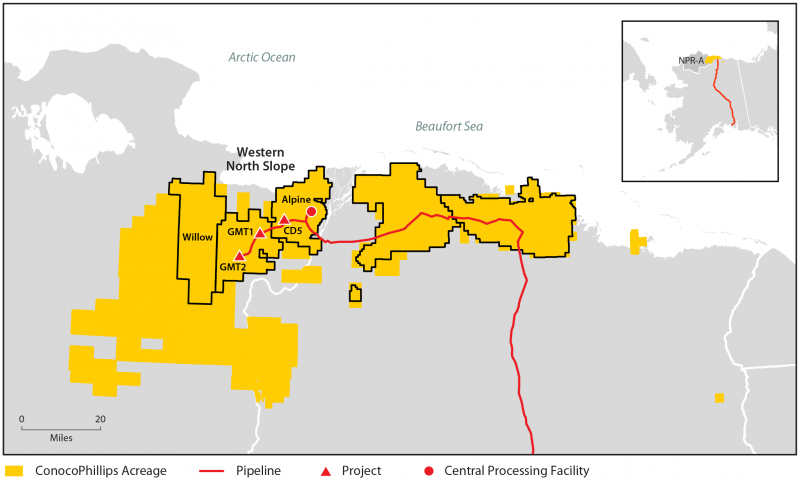
Biden’s compromise was an alternative that promises to leave 53 million barrels in the ground. The option to not develop our resources is in violation of Article VIII—Natural Resources of the Alaska Constitution: “It is the policy of the State to encourage the settlement of its land and the development of its resources by making them available for maximum use consistent with the public interest.”
The “public interest” is hardly about Alaska and climate change. A bit of extra warmth from any cause is welcomed year-round in this state, particularly since the “greenhouse signal” is oriented toward winter nights. Moreover, Alaska emits around one hundredth of one percent of global GHG emissions, calculated by multiplying the state’s 0.8 percent of U.S. emissions times the U.S. share of global emissions of 12 percent.
Willow has now moved the yard marker and will be an example for every other resource development project on federal lands, while simultaneously creating a fictitious value to SC-GHG.
Secretary of the Interior, Deb Haaland, has been the ringleader in all of this. Her nomination as secretary was advanced out of committee by Alaska United States Senator Lisa Murkowski, and she was confirmed by both Alaska US Senators Murkowski and Dan Sullivan. Most Alaska oil and gas executives endorsed Lisa for reelection in 2022, a story of pragmatism gone wrong.
Natural Gas for Alaska
Alaska’s (governmental) oil problem is also a natural gas problem. In Anchorage, the majority of power and heat comes from gas. In the last couple of years, the state has been fed a narrative of a looming natural gas shortage in the Cook Inlet basin with ideas floating around recently to import gas.
In 2011, USGS estimated that Cook Inlet Region contained 20 trillion cubic feet of gas (TCF) with a 95% probability of 5 TCF being proved (economic). That is a lot of gas, with proved reserves representing a half-century of usage in the state (primarily Anchorage) at present consumption rates.
Regional gas is supplied to ENSTAR, which was bought out in 2022 by TriSummit Utilities, owned by two Canadian public investment managers, the Public Sector Pension Investment Board (PSP) being one of them. According to TriSummit’s 2022 ESG report,
While our net-zero commitment excludes subsequently acquired assets, such as our pending acquisition of ENSTAR Natural Gas Company and Cook Inlet Natural Gas Storage Alaska, we will strive to bring our emissions reducing mindset to bear as we grow….
Chugach Corporation, the Anchorage area electric utility, uses one fourth of the gas produced from the Cook Inlet. Sentiments from Chugach executives are that natural gas is a “transitional fuel” that can be phased out. As if we desire to sell our souls to the wildly unreliable and expensive renewables.
Since losing two seats to the NGO-led green movement in the Chugach board elections last spring, the renewable energy propaganda in the newsletter is being ramped up as Alaska risks becoming cold and dark. It happened in Texas, and it can happen here.
Governor Dunleavy Problem
Instead of pushing for responsible development of natural gas in the Cook Inlet basin, Governor Mike Dunleavy has plans to turn it into a CO2 carbon capture & storage dumping ground. The Cook Inlet is one of the largest geological sequestration locations on the US west coast. Carbon management legislation, the top priority for the Dunleavy Administration in the 2023-2024 session, was fast tracked and passed 58-2 in a majority Republican legislature.
The scheme was sold as a major revenue source for Alaska, but the fiscal notes were blank. When representatives faced backlash from their constituents, they went as far as to pen opinion pieces claiming that carbon management was “Not ESG.”
Surprisingly, in the 2021-2022 session, Governor Dunleavy introduced a bill for Renewable Portfolio Standards for utilities. This bill would require certain regulated utilities to “derive increasing percentages of the utility’s net electricity sales from clean energy resources in order to minimize costs to consumers and minimize the state’s carbon emissions.” This bill didn’t progress; still, on September 30, 2022, Governor Dunleavy established the Office of Energy Innovation.
On February 23, 2023, Governor Dunleavy established the Alaska Energy Security Task Force. Then on May 25, at the second annual Alaska Sustainable Energy Conference, he signed a bill permanently extending the state’s renewable energy grant fund.
At the same time, Governor Dunleavy unveiled The Alaska Standard Inaugural Sustainability Report wherein it is said: “Alaska stands ready to lead the energy transition.” This report proudly pledged allegiance in a disturbing attempt to explain how Alaska is aligned with the United Nations SDGs.
Alaska Sovereignty at Risk
In a state where oil revenues account for up to 90% of tax revenues, we are obliterating any chance Alaska has at sovereignty. Then again, the Alaska Supreme Court ruled the legislature can raid the largest Sovereign Wealth Fund in the nation, the Alaska Permanent Fund Dividend, which is owned by the citizens, to fund the Jabba the Hut-sized government.
Alaska policy makers, led by the governor, are eradicating the free-market principles in our state. A media blackout on the problem has left only citizen-led initiatives driving the train to truth. We the People Alaska publishes an eye-opening substack on many of these topics.
We need to restore the power of the grand jury; this constitutional right as of one year ago has been halted. Why else would the court rule in violation of Alaska’s constitution if not rife with corruption – the very corruption the grand jury sought to investigate?
It is time for policy reform at all levels of Alaskan government. Overall, we need a critical mass of folks asking the tough questions. Voter apathy is a real issue in this state – turnout for the Chugach electric utility board was only 16%, for example.
I don’t recall anyone asking for any of this to be done to us, however who you choose to represent you and your involvement at the lowest level will mean deciding between food and electricity.
———————-
Kassie Andrews is a long time Alaska resident with a particular interest in natural resources and energy policy. This is her first blog at MasterResource.
The post Alaska Energy vs. Woke Government appeared first on Master Resource.
via Master Resource
September 26, 2023 at 01:07AM
Dr Euan Mearns
Letter to the Editor published in the Aberdeen Press and Journal on 22 Sep 2023 as:
Public need to be able to scrutinise the true costs on net-zero energy policy
Sir, – Reading your letters pages in recent months, there seems to be significant anger within local populations at the implementation of Scottish and UK energy policies, and justifiably so. Here, I try to cast some light on the origins of that anger. In the recent past, sound electrical engineering design dictated that electricity generation centres were located close to the population centres where the electricity was to be consumed. This was because transmitting electricity through high voltage alternating current (AC) lines results in losses that had to be paid for by the consumer, and the lines themselves were expensive to build and scarred the landscape. In the recent past the driving motives of politicians, planners and industry was to optimise the service provided to constituents and consumers.
During the early days of “the transition” renewables initiatives were sold to the public based on the proposed benefits of distributed as opposed to centralised generation (coal, gas and nuclear) where members of the public were encouraged, via generous subsidies, to install roof top solar to generate their own electricity at home. If you were lucky enough to own a farm, then you could generate your own power using a small wind turbine. Honourable goals perhaps, where wealthy property owners could harvest subsidies that were paid for by the whole population, who on average were much less well-off.
What we now have instead are vast centralised wind and solar power stations distributed outside of population centres, and quite distant to the eventual market for the third-rate power that is being produced. This is the exact opposite of the original proposals for distributed power located within population centres. In January 2022, The Crown Estate Scotland alone, licensed 17 vast offshore wind projects amounting to 25GW peak power capacity that may deliver next to nothing when the wind does not blow. Some individual projects are rated at 3 GW. These individually represent the equivalent of 3 nuclear power stations located in the middle of the North Sea, fifty miles from shore and several hundred miles from the eventual market for this power that is likely to lie somewhere in the Midlands of England. What politicians, and members of the public need to understand, is that these giant power stations will need 25GW of dedicated power lines to connect them to their market – where are these power lines going to go and who is going to pay for them? The protest banners that now line the A90 are a mere shadow of what is planned for the future.
So, what about exports to Europe? The fantasy of local politicians is that Scotland will become some kind of renewable power house, exporting electricity to England and beyond. In 2010, the UK had 2.5 GW interconnector capacity with the rest of Europe. By 2021, this had grown to 7.5 GW. In that period, electricity exports to Europe were effectively flat. On the other hand, net electricity imports in 2010 were 2.7 TWh. By 2021 these had grown to 24.6 TWh (UK government statistics). A 3-fold increase in interconnector capacity has led to a 9-fold increase in net imports. The explanation is quite simple. The UK has closed down significant amounts of dispatchable coal and nuclear generating capacity creating supply vulnerability when the wind doesn’t blow and the sun doesn’t shine. Conversely, there is a high degree of correlation in wind supply between the UK and Europe and this means that when the UK generates a surplus, Europe has a surplus too. The UK surplus has no market resulting in high constraint payments paid for by already hard-pressed consumers.
Yet another frailty of the current strategy is the need to maintain significant amounts of dispatchable generating capacity to cover supply when renewables fail. In effect, 20 GW of combined cycle gas turbines will have to be maintained to back up the 25 GW of proposed offshore wind. In addition, gas import facilities (pipelines and liquefied natural gas) will need to be maintained for occasional use. The high cost of maintaining backup supplies is normally ignored when the levelized cost of wind and solar power is reported. The proponents of the net zero strategy seem content to pile these costs on to hard pressed consumers while politicians seem content to blame the high cost of energy on Vladimir Putin.
I urge politicians in Holyrood and Westminster to suspend all new large-scale wind and solar developments and grid expansions until a comprehensive analysis and report on the real environmental and economic costs of current net-zero energy policy is presented to the public for scrutiny. This report must be based on sound thermodynamic and economic principles and not upon wishful thinking and net zero dogma that appears to underpin much of current energy policy.
Dr Euan Mearns
Aberdeen
Dr. Eaun Mearns is a member of the CO2 Coalition and has a BSc (hons) in geology and a Ph.D. in isotope geochemistry both from the University of Aberdeen, Scotland.
This commentary was first published in the Aberdeen Press and Journal on September 22, 2023.
via Watts Up With That?
September 26, 2023 at 12:03AM
 Iowa Climate Science Education