Month: September 2023

“Listen to me!”: A Climate Study into Angry Young People

Essay by Eric Worrall

“… when I discuss climate change with people who are older than me, the general response is to … feel angry and betrayed by their lack of involvement, considering that they contributed to the world we now live in.’ …”

‘Listen to me!’: Young people’s experiences of talking about emotional impacts of climate change

Charlotte A. Jones

Chloe Lucas University of Tasmania School of Geography, Planning, and Spatial Sciences, Australia

Received 23 December 2022, Revised 21 July 2023, Accepted 30 August 2023, Available online 16 September 2023, Version of Record 16 September 2023.

Highlights

  • •Results of a large national Australian survey of young people (15–19 years)
  • •High concern, worry, powerlessness, and frustration about climate change.
  • •Respondents most commonly talked to friends about climate change feelings.
  • •Feeling listened to predicted talking about climate change feelings.
  • •Differences in emotions when talking to different generations were evident.
  • •Young people need respect, opportunities to act, and shared understanding.

Abstract

The emotional significance of climate change for young people is becoming recognised. However, their experiences of talking about these feelings are not well understood, despite being acknowledged as an important avenue for support and social change. This article reports on a survey of 1,943 young people aged 15–19 years living in Australia. The survey examined their level of concern about climate change, the feelings they associate with climate change, whom they talk to about these feelings, under what conditions, and with what effects. Respondents reported a high level of concern about climate change, most associated with feelings of worry, powerlessness, and frustration. Friends were most trusted to share these feelings with, followed by parents/guardians and then teachers. The most important predictor of young people talking about their climate feelings was whether they felt listened to. Respondents were more likely to feel comfortable having climate conversations with younger or same-aged people and associated these conversations with hope. In contrast, climate conversations with older people were most often associated with betrayal, uncertainty, and worry. Through open-ended responses, the young people surveyed called for further respect and consideration of their views, opportunities to drive action and lead climate conversations, and a need for shared understanding of the issues at stake. Our findings highlight opportunities for those who care about and interact with young people to help them come to terms with the challenges of living in a changing climate through listening and creating safe spaces for what can be difficult discussions.

When talking with older people about climate change, nearly half of respondents expressed they felt betrayed (49.4%). This was supported in respondents’ open-ended reflections with one stating ‘when I discuss climate change with people who are older than me, the general response is to nod and smile and then change the subject which makes me feel angry and betrayed by their lack of involvement, considering that they contributed to the world we now live in.’ 38.5% of respondents said that when they talked to people older than them they felt uncertain, and 32.4% said they felt worried. This uncertainty and worry could be directed towards climate change, or about the direction and form of the conversation. As one participant described, ‘talking with people older than myself can be a mixed bag, it’s unsettling.’ Only a small percentage of respondents felt encouraged (15.3%), comfortable (13.5%), hopeful (11.9%) and safe (6.1%) when talking with older people. For those who did experience these feelings, open-ended responses indicated this was related to being supported and learning from older people: ‘I feel when talking about climate change to older people, I become more informed of the situation.’.

One key avenue through which the findings of this study could be enacted is within education structures, offering opportunities for changing intergenerational relationships through student–teacher interactions. While less than half of the respondents of this study shared their feelings about climate change with their teachers, it was clear from our findings that participants who felt regularly listened to by their teachers were more likely to talk to them about their emotions. Further, high perceived teacher concern about climate change was also a significant factor in increasing the likelihood of these conversations.

Studies have demonstrated how cultures of silence and silencing work to produce and cultivate maladaptive behaviours and denial (Verlie, 2022Norgaard, 2011). Conversely, to offer young people the opportunity to talk about climate change in open, non-judgemental conversation, and most importantly to listen, rather than seek to reframe their perspective, is to offer them power to adapt and respond to the crisis they face.

Read more: https://www.sciencedirect.com/science/article/pii/S0959378023001103?via%3Dihub

To her credit, the author admitted that the sample in her study was possibly biased, because “… the survey was based on a non-representative and convenience sample which may have led to a higher proportion of respondents who are concerned about climate change and engaged in climate action.”.

What does the study tell us?

I get a strong impression that young people who participated in the study think talking to older people about climate change is intolerable, if the older people do anything which remotely challenges their climate beliefs. Even nodding, smiling and trying to change the subject is enough to arouse feelings of betrayal. Young climate fanatics demand complete attention, submission and enthusiastic affirmation, otherwise they “feel betrayed”.

Nobody, including the author, asked why older people are frequently so dismissive of climate concerns, why they don’t express concern at the same intensity as young people, and the most absurd precept, the implicit believe that the climate education process is only supposed to go one way, from the younger people to the older.

The author and the participants appear to have completely ignored or discounted the possibility they might learn something new, if they do some listening, instead of insisting on doing all the talking.

One thing is very clear, this intense anger and sense of betrayal seems about as far as you can get from mutual tolerance and respect for others, which underpins Western democracy and civil society.

We all have fun laughing at the climate snowflakes getting offended at their own shadows, but then I had a disturbing thought.

Was the Chinese Communist Revolution an explosion of mob violence perpetrated by a group of left wing Maoist snowflakes?

Did the students who stormed the schools and universities, dragging teachers into the street and beating them to death, genuinely believe they were delivering righteous justice to traitors? “Traitors” being defined as anyone who gave the slightest hint of less than absolute devotion to the Maoist ideals embraced by the students?

How do we convince today’s young fanatics that they don’t have all the answers, that sometimes they need to listen to the experience and opinions of others? How do we convince them to not blind themselves with irrational feelings of hurt and betrayal, when in the presence of someone who doesn’t completely share all of their beliefs?

How do we shore up the foundations of our freedoms, by ensuring our young people learn tolerance and respect for others? Values which were so universal in our youth, it never occurred to us such values might be lost to future generations?

I think we need answers to these questions, and fast, before something terrible happens.

via Watts Up With That?

https://ift.tt/FNX2COf

September 23, 2023 at 12:08AM

Carbon Credits: The Predictable Unraveling of a Flawed System

Whaddya mean the Indulgences don’t live up to their hype?

The world of carbon credits has long been presented as a major tool for supposed climate woes. Advocates of this system have been quick to sing its praises, positioning it as the ultimate solution for mitigating greenhouse gas emissions. But skeptics, like yours truly, have long pointed out the inherent flaws in such a system. Now, even The Guardian, a publication that has been a staunch advocate of climate alarmism, seems to be having second thoughts. It’s almost as if they’re saying, “Oops, maybe the skeptics had a point.”

The Guardian’s Late Awakening

The article from The Guardian delves deep into the world of carbon credits, questioning their actual impact on reducing emissions. It’s almost amusing to see them now asking:

“Carbon credits are supposed to offset the emissions caused by companies and individuals. But do they really reduce greenhouse gases?”

https://www.theguardian.com/environment/2023/sep/19/do-carbon-credit-reduce-emissions-greenhouse-gases

A question that should have been asked and critically examined long before jumping on the carbon credit bandwagon.

The Mirage of Offsetting

The Guardian highlights a significant concern: the illusion of offsetting. Purchasing carbon credits doesn’t necessarily equate to genuine offsetting of emissions. Many of these credits are tied to projects that would have been executed regardless, meaning no real reduction in emissions.

“Many of the projects supported by carbon credits, such as the construction of windfarms and solar parks, would have been built anyway.”

In essence, it’s a system that allows companies to parade their “green” credentials without making any tangible changes to their carbon footprint.

The Inconsistencies of Carbon Credit Accounting

The article also sheds light on the convoluted and inconsistent world of carbon credit accounting. With no unified standard and a lack of rigorous oversight, it’s a system rife with potential for manipulation.

“There is no single standard for carbon credits, and critics argue that this has allowed projects that do not deliver real-world emissions reductions to flourish.”

It’s a system that skeptics have long warned about, and it seems these concerns were not unfounded.

A Misguided Approach

The Guardian’s article suggests that carbon credits, while potentially playing a role in the transition to a low-carbon economy, cannot replace genuine efforts to reduce emissions.

“While carbon credits can play a role in the transition to a low-carbon economy, they cannot replace genuine efforts to reduce emissions.”

But let’s be clear: the very premise of transitioning to a “low-carbon economy” based on the current climate narrative is questionable. The entire carbon credit system is built on a foundation of misguided intentions and collective alarmist groupthink.

Conclusion

The Guardian’s newfound skepticism towards carbon credits is a telling sign of the system’s inherent flaws. While it’s somewhat satisfying to see them finally question a system that skeptics have long criticized, one can’t help but wonder about the time, resources, and efforts wasted on such a flawed approach.

Genuine progress doesn’t come from blindly following trends or from virtue signaling. It requires a grounded, pragmatic approach. The carbon credit saga serves as a reminder that it’s high time we move beyond the current climate narrative’s fads.

H/T Alan B

via Watts Up With That?

https://ift.tt/FGjo5BI

September 22, 2023 at 08:06PM

17 years of near-zero trend in September sea ice demolishes claim that more CO2 means less sea ice

If the hottest year ever can’t precipitate ‘ice-free’ conditions in September, what’s it going to take? Arctic sea ice failed to nose-dive again this year, undoubtedly disappointing expects who have been anticipating a ‘death-spiral’ decline for ages. Arctic sea ice hit its seasonal low sometime around mid-September this year and although the precise value hasn’t been published, the average September ice coverage will likely be about 4.2 mkm2 once it gets announced in early October.

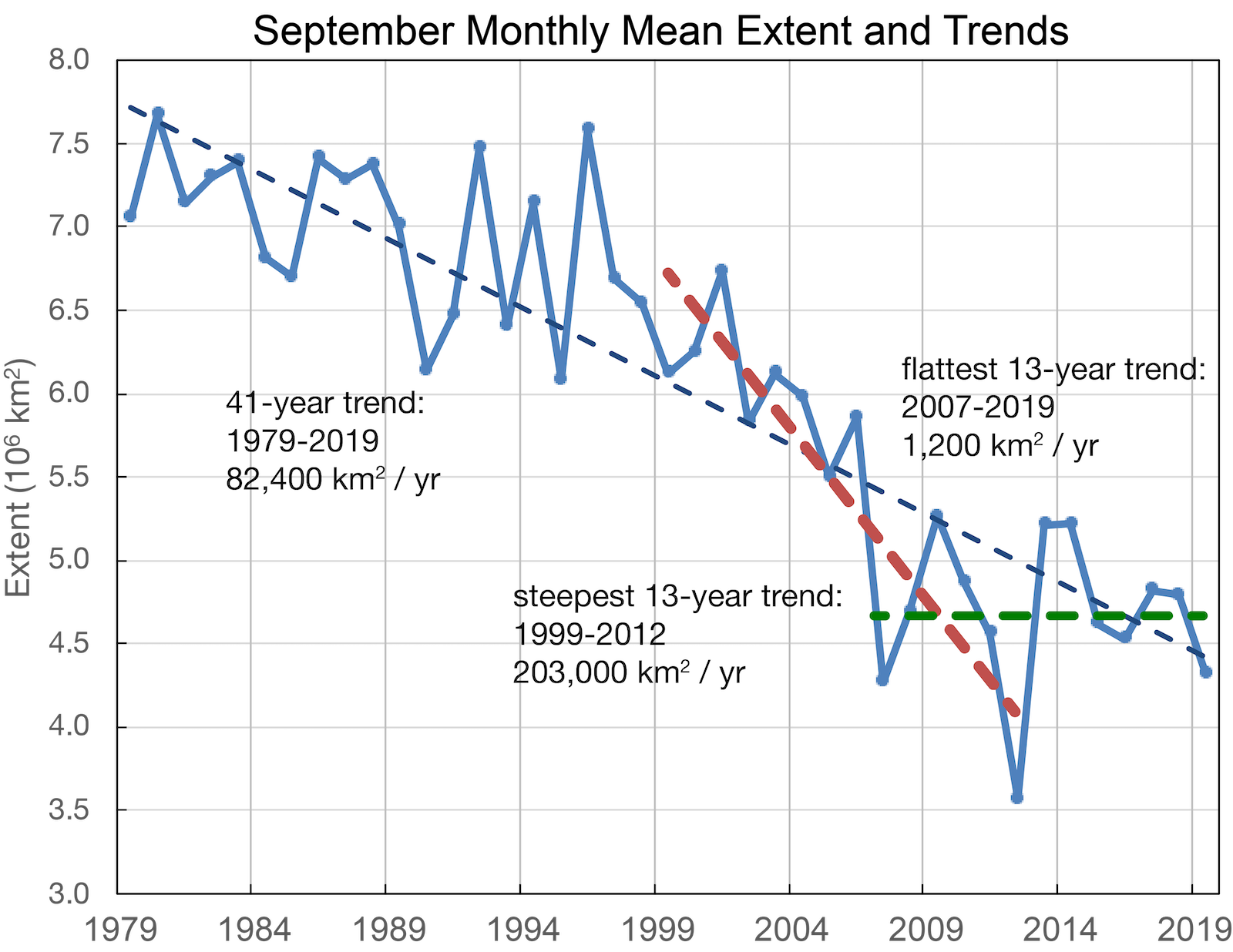
This means we have now had 17 years of a near-zero trend for September sea ice, extending the nearly-flat trend NSIDC sea ice experts acknowledged four years ago. This surely busts a huge hole in the prevailing concept that more atmospheric CO2 causes less summer sea ice. Note that CO2 levels measured in August 2023 were 419.7 parts per million (ppm), compared to 382.2 in August 2007, a rise of 37.5ppm with no corresponding decline in summer sea ice (and vs. 314.2 ppm in 1960). Measured in metric tons, CO2 emissions due to fossil fuels rose from 31.1 billion in 2007 to 37.1 billion in 2021 (last year of data), again with no corresponding decline in summer sea ice.

Background

In 2015, Neil Swart and colleagues argued that statistically speaking, the 7-year near-zero trend that was documented from 2007-2013 was caused by natural variability and was eminently compatible with models predicting “ice-free” conditions within decades due to increased CO2 levels. Their models led them to conclude that the possibility of a 14-year near-zero trend (e.g. 2007-2020) was possible but far less likely and that even longer near-zero trends are much more likely to occur when the Arctic is nearly ice-free (i.e. about 1 mkm2).

Surely a near-zero trend lasting 17 years (2007-2023), particularly before extent has reached the scary-sounding “ice-free” level, virtually destroys the assumption that sea ice extent is being controlled by atmospheric CO2 or even global temperatures, especially given the claim that 2023 may be the “hottest year on record”!

You don’t have to be a math wiz to see that there has been a nearly-flat trend in September sea ice extent since 2007 (pink dot marks approximate level for 2023 on this 2022 graph) but Walt Meier at the NSIDC actually did the math back in 2019 (insert), which is now extended another four years.

This absurd idea that atmospheric CO2 controls Arctic sea ice in summer–but causes only a slight decline in winter and no decline in Antarctic sea ice (Blanchard-Wrigglesworth et al. 2022; Crockford 2023)–has been embraced by biologists who want to see polar bears listed as ‘threatened with extinction’ by every government and conservation organization in the world, whatever the cost to their scientific integrity.

Prior to 2015, polar bear specialists needed to inject the IUCN Red List assessment with a semblance of scientific merit, so they programmed their predictive models to assume a linear relationship between CO2 and Arctic sea ice in summer (Notz and Stroeve 2016; Stern and Laidre 2016; Regehr et al. 2016: Wiig et al. 2015). And in 2023, the same assumption was made by Steven Amstrup and his sea ice expert sidekick when they made the ridiculous claim that CO2 emissions can be directly linked to reduced polar bear cub survival across the Arctic (Amstrup and Bitz 2023; Molnar et al. 2020). But while polar bear researchers generally apply this linear CO2-sea ice concept at a regional (subpopulation) scale (and use a slightly different metric of “summer” ice extent), the effect is the same: they assume more global CO2 means that summer sea ice at any Arctic location will continue to decline in a linear fashion decades into the future.

Which brings us back to the pause and my big question: Are polar bear specialists ever going to acknowledge the 17-year near-zero trend in summer sea ice or will they forever just draw a straight line from 1979 and insist summer sea ice is still declining?

Because, seriously, if the hottest year ever can’t precipitate ‘ice-free’ conditions in September and the long-predicted starving of polar bears, what’s it going to take?

Current Conditions

As shown below, at 15 September 2023, ice extent was 4.1mkm2 and by September 20, seemed to be on its way back up.

Below, Arctic sea ice extent at 20 September 2023 compared to the previous four years.

References

Amstrup, S.C. and Bitz, C.M. 2023. Unlock the Endangered Species Act to address GHG emissions. Science 381(6661):949-951. pdf here.

Blanchard-Wrigglesworth, E., I. Eisenman, S. Zhang, et al. 2022. New perspectives on the enigma of expanding Antarctic sea ice, Eos 103. https://doi.org/10.1029/2022EO220076.

Crockford, S.J. 2023. The Polar Wildlife Report. Global Warming Policy Foundation Briefing 63, London. pdf here.

Molnár, P.K., Bitz, C.M., Holland, M.M., Kay, J.E., Penk, S.R. and Amstrup, S.C. 2020. Fasting season length sets temporal limits for global polar bear persistence. Nature Climate Changehttps://doi.org/10.1038/s41558-020-0818-9 pdf here.

Notz, D. and Stroeve, J. 2016. Observed Arctic sea-ice loss follows anthropogenic CO2 emission. Science 354(6313):747-750. pdf here.

Stern, H.L. and Laidre, K.L. 2016. Sea-ice indicators of polar bear habitat. Cryosphere 10: 2027-2041.

Swart, N.C., Fyfe, J.C., Hawkins, E., Kay, J.E. and Jahn, A. 2015. Influence of internal variability on Arctic sea-ice trends. Nature Climate Change 5(2): 86–89.

Wiig, Ø., Amstrup, S., Atwood, T., Laidre, K., Lunn, N., Obbard, M., et al. 2015. Ursus maritimus. The IUCN Red List of Threatened Species 2015: e.T22823A14871490. Available from http://www.iucnredlist.org/details/22823/0 [accessed Nov. 28, 2015]. See the supplement for population figures.

via polarbearscience

https://ift.tt/ZDrQjRd

September 22, 2023 at 07:06PM

Dangerous Assault Rifle

Last year, Remington settled for $73 million with Sandy Hook families.

“The settlement comes over seven years after the families sued the maker of the Bushmaster XM15-E2S semiautomatic rifle that was used in the 2012 mass shooting in Newtown, Connecticut.”

Sandy Hook families settle with Remington, marking 1st time gun-maker held liable for mass shooting – ABC News

On the day of the shooting, law enforcement said the shooting was done with handguns, and the rifle was left in the trunk of the car in the parking lot.

“The two pistols were found inside the school and a .223-caliber Bushmaster rifle was found in the back of his mother’s car in the parking lot.”

15 Dec 2012, 7 – Daily News at Newspapers.com

“Four handguns, and apparently only handguns, were taken into the school.”

15 Dec 2012, 4 – Dayton Daily News at Newspapers.com

15 Dec 2012, Page 18 – The Los Angeles Times at Newspapers.com

via Real Climate Science

https://ift.tt/ofv8Rd5

September 22, 2023 at 06:40PM