Month: September 2023

EU reaches deal banning ‘climate-neutral’ product claims

Game over by 2026?
[image credit: climateneutral.org]

The nonsense of climate greenwashing takes a hit, starting 2026.
– – –
In the wake of longstanding complaints of greenwashing by consumer advocates, EU institutions finalised a new law on Tuesday (19 September) enacting a sweeping ban to combat the misleading of its citizens through erroneous claims of sustainability, reports Euractiv.

In March 2022, the European Commission proposed a law to empower consumers, which, following the conclusion of negotiations between EU countries and Parliament, will now ban companies from claiming that their products are climate-neutral.

“We have achieved an excellent deal for consumers,” said the S&D’s Biljana Borzan, a Croatian EU lawmaker who spearheaded the negotiations on behalf of Parliament.

The law, which still requires final approval by EU countries and the parliament’s plenary assembly – a formality – will be felt from 2026, as EU countries will be given two years’ time to adopt the changes.

Greenwashing, the practice of making misleading claims as to a product’s climate friendliness, is expected to cease rather quickly. “We are clearing the chaos of environmental claims, which will now have to be substantiated, and claims based on emissions offsetting will be banned,” said Borzan.

In practice, the changes will mean that companies are effectively prohibited from making such claims altogether.

“There is no such thing as ‘carbon-neutral’ or ‘CO2 neutral’ cheese, plastic bottles, flights or bank accounts. Carbon-neutral claims are greenwashing, plain and simple,” said Ursula Pachl, the deputy director of EU consumer advocates BEUC.

Frequent fliers may soon notice changes in airlines’ booking interfaces, where suspiciously cheap carbon offsetting offers will no longer be allowed to sell “climate-neutral” flying. After all, carbon offsetting is a practice reviled by activists for the rampant fraud in the industry and its non-permanent nature.

“The EU is sending a powerful signal to the voluntary carbon market: the era of offsetting is over,” said Gilles Dufrasne, policy lead at Carbon Market Watch.

The new law will also firm up rules around environmental claims, which will have to be backed by proof of recognised performance. Widespread product affixes like “Eco” and “natural” will need to be backed by solid evidence.

“The agreement is good news for all who want to shop sustainably,” cheered Anna Cavazzini, a green EU lawmaker in charge of the consumer protection committee.

Full report here.

via Tallbloke’s Talkshop

https://ift.tt/yLP10tA

September 21, 2023 at 03:21AM

Energy Hungry World Drives Obvious Demand for Cheap, Reliable Coal-Fired Power

Germany and Australia share delusional obsessions with wind and solar power; but they also share a desperate demand for reliable coal-fired power. Hidden from sight, both Germany and Australia have recognised (albeit a little too late) that the only way of delivering 24 x 365 power, whatever the weather at prices everyone can afford is by using coal-fired power plants.

As to Germany, Bridget Ryder take a look at moves by Germany’s RWE to demolish wind turbines to allow it to access more of Germany’s brown coal. That move doesn’t sit with the narrative about Germany transitioning to an all wind and sun powered future.

Nor does the next story from The Australian. Where reality is pressing upon those who claim that Australia is already well on its way to running on nothing but sunshine and breezes.

China and Germany: Firing Up Coal Power While Wind Takes a Back Seat
The European Conservative
Bridget Ryder
9 September 2023

Germany is dismantling a wind farm to make way for more coal mining, while China is on a spree to open new coal mines.

So goes the global push for renewable energy and decarbonisation, another sign of the reality check facing the proposed energy transition away from fossil fuels to ‘renewable’ energy such as wind.

The German energy giant RWE announced in October 2022 that it was removing a wind farm to expand its open lignite mine in the region of North Rhine-Westphalia. The first wind turbine has already been felled, and another seven are slated to be removed. The company will then have room to excavate some 15-20 million tonnes of lignite.

Lignite, also called brown coal, is the least efficient and therefore the most carbon-emitting form of coal. But it’s also abundant in western Germany, and according to the German government, it’s needed now more than ever.

The German government and RWE brokered the expansion of the lignite mine last fall because of the energy crisis engendered by the war in Ukraine and Germany’s subsequent loss of the Russian gas and oil it had relied on.

In exchange for permission from the German government to expand lignite mining for the moment, the company promised to ultimately phase out coal in 2030, eight years before the previous deadline.

With that caveat, the German government touted the deal as “a good day for climate protection,” though it seems there is little reason to believe that it wouldn’t once again prolong coal mining in 2030 should the need remain.

In fact, Germany’s attempt at switching to wind-sourced energy has proven a disaster. It is already far behind on its goals while facing increasing resistance from local communities to the installation of wind parks.

In another example of the schizophrenic tension between environmental rhetoric and political-economic reality, China has also abandoned its pledges to cut back on coal and has instead embarked on a coal burning spree.

The most recent reports from the watchdog groups Global Energy Monitor (GEM) and the Centre for Research on Energy and Clean Air show that the country is set to approve a record number of coal power projects.  The rash of new approvals started last year and has continued strong into 2023, according to analysis, with the Chinese government rubber-stamping two new coal power plants every week.

In raw numbers, in the first six months of 2023, China approved 52 gigawatt (GW) of new coal power, began construction on 37 GW of new coal power, announced 41 GW of new projects, and revived 8 GW of previously shelved projects. About half of the plants permitted in 2022 had started construction by summer. One gigawatt of energy is equivalent to one large coal-fired power plant.

While not as ambitious as the EU, China has pledged to level off CO2 emissions by 2030 and reach net zero in carbon emissions by 2061.

Ironically, China is both the world’s largest producer of renewable energy, including wind, solar, and hydroelectricity, and simultaneously the world’s biggest carbon emitter, pumping out almost a third of the world’s carbon emissions in 2020. It’s not surprising, as in many regions, the Chinese infrastructure to store and distribute wind and solar energy has not kept pace with the production of these ‘renewable’ energies, meaning the electricity produced can’t be integrated into the grid and used. At the same time, for example, the fabrication of wind turbines, in which China is also a global leader, is heavily dependent on coal-fired power plants.

But most tellingly, according to analysts, the coal-powered projects are largely being approved where there is already excess coal-fired power. This indicates that China is prioritising economic recovery and energy security over ecology.

“There is more development than there is need for development,” Cory Combs, an analyst at Trivium China, said. “When we look at it from an energy security perspective, they [provincial-level governments] are putting an extremely high premium on short-term energy security. I don’t mean systemic issues; [I mean] even making sure there’s not even a two-hour power shortage. That’s taken over everything else, including the financials, but certainly decarbonisation.”
The European Conservative

Australia must slow coal exits to safeguard affordability Alinta Energy CEO urges
The Australian
Colin Packham
15 September 2023

Australia must slow the closures of coal power stations to prevent surging power bills damaging households and businesses already battling a cost of living crisis, the head of the country’s fourth largest electricity and gas retailer has urged.

Australia has set an ambitious target of having renewable energy generate more than 80 per cent of the country’s power needs by 2030, a central pillar in the country’s plan to be net zero by 2050.

In comments that will intensify debate about the cost of the energy transition, Jeff Dimery – chief executive of Alinta Energy – said slowing the closures of coal power stations must be prioritised or households will endure more and more pain.

“I think we must slow down the pace of closing existing coal power stations a little bit. We are very good at taking higher emitting baseload generation out of the system but not so great at replacing it, and the economic signal is not strong enough at this time,” Mr Dimery told The Australian.

“Let’s not increase the burden on the consumer because prices are rising.”

Australia is battling a cost of living crisis that is weighing on support for the federal Labor government, but there is growing pressure on the country to achieve its net zero aspirations.

Mr Dimery said Alinta shares the government‘s ambitions but said there is undeniable evidence of the economic toll of rising prices.

“We have millions of people relying on subsidies and support to pay their energy bills, and I agree we had to do it but we can‘t be subsidising forever,” said Mr Dimery.

The Australian Energy Regulator in June revealed the number of households on hardship payment plans to repay electricity bills surged by 19 per cent during the first quarter of 2023, underscoring the impact of recent increases in bills.

The surge came before many households endured an increase of more than 20 per cent, the second such rise in as many years.

The comments came as Mr Dimery shared the stage with Prime Minister Anthony Albanese at News Corp’s Future Energy event in Sydney.

Coal is still the dominant source of electricity in Australia, with the 20GW of capacity accounting for about 60 per cent of the country’s power. To replace coal, however, Australia will need to build significantly more capacity than the amount of coal already in the system due to the intermittent source of renewable energy.

The government believes the transition to renewable energy can be accelerated by building new transmission lines.

About 10,000km of new lines must be built before 2030, but their development has been hampered by funding constraints and community opposition.

The federal government has said its $20bn Rewiring the Nation, which offers cheap loans and concessional finance to transmission developers, will break the bottleneck.

Mr Dimery, however, said Alinta supports the build for transmission lines, but the costs will eventually flow through to consumers – and when comparing new renewable energy projects – it must be done on a like-for-like basis.
The Australian

via STOP THESE THINGS

https://ift.tt/3rE2wFT

September 21, 2023 at 02:35AM

WILL GERMANY BE FIRST TO DITCH NET ZERO

Here again we see a country which has made a grand commitment to reach net zero CO2 emissions come up against the harsh reality of how costly it is, as the date gets nearer. When it comes to a choice of severely damaging the economy causing millions to suffer or to defer the date of achieving an arbitrary and meaningless target there can only be one rational decision.  

Ross Clark: Will Germany be the first to ditch its net zero commitments? | NOT A LOT OF PEOPLE KNOW THAT (wordpress.com)

via climate science

https://ift.tt/P1oDTcy

September 21, 2023 at 01:49AM

China Coal: Reuters’ “weird climate logic”

“According to Reuters, China is justified in burning massive amounts of coal because it uses some of that electricity to charge EVs, enabling it to reduce its crude oil imports, which is even more evil than coal. The world can continue to ignore the fact that China and the other countries in Asia emit more CO2 than the rest of the world combined.”

We are constantly told that burning coal must be eliminated because it contributes to climate change. Coal is so bad that the EPA has proposed rules that will force the closure of all U.S. coal-burning power plants, as well as natural gas generators by 2040, if not sooner. U.S. power grids are showing the effects of the early retirement of coal power generation plants, meanwhile, and grid operators are demanding that the EPA stop their proposed regulations. But the war on coal is unabated.

Apparently, the war on coal plants does not apply to China. According to an article this week in Reuters by Clyde Russell, “China’s Huge Coal Plant Building Has Weird Climate Logic,” China’s CO2 emissions from its massive coal-burning power plant program pose little problem on the road to solving “climate change.”

His article begins by explaining that China is indeed the world’s largest coal-burning country in the world and is building more quickly:

China is building two-thirds of the coal-fired electricity generation capacity currently under construction globally, and this may not be as disastrous for the climate as it sounds (emphasis added).

The world’s largest producer and importer of coal has 136.24 gigawatts (GW) of coal-fired generation under construction, according to data released in July by the Global Energy Monitor.

This represents 66.7% of the global total of 204.15 GW, and China is streets ahead of second-placed India, with 31.6 GW being built and third-placed Indonesia with 14.5 GW.

These three countries represent 89% of the coal-fired plants currently under construction, and it’s not a coincidence that all of them have large populations, growing energy demand and vast domestic coal reserves.

China’s under-construction coal generation is about 12% of its existing capacity, and adding more coal-fired power would seem incompatible with the stated goal of achieving net-zero carbon emissions by 2060.

So the energy elephant in the CO2 mitigation room is to be papered over? Given a pass with COP28 coming up? We can ignore everything we’ve ever heard or read about “planet-destroying CO2 emissions from coal plants” because:

The large coal-fired construction programme can be seen in the wider context of China’s rapid shift to electric vehicles (EVs) and away from internal combustion engine (ICE) cars and trucks.

This is a strange detour. China’s massive fleet of coal-burning power plants are saved by coal-based EVs, what Amory Lovins called emission elsewhere vehicles? The article doesn’t mention that China has been unsuccessful in forcing its population to purchase EVs, so massive numbers have been left to rot in fields.

Never mind this detail because this all leads to the not-so-obvious conclusion that China’s use of coal-fired electricity to charge their EVs will enable them to reduce their imports of crude oil, which is much worse for the environment than coal. Continuing the apologetics:

While it would obviously be better for the environment for China to stop building coal-fired power plants and instead accelerate the deployment of renewables, there is some logic to the current policy.

Using mainly domestic coal and some relatively low-cost imports will allow China to lower crude oil imports over time, increase the penetration of EVs and have a lower emissions profile than if it carried on with a predominantly ICE vehicle fleet.

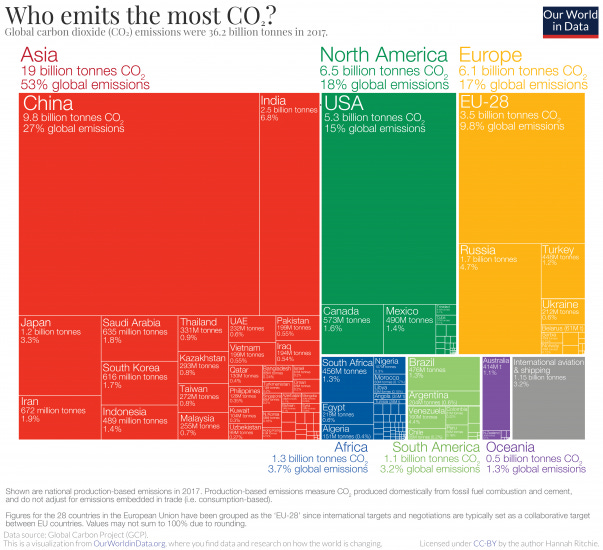
There you have it. According to Reuters, China is justified in burning massive amounts of coal because it uses some of that electricity to charge EVs, enabling it to reduce its crude oil imports, which is even more evil than coal. The world can continue to ignore the fact that China and the other countries in Asia emit more CO2 than the rest of the world combined:

The fact that China’s carbon dioxide emissions are being ignored while U.S. energy policies are destroying the reliability of its power grids and undermining its energy independence is telling. This suggests that the war on fossil fuels is a dangerous diversion from the actual agendas, which could include eliminating the dominance of the United States, establishing global governance, population control, and more.

—————

Ed Ireland, adjunct professor at TCU’s Neeley School of Business, received his B.S. from Midwestern State University and Ph.D. from Texas Tech University. This analysis was originally posted at Thoughts About Energy and Economics.

The post China Coal: Reuters’ “weird climate logic” appeared first on Master Resource.

via Master Resource

https://ift.tt/SL73IC2

September 21, 2023 at 01:05AM