Month: November 2023

Voice of America Is a Superspreader of Misinformation About Human Health and Climate Change

From ClimateREALISM

By Linnea Lueken

Voice of America (VOA), a U.S. government funded international news agency, posted an article titled “Heat, Disease, Air Pollution: How Climate Change Impacts Health,” which claims that climate change threatens human health because it worsens extreme heat, air pollution, infectious diseases, and mental health problems. Each claim is false, with none being supported by existing evidence. Each of these health problems existed before the industrial revolution and amidst modest warming most are getting better.

The article reports that the World Health Organization (WHO) has declared climate change the “single biggest health threat facing humanity,” and that avoiding a temperature rise exceeding 1.5°C warming above pre-industrial levels as countries committed to in the Paris climate agreement is essential to prevent catastrophic health impacts.

Four categories of health threats are particularly highlighted in the VOA article, the first being “extreme heat.”

VOA writes that this year is “widely expected to be the hottest on record,” and heat “is believed to have caused more than 70,000 deaths in Europe during summer last year,” and also cites a Lancet study that claims by 2050 five times more people will die of heat each year if 2°C warming occurs.

There has been a lot of media coverage claiming that this year is the “hottest on record,” focusing on individual months and the northern hemisphere in particular. However, the data used is suspect, not only because the land-based temperature record is flawed and contaminated with the urban heat island effect, but also as discussed in “Media Fails to Examine Actual Data in Making “Hottest Summer Ever” Claims,”  media conflate measured average temperatures with average temperature anomaly measurements, which are not interchangeable.

The planet began modestly warming even before the industrial revolution began, meaning 2023 is just a continuation of a multi-century trend. Blaming emissions for this year’s heat in particular ignores other natural factors, like increased water vapor from a massive volcanic eruption, an the onset of a powerful El Niño, and increased solar activity.

As described in Climate at a Glance: Temperature Related Deaths, because research shows that cold temperatures actually kill between 10 and 16 times more people than hot temperatures, the slight warming over the past century has likely reduced premature mortality related to temperatures by as many as 166,000 people from 2000 to 2019. The clear evidence shows that cold temperatures kill far more people than hot temperatures and, as a result, as the Earth has modestly warmed, deaths related to non-optimum temperatures have declined significantly.

The next category of health threats discussed by VOA is air pollution. The VOA cites the WHO to assert that outdoor air pollution driven by fossil fuel emissions kills “more than four million people every year,” partially in the form of PM2.5. This figure is not supported by real world data.

Worse still for the claim, VOA admits that deaths from air pollution have fallen over time, not increased, even as the Earth has warmed. As a result, it’s unclear how this category even relates to climate change at all. According to the IPCC, there is no consensus on even the existence of any effects of global warming on “air pollution weather,” or temperature inversion conditions that may cause ground level ozone.

The claim that infectious diseases are on the rise due to climate change has been refuted at Climate Realism many times, for example, herehere, and here, and VOA makes no new claims in this regard. VOA claims that because of animal migration, the risk of infectious disease will spread, especially those spread by mosquitos like dengue, chikungunya, Zika, West Nile virus, and malaria.

The fact remains that no matter what the computer models say, more than a dozen peer-reviewed studies demonstrate that temperature alone is not enough to guarantee migration or longer survival of mosquitoes or mosquito-borne illnesses like malaria. Human interventions like the use of DDT, emptying standing water, mosquito netting, and other methods, far outweigh any effect of temperature.

Paul Reiter, a scientist from the Centers for Disease Control and Prevention (CDC) explained in a paper that “it is facile to attribute this resurgence [of malaria in some regions] to climate change.”

Looking at other animal sources of disease outbreaks like the Bird Flu, the exotic animal trade and wet markets are much more likely candidates.

There is no evidence that modest warming has caused disease outbreaks due to animal migration nor that continued modest warming it threatens to do so in the future.

VOA devotes only a small section to the final category, mental health, writing “Worrying about the present and future of our warming planet has also provoked rising anxiety, depression and even post-traumatic stress — particularly for people already struggling with these disorders, psychologists have warned.”

This shouldn’t be hard to explain, since media and government alarmism has been significantly ramped up over time. Despite data to the contrary, the mainstream media has increasingly used words like “catastrophe,” “crisis,” and “uninhabitable” to describe the condition of the planet. Some media outlets have tried pointing out that this scaremongering is counterproductive, but it hasn’t stopped, with CNN recently declaring that “no place in the US is safe.”

In the light of this near daily the barrage of climate scare stories, it is no wonder that people struggling with or prone to mental illness in particular are deeply afraid. Survivors of a natural disaster may also struggle with PTSD or similar ailments, but it doesn’t mean that climate change is the cause, as discussed in “Wrong, Mainstream Media, Climate Change is Not Causing PTSD.”

In the end, objective scientific data does not show that human health is being negatively impacted by climate change, and it is certainly not the biggest health threat facing humanity. Because almost every claim in the story is refuted by hard data, it actually throws suspicion on much of the good work unrelated to climate alarm that the VOA and the WHO do. It is especially bad that VOA included the WHO’s unverified mental health claims in the story, since it is fearmongering by mainstream media outlets, like VOA, that are the source of climate (reporting) related mental health problems, not climate change itself.

Linnea Lueken

https://www.heartland.org/about-us/who-we-are/linnea-lueken

Linnea Lueken is a Research Fellow with the Arthur B. Robinson Center on Climate and Environmental Policy. While she was an intern with The Heartland Institute in 2018, she co-authored a Heartland Institute Policy Brief “Debunking Four Persistent Myths About Hydraulic Fracturing.”

via Watts Up With That?

https://ift.tt/r3SV0P1

November 30, 2023 at 08:00PM

Looking into a 100 percent Renewable Electricity Calculator for the United States: a severe case of averagitis

In previous post, I wondered where exactly in the calculator methane storage was implemented and how seasonal storage was dealt with. Spoiler alert, no methane storage whatsoever is implemented in the calculator and seasonal storage is not taken into account. But then, how is the proposed Power-to-Methane-to-Power backup system implemented in the spreadsheet?

The way it works is that only the totals are used in the final cost formulas and his means that problems like intermittency and seasonal storage are ironed out of existence. I can surely understand that ON AVERAGE solar and wind can keep up with demand, but this is not how a power grid works. In reality, demand in ALL time slots need to be fulfilled by solar and wind. That is where the spreadsheet is lacking.

I was puzzled for a while why NIsche didn’t add storage in the calculator. Reading his earlier post ““Correcting Anti-Renewable Energy Propaganda” post” gave me some insight in his reasoning. In that post he explains his vision of a 100% renewable electricity grid and his reasoning is that overbuilding solar and wind capacity 1.5 times the demand would already get 93% of demand covered without any storage at all. The remaining 7% then just needs to filled in with synthetic methane.

Where that methane needs to be stored until it is burnt in gas-fired power plants is not really clear from this post. He only gave the example of a “facility that generates renewable methane and injects it into the gas grid”. I can understand that putting the resulting methane on the gas grid will give some buffer, but is that enough to store it in the necessary amounts?

Particularly revealing is Nitsche’s comment in the same post as a response to someone criticizing the Power-to-Methane-to-Power part of the reasoning (my emphasis)

Technically, if you define “grid storage” as “surplus electricity is stored and reused when there’s a lack of electricity”, that’s right, power-to-gas is not storage in that sense. You generate a high share of solar and wind, say 93 percent, in real time. You curtail surplus electricity instead of storing it.

In addition to that, using different solar and wind power plants, you generate synthetic methane (hydrogen + CO2-direct-air-capture). This methane is burned in gas-fired power plants to cover the remaining 7 percent.

This is indeed exactly what he did in the spreadsheet. The total production is 1.56 times the demand. However, the demand that is directly covered by solar and wind is even higher in the calculator. It is 97.5% in the spreadsheet, so only 2.5% of the demand needs to be filled in. I can be wrong, but it is my impression that Nitsche assumes that no dedicated storage is necessary for this small amount.

This might make perfect sense when you look at it on average, but is that the case in reality? It assumes that production and demand are pretty much in balance over the year and not much storage is needed to bridge the periods of deficit. Even in the averaged dataset that he uses, there is a clear pattern of how this deficit is distributed over the year (data of the last year of the dataset, 2018):

Chart0024a: 100 percent renewables calculator US production vs demand vs deficit

This shows the discrepancy between production and demand over a year. Production is high in the first five months of the year, but then decreases and reaches it lowest point in August, after which production climbs up again. Demand makes the opposite movement. It climbs up from May and reaches its highest point in August after which it decreases gradually until October. Meaning that there is a huge overproduction in the first five months and the last three months of the year, but the highest need for backup power occurs during the summer months when production is at its lowest.

Month Deficit
(GWh)
Share
(%)
January 367,881 9.3
February 243,580 6.1
March 104,759 2.6
April 27,702 0.7
May 99,086 2.5
June 252,155 6.4
July 891,133 22.5
August 1,029,653 26.0
September 371,198 9.4
October 123,086 3.1
November 125,020 3.2
December 328,824 8.3
Total 3,964,079  

There is clearly a need for seasonal storage if one wants to use this overproduction from the first months of the year in order to fill in the deficits during the summer months. In an actual 100% renewable electricity grid, those seasonal differences are a problem that have to be solved using for example seasonal storage. In the calculator however, this seasonal variability is ironed out of existence. This means that all costs associated with (seasonal) storage are entirely ignored.

The averaging also means that no limit is assumed for the production of the methane used as backup fuel. The cost of the production is determined by the production cost of methane and multiplied by the surplus electricity, so no capacity is attached to it. However, that methane production cost is taken from a plant at full load, but in reality such factories will have a certain capacity and this will limit how much methane can be produced and how much could go into storage. Dimension it large enough to produce enough for the period June to September and it will not be that efficient. Dimension it to be more efficient will mean not enough methane in summer.

The same is true for the methane storage facilities. They are completely absent from the model, but in reality they will be needed to bridge seasonal shortages and they will also have a certain capacity attached to them that determines how efficient they will be. Seasonal storage is inefficient, therefore expensive.

Then there is the curtailment. The system is overbuild and electricity that could not be used, will be curtailed. That would make sense on average, but I don’t think that is how it would work in reality. Here, across the pond, industrial solar and wind installations are built by power companies or investors. The way they can recuperate their money is by selling electricity to the grid. Since they get a guaranteed price and some protection against negative prices, they can make a buck.

Things are different in the spreadsheet. Here a lot of solar and wind capacity is build, it is in fact overbuild to produce more than needed and the rest is curtailed. Meaning that the investors will get less income from selling their electricity to the grid and therefore their investment will pay off over a longer period. I am not really sure how such a system would work in reality.

Here in Belgium, we had a nice illustration of what would happen when solar and wind farms need to curtail their production. In the first month of the pandemic, electricity demand was pretty low and there was a lot of sun and wind. This meant that some windmills were shut down for some hours to avoid overproduction, leading to the CEO of an energy company to write an open letter to the politicians to “choose for solar and wind” instead of nuclear (read: shut down nuclear, so solar and wind could earn their buck when it is sunny and windy). The reason behind this was that those windmills were in fact shut down to avoid providing electricity at negative prices. Although those providers are protected against such negative prices, this support is not unlimited.

Now suppose that the grid was organized according to NItche’s plans, then we are looking at not just a couple hours of curtailment, but systemic curtailment of electricity, specially in early spring, autumn and winter). Remember, Nitche starts from a production of 1.5 times demand and only 2.5% of demand comes from methane. Which investor in his right mind would invest in solar and wind installations knowing that curtailment is part of the system? It should be possible to give those investors financial support for the curtailment, but then this also has to be added as the cost of a 100% solar and wind grid.

There are also the grid costs in the spreadsheet. It is a meager $279 billion / 39 years = $7.15 billion per year for the entire continental US. Nitche assumes that strengthening of the grid is not necessary, only the cost of expansion of solar and wind is needed.

This seems very low to me. Let me illustrate this again with an example here from Belgium. Just a half year ago, our Minister of Energy approved a raise of the cost of electricity because the grid manager urgently needs to make huge costs in order to accommodate more renewable energy on the grid. This would cost €7 billion over the next decade (we recently learned that this amount will be even higher). This money would be used to build more interconnections with other countries and strengthen the backbone of our grid to bring that renewable electricity inland. So, this doesn’t even include expansion of the grid.

That is somewhat more than €700 million per year for a higher share of renewables on the Belgian grid or roughly about one tenth of the cost that the US supposedly needs to get 100% solar & wind with methane backup.

Is that in proportion to the size and population of both countries? Well, Belgian has currently about 12 million souls compared to 330 million in the US. Belgium has an area of 30,689 km2, compared to 9.8 million km2 of the US. The map below shows the comparison between Belgium (blue) and the US (red). I will leave it to the readers to try locating the blue dot on this map.

Area US vs Belgium

This makes me rather skeptical towards the idea that 7.15 billion per year would be enough to reach a 100% renewables US grid. Based on the experience that Belgium is currently going through, I think 7.15 billion is woefully short of what will really be needed.

Concluding: the reason why this calculator will never ever give a realistic cost of a 100% renewables grid is that the assumptions it is based on are not realistic in the first place. The averaging of all numbers erases actual problems like intermittency and seasonal storage. Then it is pretty easy to claim that a 100% renewable electricity grid is not only possible, but also cheap. Using this (flawed) methodology, there is no need for methane storage in the system, because as long as there is enough energy produced on average, everything seems okay. In reality however, storage is necessary and, because of the seasonal differences between production and demand, will not be cheap.

Basically, the model doesn’t represent the working of an actual grid and therefore can’t possibly determine the cost of a 100% renewable electricity grid.

via Trust, yet verify

https://ift.tt/xGKlOb1

November 30, 2023 at 05:19PM

New Study: 68% Of Scientific Papers Can Be Said To Reject The AGW Hypothesis…

…when using the same assumption-based methodology to arrive at the conclusion only 0.5% of scientific papers reject AGW.

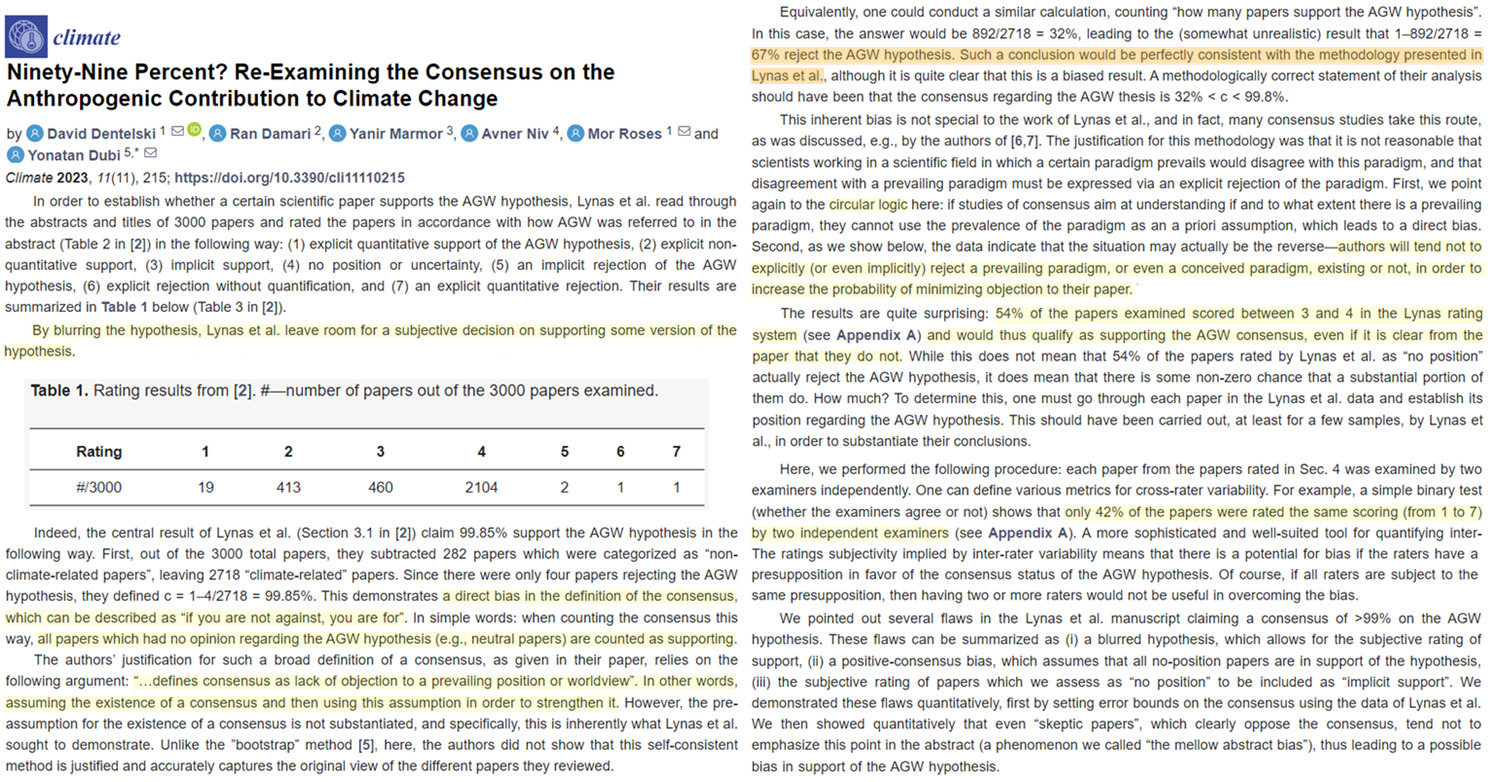
In a new study, six scientists (Dentelski et al., 2023) effectively eviscerate a methodologically flawed 2021 study (Lynas et al.) that claims 99.53% of 3,000 scientific papers examined (by subjectively classifying papers based only on what is written in the abstracts) support the anthropogenic global warming, or AGW, position.

Image Source: Dentelski et al., 2023

The Lynas et al. authors begin with the assumption that a consensus on the human attribution for global warming not only exists, it is ensconced as the unquestioned, prevailing viewpoint in the scientific literature. So their intent was to effectively quantify the strength of this assumed widespread agreement by devising a rating system that only assesses the explicit rejection of AGW in the paper’s abstract as not supporting the presumed “consensus.”

Of the 3,000 papers analyzed in Lynas et al., 282 were deemed not sufficiently “climate-related.” Another 2,104 papers were placed in Category 4, which meant either the paper’s authors took “no position” or the position on AGW was deemed “uncertain”…in the abstract. So, exploiting the “if you are not against, you are for” classification bias, Lynas and colleagues decided that the authors of these 2,104 scientific papers in Category 4 do indeed agree with AGW, as what is written in the abstract does not explicitly state they do not agree.

Interestingly, if this classification bias had not been utilized and the thousands of Category 4 (“no position” or “uncertain”) papers were not counted as supporting AGW, only 892 of the 2,718 (climate-related) papers, or 32%, could be said to have affirmatively stated they support AGW. So, simply by assuming one cannot divine the AGW opinions of authors of scientific papers by reading abstracts, it could just as facilely be said that 68% (1,826 of 2,718) of climate-related papers reject AGW.

Dentelski and colleagues also point out that by their own analysis, 54% of the papers they examined that were classified by Lynas et al. as only “implying” support (Category 3) for AGW or Category 4 (“no position” or “uncertain”) actually described a lack of support for AGW in the body of the paper itself. But since this expressed non-endorsement of AGW was not presented in the abstract, these papers were wrongly classified as supporting AGW anyway.

To fully grasp the subjective nature of the methodology employed by Lynas and colleagues, Dentelski et al. uncover the internals of the study indicating 58% of the time two independent examiners did not agree on numerical classification scale (from 1 to 7) for a paper. If two people agree just 42% of the time when classifying papers, it cannot be said that the rating system is sufficiently objective.

The Lynas et al. paper appears to be little more than an exercise in propaganda.

via NoTricksZone

https://ift.tt/Cv9bWnx

November 30, 2023 at 04:21PM

Amicus Brief Details Climate Litigation Campaign’s Political Origins

From Climate Litigation Watch

Newly obtained records withheld for seven years reveal NYAG attorneys abandoned misgivings about pre-packaged “subpoena suggestion” after months of activists’ climate-lawsuit lobbying

“[M]aybe he can come to see that he’s wrong” met “Please do know that I want to find a way on this as much as you do”, and politics carried the day

This week, Judge Valeri Caproni of the U.S. District Court for the Southern District of New York granted leave for Energy Policy Advocates (EPA) to file an amicus brief with that Court in City Of New York v. Exxon Mobil Corporation et al. The brief includes an appendix of over 100 pages of emails and memos sent to and from the New York Attorney General’s Office (NYAG), which were recently obtained by Government Accountability & Oversight (GAO). Most of these emails were recently released for the first time and following years of stonewalling. All of this reveals the Rockefeller Family Fund’s (RFF) instrumental role in originating the ever-expanding climate litigation campaign which began with the New York Attorney General’s November 2015 subpoena of ExxonMobil. 

In a breathtaking read, the public now sees in the principals’ own words that the admitted objective is to obtain discovery for help with, and otherwise help move along, a national campaign of lawfare designed to coerce defendants “to the table” in support of unpopular national ‘climate’ (i.e., energy-constraint) policy.

The newly released public records date from former New York Attorney General Eric Schneiderman’s time in office but feature senior officials who remain in their positions today, as well as now-Manhattan District Attorney Alvin Bragg. 

The emails and memos lobbying NYAG showcase RFF’s extraordinary access to and influence within NYAG. Working first with political allies, RFF provided the materials and legal strategy for the first climate investigation/prosecution. These materials were pre-packaged and presented to a NYAG office whose lawyers initially reacted to the former NYAG attorney engaged by RFF to prepare its memos by hoping, “maybe he can come to see that he’s wrong.” 

However, EPA’s amicus brief shows how RFF, with the assistance of an NYAG political appointee, succeeded in lobbying law enforcement to overcome this position, i.e., the OAG attorneys’ own internally expressed misgivings about RFF’s proposed subpoena strategy. 

* * *

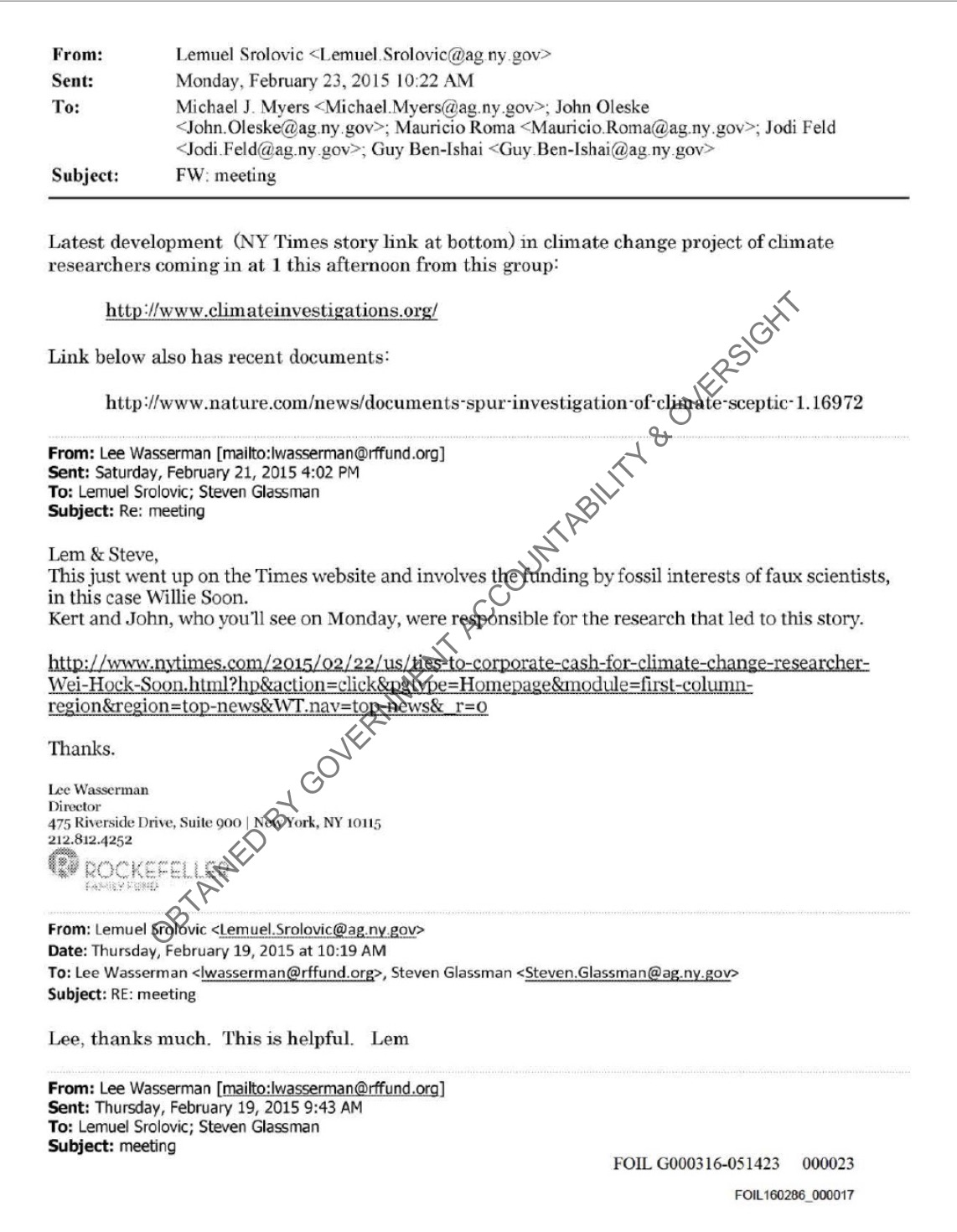
At a previously unknown February 23, 2015, meeting organized by RFF President Lee Wasserman, the NYAG was presented with a “trove of materials” on ExxonMobil curated by activists Kert Davies of Climate Investigations Center and John Passacantando of Greenpeace, who Wasserman also brought in to help pitch NYAG into action. Specific references in the correspondence between NYAG staff indicate that the “trove” may have included internal company documents published months later in the #ExxonKnew reporting series, which allegedly spurred investigations from NYAG and other state attorneys general. Wasserman also boasted that the pair’s work was behind a (then-)recent NYT hit piece on climate scientist Willie Soon— while also suggesting his own involvement in arranging for this, what the brief reminds the Court was just one of a spate media items engineered in aid of RFF’s campaign.

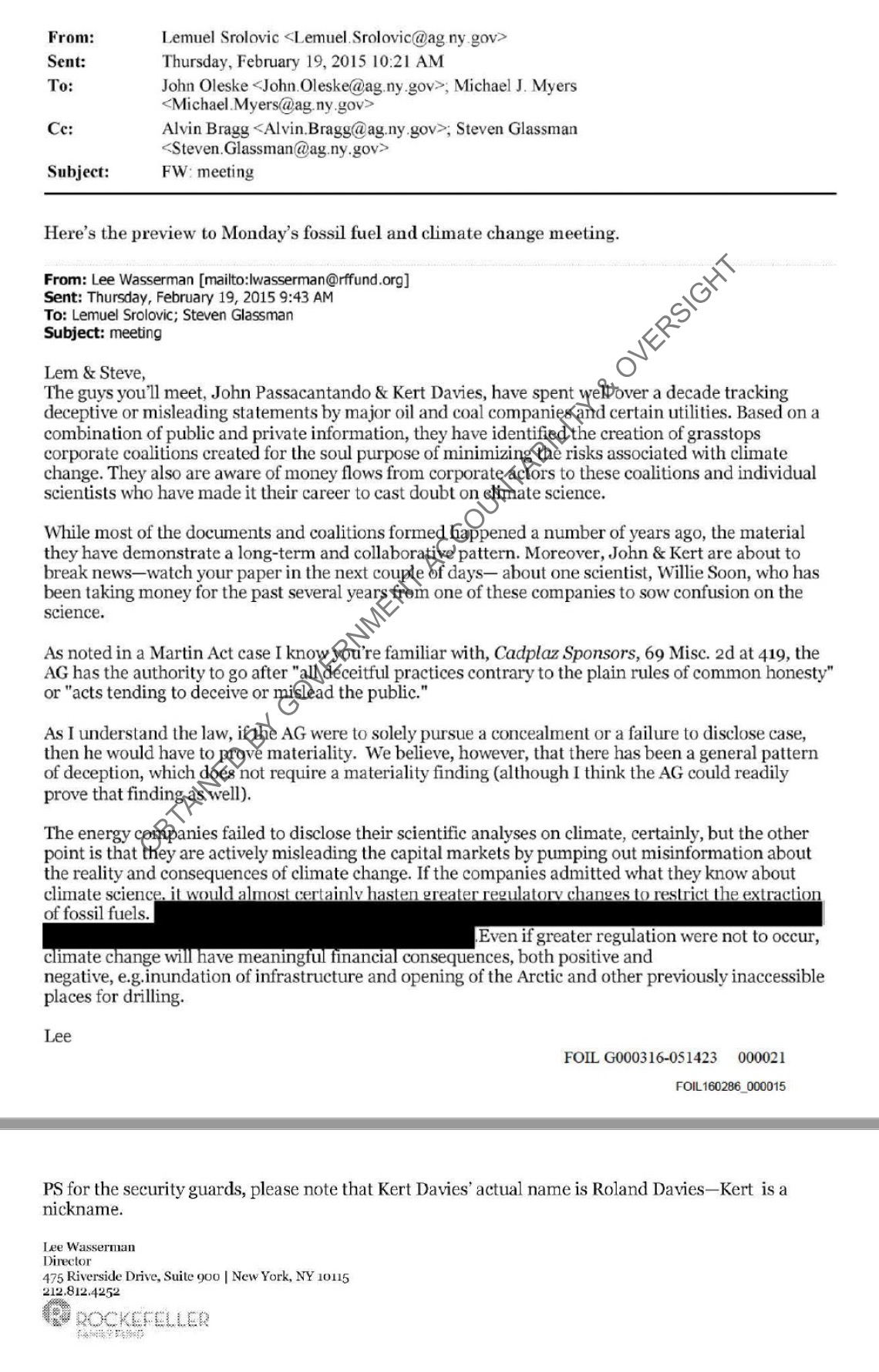
The public records highlighted in EPA’s amicus brief fill in many of the gaps in old Schneiderman-era privilege logs from past Freedom of Information Law (FOIL) litigation, but questionable redactions and withholdings remain. Notably, NYAG redacted a portion of a February 19, 2015, email from Wasserman, a private actor, to NYAG staff that included a detailed preview of the upcoming Feb. 23 “fossil fuel and climate change meeting”:

“If the companies admitted what they know about climate science, it would almost certainly hasten greater regulatory changes to restrict the extraction of fossil fuels. In our opinion, [                                    REDACTED                                                                   ]. Even if greater regulation were not to occur, climate change will have meaningful financial consequences…”

This decision to redact a third party’s opinion about its own strategy that was sold to NYAG, and the desired outcome therefrom, e.g., for such litigation to “hasten greater regulatory changes,” is indicative of the disproportionate sway Wasserman still carries in the Office.

That withholding, which is different depending on the version most of which hide the “In our opinion,” is the subject of recently filed FOIL lawsuit.

But although Wasserman and his allies had political sway, getting the rank-and-file attorneys on board was another matter.  

A month after the February 23 meeting, RFF’s Wasserman emailed Attorney General Eric Schneiderman’s chief of staff Micah Lasher the first of two Martin Act/subpoena-strategy memos making the case for how and why the Office should use that law to investigate ExxonMobil. One pitch was that the company might be so embarrassed by the prospect of press attention that the public would never find out about NYAG’s move.

According to emails between Lasher and Wasserman, NYAG attorneys were initially skeptical of the approach, and it fell to Lasher – a political operative – to liaise with Wasserman to smooth over NYAG attorneys’ concerns about the approach. As Lasher wrote to Wasserman after one meeting in March 2015, Please do know that I want to find a way on this as much as you do.”

NYAG attorneys’ skepticism was prescient. The case that these months of correspondence and closed-doors lobbying launched, People of the State of New York v. ExxonMobil Corporation, ended in a decisive failure for the state and the activists. Afterward, following exposure for being behind the media campaign cited by Schneiderman in support of his lawsuit—and as GAO has detailed in a report based on records obtained from the Minnesota Attorney General—RFF began working through a group called Center for Climate Integrity (CCI), for which it also toured the country raising further financing, which then would, e.g., help ghost-write the memos recruiting AGs as plaintiffs and arrange for local climate activists to serve as front-facing advocates lobbying AG/plaintiffs. 

Even so, RFF and the groups it manages behind the scenes continue to package up and pitch and help direct the campaign seeking filing of more versions of that first lawsuit to public officials across the country, indicating the national ambitions and federal nature of this litigation campaign. 

via Watts Up With That?

https://ift.tt/TGH7NYb

November 30, 2023 at 04:13PM