Here we go again. Sound the alarm – louder! So far most climate models have consistently over-estimated temperature rises, compared to observations. The paper goes online shortly (see below for full details).
– – –
According to a new paper in Oxford Open Climate Change, the strategies humanity must pursue to reduce climate change will have to include more than reducing greenhouse gases.
This comes from an analysis of climate data led by researcher James Hansen, says the press release (@ EurekAlert!).
Scientists have known since the 1800s that infrared-absorbing (greenhouse) gases warm the Earth’s surface and that the abundance of greenhouse gases changes naturally as well as from human actions. [Talkshop comment – the human actions part at least is still a theory].
Roger Revelle, who was one of the early scientists to study global warming, wrote in 1965 that industrialization meant that human beings were conducting a “vast geophysical experiment” by burning fossil fuels, which adds carbon dioxide (CO2) to the air.
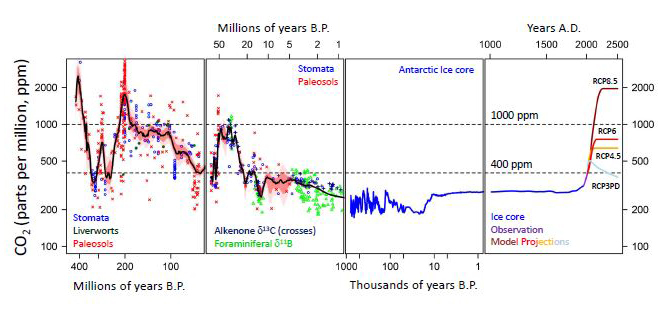
CO2 has now reached levels that have not existed for millions of years. [Talkshop comment – no, CO2 levels are low by long-term historical standards].
Climate sensitivity
A long-standing issue concerns how much global temperature will rise for a specified CO2 increase. [Talkshop comment – built-in assumption]. A 1979 study released by the United States National Academy of Sciences concluded that doubling atmospheric CO2 with ice sheets fixed would likely cause global warming between 1.5 and 4.5° Celsius. This was a large range, and there was additional uncertainty about the delay in warming caused by Earth’s massive ocean.
This new paper re-evaluates climate sensitivity based on improved paleoclimate data, finding that climate is more sensitive than usually assumed. Their best estimate for doubled CO2 is global warming of 4.8°C, significantly larger than the 3°C best estimate of the United Nations Intergovernmental Panel on Climate Change.
. . .
The paper, “Global warming in the pipeline,” will be available (at midnight on November 2nd) at: https://doi.org/10.1093/oxfclm/kgad008.
Full press release here.
via Tallbloke’s Talkshop
November 2, 2023 at 11:51AM
 Iowa Climate Science Education