
By Paul Homewood

Archaeologists surveyed melting ice patches in Canada and uncovered dozens of ancient artifacts spanning 7,000 years. Photos show the “unique” — and perishable — finds.
After two winters with “extremely low snowpack,” researchers set out to survey several melting ice patches in Mount Edziza Provincial Park in the summer of 2019, according to a study published Oct. 31 in the Journal of Field Archaeology.
Mount Edziza Provincial Park is a volcanic landscape that is “extremely significant” to the Tahltan, one of Canada’s indigenous First Nations, the study said. The Tahltan have used the mountains for seasonal hunts for centuries and continue to do so today.
Previous scientists had located many “vast obsidian quarries” and obsidian artifacts in the park, but the nearby ice patches had not been studied as extensively. Researchers said they were intrigued by the possibility of finding perishable ancient artifacts preserved in the ice.
So as the ice melted under the summer sun, researchers visited nine ice patches — and found 56 perishable artifacts, the study said.
“Most of the perishable artifacts were manufactured from wood, including birch bark containers, projectile shafts, and walking staffs,” researchers said. Other artifacts were made “using animal remains include a stitched hide boot and carved antler and bone tools.”
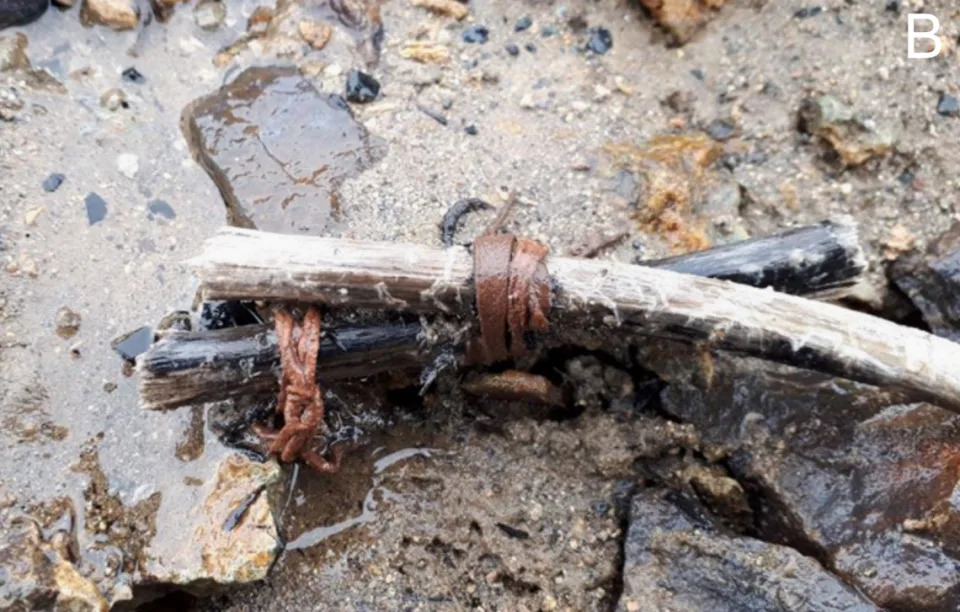
A 3,000-year-old pair of stick wrapped in animal hide found in the ice.
Archaeologists found two bark containers with stitching. A photo shows one of these containers. The 2,000-year-old piece of bark is folded with two rows of stitching along one side and some of the stitching material still left in the holes, the study said.
The other “unique” bark container has sticks stitched into its sides, suggesting it was part of a reinforced basket used for transporting heavy loads. Researchers said it dated back over 1,400 years.
Archaeologists also uncovered an artifact made of stitched animal hide that they identified as the remains of a moccasin-like boot. A photo shows the 6,200-year-old fabric. It has “two different thicknesses of hide … which have been stitched in multiple places,” the study said.
Mount Edziza Provincial Park is in British Columbia and near the Canada-U.S. border with Alaska. The park is about 660 miles northwest of Vancouver and about 155 miles southeast of Juneau.
https://news.yahoo.com/melting-ice-reveals-dozens-7-221609873.html
Now I wonder why they went to all that bother burying things under the ice 7000 years ago?
via NOT A LOT OF PEOPLE KNOW THAT
November 22, 2023 at 02:00PM
 Iowa Climate Science Education