Variation in solar activity during a recent sunspot cycle [credit: Wikipedia]
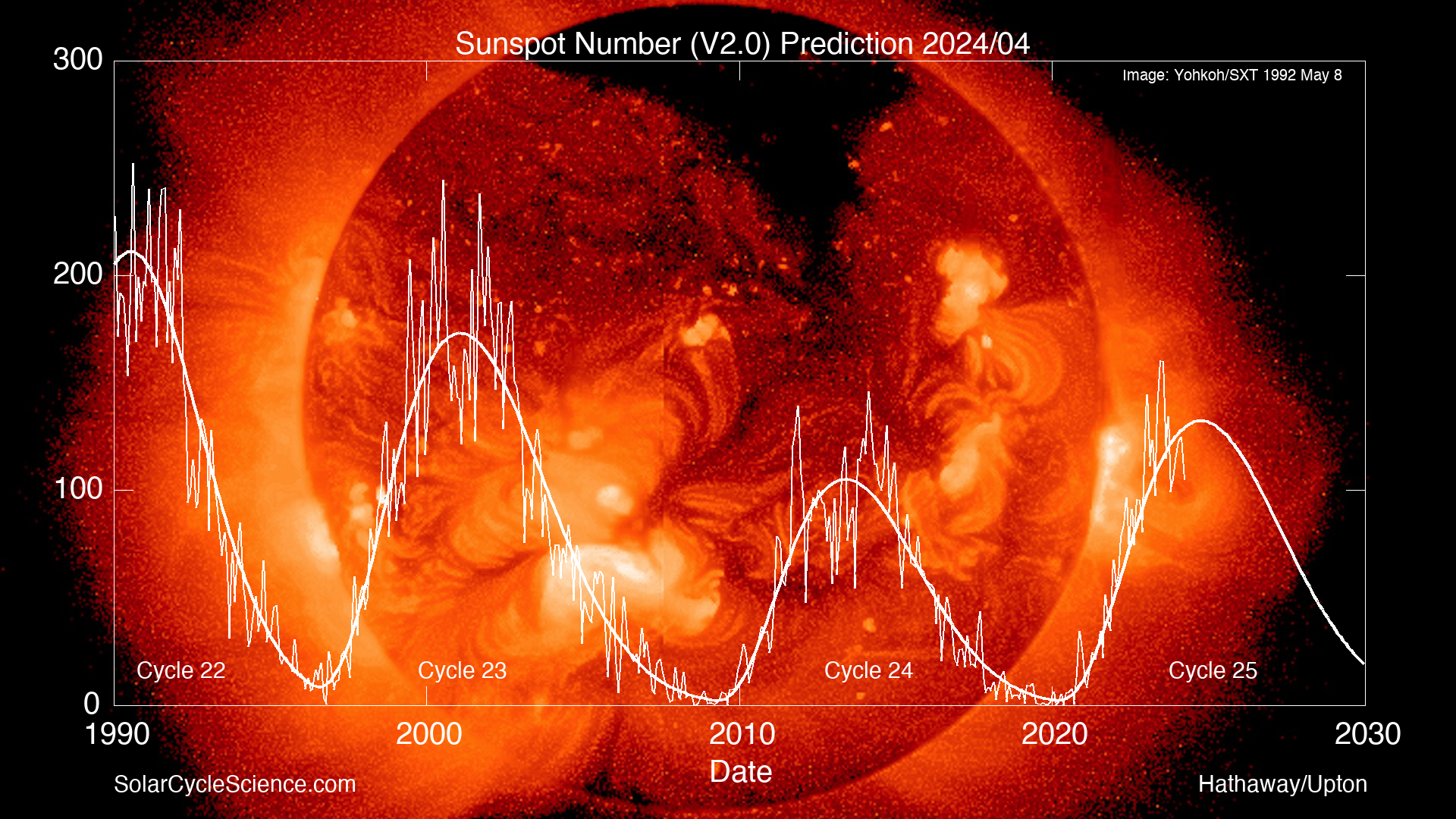
So soon there’s barely time to read the study, if the prediction is anywhere near correct. Solar cycle 25 has already defeated the majority of pundits anyway, by being considerably more active prior to its peak than the last one. However, at least one group of researchers has already forecast a peak around now (see this April 2023 Talkshop post). The latest (i.e. just revised) Hathaway/Upton forecast graphic is here. What the value is of SC predictions of such short duration, even if they turn out to be close to correct, is not entirely clear. It seems like placing a bet when the jockeys can already see the finish line.
– – –
A new study has found that the impending peak in the Sun’s activity cycle will likely arrive significantly sooner than previously predicted, says Science Alert.
According to an analysis by astrophysicists Priyansh Jaswal, Chitradeep Saha, and Dibyendu Nandy at the Center of Excellence in Space Sciences India, solar maximum is likely to hit in January 2024.
This is much, much sooner than the initial official prediction, which found solar maximum would take place in July 2025.
The finding suggests that there may be better ways of predicting the Sun’s behavior than the methods used for the official predictions for the current solar cycle, solar cycle 25.
Solar cycles are somewhat mysterious – it’s not entirely clear what drives them – but they are very normal.
Simply put, every 11 years or so, the Sun’s magnetic field reverses polarity. This is accompanied by a rise and fall of solar activity – sunspots, solar flares, and coronal mass ejections.
The point at which the poles switch places is known as solar maximum, characterized by a peak in activity. Solar minimum follows several years later; the Sun de-escalates its activity before ramping up to the next maximum.
We track and predict when this will occur based on the number of sunspots that speckle the face of the Sun. However, this method has never been an exact science; we know roughly when solar maximum will occur, but official predictions are more of an estimate than a precision pinpoint.
The last solar minimum, marking the end of solar cycle 24, took place in 2019. Solar cycle 24 was relatively quiet, as solar cycles go; the NOAA prediction was that solar cycle 25 would follow suit, with subdued activity, and a peak in July 2025.
Nothing has gone according to that prediction.
Since solar activity started climbing, it has vastly exceeded official predictions; solar cycle 25 is proving to be one of the strongest since we started recording solar cycles back in 1755, and solar activity in the last few years has been tremendously exciting to follow.
Some scientists called it. Robert Leamon of NASA and Scott McIntosh of the US National Centre for Atmospheric Research predicted that solar maximum would be stronger than others believed, and take place in mid to late 2024.
Last month, the NOAA revised its prediction, announcing that the maximum is now expected between January and October of 2024.
Full article here.
– – –
Solar Cycles website: Discover the Predictions! – by Dr. Lisa Upton and Dr. David Hathaway
via Tallbloke’s Talkshop
December 4, 2023 at 07:18AM
 Iowa Climate Science Education