
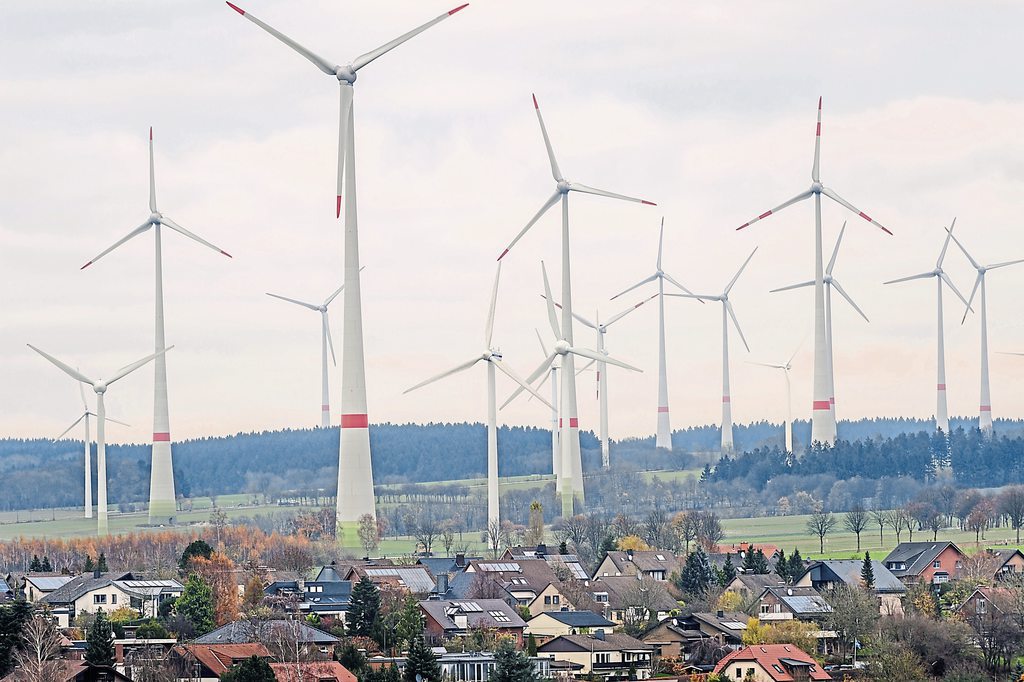
Once upon a time, the object was delivering power to everyone, everywhere, all the time. Not anymore. Chaotically delivered and heavily subsidised wind and solar have another object, and it is not one that their proponents dare speak of. If delivering reliable and affordable power were the object, then no one would be talking about sunshine and weather-dependent solar and weather-dependent wind.
Having manifestly failed to convince the proles that their occasionally delivered product provides any kind of answer, the wind and solar industries are seeking shelter behind so-called net-zero carbon dioxide gas emissions targets, and these days rarely break cover – outraged households and businesses being constantly pounded by crippling power bills have worked out the true and proximate cause and the villains responsible.
As David King explains below, pursuing the path set by no-nothing ideologues is a guarantee of economic oblivion.
Economic Euthanasia
Quadrant Online
David King
14 November 2023
Australia, like most developed nations, is seemingly committed to pursue “decarbonisation” by way of an “Energy Transition” from fossil fuels to so-called renewables. This Energy Transition is supposed to deliver a Net Zero in anthropogenic carbon dioxide emissions within a few decades.
We are told that this transition will not only save the planet, but will deliver, inter alia, cheaper energy, massive job growth and economic prosperity. Irrespective of one’s views on whether (or to what extent) the planet does need saving, nothing could be further from the truth with regard to the economic consequences. This Energy Transition will inevitably lead to higher energy costs, massive job losses in the many manufacturing and other industries that cannot survive these higher costs, inevitable rampant inflation; and of course consequential social disorder. Being self-inflicted, this Energy Transition (and absent the widespread deployment of nuclear energy) is akin to euthanasing the national economy.
I have argued in an earlier essay (“The Power of the Sun and the Futility of Net Zero”, Quadrant, October 2022) that the scientific rationale for pursuing Net Zero is deeply flawed, but in the present context the scientific rationale is of no great consequence. The economic rationale for pursuing an Energy Transition, by precluding us from exploiting our bountiful and cheap fossil fuels, is based on a number of myths.
The first myth is that renewables (predominantly wind and solar, supported by battery storage technology) have become cheaper because of advances in technology and improved manufacturing/deployment efficiencies. More detailed analysis would suggest that any fall in costs has been predominantly a result of lower energy prices.
With energy prices now rising, in part courtesy of the war in Ukraine, the cost of renewables is increasing. Compounded with the energy efficiency of renewables being unarguably vastly inferior to energy derived from fossil fuels, the rising cost of renewables is a clear portent of massive economic pain to come.
The second myth is that all the grand plans to implement the Energy Transition are capable of being implemented. They cannot be implemented on the scale and in the timeframes targeted, for the simple reason that the materials required are not and will not be available. The World Bank estimates that the mining of the critical minerals necessary for implementation of the transition will need to increase by more than 1000 per cent, because so-called “green” technologies are significantly more material-intensive, and require a very different mix of critical minerals, than technologies in the current energy mix.
It is not that the materials required do not exist, it is just that the exploration for, and development of, these critical minerals is just not happening—ironically largely because of the anti-mining sentiments of the very proponents of the Energy Transition! As one example, it is estimated that to achieve the targeted transition will require 450 megatonnes of copper over the next twenty-two years—equal to the total historical production of copper by humankind. And there are no signs of any substantial increase in copper exploration and production.
The third myth is that ramping up the renewables component in the energy mix will lower electricity prices. The Australian government and policy-makers continue to use the “levelised cost of electricity” (LCOE) for comparing the costs of electricity generation, relying on the annual CSIRO GenCost report to rank the economics of different forms of generation technology. LCOE is an estimate of the net present cost of electricity generation for a generator over its lifetime.
Useful as it has been in the fossil fuel era, the LCOE is not fit for purpose when comparing intermittent forms of energy generation with forms that are readily dispatchable. Although the CSIRO work does take account of some of the additional costs for the widespread deployment of renewable energy, it clearly does not go far enough.
A landmark paper in the Journal of Management Sustainability by Lars Schernikau, William Hayden Smith and Rosemary Falcon in June 2022 elegantly develops the concept of the “full cost of electricity” (FCOE) to overcome the shortcomings of the LCOE, taking account of not only costs of building, fuel and operating costs, but costs of transporting, storage, back-up, emissions, recycling, land footprint and more. Their detailed analysis shows why wind and solar are not cheaper than conventional fuels, and in fact become more expensive the higher their penetration in the base load energy supply. So much for our policy-makers’ promises that more renewables will lower the cost of electricity.
The concept of “Energy Return on Energy Invested” (EROEI) is useful in understanding why the economic rationale for the Energy Transition is delusional. EROEI is the ratio of usable energy output over the energy required to deliver that output. By way of example, the EROEI of natural gas is estimated to be around 30, and for wind and solar around 3.5 (after allowing for intermittency and redundancy).
In other words this transition seeks to replace gas, with a surplus energy of ~29 units for each energy unit invested, with renewables with surplus energy of ~2.5 units for each energy unit invested. This means it takes around eleven wind or solar installations to deliver the same surplus energy that a single gas installation delivers. It should be no surprise then that as we replace gas (or other fossil fuels) with wind and solar, the cost of energy will inevitably go up. Since it is surplus energy which is available to power economic activities and drive growth, the economic consequences of this transition will hurt both producers and consumers.
It is ironic that the same reasoning explains why the transition away from fossil fuels would do little or nothing towards delivering the desired reduction in carbon emissions. What it would deliver is higher and higher energy prices, and then inevitably an economic (and social) catastrophe.
Thirty years ago, political activists were able to propagate a distant “Green future” to capture the public imagination, in particular in Europe. Now, when the first steps are taken by political command, the economic costs become painfully evident to ordinary citizens—and all of a sudden, more and more wake up to the realisation that they were misled by the myths. The tide may well turn again (and indeed is already turning in Europe), and it may well be fortunate that the materials necessary to implement the transition will not be available, and save our energy-dependent civilisation from economic euthanasia.
Quadrant Online

via STOP THESE THINGS
December 5, 2023 at 12:39AM
 Iowa Climate Science Education