
A lie will travel halfway around the world while the truth is lacing her boots, so the adage goes. And so, the showmen will continue to misrepresent natural disasters that befalls northern Australia while finding something popular to say at the very moment everyone’s attention is focused on that event. For sure, the rainfall associated with Cyclone Jasper was extraordinary, but not unprecedented for the Cairns catchment. For sure, it is difficult to forecast weather and climate, but the skill of new systems based on artificial intelligence (AI) show great improvement, while the Australian Bureau of Meteorology remains wedded to its General Circulation Models.
Contrary to various popular claims, including by my colleague Peter Ridd, the Bureau uses the same supercomputer and the same general circulation model to forecast rainfall whether considering the next three-hours, the next three months or the next three decades. It uses a simulation developed by the UK Met Office known as ACCESS-S2, that is also one of the Intergovernmental Panel on Climate Change’s CMIP6 models.
All the general circulation models are underpinned by the assumption that carbon dioxide drives climate change, and all these same models are focused on large scale processes making it difficult to accurately forecasts what matters to real people – local climate, especially extreme rainfall known to be associated with cyclones, and also seasonal rainfall deficient associated with drought.
The Bureau claims it can accurately forecast temperature to within 2 degrees Celsius on any day. This may be of intense political interest, but it is of little real value to the Australian community. Being able to accurately forecast rainfall would be much more meaningful.
There are four types of precipitation-forming processes, including cyclonic rotation (low pressure), though the IPCC’s models are all based on surface-heating (convection). It is perhaps for this reason that these models while accurately simulating general global patterns of rainfall remain unable to capture high intensity events over small areas including rainfall associated with cyclones. Some of these problems can be overcome through downscaling, but even then, it is unclear why the elevation of mountains is mostly underestimated while their spatial extent is overestimated. Fundamentally, and at the core of the problem, is that clouds formation occurs at a scale much smaller than the resolvable grid scale used within all the general circulation models.
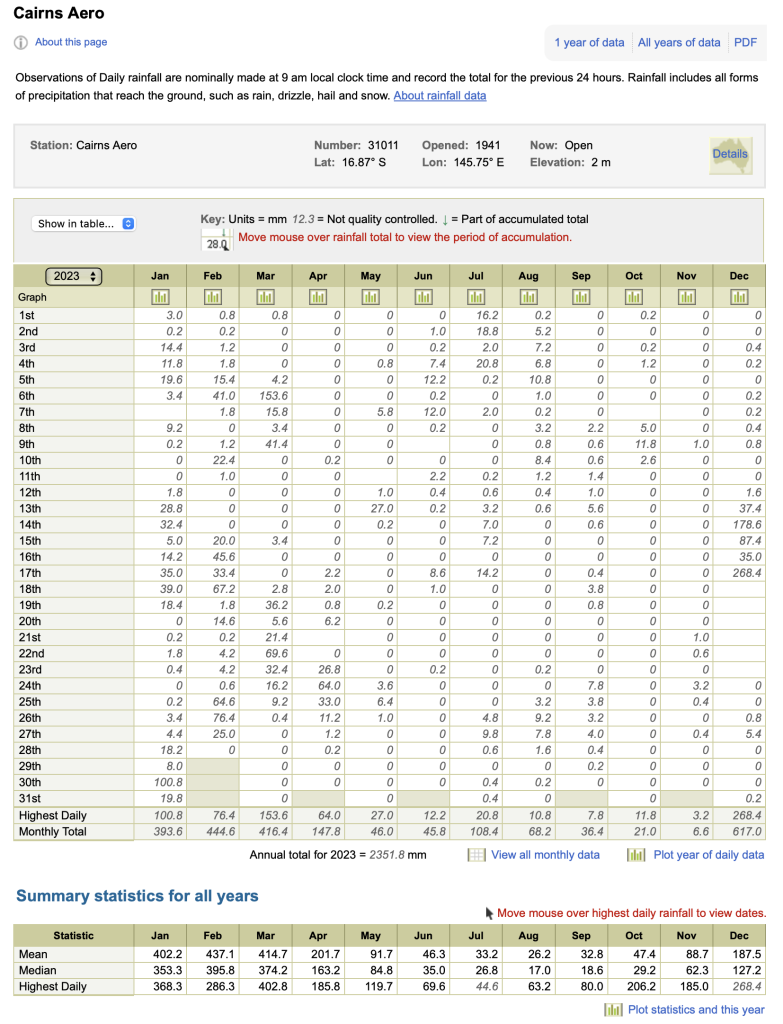
The Bureau was able to accurately forecast the trajectory of Cyclone Jasper as it presented as a large and slow-moving weather system, but once the structure of the cyclone began to break down, and this occurred from December 9, ACCESS-S2 struggled to accurately forecast both direction and intensity. Worst, when the heaviest rainfall began eight days later, on December 17 in Cairns, the Bureau was unable to capture the extent of the downpour because its automatic weather recording system at Cairns airport failed. The same problem was experience during the Lismore flooding of April 2022, meaning that the true intensity of the rainfall from these events is not even properly documented.
I first became interested in rainfall forecasting using artificial intelligence in January 2011, following the flooding of Brisbane. My colleague John Abbot used artificial neural networks, a form of AI, for share market trading, and so successfully he bought a red corvette with the winnings one day. That same sports car was drowned in the 2011 Brisbane flooding.
Over the next five years to 2017, John Abbot and I successfully published a dozen research papers on our new technique using AI for monthly rainfall forecasting. We published in the best international peer-reviewed journals and as book chapters following AI conferences.
Our very first paper about forecasting monthly rainfall – for 17 locations in Queensland 12 months in advance – was published in Atmospheric Research which is an Elsevier journal sponsored by the Chinese Academy of Sciences.
Back 12 years ago, when we were pioneering the technique, the Chinese were very interested, and prepared to publish us, but not our own Bureau of Meteorology who scoffed at the idea that AI could be used for weather or climate forecasting.
“But the climate is on a new and dangerous trajectory”, said Oscar Alves who then headed-up the long-range forecasting unit at the Bureau in Melbourne. At the time the Bureau was using a statistical technique for its medium-term forecasts developing its own general circulation model known as POAMA. POAMA was subsequently used for operational forecasts from June 2013, before being replaced by ACCESS-S1 without even a media release announcing the change over in August 2018. It took the Bureau 20 years to develop POAMA, and they pulled it after just five years.
John Abbot and I spent an afternoon with Alves, back in August 2011. John Abbot and I wanted to collaborate. We were convinced back then that AI could significantly improve the skill of the Bureau’s rainfall forecasts. He had no interest in learning anything new. Alves now heads up Bureau’ Earth System Modelling unit.
All these years later and the Bureau is still refusing to consider the value of AI for forecasting rainfall extremes whether the consequence of a cyclone or a drought.
Meanwhile Google is now using AI for weather forecasting with their GraphCast, run on a desktop, outperforming all the GCMs run on supercomputers.
Google’s GraphCast works from the same principles John Abbot and I used: recurrent cycles that can be found in weather and climate data – as long as the data hasn’t been remodelled to fit the human-caused global warming theory. And the Chinese are now working on AI systems that can forecast both the intensity of rainfall during cyclonic events, as well as trajectory.
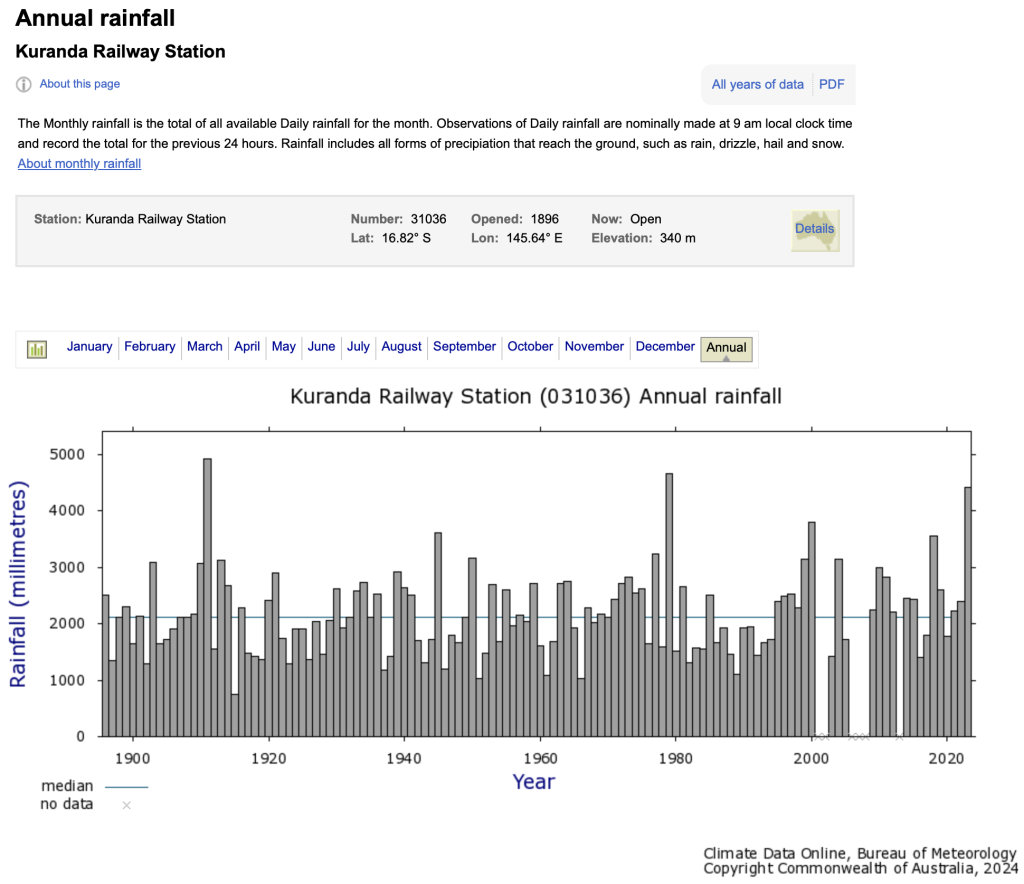
There has been commentary suggesting Cyclone Jasper resulted in unprecedented rainfall in the headwaters of the Barron River causing flooding of Cairns, particularly of the Northern Beaches. There is a long continuous rainfall record for Kuranda indicating that while December 2023, and the rainfall associated with Jasper was extraordinary, there are higher totals for previous year going back to 1911. I have no doubt that the rainfall forecasts for North Queensland following landfall by Cyclone Jasper would have been far superior if ten years ago the Bureau had began to invest in AI technology, had began to develop some capacity in this very different technique.
The Australian emergency management minister, Murray Watt, has ordered a review of the weather warning systems used by the Bureau of Meteorology, while claiming it will become increasingly difficult to predict the weather because of climate change. He should be calling for much more than this, and not using the excuse of ‘climate change’ for both the failed 3-day rainfall forecast and also the failed warning system after the heavy rains began to fall.
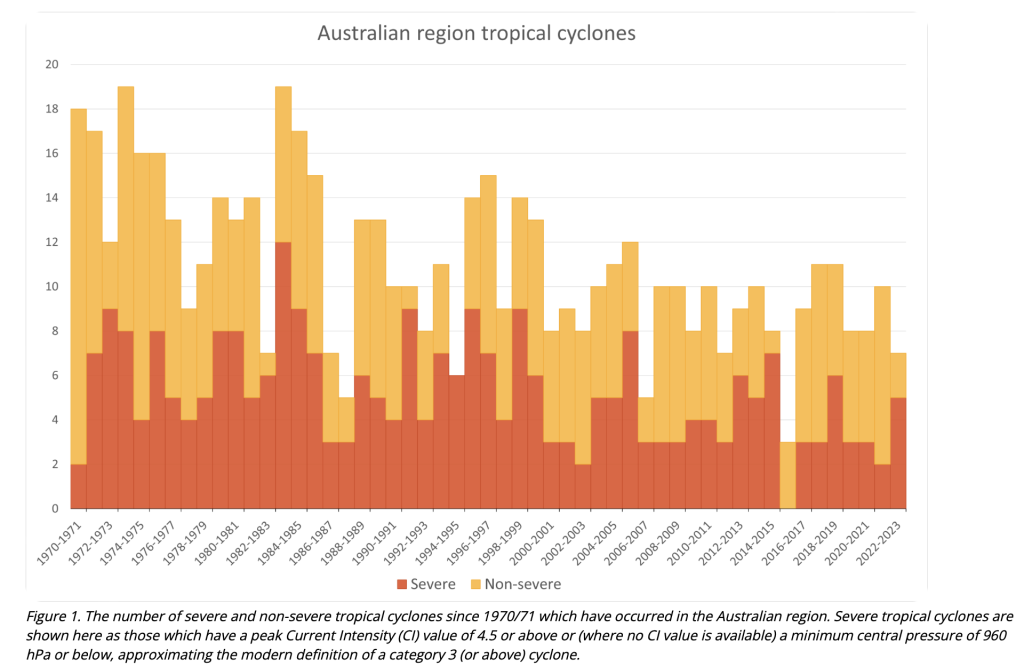
For the last twenty years various international working groups associated with the IPCC and World Meteorological Organisation have been making submissions and predictions regarding the likely effects of global warming on tropical cyclones. These reports have indicated the maximum intensity of cyclones is unlikely to significantly increase, certainly not beyond 10-20 percent. A ‘Statement on Tropical cyclones and Climate Change’ in 2006 by Dr G. B. Love the Permanent Representative for Australia indicated that rainfall intensity could increase, due to the increasing water vapour content of the atmosphere. Twenty years later, the data shows that both the intensity and number of cyclones has been declining.
The extraordinary rainfall associated with the flooding of Lismore and surrounds in early 2022, may have been exacerbated by the increase in water vapour content from the explosion of the volcano Hunga Tunga in January of that year. It could be that the Hunga Tonga eruption has also caused a depletion of ozone in the stratosphere, after temporarily increasing the water vapour content. There has been no overall increase in water vapour content of the lower troposphere associated with increasing atmospheric levels of carbon dioxide.
The general circulation models have difficulty simulating the local impact of volcanic ash on rainfall intensity and global temperatures, and this is a problem because aerosols can supercharge the atmosphere making rainfall more intense.
Importantly, and contrary to recent popular commentary, there are no two separate parts to the Bureau: one making operational weather forecasts and one concerning itself with climate change. Since June 2013, forecasts for the next three-hours and next three-months have relied on a general circulation model and since 2018 specifically on ACCESS, with some adds-on to provide more resolution. There is an urgent need for the skill of this general circulation model to be properly assessed. This could be done as a matter of urgency and through a comparison of forecast versus predicted rainfall for the Cairns catchment area through December 2023, particularly after cyclone Jasper made landfall.
There is also a need for the Bureau to quantify the skill more generally of ACCESS against the skill of the new AI weather and climate forecasting systems including Google’s GraphCast and the Pangu-Weather AI model for predicting the direction of cyclones and their likely impact, particularly their capacity to generate intense rainfall over a small area.
There has been much talk about the unprecedented, what would be both unprecedented and welcome would be for the Bureau to start doing KPI’s and measure predictions against actual rainfall totals. This needs to be done for the three-hour rain burst events associated with low pressure systems and also their longer seasonal rainfall forecasts. It is the case that the Bureau also forecast, using the same ACCESS general circulation model, that this summer would be an exceptionally dry one for the same regions that have been flooded. These wrong forecasts have also caused unnecessary hardship, with farmers selling livestock at discounted prices as everyone anticipated drought.
via Jennifer Marohasy
January 4, 2024 at 07:30PM
 Iowa Climate Science Education