
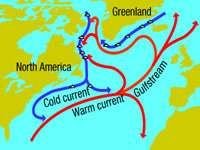
Gulf Stream flows
Some recent cold weather events are puzzling to global warming researchers, in terms of climate model expectations. Especially so for the ‘Center for Irreversible Climate Change’ in South Korea. Temporary natural variation seems to be the conclusion. What else could they say without casting doubt on human-caused warming theories?
– – –
If the world is warming, why are our winters getting colder?
Indeed, East Asia and North America have experienced frequent extreme weather events since the 2000s that defy average climate change projections, says Phys.org.
Many experts have blamed Arctic warming and a weakening jet stream due to declining Arctic sea ice, but climate model experiments have not adequately demonstrated their validity.
The massive power outage in Texas in February 2021 was caused by an unusual cold snap, and climate models are needed to accurately predict the risk of extreme weather events in order to prevent massive socioeconomic damage.
In particular, climate technology leaders have recently set the ability to predict the climate of the next decade or so as an important goal.
The Korea Institute of Science and Technology (KIST) has announced that senior researcher Mi-Kyung Sung of the Sustainable Environment Research Center and professor Soon-Il An of the Center for Irreversible Climate Change at Yonsei University have jointly discovered the role of mid-latitude oceans as a source of anomalous waves that are particularly frequent in East Asia and North America, paving the way for a mid- to long-term response to winter climate change.
The work is published in the journal Nature Communications.
. . .
The process of heat accumulation in oceanic frontal regions lasts from years to decades. During this time, a warming hiatus can occur in the continental regions that bucks the global warming trend. Conversely, during decades of ocean frontal cooling, continental regions appear to experience a sharp acceleration of warming.
This suggests that the recent decadal cooling trend is essentially reinforced by temporary natural variability in the global climate system, and that we can expect unseasonably warm winter weather to become more prevalent as the heat buildup in the ocean front is relieved.
Full article here.
via Tallbloke’s Talkshop
January 24, 2024 at 12:57PM
 Iowa Climate Science Education