
The researchers wrestle with the non-correlation of extreme winter weather events and the monotonic increase in CO2 levels, offering a verdict of ‘probable’ natural variation. They try to support IPCC climate assertions, but the article keeps saying ‘however’. One of the study’s authors says: “This is still a challenging issue that needs further exploration to quantify the relative contributions of natural variability and human activity to regional extreme events.”
– – –
A recent study by researchers from the Institute of Atmospheric Physics, Chinese Academy of Sciences, presents robust interdecadal changes in the number of extreme cold days in winter over North China during 1989–2021, and the findings have been published in Atmospheric and Oceanic Science Letters, says EurekAlert.
Specifically, the number of extreme cold days increased around the year 2003 and then decreased around the year 2013, with a value of 8.7 days per year during 1989–2002, 13.5 during 2003–2012, and 6.6 during 2013–2021.
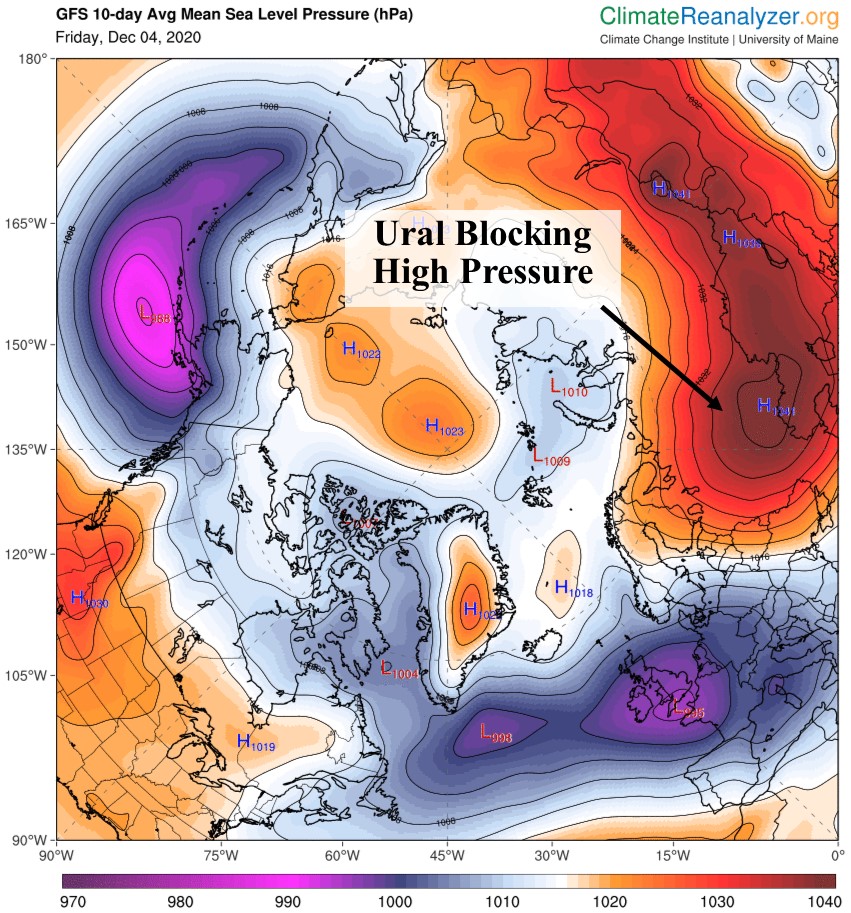
During 2003–2012, the Siberian–Ural High strengthened and the polar jet stream weakened, which favored frequent cold air intrusion into North China, inducing more extreme cold days. In addition, the intensity of extreme cold days in North China showed no significant difference in the three periods.
However, the related cold air could influence a larger area, which was especially the case for the stronger cold air center located to the west of Lake Baikal during 2013–2021.
The increase in the number of extreme cold days in North China in 2003–2012 probably arose from natural decadal variability. However, as pointed out by the corresponding author of this study, Prof. Yali Zhu, “This is still a challenging issue that needs further exploration to quantify the relative contributions of natural variability and human activity to regional extreme events.”
How extreme weather and climate events change is an intriguing issue in the context of global warming. As IPCC AR6 points out, cold extremes have become less frequent and less severe since the 1950s, mainly driven [Talkshop comment – they claim] by human-induced climate change.
However, cold extremes could also exhibit robust interdecadal changes at regional scale.
Source here.
– – –
Image: Ural Block [credit: netweather.tv]
via Tallbloke’s Talkshop
March 8, 2024 at 05:28AM
 Iowa Climate Science Education