By Paul Homewood
.
The Conversation claims to be an independent source of news analysis and informed comment written by academic experts, working with professional journalists who help share their knowledge with the world.
Unfortunately as far as climate change is concerned, it is little more than a one-dimensional propaganda outlet, as this latest article reminds us:

As the Arctic warms, its mighty rivers are changing in ways that could have vast consequences – not only for the Arctic region but for the world.
Rivers represent the land branch of the earth’s hydrological cycle. As rain and snow fall, rivers transport freshwater runoff along with dissolved organic and particulate materials, including carbon, to coastal areas. With the Arctic now warming nearly four times faster than the rest of the world, the region is seeing more precipitation and the permafrost is thawing, leading to stronger river flows.
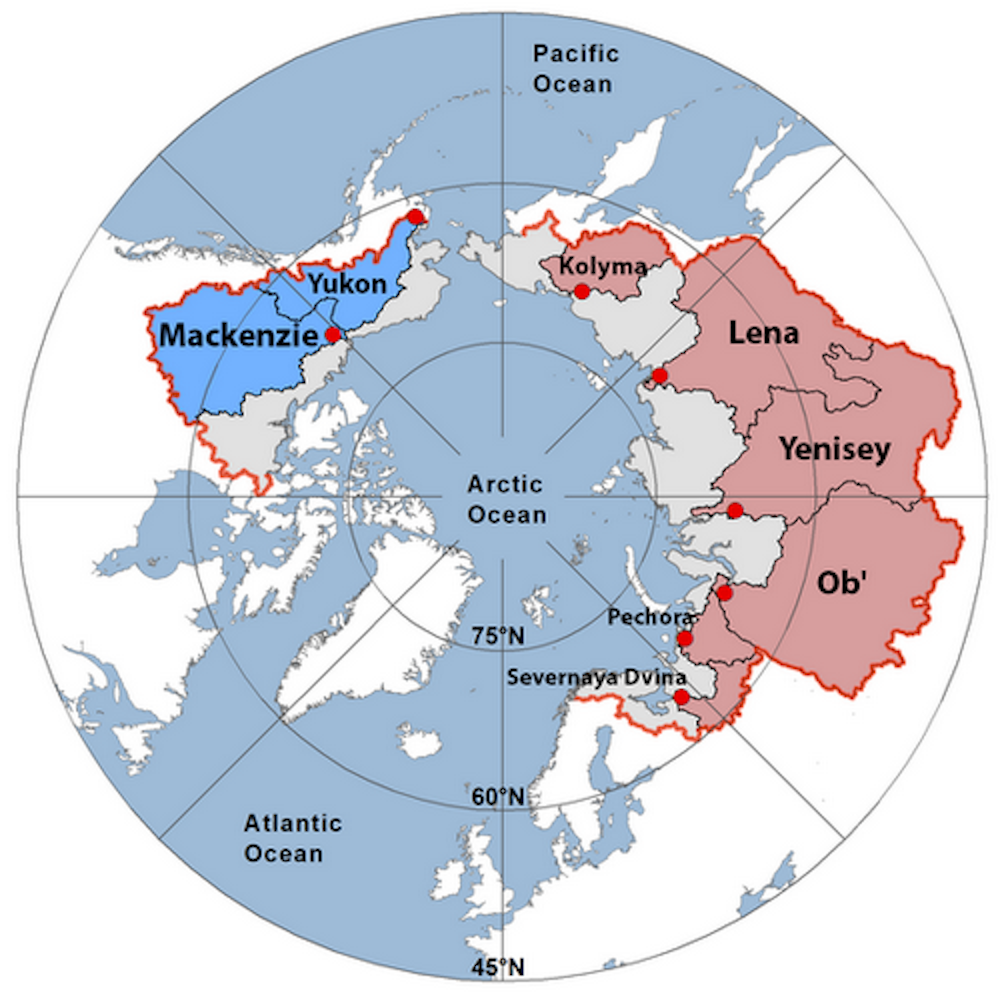
Major river basins of the Arctic region. NOAA Arctic Report Card
We’re climate scientists who study how warming is influencing the water cycle and ecosystems. In a new study using historical data and sophisticated computer models of Earth’s climate and hydrology, we explored how climate change is altering Arctic rivers.
We found that thawing permafrost and intensifying storms will change how water moves into and through Arctic rivers. These changes will affect coastal regions, the Arctic Ocean and, potentially, the North Atlantic, as well as the climate.
.
The rest of the article is full of “might bes” and “climate models”. Yet nowhere is there any mention or recognition of how all of this fits into the longer term cycles of Arctic climate. They whittle on about loss of permafrost, without any self awareness about their admission that permafrost can be soil that has only been frozen for as little as two years!

We get clear evidence that this is all about propaganda and not science, when they say “With the Arctic now warming nearly four times faster than the rest of the world”.
This claim comes from a previous crooked Conversation article, which stated:

The choice of 1980 as the starting point is very damning, given that this marked the end of four decades of cooling in the Arctic. Any honest scientist would have also mentioned the fact that temperatures now are barely higher than in the 1940s, before that drastic fall in temperatures.

Only at the very end do they write:

.
The AMOC scare has already been thoroughly debunked here.
But they show no awareness that their comment about freshening of the Arctic Ocean concerns a natural Arctic climate cycle.
When the Arctic warms, precipitation increases around the region, notably in Siberia and Northern Canada, as their own study observes. The consequence is the discharge into the Arctic Ocean of massive amounts of fresh water. And guess what? Fresh water freezes much more readily than salt water.
As this fresh water enters the polar gyres, it pushes back the warm salty Atlantic waters, which has previously led to the very Arctic warming we have been observing in recent years. Arctic sea ice expands, just as it did during the 1960s and 70s, bringing a much colder climate to the likes of Greenland, Iceland and Siberia.
Proper Arctic scientists have known about this cyclical nature of the climate for decades. For instance, Dickson & Osterhus wrote about it their study “One Hundred Years in the Norwegian Sea”. They described the interlinked cold and warm cycling phases in the Arctic, of which the latest one is just a part:

These climatic shifts are easily identifiable on the above chart of Arctic temperatures.
Nowadays, junk scientists such as Rawlins & Karmalkar, who wrote this Conversation article, simply only consider evidence from the last decade or so, and ignore everything which went before.
No doubt they are well rewarded for publishing this selective misinformation. But it is not science.
Maybe one day the Conversation will publish articles showing the full story, but I am not holding my breath!
via NOT A LOT OF PEOPLE KNOW THAT
March 9, 2024 at 01:36PM
 Iowa Climate Science Education