
The warming of the oceans since the turn of the century can easily be explained by the increasing trend in absorbed solar radiation.
Earth’s energy imbalance was determined to be +0.6 W/m² during the first decade of the 21st century (Stephens et al., 2012) using satellite observations. However, uncertainty in this positive imbalance value is large: ±17 W/m².
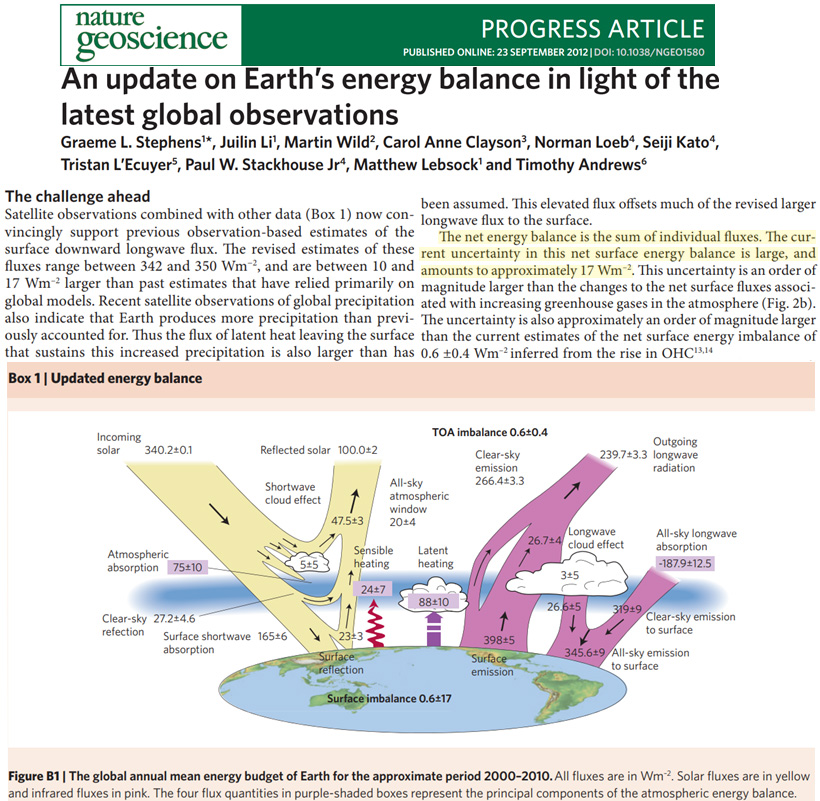
Image Source: Stephens et al., 2012
According to a new study (Kato and Rose, 2024), absorbed shortwave irradiance has been increasing since 2000 at a rate of +0.68 W/m² per decade. This can explain why the top of atmosphere (TOA) energy imbalance has been “increasing with time.”
This positive imbalance “leads mostly to heating ocean,” and it fully accounts for the surface imbalance estimate (0.68 W/m² versus 0.6 W/m²).
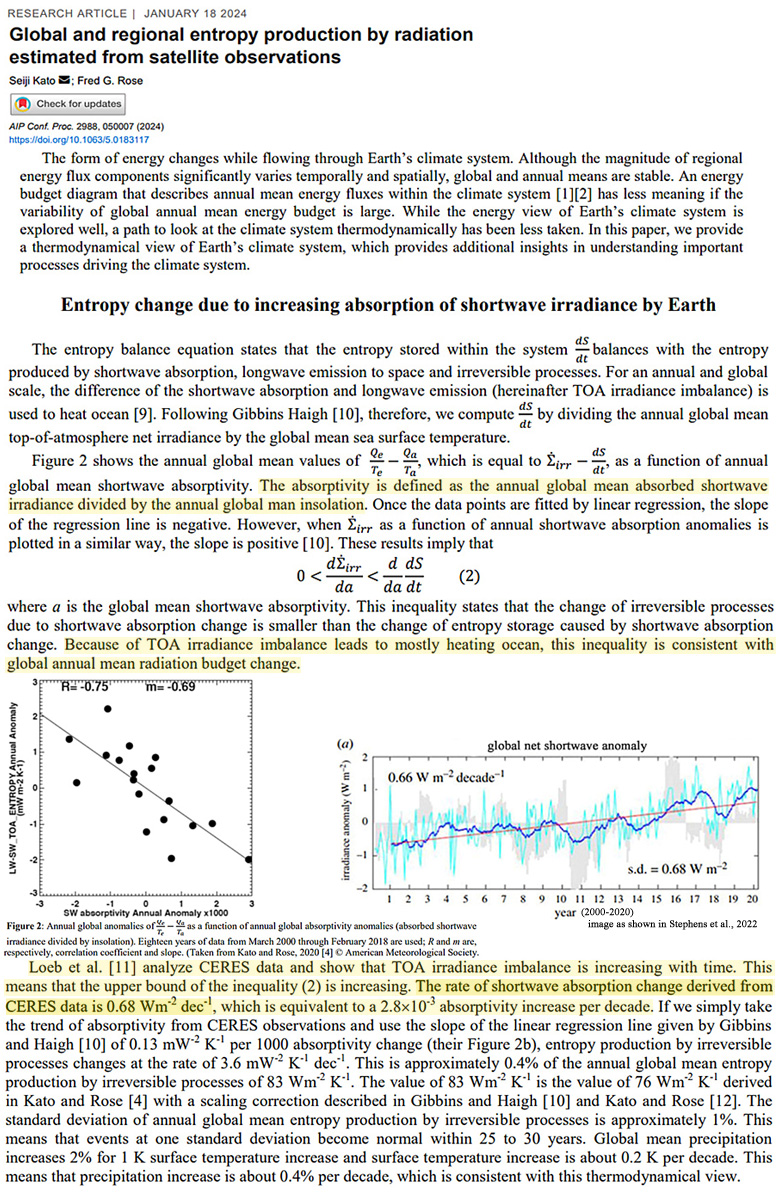
Image Source: Kato and Rose, 2024
CERES data indicated a +0.66 W/m² per decade−1 (+1.3 W/m²) increase in absorbed solar radiation during the 21st century (March 2000 to March 2020) per a 2022 study (Stephens et al.).
It was determined the net absorption of solar energy that has occurred due to the reduction of solar radiation reflected to space by clouds and aerosols is “by far the largest contribution to the increasing rate of change of EEI.”
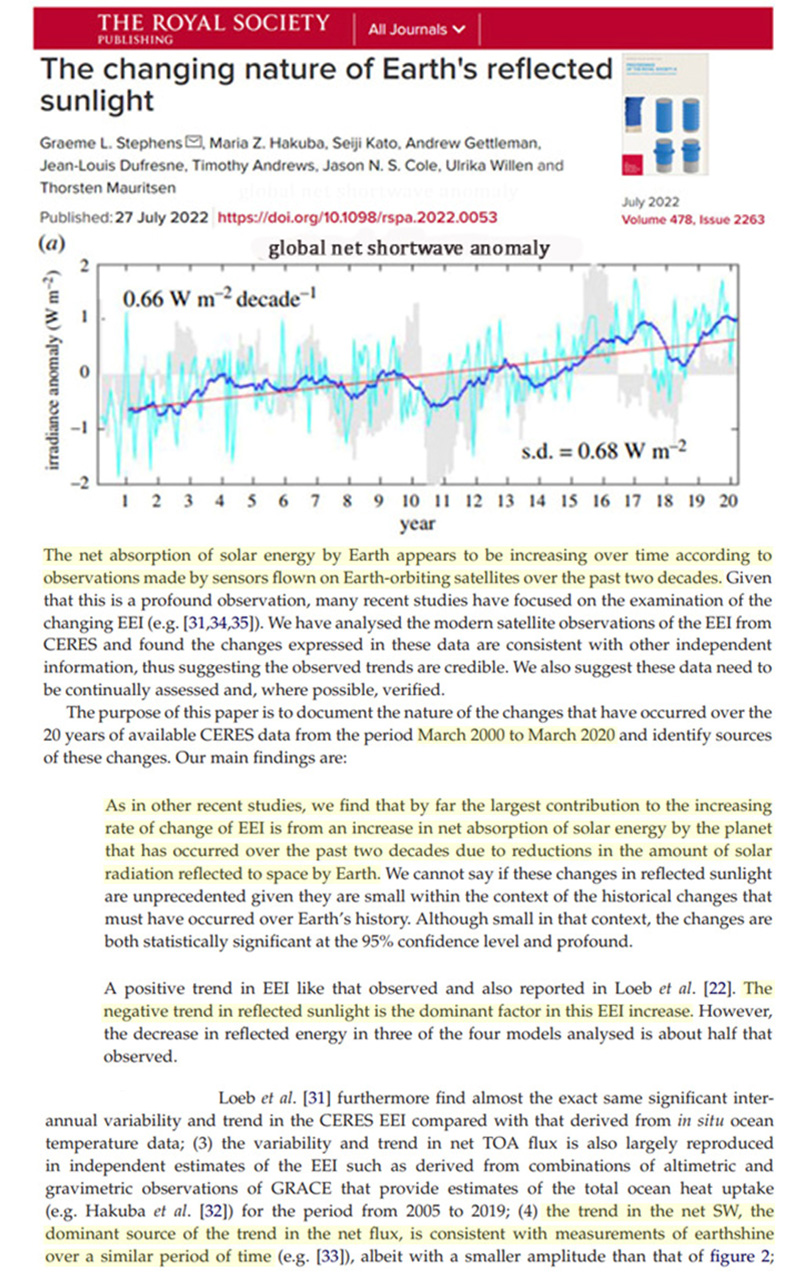
Image Source: Stephens et al., 2022
via NoTricksZone
March 14, 2024 at 07:33AM
 Iowa Climate Science Education