
“From modern instrumental carbon isotopic data of the last 40 years, no signs of human (fossil fuel) CO2 emissions can be discerned.” – Koutsoyiannis, 2024
It is routinely claimed that a telltale sign human emissions (fossil fuels) have irrevocably altered the atmospheric CO2 concentration is a declining trend in carbon isotope 13 (δ13C), considered an interruption of natural carbon cycle processes.
But new research examining isotopic data from four observation sites (South Pole, Mauna Loa, Barrow, La Jolla – regarded as “global” in their coverage) indicates there is no isotopic pattern consistent with a human fingerprint.
“The standard metric δ13C is consistent with an input isotopic signature that is stable over the entire period of observations (>40 years), i.e., not affected by increases in human CO2 emissions.”
In fact, not only has the input isotopic CO2 signature not been declining as proposed by those who believe humans are fully responsible for the increase in atmospheric CO2 concentration, but, according to multiple detection techniques using both modern data and data extending to the Little Ice Age (19th century), δ13C [input] has actually been increasing.
This directionality is the exact opposite of what is supposed to happen if fossil fuels were driving atmospheric CO2 increases.
“…for the longer subperiod lengths, 20 and 30 years, the tendencies are clearly increasing, opposite to the hypothesis that they are caused by fossil fuel emissions”
“…the trends are small and always positive, again contradicting the fossil fuel origin of the phenomenon”
“…from period B to C [1899-1976 to 1977-1997], we note an increase in δ13C [input, from -13.9‰ to -12.9‰], contradicting the fossil fuel origin of the phenomenon”
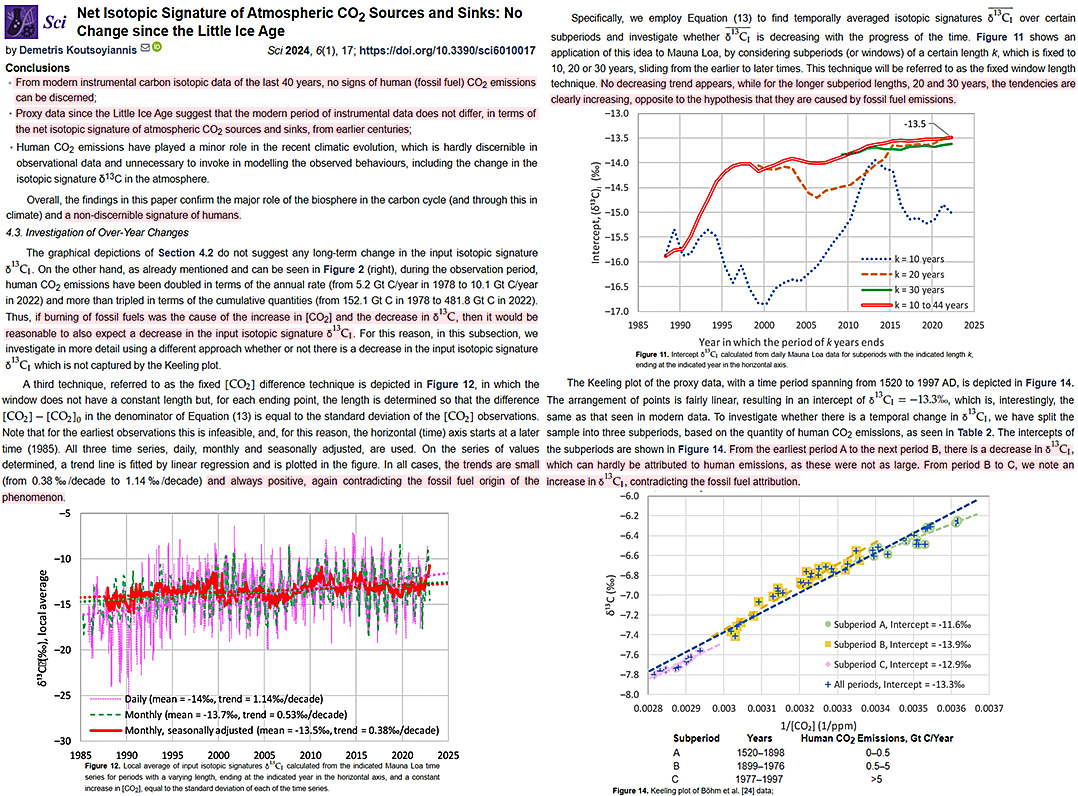
Image Source: Koutsoyiannis, 2024
via NoTricksZone
March 18, 2024 at 04:01PM
 Iowa Climate Science Education