
I like lithium batteries. My 2019 iPhone has a lithium battery, and it shows no signs of degrading just yet. But when it comes to grid-scale batteries, is it a case of horses for courses?
In response to a comment by Mark, where he quoted the Guardian as saying
The NatPower investment would lead to the construction of 60 gigawatt hours of battery storage
I visited the internet, wondering not so much at first how much said storage would cost… but how much mass it would be. The cost was there in the quote – £10 billion, ’twas said. Not that much. Hardly enough to buy a couple of aircraft carriers (with or without the appropriate launch facilities for the best version of the available planes).
So, what about the mass? I mean, 60 jiggawatt-hours of battery is probably heavy enough to cause Britain to capsize or something.
Naturally, the internet is reluctant to divulge its secrets. But according to Electrek, a Tesla Megapack of 3.9 MWh is 83,996 lbs “max,” or, if you prefer, 38,180 kg. (This is for an LFP battery, which in September 2022 Electrek seemed to think Tesla had begun to use.)
However, it is a little difficult to work out what that mass comprises. It’s about 1% lithium, according to somewhere else on the internet.
What about if you scale up to 60 jiggawatt hours? You get 587,384,615 kg, which I’m writing in full because it’s a nice number.
In searching for this number, I came across several pages referencing the Pillswood battery energy storage system, “the biggest in Europe.”
According to the BBC, this collection of sessile Teslas cost £75,000,000, and is
said to be able to store enough electricity to power 300,000 homes for two hours
(at about 300 watts).
Pillswood, at 196 MWh, is 1/306th of the 60 GWh promised by GnatPower. I mean NatPower. Helpfully, its creator, Harmony (sic) Energy, have a case study on their website where more details of the project can be gleaned.
For instance, because the site was in a flood-sacrifice zone, they had to raise the entire thing 1.8 m off the ground.
In January 2022, we began to prepare the battery site itself, which involved the installation of 478 individual piles, each to a depth of around 15m. These were installed to support the steel frame elevating all of the electrical equipment approximately 1.8m off the ground.
Harmony Energy
Gotta say, I think I would have looked for a place I could have put the batteries on the ground, but hey. Reading further down, this caught my eye:
The project will continue to be operated through Autobidder, Tesla’s algorithmic trading platform. Autobidder has demonstrated a strong track record over the past two years in managing both the Holes Bay and Contego BESS projects. These are two existing battery storage projects also developed by Harmony Energy Limited in conjunction with FRV.
Ibid.
Autobidder? Sounds to this cynic like a trading algorithm trying to maximise the value of sales of energy from the battery rather than optimise the grid. What is it? According to Electrek again,
It’s a real-time trading and control platform for energy assets, like Tesla’s Powerpacks, Powerwalls, and Megapacks, optimized through machine learning to better use and more directly monetize the assets.
The algorithm had apparently “made” $330,000,000 for the owners of its batteries (worldwide) by September 2023. (And by that time had grown to manage 7 GWh.)
Obviously, offering a service to stabilise the UK’s grid and running an algorithm to maximise profit while doing so are two different things. Are they compatible? The situation is complex, but I invite the reader to consider a situation where say 30 GW of battery power is controlled by a merciless algorithm whose sole criterion for success is profit. If some proportion of this power is vital, i.e., if without it, a power cut will occur, we end up where the offer price can rise to crippling levels, and our grid managers are forced to bid up to it, knowing that the cost of an outage is far more.
Now, I’m not saying this is going to happen, because there is no evidence that battery owners will collude – each agreeing not to trigger sales until a set price is reached. Nevertheless, it makes me a bit twitchy. [And if one company has a large proportion of the supply, collusion is unnecessary.]
ASTERISK: What if they all use the same algorithm, but independently?
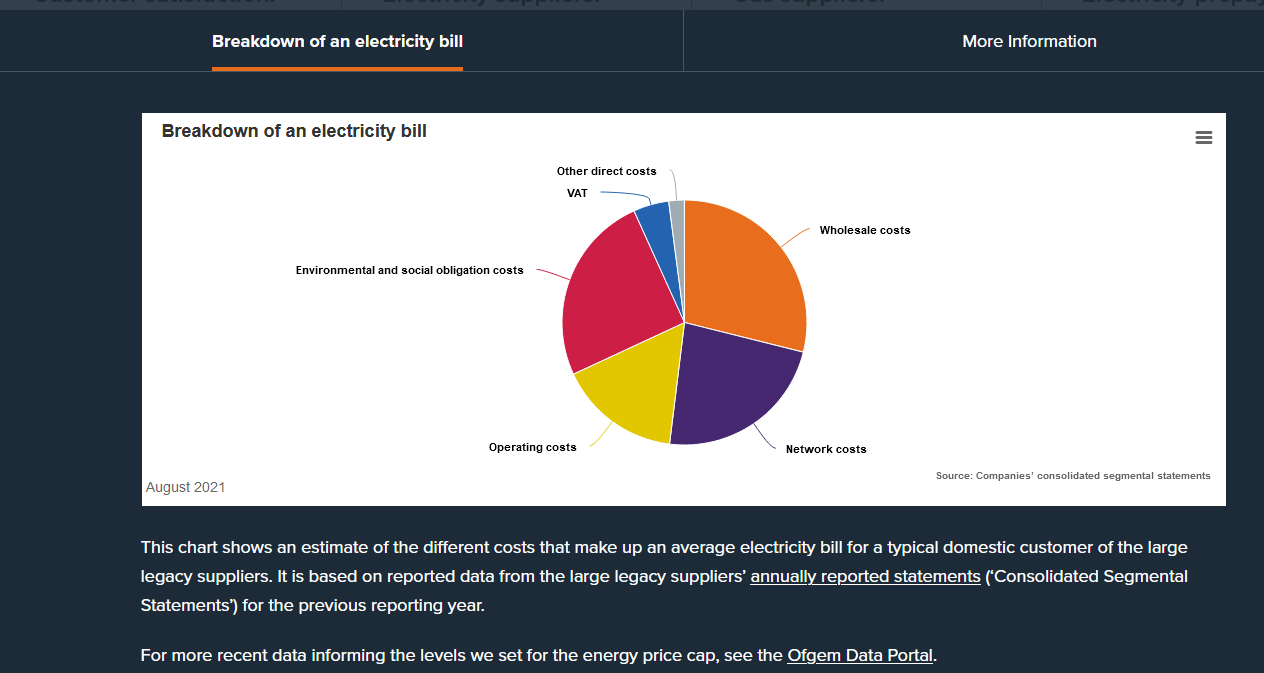
Generally, increased production causes a reduction in profit. Hopefully for the sake of household bills, this rule applies here. It is important to realise that the £10 billion for the Gnatpower batteries will have to be paid back within the ten-year lifespan of the batteries, with allowance made for interest and maintenance. (Assuming 4,000 discharges, I get a value of 10p/kWh to pay back the 75 mil for the Pillswood battery, without repaying interest, without operational costs, with free leccy to charge up with, and without profit.) (Context: the latest leccy price cap from Ofgem is 24.5p/kWh; there is a significant inflation between wholesale costs and the number on the bill. This figure from Ofgem is well out of date, but is the best I can find.)
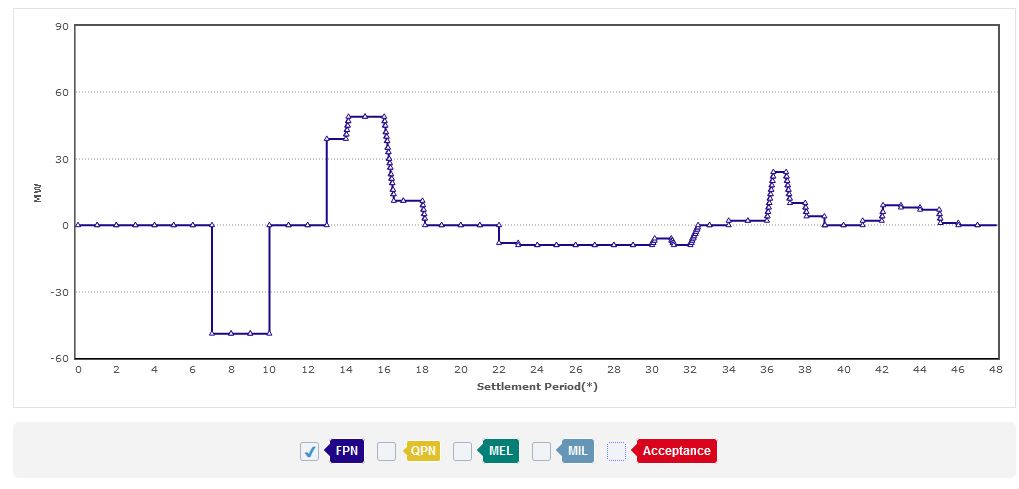
The figure below shows Pillswood’s battery 1 (of 2) charging and discharging on 8th March 2024. Note that the day is divided into 48 half-hour blocks. Positive numbers are when the battery is sending leccy to the grid (maximum 50 MW).
Here you can see a list of grid-connected batteries in the UK, with who their owners are. At the moment we are up to 4 GW for an hour and a bit flat out. “Optimiser” tells you whose mighty algorithm runs the show.
Megapacks seem to be springing up all over the place. My prediction is that adding them to grids will not save citizens any money (although adding a solar installation and a battery might save a household money eventually – it’s obvious that the more expensive electricity gets, the more attractive off-grid solutions become). Electrek, cited here several times, are fans of Megapacks. This headline of theirs made me chuckle:
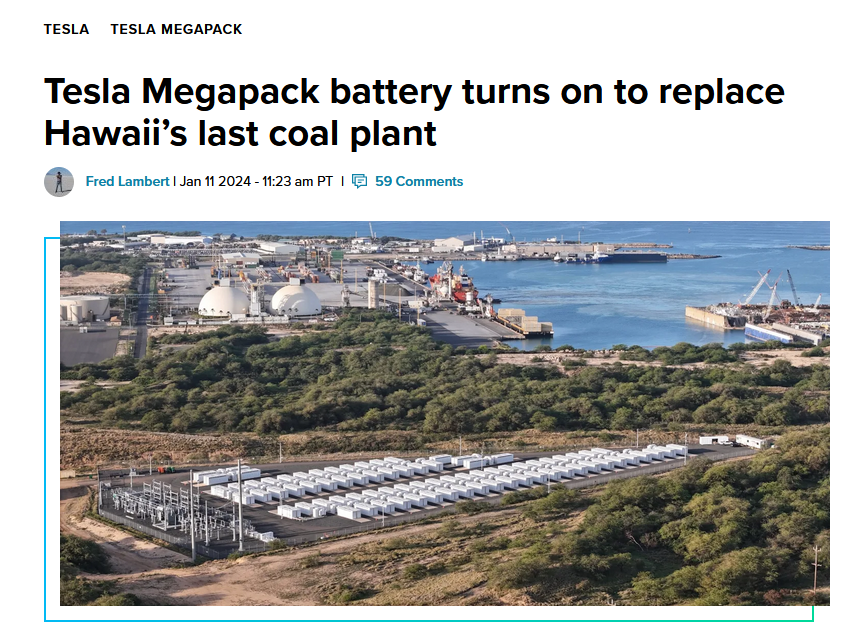
Because the battery is not replacing a coal plant: it’s replacing a heap of coal. Now, I know what you’re going to say: the battery extracts its own energy, so it’s better than a heap of coal. You still need a coal plant to convert the chemical energy in the coal into electricity. That is true. But the coal plant can produce electricity on its own, indefinitely, while the battery can only return what it borrowed, less a little lost in the conversion. The battery is not there to supply a baseload of power like a coal plant… it is there to contribute a little at peak times and to stabilise a grid that is made unstable by too much renewable electricity and not enough baseload.
What about the UK’s attached batteries?
These projects are not supported by taxpayer subsidy and will play a major role in contributing to the Net Zero transition, as well as ensuring the future security of the UK’s energy supply and reduced reliance on foreign gas imports.
I’m not really convinced by those claims.
See also friend of the channel Francis Menton’s pieces on battery storage, including this recent post where, among other points, he notes the unfortunate frequency of fires associated with grid storage batteries.
via Climate Scepticism
March 20, 2024 at 11:45AM
 Iowa Climate Science Education