Month: March 2024

Will Volcanic Dust Soak Up Carbon?

Guest Post by Ian Magness

As a somewhat lapsed geologist, this old chestnut – save the planet by spreading volcanic dust as fertiliser – interests me and I see that, like so many other discredited climate memes, it’s doing the rounds again:


 image

Sprinkling volcanic dust onto crops boosts yields by up to 20 per cent while pulling carbon dioxide from the atmosphere, scientists have shown.

https://www.telegraph.co.uk/news/2024/03/28/volcanic-dust-crops-soaks-up-carbon-emissions-yield/


There is, however, a little twist to this as number of business types have already jumped on the bandwagon to make a quick buck out of gullible, virtue-signalling punters. You only need to look on eBay or Amazon to see bags (all sizes to 25kg) of the stuff being sold. Larger bags seem to cost around 75p per kg – with 1kg apparently enough to treat 2 square metres, presumably for a year but that isn’t specified. So, that’s 37.5p per square meter, probably per year. At a wild guess, industrial quantities might cost a third of that – shall we say 12.5p per square meter but, of course, there would be highly significant costs on top of that, as I shall explain.

.

So, what’s not to like? Fertilise your ground and save the planet. Let’s roll this out across the UK to ensure we reach net zero a lot faster! Ignoring the obvious point that CO2 doesn’t actually drive the climate, so this is a fatuous pursuit anyway, let’s humour the project sponsors and analyse it. Points are as follows:

1) The existing dust itself appears to be taken, presumably cheaply, from the waste piles of existing mining and crushing of basalt in the UK.

2) It is claimed that crop yields are boosted by 10% to 20% by the dust.

3) The article states that "It is estimated that if rolled out widely, the process could remove up to 30 million tonnes of carbon dioxide by 2050, representing 45 per cent of the atmospheric carbon removal Britain requires to reach net-zero.

.

So far so good. But:

a) Is a yield enhancement of 10% to 20% that great compared to existing fertilisers? If the enhancement was below 20%, would farmers even bother with all of the extra cost? I doubt it. There is no doubt that crushed basalt contains many minerals useful to plants. Then again, chemically complex basalt averages around 50% silica alone, which is completely useless from a plant nutrition perspective. It’s a shame that the study doesn’t specify what % of volcanic dust is useful fertiliser (clearly, significantly less than 50%) and compares that to the % usefulness of present industrial fertilisers. I suspect that modern fertilisers are a lot more efficient by weight and volume – otherwise why waste all those extra costs for manufacture, packaging, transportation and distribution?

b) Government statistics indicate that “croppable” British land covered some 6 million hectares in 2023. 1 hectare is 10,000 square metres. So, the croppable area covers approximately 60 billion square metres. At 1kg per 2 square meters, this requires 30 billion kg of volcanic dust per annum. Yes, that’s 30,000,000,000kg per annum.

c) Under the fantasy scenario revealed in this article, approximately 1.2 million tonnes of CO2 will be removed by this process per annum. I assume they mean metric tonnes, so that’s 1.2 billion kg of CO2. So that’s 30 billion kg of ground spread volcanic dust to reduce “carbon emissions” by 1.2 billion kg a year, of course ignoring those pesky production and distribution “emissions”.

d) What is the estimated impact on global warming of removing this 1.2 million tonnes of CO2? Well, it is estimated that removing 7,800 million tonnes of CO2 would result in a drop in CO2 concentration of 1ppm. But, global mean surface temperature has only risen around 1.5C as a result of c220 more ppm of CO2. So, the temperature difference per 7,800 million tonnes is 1.5/220 = 0.0068C. We, however, are only talking about 1.2 million tonnes, so the annual difference in mean global temperature will be 0.0068 x 1.2/7,800 = 0.000001C. Hmmm, can we even measure that? Would it matter if 100 countries did the same? Maybe not. Oh, and that’s before related emissions from the processes.

e) Looking at the distribution costs in terms of CO2 emissions, let’s do a back-of-the envelope calculation. Let us assume that a large, multi-axle truck can carry 40 tonnes of rock dust. With 30 million tonnes to shift, that’s 750,000 return truck journeys. Let’s assume that the average return journey would be 200 miles. So, that equates to 150 million truck miles per annum. Now, estimates vary but a reasonable figure might be CO2 emissions of 5 metric tonnes per 1,000 miles of travel. The return journey would be a lot lighter, so let’s guestimate 3.5 metric tonnes per 1,000 miles. At 150 million miles, that equates to 525,000 metric tonnes of CO2 emissions. Remember, we are only avoiding 1.2 million tonnes of CO2 in the first place. Even if these heroic estimates are somewhat inaccurate, the truck distribution emissions alone take a sizeable chunk out of the savings. That, of course, ignores the emissions from the mining and crushing processes noted below.

f) It is not clear just how much spare dust our basalt processing industries create per annum but I would assess that the chances of it being 30 billion kg per annum to be approximately zero. In practice, this would mean that a whole new rock mining and processing industry would have to be created to create the dust and, gosh, just think of the carbon emissions that all those men, machines and consumables would generate in crushing all those tons of basalt. And that’s all before the billions of kg of dust is packaged up and transported on journeys across Britain.

g) Most mineable basalt in the UK is found in the so-called Tertiary volcanic district of western Scotland, the Hebrides and the tip of Northern Ireland. There are other possible areas with older basaltic rocks – the Campsie Fells and the Lake District spring to mind – but, again, the bulk are well north of where most "croppable" agricultural land is. There are significant transport and distribution costs in terms of cash and "carbon emissions" resulting from that fact.

To summarise, we are looking at the creation of a new multi-billion £ industry just to make an inefficient fertiliser compared to chemical fertilisers as available to farmers right now. Further, if you add up the "carbon" costs of the mining, processing and distribution resulting from this new heavy industry, and compare that to the "carbon" supposedly to be removed from the atmosphere (and that’s using pretty dubious assumptions), is this scheme even worth considering? It certainly won’t make any discernible difference to the climate that’s for sure.

I don’t doubt that there are good, viable localised scenarios where basaltic dust can be efficiently used by the farming or domestic communities, very especially if the dust is simply a waste product of other industrial processes. When you consider this – as the proponents do – on a national scale, however, the maths just don’t add up either for monetary or CO2 cost. This just seems yet another completely ridiculous scheme to me. The numbers are not hard to find or crunch so, yet again, why didn’t this journalist do the simple maths?


Paul’s Thoughts

I have one very basic question for those pushing this harebrained scheme:

If it is such a good and cost effective fertiliser, then surely farmers would be using it already?

As they are not, it appears just to be another waste of money, pursuing miniscule savings of carbon emissions, which as Ian Magness points out, probably won’t even exist once the supply chain is taken into account.

via NOT A LOT OF PEOPLE KNOW THAT

https://ift.tt/N7hwKW0

March 29, 2024 at 04:06PM

China Emissions Rose By 5.2% Last Year

By Paul Homewood

From Carbon Brief

image

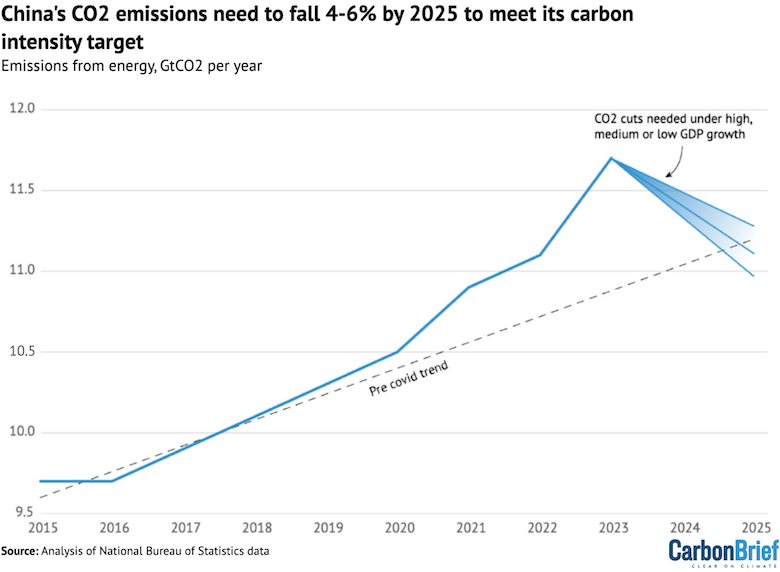
China’s energy sector carbon dioxide (CO2) emissions increased 5.2% in 2023, meaning a record fall of 4-6% is needed by 2025 to meet the government’s “carbon intensity” target.

The new analysis for Carbon Brief, based on official figures and commercial data, shows rapid electricity demand growth and weak rains boosted demand for coal power in 2023, while the rebound from zero-Covid boosted demand for oil.

Other key findings from the analysis include:

  • China’s CO2 emissions have now increased by 12% between 2020 and 2023, after a highly energy- and carbon-intensive response to the Covid-19 pandemic.
  • This means CO2 emissions would need to fall by 4-6% by 2025, in order to meet the target of cutting China’s carbon intensity – its CO2 emissions per unit of economic output – by 18% during the 14th five-year plan period.
  • China is also at risk of missing all of its other key climate targets for 2025, including pledges to “strictly limit” coal demand growth and “strictly control” new coal power capacity, as well as targets for energy intensity, the share of low-carbon energy in overall demand and the share of renewables in energy demand growth.
  • Government pressure to hit the targets, most of which are in China’s updated international climate pledge under the Paris Agreement, makes it more likely that China’s CO2 emissions will peak before 2025 – far earlier than its target of peaking “before 2030”.

According to preliminary official data, China’s total energy consumption increased by 5.7% in 2023, the first time since at least 2005 that energy demand has grown faster than GDP.

With coal consumption growing by 4.4%, our analysis shows CO2 emissions increasing by 5.2% – at the same rate as GDP – highlighting energy-intensive recent growth patterns.

China’s economic growth during and after the Covid-19 pandemic has been highly energy- and carbon-intensive. CO2 emissions grew at an average of 3.8% per year in 2021-23, up from 0.9% a year in 2016-20, while GDP growth slowed from an average of 5.7% to 5.4%.

Another year of rapidly rising emissions in 2023 leaves China way off track against its target of cutting carbon intensity by 18% during the 14th five-year plan (2021-25).

As a result, CO2 emissions would now need to fall by 4-6% by 2025 to hit the goal. This is illustrated in the figure below, showing historical emissions (blue line) and the reductions needed by 2025 to hit the carbon intensity target, depending on the rate of GDP growth.

Even if China’s GDP growth is high and averages 6% per year in 2024-25, the intensity target requires CO2 emissions to fall by 4%.

China's CO2 emissions need to fall 4-6% by 2025 to meet its carbon intensity target

https://www.carbonbrief.org/analysis-record-drop-in-chinas-co2-emissions-needed-to-meet-2025-target/

The idea that this is all some sort of bounce back from COVID is patently absurd, as there never really was a drop off in 2020. As the graph shows, the rate of increase has been steadily rising for years.

In simple numbers, CO2 emissions are now 11.7% higher than in 2019, pre pandemic.

None of this should surprise anybody, but apparently it still does.

via NOT A LOT OF PEOPLE KNOW THAT

https://ift.tt/wAOqpcB

March 29, 2024 at 04:06PM

Canadian Wildfires Due To Decades Of Fire Suppression, Not Climate Change

By Paul Homewood


Last year’s wildfires in Canada were inevitably blamed on climate change. But forestry experts have known for years that it was just the sort of conflagration that was waiting to happen , thanks to decades of fire suppression:


image

Alberta’s aging forest puts our communities at ever greater risk of wildfires, said the Alberta government’s expert committee on containing wildfires.

In 1971, more than half of Alberta’s boreal forest was deemed to be young, with about a third immature, five per cent mature and a small portion deemed “overmature”.

By 2011, that had changed to less than 10 per cent young, about a quarter immature, more than 40 per cent mature, and more than 20 per cent overmature.

“Before major wildfire suppression programs, boreal forests historically burned on an average cycle ranging from 50 to 200 years as a result of lightning and human-caused wildfires,” the panel found in a report released in 2012.

“Wildfire suppression has significantly reduced the area burned in Alberta’s boreal forest. However, due to reduced wildfire activity, forests of Alberta are aging, which ultimately changes ecosystems and is beginning to increase the risk of large and potentially costly catastrophic wildfires.”

The panel’s report came in response to Alberta’s unprecedented May 2011 fire season, which culminated in the deadly and costly Slave Lake fire that killed one helicopter pilot and took out 510 homes and buildings costing $700 million. The Alberta government’s Sustainable Resource Development department set up a panel to figure out how to deal with this kind of threat.

The panel reported that Alberta can expect more such dire situations due to humans living closer to the forest, and the aging of the Alberta forest.

“More Albertans are choosing to live, work, and play throughout the forested regions of the province, with investment and activity in Alberta’s wildlands accelerating.  As a result, the risk of wildfires, and the threat they pose to lives, homes, communities, and industry is increasing.”

In May 2011, the committee reported that “189 human-caused wildfires ignited across the province and threatened over 23 communities/locations (e.g., camps, worksites, parks, wildfire lookouts). Strong, sustained winds from the southeast created wildfire suppression challenges.”

The number of human-caused fires has been rising rapidly, from slightly more than 200 per year in 1993 to more than 1,100 a year by 2011. After human activity, lightning is the next biggest cause of wildfires, responsible for 40 per cent of them.

Before the Slave Lake fire, there had been few major wildfires in Alberta that took out homes.

“The last wildfire causing widespread damage to a community was in 1919 when the Town of Lac La Biche was destroyed, and 14 people lost their lives. Since 1919, and prior to the 2011 wildfires in the Slave Lake area, the most significant losses were experienced in 2001 when a wildfire destroyed 10 homes in the hamlet of Chisholm.”

But wildfires were to be expected.

“Wildfire is a natural part of the life cycle of the boreal forest; many of the vegetation species, including trees, are well adapted to large, intense wildfires. These boreal wildfires typically burn as ‘crown fires,’ and are responsible for most of the area burned in the boreal forests of North America, Europe and Asia. Intense wildfires consume forest canopy and can spread from treetop to treetop, releasing huge quantities of sparks, smoke and other gases.”

https://edmontonjournal.com/news/local-news/albertas-aging-forests-increase-risk-of-catastrophic-fires-2012-report


The Government of Canada’s environmental website explains how fires are an essential part of forest evolution:

image

image

image

image

image

image

https://natural-resources.canada.ca/our-natural-resources/forests/wildland-fires-insects-disturbances/forest-fires/fire-ecology/13149

Alberta’s population has increased fivefold since 1951.

The fact that so many people now live among these forests makes one wonder how this balance of human and ecological objectives can ever work.

via NOT A LOT OF PEOPLE KNOW THAT

https://ift.tt/Fd9Dwbq

March 29, 2024 at 04:06PM

The EU’s net zero retreat is gathering steam

By Paul Homewood


 image

Building new gas power plants will, of course, “only make the transition to renewables-based power unnecessarily costly”. How do I know?  Because I heard it from a bunch of climate activists calling themselves Beyond Fossil Fuels. What’s more, building new gas plants runs contrary to the “emerging consensus” that Europe must phase out all fossil fuel-generation of power by 2035.

I’m used to activists making sweeping assertions and talking in generalities rather than addressing the boring old details like how we keep the lights on when there is little in the way of wind and solar energy on offer, but this really does take the biscuit. Only a “consensus” of climate activists with their heads in the clouds – plus Ed Miliband – thinks we could save consumers money by closing down all our gas power plants in the near future. Judge European governments by their actions rather than their words and the clear consensus is that we are very much going to need gas power in the future. As Beyond Fossil Fuels itself reveals, Britain is not the only country that is building new gas plants. Across Europe, 72 gigawatts-worth of them are being planned. This may well be contrary to the targets governments have set themselves to decarbonise their power sectors, but when forced to make a choice between virtue-signalling and keeping the lights on they are invariably choosing the latter.   

It ought to be obvious that you cannot construct a national grid on solar and wind power alone. Renewables are great on a sunny, windy day like today when wind and solar farms between them are generating 21 gigawatts of power. It is rather less good on calm winter evenings when they can struggle to generate 1 gigawatt. What makes it possible to incorporate so much wind and solar power in our energy mix is gas power plants, which can be turned up or down at short notice to balance variable and unpredictable renewable power.


 Only a “consensus” of climate activists with their heads in the clouds – plus Ed Miliband – thinks we could save consumers money by closing down all our gas power plants in the near future


Take gas away and you have a serious problem. We could store energy in lithium batteries or pumped storage reservoirs – but at a very high cost. We could theoretically use surplus power to generate hydrogen via electrolysis of water, store the hydrogen in underground caverns and burn it to generate power on windless and sunless days – except that the technology doesn’t yet exist on a commercial scale and when it does it is likely to be as expensive, if not more so, than lithium batteries. It certainly won’t be saving consumers money.     

Rather than seeing gas a great evil, green lobbyists should see it for what it is: part of a system which has allowed us hugely to reduce carbon emissions from power generation over the past three decades. It has enabled us to all-but banish coal power plants – a form of energy which, gigawatt for gigawatt, produces around twice as many carbon emissions. And it has enabled the rollout of wind and solar by providing reliable back-up. Moreover, it may be possible in future to fit gas plants with carbon capture technology – although that won’t be cheap, either.

Green lobbyists are making themselves an irrelevance by turning against all fossil fuels in all circumstances. Governments may have nodded along with their demands up until now, by setting net zero targets. But clearly, when ideology collides with reality, governments are not going to sacrifice the well-being of their citizens. The move to build new gas plants is yet one more sign of Europe’s retreat from unrealistic net zero targets.      

https://www.telegraph.co.uk/news/2024/03/27/europes-net-zero-retreat-is-gathering-steam/

via NOT A LOT OF PEOPLE KNOW THAT

https://ift.tt/NCfDc3y

March 29, 2024 at 04:06PM