
By Paul Homewood
h/t Paul Kolk

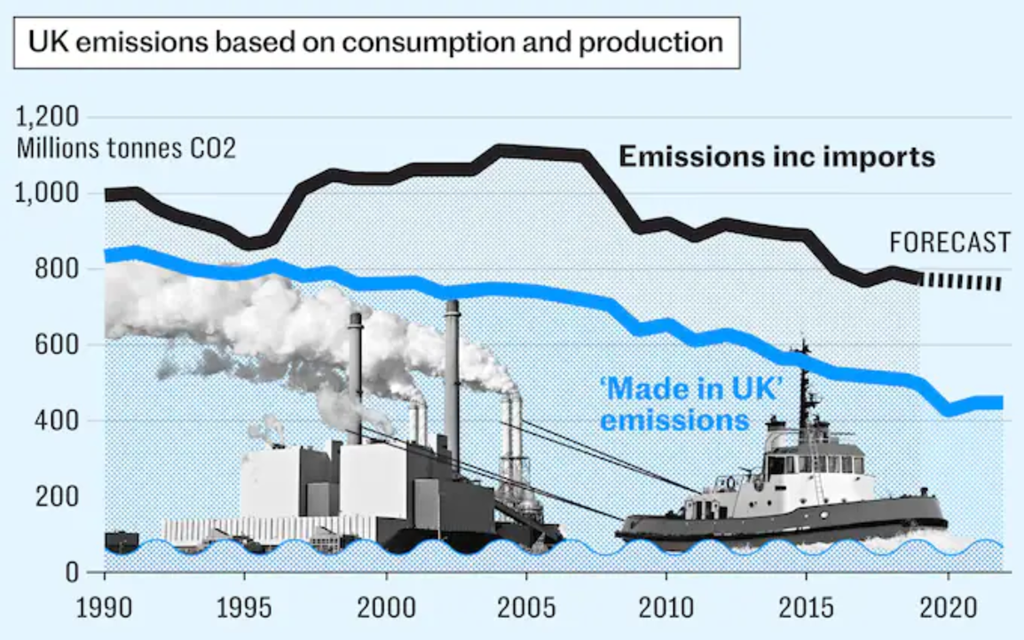
It’s one of the Government’s proudest boasts. Britain, it claims, has almost halved its greenhouse gas emissions from 800m tonnes in 1990 to just 417m tonnes in 2022.
It’s a staggering decrease – a faster decline than almost any other advanced nation. And it is a fact that is used regularly by politicians to trumpet the UK’s progress.
“We’re far ahead of every other country in the world,” Rishi Sunak said in September. “We’ve had the fastest reduction in greenhouse gas emissions in the G7. Down almost 50pc since 1990. France? 22pc. The US? No change at all. China? Up by over 300pc.”
But can a nation whose population has grown by several million in the past two decades, with each citizen consuming more than ever, really have cut emissions by such a massive amount?
Part of the answer to that question lies in the databases of Leeds University where the UK’s official “consumption emissions” figures – the statistical elephant in the room – are compiled by a team led by Professor John Barrett.
When politicians say that emissions have fallen to 400m tonnes, they are referring to the greenhouse gases emitted within Britain’s borders, from power stations, cars, homes, offices and what’s left of industry. These are known as territorial – or production – emissions.
What they exclude is everything else, meaning all foreign-produced cars, clothes, food and every other import as well as the shipping that imports those goods into the UK, and most of the aviation fuel burned for passenger flights.
These overseas emissions used to be relatively small, but as the UK’s own industries have shrunk, they have become an ever-increasing proportion of the overall carbon footprint.
In real terms it means that, in addition to the 400m or so tonnes of CO2 pouring from Britain’s homes, vehicles and remaining smokestacks, there are another 350m to 400m tonnes being produced on the UK’s behalf but in other countries. If you add those two figures together and make an adjustment for the UK’s exports, you get Britain’s overall carbon footprint – its consumption emissions – which now total around 750m to 800m tonnes.
It is a marked fall from 1990 when the UK’s consumption emissions totalled 1bn tonnes but nowhere near the 50pc cut claimed by Mr Sunak last year.
“We have provided the Government with the UK’s consumption-based emissions data for many years,” says Barrett. “However, it is rarely or never quoted when statements are made about emission reduction. I believe it should be. Both approaches are needed.”
Energy consumption figures give an answer as to why the UK’s own CO2 emissions have sunk so rapidly. In 2022, the country used less energy from all sources including coal, gas and renewables than in any year since 1970.
The Government’s energy statistics briefings link this to warm weather and improved efficiency.
For economists there has always been a direct link between economic growth and rising energy consumption; the more energy a country can consume, the richer its population becomes.
Jorge León, senior vice-president for oil and energy research at Rystad Energy, says: “I’ve heard loads of politicians saying, ‘look, this decline in energy consumption is great, we’ve become more efficient’. But I don’t think it is all due to greater efficiency.
“We have seen many energy intensive industries closing down in Europe because of the high energy costs. This is a broad macroeconomic environment where things are not looking great, where output is decreasing. Our declining emissions reflect that.”
The Government’s own statistics show that the sector experiencing the biggest decline in energy use is UK industry. In 1970 when the UK still had its own steel and other heavy industries, energy equivalent to 65m tonnes of oil was consumed. By 2022 that had plummeted by two-thirds to 22m tonnes.
However the Government’s own advisers, the Climate Change Committee, said in its latest progress report to ministers, that the UK “must also reduce its consumption emissions, those embedded in imported goods and services”.
It added: “The Committee will continue to scrutinise progress on consumption emissions alongside territorial emissions and advise on policies that reduce both. Reducing emissions in the UK must not be at the expense of exporting jobs and emissions overseas.”
Myles Allen, Oxford University’s professor of geosystem science, who served on the UN Intergovernmental Panel on Climate Change (IPCC), says the real discussions about emissions should be around ending them completely.
“Achieving net zero should mean, from 2050, no one can be allowed to sell stuff that causes global warming,” he says. “So anyone who sells a product that causes global warming would need to explain how they are going to stop it causing global warming – whether through its production, use or disposal – by 2050.
“If a single politician could spell it out in these not-very-complicated terms, it would have far more impact than claims about the UK’s carbon footprint.”
https://vnexplorer.net/the-big-net-zero-lie-britains-hidden-carbon-emissions-s1833292.html
The various suggestions from the CCC and others that the government should take account of consumption emissions are utterly absurd. How on earth can the UK influence what China, for instance, are doing with their emissions. Do they then propose some form of rationing of imports? As for Myles Allen, his plan would effectively end the importing of any products, raw materials or food. Does he have the slightest idea what that would entail for the UK’s population?
Far from “taking account” of consumption emissions, they expose the whole hypocrisy and futility of the UK’s Net Zero agenda. Until the rest of the world phases out fossil fuels, nothing we can do will make the blindest bit of difference.
via NOT A LOT OF PEOPLE KNOW THAT
March 11, 2024 at 11:42AM

 .
.


 Iowa Climate Science Education