Month: March 2024

Ode To Joy

This morning the postman delivered an envelope addressed anonymously to my house. It informed me that I “could be one of 30 people selected to take part in the Jury for Joy”. Lucky me. I could do with a bit of joy. So what’s it about?

Apparently I could help to decide how money is spent on culture and creativity where I live, by “exploring” the question “How can everyone enjoy creativity together in West Cumbria?”.

What relevance is this to Cliscep? Well, the paperwork assures me that:

This event will follow an established democratic process that is used all over the world called a citizen’s jury. It brings together a group of people selected by lottery, who broadly represent the entire community. The people who attend learn about issues, discuss them with one another, and then make decisions about what should happen and how things should change.

At first blush that sounds great, but a moment’s thought reveals that this process is the antithesis of democracy. Thirty people apparently selected at random cannot be assumed to “broadly represent the entire community.” Nor can the independent bona fides of those chosen to teach them what they will “ learn about issues” be taken as a given. Finally, why should thirty people who nobody voted for, having been hectored by people with an agenda and nudged into embracing the ideas expressed by those agenda-driven “experts” get to decide what the rest of us have to do and how our money is spent? Isn’t that the point of us all having the right to elect representatives to make those decisions for us?

OK, Mr Hodgson, so you’ve had your rant, but you still haven’t said what this has to do with Cliscep. Well, dear reader, I refer you to three articles at this website from four years ago. The first was written by Jaime Jessop (then of this parish, and still a welcome visitor and contributor). It was titled Climate Policy UK: Government Adopts Key Demand Of Group Officially Listed As Extremist By Anti-Terror Police. It was followed by two articles by Geoff Chambers, namely Climate Assembly and Climate Assembly: Weekend 2. I recommend the reading of all three, have you not previously seen them.

My point in talking about this subject again four years later is because it has never gone away, and some groups continue to rely on its supposedly democratic facade in order to manipulate a small group of people into agreeing with their views, then demanding that their views be implemented because a citizens’ assembly (or jury), after due indoctrination, has concluded that their views are correct and should be implemented.

Am I being a bit paranoid? Perhaps, but everything is connected, and a tangled web slowly reveals itself when you dig a little deeper. If I wanted to register for the chance to be one of thirty local residents who will be “well looked after throughout each session”; who “do not need to have any prior knowledge – all the information you need will be provided during the day”; who will be provided with lunch and transport expenses (if required); and who will receive £200 in shopping vouchers as a thank you – then I can do so by visiting this section of the website of the Sortition Foundation.

And this is where the web starts to get tangled. The paperwork that landed on my doormat this morning tells me that the Sortition Foundation is:

a not-for-profit organisation that specialises in recruiting and selecting people by lottery to take part in these kinds of events, in a way that is broadly representative of the wider population.

As I have already mentioned, selecting people by lottery (i.e. presumably at random) cannot be assumed to produce a group that “is broadly representative of the wider population.” More relevant for my purposes, however, is the fact that the Sortition Foundation is also a net zero-worshipping, climate alarmist organisation. For instance, later this year it will be helping to run a similar session on “Our Energy Futures: a Citizens’ Panel on Energy Demand Reduction” (here if you’re interested):

The panel will address the following question:

As a nation we need to use less energy, to meet our climate targets, increase energy security, and save households money. How can we do this in ways that work for everyone?

The first “proven solution” “from around the world” on its website is Climate Assembly UK:

Climate Assembly UK brought together people from all walks of life and of all shades of opinion to discuss how the UK should reach net zero greenhouse gas emissions by the year 2050.

The citizens’ assembly had over 100 members, who together were representative of the UK population, and they were due to meet over four weekends in Spring 2020 (the fourth weekend switched to an extended online event due to the coronavirus pandemic). They heard balanced evidence on the choices the UK faces, discussed them, and made recommendations about what the UK should do to become net zero by 2050.

Note that the discussion was about “how the UK should reach net zero greenhouse gas emissions by the year 2050”, not whether it should do so. So much for allowing “ all shades of opinion”.

Another organiser of the Jury For Joy to which I have been potentially invited is Action With Communities in Cumbria (ACT). This, I am told, is:

the rural and development charity for Cumbria. They are the lead organisation hosting this CPP [Creative People & Places] project.

Do they have any sort of agenda? Yes they do:

Reducing carbon and living sustainably is a 21st Century challenge.

Much of the work ACT assists communities with aims to help communities to be sustainable in the longer term.

Our Community Planning, Community Buildings, Community Led Housing, and Transport support are key tools in developing and maintaining community sustainability.

We work with Cumbria Action for Sustainability to promote projects for community sustainability.

We promote discussion and help facilitate solutions for zero carbon communities, while being alive to the challenges and opportunities for rural communities.

OK, so they in turn work with Cumbria Action for Sustainability:

We are Cumbria’s climate change and sustainability organisation.

Our vision is a zero carbon Cumbria which is socially, environmentally, and economically beneficial for all.

We aim to achieve this by promoting and facilitating low carbon living and its benefits – inspiring and supporting individuals, communities, and organisations across Cumbria and beyond to decarbonise lives and businesses by 2037 or sooner.

Who else is involved? Basically, the funding and main organisation seems to come from the Arts Council. Of course, the Arts Council is also fully signed up to climate alarmism and net zero. An example can be found here:

As COP26 takes place our CEO Darren Henley provides an update on what we’ve been doing to help the creative arts and cultural sector meet the climate challenge…

…At the Arts Council we know that creativity and culture has the power to make you stop and think, help improve lives and shape conversations. We believe that includes the vital issues of climate change and the environment. That’s why a decade ago we became the first cultural organisation in the world to make environmental action part of our funding conditions…

…This isn’t the only way we’re showing our commitment. We’re also investing £350,000 in Julie’s Bicycle’s Creative Green Tools. They’ll help cultural organisations better understand how their actions impact on climate change – what’s called carbon literacy. It’ll also help them better report and forecast their own environmental data. And give them support to look at how they can reduce the amount of carbon dioxide their activities release into the atmosphere, while balancing any remaining emissions – creating what are called Net Zero Carbon Pathways…

…Through our National Lottery Project Grants programme we’ve funded some amazing work that shows the growing appetite among artists and cultural organisations to use their work to respond to the climate crisis. [They don’t seem to have any choice if they want Arts Council funding]. Led by Arts Admin and our environmental partner, Season for Change saw 15 new cross-artform works and projects commissioned. It also invited all artists and cultural organisations to host events or create artworks. Roots and Branches led by Manchester Museum with Museum Development North West and the Carbon Literacy Trust brings together museum staff, educators, artists, and others to help build an environmentally active and aware museums sector. Meanwhile, Tongue Fu, the spoken word and music collective, created Hot Poets. It brought together artists, scientists, campaigners and charities to tell hopeful stories of what was being done in the fight against climate change.

In view of all of the above, I don’t think I’ll be registering my interest. Just call me a killjoy.

via Climate Scepticism

https://ift.tt/YeoIMk8

March 9, 2024 at 02:39PM

Arctic rivers face big changes with a warming climate, permafrost thaw and an accelerating water cycle– LATEST CONVERSATION JUNK SCIENCE

By Paul Homewood

.

The Conversation claims to be an independent source of news analysis and informed comment written by academic experts, working with professional journalists who help share their knowledge with the world.

Unfortunately as far as climate change is concerned, it is little more than a one-dimensional propaganda outlet, as this latest article reminds us:

 image

As the Arctic warms, its mighty rivers are changing in ways that could have vast consequences – not only for the Arctic region but for the world.

Rivers represent the land branch of the earth’s hydrological cycle. As rain and snow fall, rivers transport freshwater runoff along with dissolved organic and particulate materials, including carbon, to coastal areas. With the Arctic now warming nearly four times faster than the rest of the world, the region is seeing more precipitation and the permafrost is thawing, leading to stronger river flows.

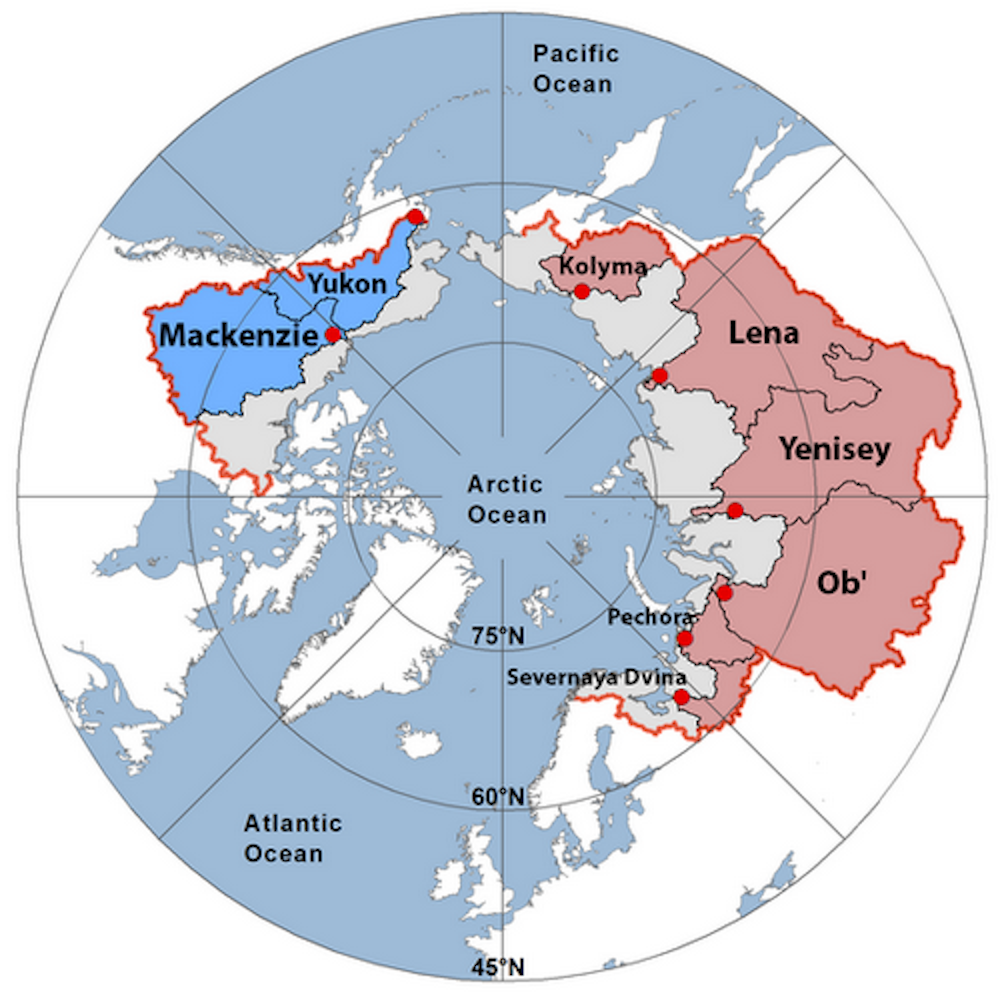
A map shows major rivers and their water sheds, primarily in Russia, Alaska and Canada.

Major river basins of the Arctic region. NOAA Arctic Report Card

We’re climate scientists who study how warming is influencing the water cycle and ecosystems. In a new study using historical data and sophisticated computer models of Earth’s climate and hydrology, we explored how climate change is altering Arctic rivers.

We found that thawing permafrost and intensifying storms will change how water moves into and through Arctic rivers. These changes will affect coastal regions, the Arctic Ocean and, potentially, the North Atlantic, as well as the climate.

https://theconversation.com/arctic-rivers-face-big-changes-with-a-warming-climate-permafrost-thaw-and-an-accelerating-water-cycle-the-effects-will-have-global-consequences-224869

.

The rest of the article is full of “might bes” and “climate models”. Yet nowhere is there any mention or recognition of how all of this fits into the longer term cycles of Arctic climate. They whittle on about loss of permafrost, without any self awareness about their admission that permafrost can be soil that has only been frozen for as little as two years!

image

We get clear evidence that this is all about propaganda and not science, when they say “With the Arctic now warming nearly four times faster than the rest of the world”.

This claim comes from a previous crooked Conversation article, which stated:

image

https://theconversation.com/arctic-is-warming-nearly-four-times-faster-than-the-rest-of-the-world-new-research-188474

The choice of 1980 as the starting point is very damning, given that this marked the end of four decades of cooling in the Arctic. Any honest scientist would have also mentioned the fact that temperatures now are barely higher than in the 1940s, before that drastic fall in temperatures.


image

https://climate4you.com/


Only at the very end do they write:

image

.

The AMOC scare has already been thoroughly debunked here.

But they show no awareness that their comment about freshening of the Arctic Ocean concerns a natural Arctic climate cycle.

When the Arctic warms, precipitation increases around the region, notably in Siberia and Northern Canada, as their own study observes. The consequence is the discharge into the Arctic Ocean of massive amounts of fresh water. And guess what? Fresh water freezes much more readily than salt water.

As this fresh water enters the polar gyres, it pushes back the warm salty Atlantic waters, which has previously led to the very Arctic warming we have been observing in recent years. Arctic sea ice expands, just as it did during the 1960s and 70s, bringing a much colder climate to the likes of Greenland, Iceland and Siberia.

Proper Arctic scientists have known about this cyclical nature of the climate for decades. For instance, Dickson & Osterhus wrote about it their study “One Hundred Years in the Norwegian Sea”. They described the interlinked cold and warm cycling phases in the Arctic, of which the latest one is just a part:

https://notalotofpeopleknowthat.files.wordpress.com/2024/02/image-76.png

These climatic shifts are easily identifiable on the above chart of Arctic temperatures.

Nowadays, junk scientists such as Rawlins & Karmalkar, who wrote this Conversation article, simply only consider evidence from the last decade or so, and ignore everything which went before.

No doubt they are well rewarded for publishing this selective misinformation. But it is not science.

Maybe one day the Conversation will publish articles showing the full story, but I am not holding my breath!

via NOT A LOT OF PEOPLE KNOW THAT

https://ift.tt/Tt4dE7F

March 9, 2024 at 01:36PM

CO2 Coalition Does Climate Reveal in Wyoming

The CO2 Coalition article is CO2 Coalition Takes the Science to Wyoming.  Excerpts in italics with my bolds and added images.

Wyoming has vast resources of coal, oil and natural gas. With 40% of the nation’s coal resources, the state has been the United States’ top producer since 1986, primarily from the Powder River Basin located in the northeastern part of the state. It is also a national leader in the production of oil and natural gas, ranking in the top 10 in production of both products. 

Yet, even though the Wyoming economy is heavily dependent on the mining and extraction of fossil fuels, its governor, Mark Gordon, has adopted a strong “decarbonization” policy. The science tells us that this is not a winning strategy for the people of Wyoming. 

The CO2 Coalition believes that public policy on such matters should be driven by scientific review and analysis, not political agendas. To provide such an analysis, we have produced this report, Wyoming and Climate Change: CO2 Should Be Celebrated, Not Captured

We also sent a team of climate experts from the CO2 Coalition,  including Dr. William Happer, Dr. Byron Soepyan and Gregory Wrightstone to Wyoming to provide the facts concerning the huge benefits of carbon dioxide. This team presented the science at a hearing of the Wyoming Senate Agriculture Committee (pictured above.)

The team also presented accurate science regarding Wyoming’s climate to students at Gillette College, Laramie County Community College, and at the University of Wyoming.

Temperature Data Shows Good News for Wyoming

Data for Wyoming contradict the 4th National Climate Assessment (NCA4) assertion that “the frequency and intensity of extreme high temperature events are virtually certain to increase.”

Our data analysis shows that high daily temperatures peaked during the Dust Bowl years of the 1930s and have been in a 90-year decline. This is confirmed by reviewing the percentage of days that were reported to be hotter than 100°F (37.8°C) by Wyoming temperature stations. There is no discernible increase, and the largest numbers occurred in the first half of the 20th century when CO2 levels were 70% of recent measurements.

There has been, however, a beneficial increase in the minimum nighttime temperatures, which has led to a lengthening of the Wyoming growing season. Since the late 1800s, these nighttime temperatures have increased about 2°F (1.1°C).

The slight increase of about 1.2°F (0.7°C) in the average temperature
in the last 120 years is being driven by reductions in extreme cold
rather than increases in extreme heat.

Full Report:  Wyoming and Climate Change

Conclusion From Full Report 

The recent proposal by Wyoming Governor Mark Gordon to use “carbon capture” to achieve what he
terms “negative net zero” (Gordon 2021) is based on a flawed theory that increasing CO2 in the
atmosphere is leading to harmful effects on Wyoming’s environment and its people. Within this report,
we have documented that modest warming and increasing carbon dioxide are clearly beneficial for the
Cowboy State’s ecosystems and citizenry.

The data tell us the following:

• Current levels of carbon dioxide are at near historically low concentrations.
• Adjustments to historic temperature records have artificially amplified modern warming.
• Wyoming temperatures have increased a modest 1.2°F (0.7°C) since 1895.
• Heat waves peaked in the 1930s and have been in slight decline since that period.
• Nightime low temperatures have increased, lengthening growing seasons.
• Precipitation data, while varying greatly from year-to-year, show no increasing or decreasing
trend.
• Droughts are not increasing in Wyoming.
• Severe weather and natural disasters are declining.
• Agricultural production, globally and in Wyoming, is thriving due to modest warming and more
CO2.
• Vegetation in Wyoming and around the world is increasing.
• Greenhouse-induced warming that would be averted (< 0.003°F) by eliminating Wyoming’s CO2
emissions would be too small to measure and achieved, if at all, at enormous cost.
• Models used to project future temperatures significantly overpredict the amount of warming in
coming decades.

CO Should Be Celebrated, Not Captured

via Science Matters

https://ift.tt/5sG9l64

March 9, 2024 at 12:32PM

Curtin University: Climate Activism can Help Mitigate Anxiety

Essay by Eric Worrall

According to Curtin University academic Dr Diana Bogueva, “it is not too late for Gen Z to make a difference fighting for a sustainable future.” – but they mostly aren’t engaging.

Gen Z’s climate anxiety is real and needs action — for everyone’s wellbeing

05 MAR 2024 | Samuel Jeremic

Published in Sustainable Earth Reviews, the study surveyed Australian university students belonging to Generation Z (people born between 1995 and 2010) and found climate change was their number one environmental concern.

More than 80 per cent reported being ‘concerned’ or ‘very concerned’ about climate change, with many revealing they felt anxious over the issue.

Dr Bogueva stressed it wasn’t solely Gen Z’s responsibility to solve climate change — a problem they didn’t create — but taking meaningful action can help alleviate an individual’s feelings of anxiety and powerlessness.

“This can include finding out how they can be part of the solution in their personal lives, whether it’s choosing a career which has an impact or adjusting the products or food they consume,” she said.

While the challenges of climate change can be scary it is not too late for Gen Z to make a difference fighting for a sustainable future.

Australia’s university Generation Z and its concerns about climate change’ was published in Sustainable Earth Reviews.

Read more: https://www.curtin.edu.au/news/media-release/gen-zs-climate-anxiety-is-real-and-needs-action-for-everyones-wellbeing/

The abstract of the survey;

Australia’s university Generation Z and its concerns about climate change

Rodrigo Bardales SalgueroDiana Bogueva & Dora Marinova 

Sustainable Earth Reviews volume 7, Article number: 8 (2024) Cite this article

Abstract

Despite scientific evidence about the imminent threat of climate change, people and governments around the world are slow in taking sufficient action. Against these bleak outlooks, Generation Z (Gen Z) born 1995–2010 will inherit the consequences of prolonged inaction. This research delves into the climate change concerns of Australia’s university Gen Z. A representative survey of 446 Australian university students conducted between September 2021 and April 2022 revealed that climate change is the top environmental concern for Gen Z with 81% of these young people being significantly concerned and many experiencing serious climate anxiety. Despite this pervasive concern, 65% of Australia’s university Gen Z is not engaged in traditional climate activism; however, these young people are using technology to voice their concerns. As the future decision-makers of the world, it is crucial for Gen Z to accelerate climate action in all of its forms, including engaging with scientific knowledge and other generations to shape policies and safeguard a liveable planet for all.

Read more: https://sustainableearthreviews.biomedcentral.com/articles/10.1186/s42055-024-00075-w

The survey authors explain respondents are self selecting, and may not be a representative sample.

Even so, my first impression was “that climate indoctrination has clearly malfunctioned”.

For decades far too many schools have pumped kids full of climate propaganda and end of world messages, only to see their army of climate activists melt away like ice cubes in a glass of Tequila on a hot summer day.

The study authors seem concerned about the lack of engagement, though their focus appears to be the mental health of the climate worriers – “… Moreover, there is a pressing need to develop effective strategies aimed at assisting individuals, especially the youth, in channelling their climate-related fears in a positive direction, including through their employment and career choices. …” 

Are GenZ climate worriers just expressing climate concern to fit in, but don’t actually care? Has despair overwhelmed their will to act?

Does sharing tweets or snap chatting their climate concern, and “lifestyle changes” like using the recycling bin count as climate action in their minds?

Are all but the most committed GenZ climate worriers just lazy?

Future generations will wonder at the failure of education which led to this mass hysteria, yet rendered hysterics mostly unable or unwilling to actually do anything to address their fear.

via Watts Up With That?

https://ift.tt/GpMEUj0

March 9, 2024 at 12:01PM