It seems so obvious that I cannot believe our political leadership has not realised the threat to our national security. Either that, or they have realised and are prepared to take the risk.
The Port Talbot closure harshly exposes the costs of luxury ‘green’ beliefs. We cannot be dependent on imports for the full range of necessary steels to rebuild our arsenals – the Navy first and foremost – and, most ridiculously, we cannot depend for them on our global antagonists.
Furthe
rmore, our armed forces are wholly dependent on oil to keep them in the field, and our electricity grid will collapse without gas. Any attempt to abandon them will leave us entirely at the mercy of hostile powers.
“The prospect of Alaska becoming Germany energy-wise is a troubling concept to imagine. At least Germany had industry and an economy to destroy…. It’s up to us to elect common-sense realists instead of ideologues.”
Alaska Governor Mike Dunleavy’s plan for a Renewable Portfolio Standard (RPS) to mandate unreliable and costly sources of energy has stalled out, thanks to Jesse Bjorkman, Chair of the Senate Labor and Commerce Committee. But sinister private interests and ethically corrupt bureaucrats are out to force a Green New Deal on taxpayers and ratepayers under a new guise.
Governor Dunleavy has now teamed with the Alaskan House Energy Committee to push for an equally bad Clean Energy Standard (CES). Introduced February 20, House Bill 368 is titled “An Act relating to clean energy standards and a clean energy transferable tax credit; and providing an effective date.”
Putting the Fix In
A year ago, Governor Dunleavy tasked the Alaska Energy Security Task Force to create an energy plan (government plan) to lower Alaskan electricity rates to 10¢/kWh (his “moonshot”). Currently, Alaskans pay about 24¢/kWh, the second highest rate in the country next to Hawaii. RPS was a key component of the original draft plan, but at the 11th hour, CES became the new Trojan Horse.
The fix was in. No stakeholders relevant to the development of our reliable sources of energy were on the task force assigned to create a comprehensive statewide energy plan. “Stakeholders” who actually have invested in, know well, and are ready to extract and utilize readily available local coal and gas were excluded from planning and considerations. The result? An energy plan to “Adopt a Clean Energy Standard with incentives to diversify generation.”
Dueling Plans
The Regulatory Commission of Alaska (RCA) unanimously opposed the RPS legislation in December 2023. House Bill 368, a Clean Energy “Standard,” appears to be the first of many standards tied to what is to come from the Electric Reliability Organization (ERO).
Although this legislation comes ahead of the ERO Integrated Resource Plan (IRP), new standards and modifications are subject to the review by the RCA. The ERO concept was signed into law in 2020 and was heavily supported by our friends at the Renewable Energy Alaska Project (REAP). The duties of the ERO include developing reliability standards that provide for an adequate level of reliability of an interconnected electric energy transmission network and the development of integrated resource plans. In part, the ERO legislation states:
An electric utility must participate in an electric reliability organization if the utility operates in an interconnected electric energy transmission network served by an electric reliability organization certificated by the commission.
remove barriers to renewable energy development in a number of ways. It will mandate non-discriminatory access by independent companies that wish to sell renewables into the grid, take a first step toward eliminating redundant fees to transmit power along the grid and establish a transparent, public “integrated resource planning” process to determine what new generation projects the region will build in the future.”
The science is clear: the world, including Alaska, must reduce Greenhouse Gas (GhG) emissions from burning fossil fuels to net zero by 2050 to keep our planet below 1.5-degree Celsius warming and avert dangerous run-away climate change.
And
The interest of consumers are not best served by relying on private companies with a profit motive as the only potential actors. IPPs, member-owned utilities, and the state should all be able to pursue beneficial renewable energy, storage, and transmission projects
Moving the Railbelt utility system off fossil fuels (currently 85% of our generation) to a fully integrated and resilient wind-solar-storage powered system serves the highest public interest as we face the existential threat of climate change. We urge the RCA to do everything in its power to facilitate that immediate and rapid transition on the Railbelt and throughout Alaska.
More central planning where we can least afford it. Witness the devastation that occurred in 2021 with Winter Storm Uri in Texas under the Electric Reliability Council of Texas (ERCOT) ‘scentral planning of electric utilties.
Alaska’s Electric Reliability Organization is Railbelt Reliability Council, RRC, whose mission is
Serve the public interest and provide the greatest long-term value to the Railbelt by working collaboratively and transparently to establish and uphold protocols that sustainably balance safety, reliability, cost, and environmental responsibility.
The RRC will insert themselves into the process and centrally plan for the utilities on the railbelt that provide power to 75% of Alaska’s population. The utilities under their planning purview include Homer Electric Association (HEA), Chugach Electric Association (CEA), Matanuska Electric Association (MEA), and Golden Valley Electric Association (GVEA) which currently have boards that represent the needs of the rate payers.
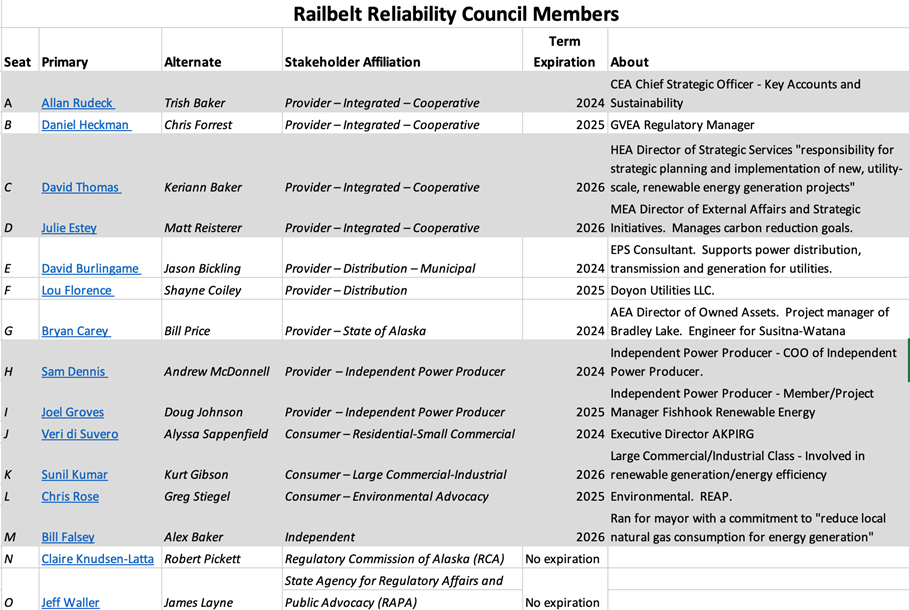
The council is made up of a 15-member board, many with questionable proclivities as it relates to the future reliability and affordability of our power given their background and roles they are currently in at their day jobs.
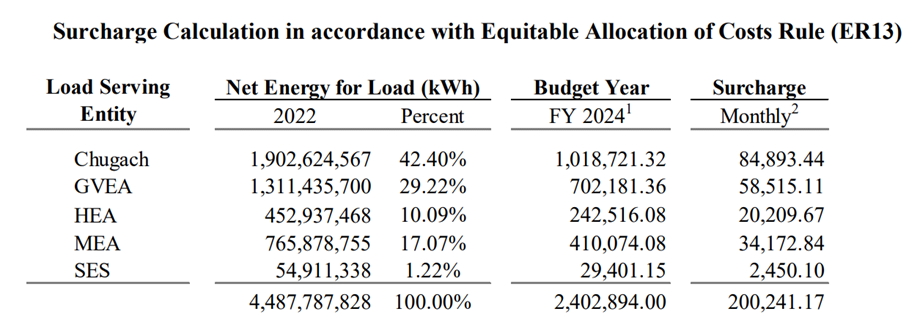
This central planning “service” comes to us with a surcharge. Although the surcharge has already made it onto the bills of rate payers – (see ERO Surcharge on your electric utility bill) the RCA has suspended the tariff and has approved the surcharge on an interim basis. The current interim surcharge for Chugach Electric ratepayers is $0.00054 per kilowatt hour (kWh).
With reliability being the key word to the Railbelt Reliability Council, what does allowing renewables onto the grid have to do with reliability? Nothing. All the central planning processes that are being rapidly established, along with the allowance by the RCA for independent power producers to enter onto the grid will come at great costs with no clarity or accountability to who represents the rate payer. This is done on purpose to avoid liability.
The development of the Integrated Resource Plan (IRP) will be key to the transformation to our grid. The ERO must consider reliability and cost factors however they will be able to weigh in on other interests that will have a negative impact on rate payers such as the narrative that the earth has reached global boiling and installation of windmills and solar will have an effect on the sun.
In a white paper by REAP on the need for an Independent System Operator, the word affordability appears zero times; reliability appears two times (and not in reference to reliability as an priority); renewable appears at least twenty times. and climate appears five times. It is abundantly clear how these competing priorities will be weighed when you have the likes of Chris Rose with REAP and IPPs with self-serving interests to sell their renewable energy representing this “reliability council.”
Independent Power Producers
The ability for Independent Power Producers (IPPs) to enter onto the grid and amendments to regulations to facilitate integration were adopted and approved by the RCA in late 2015. Utilities are rapidly being compelled to sell off their generating capacity to independent power producers.
Much of this due to unrealistic decarbonization goals that are being adopted by utilities. IPPs are allowed to steal money from ratepayers by supplying unreliable energy paid for with special funding and subsidies, while the host utilities bear the costs to make them reliable. In other words, IPPs are opportunistic ticks on the backsides of humanity only allowable by coopted, feckless corrupted politicians and bureaucrats.
Present an IPP whose intent is to serve the interests of the country and state, provide reliable and affordable energy that stands on its own without reliance on the utility and I will stop complaining.
“Clean Energy” Standards
In a conversation with a member of the House Energy committee, it was stated that Governor Dunleavy wants an RPS because he needs assurances for investors from the lower 48. The narrative? This CES bill is a compromise from the mandates within the RPS bill. As RPS appears to have died in the Senate Labor and Commerce Committee, the governor is taking another run at compliance and preparation for his investors. But Governor Dunleavy trumped letter to Warren Buffet (please read it) is a subterfuge for the politically correct in place of the economically correct.
Clean Energy Standards require a minimum share of a utilities electricity to be generated from “clean” sources. They require utilities to buy wind and solar power regardless of their cost. The idea has been sold by using half-truths that these clean sources are cheaper. They are “cheaper” on the backs of our children and grandchildren through taxpayer subsidies, only to later compromise the reliability of the grid eventually resulting in costly increases to the ratepayer. Think of a “cheaper” car with a trick motor having a lot of problems down the line.)
Similar to how electric vehicles are sold as being cheaper, the costs are hidden with everyone else paying for the infrastructure, the same concept applies here where our utilities foot the bill for making the grid 100% reliable. Wind and solar cannot compete with conventional energy such as natural gas and coal, so the greens need a law to force utilities to adopt use of their whirligigs and whatnots. Clean Energy Standards are hidden energy taxes.
CES is being sold as an acceptable stand in for RPS because there are no mandates to reach a certain percentage of renewables as of a certain date. This too is a half-truth.
The legislation states the load-serving entity’s portfolio shall include clean energy in the following percentages: 35 percent by December 31, 2036, and 60 percent by December 31, 2051.
Clean energy is defined as follows:
When generated by a load-serving entity, does not release carbon dioxide or releases carbon dioxide in an amount that is offset by the amount of carbon dioxide the load-serving entity absorbs or removes from the atmosphere;
Is generated from coal with a sulfur content of one percent or less by weight;
Is generated from renewable energy resources; or
Is generated from nuclear energy;
The bill states that new construction of a large power facility cannot be detrimental to meeting the clean energy standard. This means that we cannot bring new sources of energy found in abundance in our own state unless we play the unproven and wildly expensive game of carbon offsets or carbon capture. One of the main priorities laid out by the Alaska Energy Security Task Force is to “significantly increase load to drive down energy rates” couple that with this CES mandate that new sources must fall into the clean energy category, I see this hardly different than the RPS mandated percentages.
While we have more time allowed to meet the percentages and the utilities have no fee per se, but when you combine the Railbelt Reliability Council and their interests, the Independent Power Producers and their interests, the result isn’t necessarily a mandate but our co-ops being under the gun to adapt to the whims of investors and environmental special interests to integrate their toy things onto our grid. Our co-ops have boards that represent the rate payers and our needs. This process and legislation usurps that completely.
Intermittency Risks
Weather happens in Alaska regularly. And when it does, wind and solar are absolutely useless. An example of this is the CIRI wind farm. When we were most desperate for the power in late-January, its fairytale 17MW nameplate was nowhere to be seen. At the most critical time, in a 24-hour period, 2% of name plate was achieved. It was nothing but a big hunk of ugly yard art.
Imagine any other endeavor where an 2% success rate is acceptable. The gas plants held up their end of the bargain that day. Eklutna hydro was spooled up to 100% capacity and generated 100% of nameplate capacity. As far as the Railbelt Reliability Council should be concerned …. Reliably renewable is an oxymoron.
All of these policies and processes together are critical to compromising the system, disenfranchising and separating the ratepayer from ownership. In turn this will allow for more renewable generation such as wind and solar farms with our co-ops transforming into nothing more than a beat down and unreliable billing function.
What comes during and after the co-ops are rendered useless surely won’t be fun to live though. Jenn Miller with Renewable IPP, gleeful about the construction of the largest solar panel farm in Willow, Alaska said it best “The state’s power portfolio could be more like Germany’s – Germany gets a similar amount of sunlight to Alaska, but about 10% of its power comes from solar energy….” The prospect of Alaska becoming Germany energy-wise is a troubling concept to imagine. At least Germany had industry and an economy to destroy. I suppose it is better to be a has been than a never was. Poor Alaska never stood a chance.
In August of 2023, the North American Reliability Corporation (NERC) identified energy policy and grid transformation as the top two risks among five significant evolving and interdependent risks to grid reliability. According to the report:
Existing resource sufficiency requirements and underlying studies are based on a pre-decarbonization paradigm that traditionally focused on peak capacity requirements and assumed energy sufficiency would result; traditional resource adequacy planning is capacity focused…. With a higher proportion of variable and renewable fueled resources evolving, this aspect of resource adequacy must be more specifically assessed.”
Hint: We are warned. Clean Energy Standards is energy policy to be avoided.
What Can Be Done?
In a state where we are in an “energy crisis,” shoehorning our utilities to buy unreliable sources of energy is the last concept that we need to adopt. House bill 368 for CES is in the special energy committee. Call and email the chair, Representative George Rauscher. 907-465-4859. Representative.George.Rauscher@akleg.gov.
To date, two hearings have been held on this bill. The hearing held on February 29th was from invited testimony from Ultra Safe Nuclear Corporation who stated there is no source of uranium, no current spent fuel storage capability, no known deployment timeframes and provided no costs. The next hearings are scheduled for March 5th and 6th at 10:15 AM for more invited testimony. If you do not have time to call in or email, you can submit a Public Opinion Message (POM). The Public Opinion Messaging System allows you to send a fifty word message to individual legislators and entire committees.
Coal. The Alaska Energy Security plan states that Alaska’s known coal reserves could “power the entire country for decades if not centuries.” 218 pages with a 1714 page appendix and nothing stated about expanding the use of coal in our energy crisis. Rejuvenate Healy Coal.
Natural Gas. What is the yearly cost to make the gas field viable compared to all of these other fairy tales that have received far more attention than expanding and upgrading the generation infrastructure and production we already have?
Alaska should be more like Kansas. Declare sovereignty: Article XIII of the Kansas Republican Party Platform States:
Kansas leaders should not be allowed to arbitrarily deny permits to build new power and energy-producing plants. Carbon dioxide, one of the most common gases on earth, should not be declared a pollutant nor used as an excuse to deny the construction of new power plants. We oppose so-called Cap and Trade legislation. We oppose efforts to force communities to engage in sustainable development under guidance from the federal government or the United Nations.
Adopt resolutions. “Whereas irrefutable evidence demonstrates that ill-health effects to mankind and the environment are occurring due to the side effects of industrial scale wind installations. These occurrences are widespread, wherever these installations have been constructed; Therefore, be it resolved, the Republican Party of Kansas, in view of the preponderance of evidence, will support candidates and legislative intent regarding energy policy that will serve to provide protection to our citizens security, physical health, financial health, access to reliable energy and property rights across all Kansas counties.”
Support common sense candidates in your local utility board elections. The incumbents up for reelection at Chugach Electric voted to support decarbonization initiatives and Renewable Portfolio Standards. These concepts have been proven to dismantle utilities and co-ops across the country when implemented. Chugach Electric has elections beginning mid-April with two candidates that fit that bill. Todd Lindley and Dan Rogers. Please support them and make a plan to vote. Visit their website at https://www.votechugachstability.org/
It’s up to us to elect common-sense realists instead of ideologues. Let’s challenge our friends and neighbors to increase turnout this year from 16% to 18%.
The millions of solar panels and hundreds of thousands of turbine blades already ground up in landfills means there’s absolutely nothing ‘renewable’ about wind or solar.
The term ‘renewable’ is just another monstrous abuse of the English language perpetrated by a cult that would have us believe the unbelievable by ignoring the bleeding obvious: weather-dependent power generation ‘systems’ are just that and, accordingly, have absolutely no hope of delivering power as and when we need it.
Moreover, there is nothing even vaguely ‘clean’ or ‘green’ about wind or solar, as Russel Schussler explains below.
Time to retire the term ‘renewable energy’ from serious discussion and energy policy directives
Climate ETc
Russel Schussler
5 February 2024
Part I: Renewable energy as a grouping lacks coherence This series will look in depth at the inherent and emerging flaws within the renewable/nonrenewable framework for classifying generating energy resources. It may have made sense 50 years ago to speak in terms of renewable and non-renewable resources when thinking of future energy needs and plans. That basic conceptualization helped promote change and thinking about the impact of generation resources on the environment. But we are now far removed from the 1970’s. Current calls for major changes in the electric supply system, such as Net-Zero, envision sweeping change. Broad system efforts to address environmental concerns while meeting energy needs call for a more sophisticated understanding than can be supported by a dichotomy between “renewable” and “non-renewable” resources.
Neither “renewables” or “non-renewables” are coherent groupings for an energy resource typology. Similarities between resources in different groupings can be strong and within group differences can be large. Most statements made in reference to generic “renewables” are either trivial or misleading. Policy and legislation favoring renewables over other generation resources can encourage poor resource choices and hinder good resource alternatives.
It might be expected that those who are concerned about C02 emissions, those concerned about nuclear power, and those more broadly identifying with environmental movements might take exception with this proposal. But any serious proponents of net-zero or of major energy transitions should be in favor of more clarity and increased precision when undertaking serious discussions. Many environmentalists have grave concerns with expanded hydro and biomass-based generation, for example. This series will discuss later how “non-renewable” resources might be the cleanest and greenest proposals in many instances. Furthermore, the case against burning fossil fuels is more strongly made based on current environmental concerns, not based on fears that such resources might run out hundreds of years from now.
Instead of speaking of renewables, let’s talk about how clean resources are, how green they might be, how sustainable they might be, and how well they work for supporting the needs of consumers and the power system. Let’s not lump resources which can be expanded with those that have limited future applicability. We shouldn’t confuse resources that support the grid with those that stress the grid, and pretend they have similar potential. For example, Iceland with abundant hydro and geothermal resources does not provide a renewable model to provide guidance and support for an area rich with wind and solar resources.
Renewable is a Relationship not an Independent Characteristic of Energy Sources The UN defines Renewable energy as “energy derived from natural sources that are replenished at a higher rate than they are consumed.” Whether something is renewable or not, then is dependent upon the relationship between replenishment and consumption. Are wooden ships “renewable”? Yes and no. Forests in Ireland and Iceland provided “renewable” timber needed for ship building, until consumption increased much faster than the tree stocks could be renewed. Ship timber went from being a renewable resource to limited resources to a tragic environmental loss in a short time frame. At one point whale oil was a viable “renewable resource” which gave light to much of the western world. While many resources are “renewable” for a time, as usage increase their use may prove to be unsustainable.
Such relationships can be observed with present renewable energy sources as well. If you overbuild or over-dispatch generation relative to some geothermal resources, they can be exhausted. Similarly, the use of hydro resources can be depleted. Many areas have “water wars” where various constituencies fight over how water resources are used by recreational, agricultural, aquaculture, navigation and energy production. Past hydro energy usage patterns are not sustainable in many regions. Biomass generation, as did shipbuilding, can lead to resource depletion as well.
What about Non-renewable Resources? Is the problem with nuclear, natural gas and coal, as suggested by the renewable/non-renewable dichotomy, that we may one day run out of these resources? Or are the concerns better focused on their potential impacts in nearer terms?
Nuclear power is generally not considered renewable. Nuclear waste purportedly could power the US for 100 years. Economically assessable uranium might last 200 years. With breeder reactors we may be able to generate with nuclear power for billions of years. Recognizing all the resources needed to produce electrical energy, based on our current technological abilities it looks like we could generate far more energy for longer time periods with nuclear resources before facing significant resource constraints than we might with renewable resources such as wind and solar. Sustainability based arguments against nuclear power are weak. Arguments against nuclear should be based on considerations beyond whether it is renewable or not.
Now let’s look at coal. The estimates for coal availability span 50 to 500 years or more. Those who oppose the use of coal want it sharply curtailed in the near term because of its environmental impact, not because they want to have it available for future use. Those who favor use of coal generally see coal as a bridge fuel and are not wedded to coal as a fuel choice beyond the life of existing and planned coal plants. Most importantly the arguments around coal use are not around issues of sustainability of supply, but rather the impact of coal plants today. Virtually no one’s position on coal use today will change based upon their understanding of whether we have 50 years or 3 million years of coal availability remaining.
Finally let’s consider natural gas. Because it is “cleaner” than coal, many see it as an excellent fuel choice to transition away from coal. Common estimates of natural gas availability fall between 60 and 120 years. This is far more natural gas than was assumed available before the advent of horizontal fracking. Again, even at the lower ends of availability, there is plenty of natural gas availability to allow for current natural gas facilities and significant future additions. Once again. overwhelmingly concerns around natural gas focus on the impacts of current fracking efforts and CO2 contributions, not the long-term availability of natural gas.
Resource Availability Mankind depends on many resources for energy and other needs. Most all of these resources depending on demand, may become constrained. Does it make sense to set policies that consider resource availability hundreds of years in the future? As the saying goes, “It’s hard to predict, especially about the future.” If the thinking that dominated the renewable energy debate expanded into other areas, we would look at many resources very differently than we do now. WorldWatch says we could run out of iron ore by 2070. Projections for bauxite suggest it might only last for 25 to 200 years. Scientists from the Global Phosphorous Research initiative estimates that peak phosphorous will be reached by 2030. Gold mining may be uneconomically sustainable by 2050. Supply problems for cobalt may emerge in the next decade. Tungsten sources appear to be very limited. On the other side, it appears that we may have significantly more lithium than previously anticipated.
Many will argue that human ingenuity, changes in technology, alternative ways of doing things, alternative ways to capture resources and such will forestall any severe consequences from such forecasted resource depletions. So far, we have been good at coming up with solutions to anticipated resource problems. We had a close call with nitrogen a little over 100 years ago. Nitrogen for weapons and fertilizer were dependent upon reserves of bird guano built up over ages on remote islands. The supply was precariously dwindling, threatening to bring civilization to a halt. The Haber-Bosch process developed in Germany was able to draw nitrogen from the air and produce ammonia. Nitrogen from the ammonia could then supply the world. As an additional note – the initial process was dependent on osmium, an extremely rare element as a catalyst. Other catalysts and other processes have since been discovered, such that we are no longer dependent on osmium or the Haber-Bosch process. We should also be aware that today’s solution may be tomorrow’s problem. Instead of problems relating to dwindling nitrogen availability, abundant anthropogenic nitrogen creates environmental problems by supporting cyanobacteria and resultant algae blooms.
None of the above is to argue that we should glibly and wastefully use resources, ignoring potential future consequences. But neither should we dogmatically proclaim that resource depletion is just around the corner and that present trends cannot possibly persist. We have no real idea of any resource needs 100 years in the future. As we look at various generation resources ,the question of sustainability will always bring challenges. In considering competent alternatives it will be important to be as evenhanded as possible across resource types.
Sustainability Depends on the Entire Energy Conversion Process Wind and solar appear not as constrained as some other renewable resources might, since we get fresh quantities daily. It is important though that we look not only upon the direct energy source, but at all resources needed to produce electric energy as well as the complete life-cycle impacts including construction, transportation and support services. To capture energy from wind and solar sources, we rely on many resources that are only available in limited amounts. It is arbitrary (and incorrect) to say that we only care about the renewability of the original energy source itself, and not the resources needed to convert the energy source to electric energy. If you are going to treat all potential resources fairly, it should be considered that the construction of vast solar and wind facilities can deplete critical resources, possibly making their increased use unsustainable. Current technologies do not allow for the replenishment in the foreseeable future of all the resources needed to convert wind and solar energy to electrical energy.
One may argue that wind and solar may not always be dependent on the limited resources that they rely on today, such as rare earth metals. That eventually through currently unknown technologies, they will be able to always meet power needs. As previously discussed, this is a perfectly reasonable hope. However, if you can make that argument, a similar one for nuclear fuel is likely even more well founded. Any dichotomy that places hydro, biomass, wind and solar as sustainable power sources, but sees nuclear power as being somehow less sustainable, should be considered suspect.
Does Renewable Mean Clean or Green? Should We Quickly Retire Non-Renewable Resources? Environmental groups have been clear for years in their opposition to most all new hydro projects. Many environmental groups strongly oppose the Biomass industry, decrying the environmental impacts of our current approaches. FERC just approved the removal of four existing hydro resources based upon their continuing impacts. Geothermal plants release CO2 and most are carefully monitored to track emissions. Even wind and solar plants are not universally clean and green, as they can have particularly adverse impacts in some environments.
Many fossil fuel plants which could effectively provide backup power are imprudently retired to hasten a transition to support higher levels of renewables. This may provide aggregate numbers which look better to some, but this can be counter-productive. When considering lifecycle impacts of generation resources, retaining old plants for emergency service can be the most environmentally smart move available. Most environmental damage has already happened. Remaining incremental fuel impacts are small compared to the benefits. Considering CO2 alone, building extensive wind and solar or adding batteries to replace the emergency power that such units might provide, may have far greater adverse environmental impacts than prolonging limited fossil fuel generation.
The Line Between Renewable and Non-Renewable is Not Clear and Will Continue to Blur Energy resources of the future may vary considerably from today’s expectations. It is likely that many might straddle the line between what is considered renewable and non-renewable. Existing technologies already blur the line. Molten salt cores are heated with mirrors to enable solar power to better match the grid capabilities of fossil fuel-based resources. As part of the process in some applications, the “renewable” solar resource was designed to burn supplemental natural gas to make the process more efficient. So far, such plants have not worked as well in practice as in theory. But they have provided hopes to many as a future synchronous “renewable” resource. If in fact they did work as planned, it might well make a lot of sense to be able to effectively tap a lot of solar power with the addition of a little natural gas, even if such a plant was not strictly “renewable”. Without careful attention to actual impacts, future clean plants which fall short of being strictly “renewable” may face undue hurdles.
Final Note Speaking in terms of renewables and nonrenewable generating resources generally provides more confusion than clarity. Within-group differences are large in many cases. We can’t see the future and know what alternatives might emerge and prove successful. It is, however, clearly emerging that “renewable” and “nonrenewable” are dated terms who have outlived their usefulness. The next part of this series will look at how various generating resources impact the grid. Some “renewables” provide great support for the grid, while others create challenges. Lumping them together in discussion of grid impacts creates misunderstandings and problems that will long term harm any efforts to change the grid. Climate Etc



 Iowa Climate Science Education