Month: March 2024

Breaking: US Supreme Court decides jury of 150 million can rule on Trump

Breaking: US Supreme Court decides jury of 150 million can rule on Trump

By Jo Nova

In a democracy the Court of Public Opinion is (still) the highest court

Donald Trump’s name can stay on the ballots.

US Flag, Flying.

It’s one of those rare moments in 2024 when something makes sense. All nine justices of the US Supreme Court  have decided that the largest jury in the world should be allowed to judge for themselves who they want to have as President.

The Colorado Supreme Court had decided that Donald Trump was too naughty for people to vote for, even though he hadn’t been charged or convicted of leading an insurrection of horned people (or any one else) to overthrow the US government.  The votes of a few state officials would therefore overrule the votes of millions potentially. And the whole idea of being innocent until proven guilty was tossed out the window.

The Court of Public Opinion is the only one that matters in a democracy. If there was free speech and a free media, crimes will be investigated, and the evidence put on display

As The Epoch Times said — it has never happened like this before:

The [Colorado Supreme] court’s decision is also “the first time in the history of the United States that the judiciary has prevented voters from casting ballots for the leading major-party presidential candidate,” his lawyers said, concluding that it “is not and cannot be correct.”

Justice Clarence Thomas has an excellent question:

Justice Clarence Thomas asked the lawyer, Jason Murray, why there weren’t many examples of individual states’ disqualifying candidates under the 14th Amendment after the Civil War.

“There were a plethora of confederates still around, there were any number of people who would continue to either run for state offices or national offices, so it would seem—that would suggest there would at least be a few examples of national candidates being disqualified,” Justice Thomas, a Bush appointee, said.     — Reported by ZeroHedge

Why indeed? If starting a civil war doesn’t count as an insurrection… what does?

—————

Sadly, the outcome of the US election will probably have more effect on science and energy than any observations we can discuss.

US Flag photo. Image Clément Bardot

0 out of 10 based on 0 rating

via JoNova

https://ift.tt/LoDVK5p

March 4, 2024 at 02:06PM

Britain’s e-bus ticking timebomb: How nearly TWO THOUSAND electric buses worth £800m face urgent recall over fears they could see burst into flames

From NOT A LOT OF PEOPLE KNOW THAT

By Paul Homewood

h/t Patsy Lacey

From The Mail:

Safety watchdogs have ordered the recall of almost 2,000 electric buses over fears they can catch fire if left unattended.

The Driver and Vehicle Standards Agency has warned operators who use the Alexander Dennis Enviro200 and Enviro400 single and double decker buses of the critical safety issue.

The buses are currently operational across the UK, with more than 600 in London and a further 100 in Manchester.

All of the affected vehicles were manufactured between May 3, 2019 and February 6, 2024. They all contain batteries supplied by Chinese firm BYD. 

Initial investigations suggest the fault may be in the air conditioning and heating system. The alert was issued following a scare on board one of the buses – which can cost up to £450,000 each – putting the value of the entire fleet at £800m.

At present, there is no permanent solution to prevent future fires. Instead, operators using the high-tech buses are warned to ‘switch off the Hipsacold HVAC system when the vehicle is left unattended’. 

https://www.dailymail.co.uk/news/article-13141825/Britains-e-bus-ticking-timebomb-nearly-TWO-THOUSAND-electric-buses-worth-800m-face-urgent-recall-fears-burst-flames.html#newcomment

via Watts Up With That?

https://ift.tt/v9Cc74z

March 4, 2024 at 12:02PM

Can volcanic super eruptions lead to major cooling? Study suggests no


The research came up with ‘relatively modest temperature changes’. One NASA atmospheric scientist commented: “To me, this is another example of why geoengineering via stratospheric aerosol injection is a long, long way from being a viable option.” (Here’s another one). Climate alarmists can imagine doing some things, but so can Hollywood scriptwriters.
– – –
New research suggests that sunlight-blocking particles from an extreme eruption would not cool surface temperatures on Earth as severely as previously estimated, says Phys.org.

Some 74,000 years ago, the Toba volcano in Indonesia exploded with a force 1,000 times more powerful than the 1980 eruption of Mount St. Helens. The mystery is what happened after that—namely, to what degree that extreme explosion might have cooled global temperatures.

When it comes to the most powerful volcanoes, researchers have long speculated how post-eruption global cooling—sometimes called volcanic winter—could potentially pose a threat to humanity.

Previous studies agreed that some planet-wide cooling would occur but diverged on how much. Estimates have ranged from 3.6°F to 14°F (2°C to 8°C).

In a new study published in the Journal of Climate, a team from NASA’s Goddard Institute for Space Studies (GISS) and Columbia University in New York used advanced computer modeling to simulate super-eruptions like the Toba event. They found that post-eruption cooling would probably not exceed 2.7°F (1.5°C) for even the most powerful blasts.

“The relatively modest temperature changes we found most compatible with the evidence could explain why no single super-eruption has produced firm evidence of global-scale catastrophe for humans or ecosystems,” said lead author Zachary McGraw, a researcher at NASA GISS and Columbia University.

To qualify as a super eruption, a volcano must release more than 240 cubic miles (1,000 cubic kilometers) of magma. These eruptions are extremely powerful—and rare. The most recent super-eruption occurred more than 22,000 years ago in New Zealand.

The best-known example may be the eruption that blasted Yellowstone Crater in Wyoming about 2 million years ago.

Full article here.
– – –
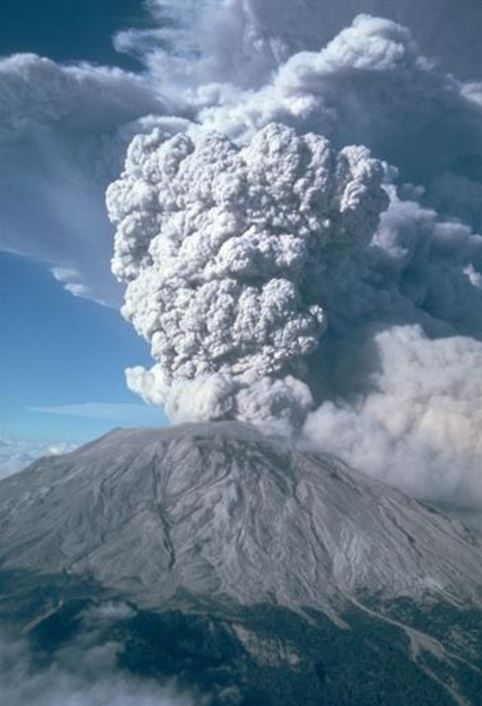
Image: Volcanic eruption.

via Tallbloke’s Talkshop

https://ift.tt/Bx4ib2m

March 4, 2024 at 10:41AM

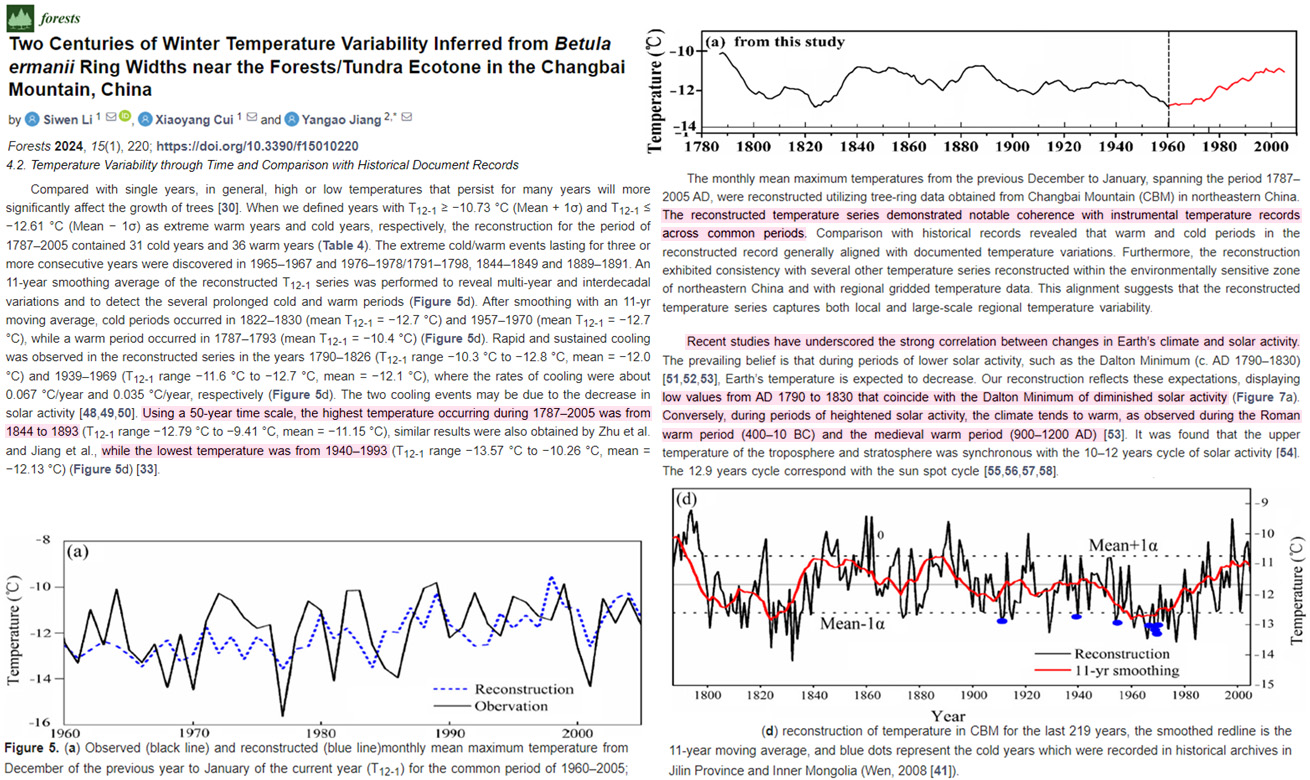
A New 1787-2005 Temperature Reconstruction Determines The Coldest 50-Year Period Was 1940-1993

The warmest 50-year period in northeastern China occurred from 1844-1893.

Li et al., 2024

“Compared with single years, in general, high or low temperatures that persist for many years will more significantly affect the growth of trees [30]. When we defined years with T12-1 ≥ −10.73 °C (Mean + 1σ) and T12-1 ≤ −12.61 °C (Mean − 1σ) as extreme warm years and cold years, respectively, the reconstruction for the period of 1787–2005 contained 31 cold years and 36 warm years (Table 4). The extreme cold/warm events lasting for three or more consecutive years were discovered in 1965–1967 and 1976–1978/1791–1798, 1844–1849 and 1889–1891. An 11-year smoothing average of the reconstructed T12-1 series was performed to reveal multi-year and interdecadal variations and to detect the several prolonged cold and warm periods (Figure 5d). After smoothing with an 11-yr moving average, cold periods occurred in 1822–1830 (mean T12-1 = −12.7 °C) and 1957–1970 (mean T12-1 = −12.7 °C), while a warm period occurred in 1787–1793 (mean T12-1 = −10.4 °C) (Figure 5d). Rapid and sustained cooling was observed in the reconstructed series in the years 1790–1826 (T12-1 range −10.3 °C to −12.8 °C, mean = −12.0 °C) and 1939–1969 (T12-1 range −11.6 °C to −12.7 °C, mean = −12.1 °C), where the rates of cooling were about 0.067 °C/year and 0.035 °C/year, respectively (Figure 5d). The two cooling events may be due to the decrease in solar activity [48,49,50]. Using a 50-year time scale, the highest temperature occurring during 1787–2005 was from 1844 to 1893 (T12-1 range −12.79 °C to −9.41 °C, mean = −11.15 °C), similar results were also obtained by Zhu et al. and Jiang et al., while the lowest temperature was from 1940–1993 (T12-1 range −13.57 °C to −10.26 °C, mean = −12.13 °C) (Figure 5d) [33].”
Recent studies have underscored the strong correlation between changes in Earth’s climate and solar activity. The prevailing belief is that during periods of lower solar activity, such as the Dalton Minimum (c. AD 1790–1830) [51,52,53], Earth’s temperature is expected to decrease. Our reconstruction reflects these expectations, displaying low values from AD 1790 to 1830 that coincide with the Dalton Minimum of diminished solar activity (Figure 7a). Conversely, during periods of heightened solar activity, the climate tends to warm, as observed during the Roman warm period (400–10 BC) and the medieval warm period (900–1200 AD) [53]. It was found that the upper temperature of the troposphere and stratosphere was synchronous with the 10–12 years cycle of solar activity [54]. The 12.9 years cycle correspond with the sun spot cycle [55,56,57,58]. Correlation analyses revealed a significant positive correlation between the annual reconstructed T12-1 and the number of sunspots from the previous December to the current January, with r = 0.22 (N = 188 years, 1818–2005, p = 0.011). The 73-year cycle may be linked to the 50–80 years Lower Gleissberg cycle [31], reflecting changes in solar radiation intensity [57]. A noteworthy relationship between the reconstructed series and sunspot numbers was identified during specific periods, including the 1790s–1840s, 1850s–1870s, 1920s–1930s, and 1950s–2000s (Figure 8B). Additionally, other studies in northern China have also detected cycles of approximately 10 years [25,58,59] and approximately 70 years [45], suggesting potential effects of solar activity in the region.”

Image Source: Li et al., 2024

via NoTricksZone

https://ift.tt/zjWBvDn

March 4, 2024 at 10:19AM