Month: March 2024

X Users Didn’t Like a Paper’s Tone and Findings, So They Got It Rejected

By Ross Pomeroy

February 28, 2024

At Frontiers in Psychology, it seems that users on X are now part of the peer review process.

On January 4th, the paper “Meta-analysis: On average, undergraduate students’ intelligence is merely average,” was accepted to the journal. That same day, the abstract was published with the notice that the “final, formatted version of the article will be published soon.”

Soon thereafter, the paper went viral, quickly accruing over 54,000 views, wide discussion on X and Reddit, and coverage in popular media (including RCS). It garnered this attention for its intriguing yet simultaneously obvious finding: over the past 80 years, as a far greater proportion of North Americans attended college, the average IQ of college undergraduates dropped from around 120 to 102, just slightly above the average of 100.

As the authors, Bob Uttl, a psychologist and faculty member at Mount Royal University, and his students Victoria Violo and Lacey Gibson, noted, “The decline in students’ IQ is a necessary consequence of increasing educational attainment over the last 80 years. Today, graduating from university is more common than completing high school in the 1940s.” College students no longer come solely from the ranks of the highly intelligent and privileged, they come from all corners of society. Uttl and his colleagues noted that this has implications. For example, academic standards and curricula might have to be adjusted. Moreover, employers can’t assume that applicants with university degrees are more capable or smarter than those without degrees.

A little over a month after Uttl, Violo, and Gibson’s paper was accepted and the abstract published, they were abruptly notified by email that it was rejected. They were apprised that Specialty Chief Editor Eddy Davelaar, a Professor of Psychology and Applied Neuroscience at Birkbeck, University of London, overrode the three peer reviewers who approved the paper and even his own handling editor. His reasons were subsequently forwarded to Uttl and his colleagues.

While Davelaar raised a couple of issues with the paper’s methods, the vast majority of his focus was on its tone. He wrote that the use of the word “merely” in reference to college students’ just-above-average IQ was “demeaning.” He also noted that the authors’ critiques of other scientists’ works “could have been packaged more sensitively.” He also called unfounded the authors’ opinion that the widening participation policies of universities were the cause of undergraduates’ falling IQs.

In emails viewed by RealClearScience, Uttl extensively refuted Davelaar’s issues the same day the paper was rejected (Feb. 6), to which he received no reply from Davelaar or Frontiers for six days. On February 12, Frontiers replied saying that Davelaar’s concerns remained. If they were addressed, “the manuscript could be reconsidered for publication.”

Uttl subsequently published his refutations of Davelaar’s methodological criticisms online. Lending strength to his arguments is that fact that three peer reviewers and even Davelaar’s own handling editor did not find fault with Uttl’s paper.

Davelaar’s problems with the paper’s tone and conclusions were harder to address, because they were his opinions. It seemed strange that an editor’s opinions should supplant those of the paper’s authors. It’s not his paper, after all.

In response to a request for comment, Frontiers stated that an article can be rejected at any stage before official publication. A public relations manager then quoted their editorial process, “…if a manuscript does not meet our editorial criteria and standards for publication, or if peer-review or research integrity concerns are raised by any review participant or reader (abstracts are published online ahead of official publication), the journal’s chief editors and Frontiers’ Chief Executive Editor will investigate these concerns, regardless of peer review or acceptance stage.”

Frontiers added:

The Speciality Chief Editor (SCE) reviewed the paper in line with our clearly stated editorial process when concerns were raised about the abstract, particularly about underlying bias. The SCE assessment concurred with some reviewers’ judgements, identifying substantive flaws in the meta-analysis and bias in the tone of the paper. The authors were given further opportunities to revise the paper in line with reviewer and SCE comments. These requested revisions were not made but once again disputed. 

RealClearScience reached out directly to Davelaar for comment, but he has not replied.

Uttl was curious what brought on the sudden rejection of his already accepted paper, so he asked representatives at Frontiers. He was told that “several posts” on X triggered Dr. Davelaar’s review. As readers were only able to view the abstract, and thus weren’t able to assess the authors’ methodology, it seems clear that they complained purely about the authors’ tone and provocative conclusions. Davelaar only found ‘problems’ with Uttl, Violo, and Gibson’s methods afterwards.

Uttl and his co-authors were not apprised of the content of the X posts.

“I think an editor or whoever owes it to us to tell us what the issues are, allows us to respond, before rejection,” he told RCS in an email.

Uttl, Violo, and Gibson have since had their publication fees refunded and have submitted the paper for publication at another journal.

This article was originally published by RealClearScience and made available via RealClearWire.

via Watts Up With That?

https://ift.tt/deBiQ6J

March 4, 2024 at 12:03AM

Warming Earth Has Changed U.S. Hardiness Zones

News Brief by Kip Hansen — 2 March 2024

Several times I have had readers at WUWT ask in comments:  “If the climate is changing, why haven’t the planting zone maps changed?”

Well, they have and they do.  The U.S. Department of Agriculture issues a new U.S.D.A. “Plant Hardiness Zone Map” periodically.  A new version of the map was just released on Nov. 15, 2023.  I became aware of it because my wife is an avid gardener and follows our local agricultural County Cooperative Extension news.  

When she followed the link to the new Plant Hardiness map and checked our very local area, she was surprised to see that it had “warmed” here by 5°F.   Here is the bit of the page she was looking at:

She was a bit perplexed by this news, as we have been having not “hot” years but cooler years recently. It took me a minute to sort through it to see that the drop down was not clear on what temperature change they were talking about.  That temperature change elevated us one half a zone from zone 5b to zone 6a.

This is what the hardiness map is meant to show, according to the U.S.D.A. [USDA hereafter]:

USDA’s Plant Hardiness Zone Map is the standard by which gardeners and growers can determine which plants are most likely to thrive at a location.”

“The 2023 map is based on 30-year averages of the lowest annual winter temperatures at specific locations, is divided into 10-degree Fahrenheit zones and further divided into 5-degree Fahrenheit half-zones.”

“The 2023 map incorporates data from 13,412 weather stations compared to the 7,983 that were used for the 2012 map.”

The confusion about “Temperature Change 2012-2023” was that it is not the Global Warming type of change – average surface temperature change – but rather 30-year averages of the lowest annual winter temperatures”.  Those of you who follow the odd science of averaging temperatures will see that this type of average gives a common-sense view of the most likely absolutely lowest temperature in a year expected for an area based on a 30-year climatic-period average.  What hardiness zones don’t give is the lowest possible temperature.

Why do they track this particular metric? 

“Plant hardiness zone designations represent what’s known as the ‘average annual extreme minimum temperature’ at a given location during a particular time period (30 years, in this instance). Put another way, the designations do not reflect the coldest it has ever been or ever will be at a specific location, but simply the average lowest winter temperature for the location over a specified time. Low temperature during the winter is a crucial factor in the survival of plants at specific locations.”

For instance, when we plant gladiolus bulbs [aka “glads”] the usual practice  recommended is “In temperate zones, the corms [bulbs] of most species and hybrids should be lifted in autumn and stored over winter in a frost-free place, then replanted in spring.“  But, in our experience, when we have a mild winter, glads that we missed when lifting (digging up) in the Fall, come up in the Spring just fine.  We find that aggravating, as it is a lot of work to dig them up if we could have left them in the ground.  But…if one fails to lift the bulbs, and we get a hard winter, of which we have had many over the last 30 years, the majority of the glads will be frozen and lost.    Now, we find that our “average lowest annual winter temperature” is -10°F to -5°F.  In that range, it is possible, maybe with a lot extra care, not to dig them up.  But….if we get that  winter with -20°F or  -10°F for a week running, we’d lose all of the glads still in the ground. 

Enter the Hardiness Zone map.  For our area, we are on the cusp of being able to leave glads in the ground and needing to dig them up.  In the little bit of map above, we see that the green area spreading north along the Hudson River Valley from New York City.  The low altitude and the warmer water of the river (comparatively warmer) keep the valley a bit warmer, as for lowest temperatures, than in the rising hills to the west and east. 

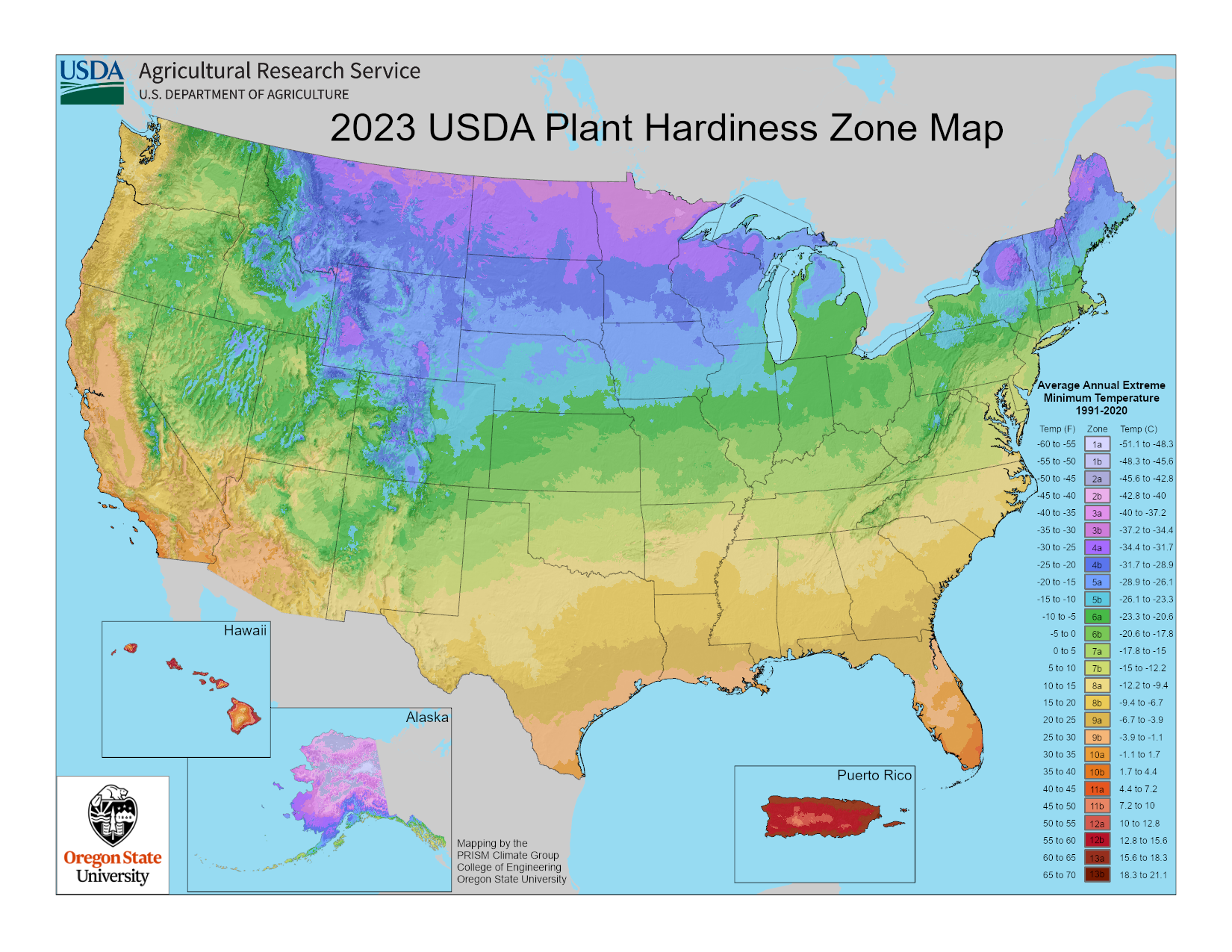
Here is the whole U.S.A.:

If your area is obscured by the drop down in the middle, or you just want to see a larger version – use this link.  At the USDA site, you can put in your zip code and the little drop-down report shown.  You can see by the index along the right that to be totally safe from frost, temperatures below freezing, you must be in zones 10 or above.

The Arbor Day Foundation has its own versions of Hardiness Maps and interesting comparisons over the last 30 years.  Why Arbor Day? “Fruit Trees for Cold Hardiness Zone 4 (Average Minimum Temperature of -30° F/-35° C) — These Apple, Cherry, Peach, Plum, Apricot, Nectarine, Pear, Asian Pear, Almond, and Walnut trees can be expected to grow and thrive in climates rated as being within USDA Cold Hardiness Zone 4. These cold hardy and resilient fruit trees are known to withstand temperatures down to -30°F / -35°C! “ [source]   Also see “Orchard Frost – Critical Temperatures for Various Fruits” for common spring temperatures that can ruin orchard crops in my area.   

What does all this mean?  If one is going to plant expensive garden or landscaping plants, stick to the USDA Hardiness map and give yourself an extra half zone.  For me, that would be sticking with my old zone 5b instead of hoping my 6a plants will survive.  If I were planting a commercial orchard or nursery, I would fall back of lowest recorded temperatures for the last century or so – averages be hanged.

Personal note: My family has lived in this area for 30 years (albeit, my wife and I flitted off to the Caribbean for a decade and a bit).  We have had winters with nary a flake of snow and we have had a winter that remained between -20°F and -10°F, day and night, for a week.  Decimated the gardens. 

As the planet has slowly come up out of the Little Ice Age, growing conditions in many places have improved with earlier frost-free dates in the Springs and later first-killing-frost dates in the Falls which add up to longer growing seasons.  In some areas, this is allowing two dependable crops in the same calendar year.  Hardiness Zones reflect this gentle beneficial warming.  

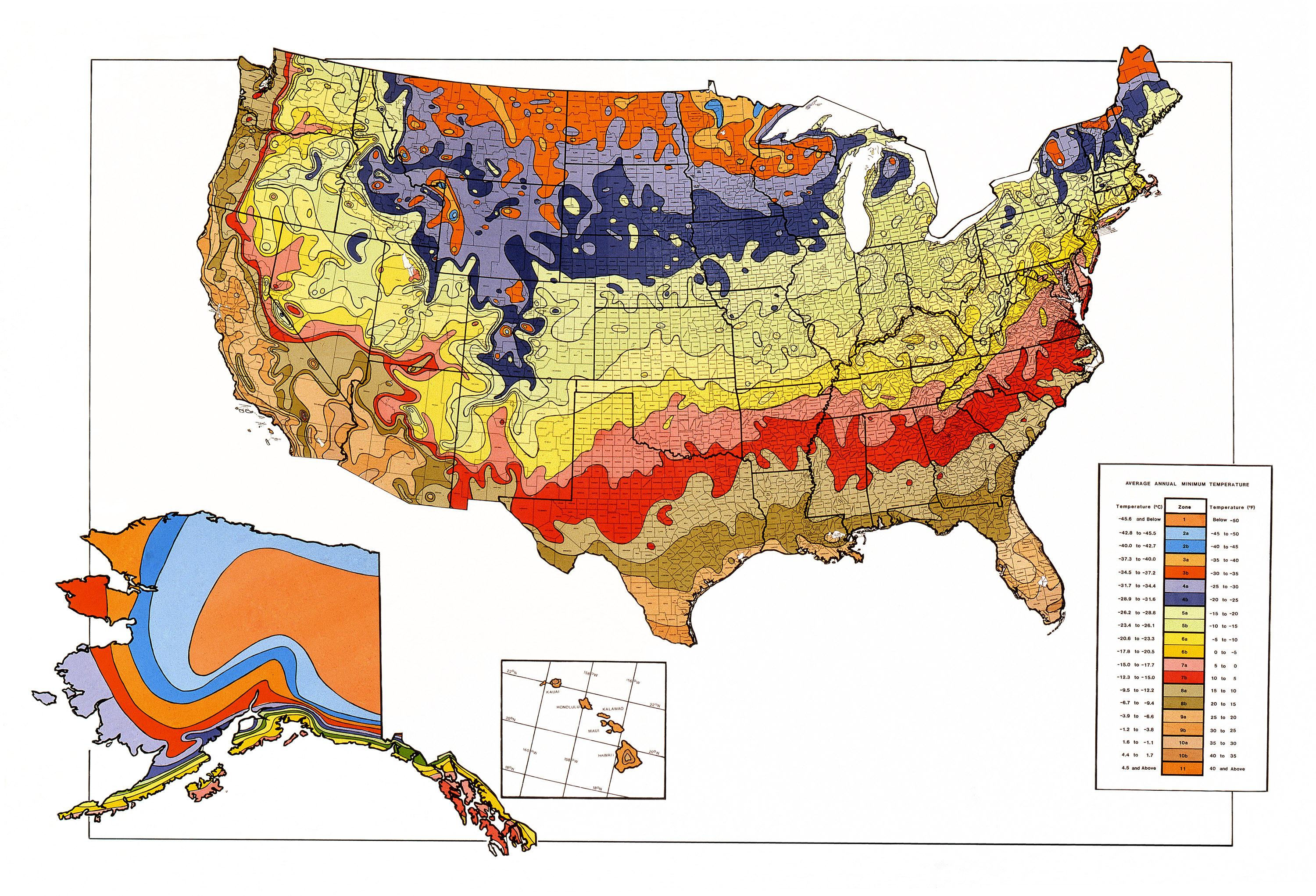
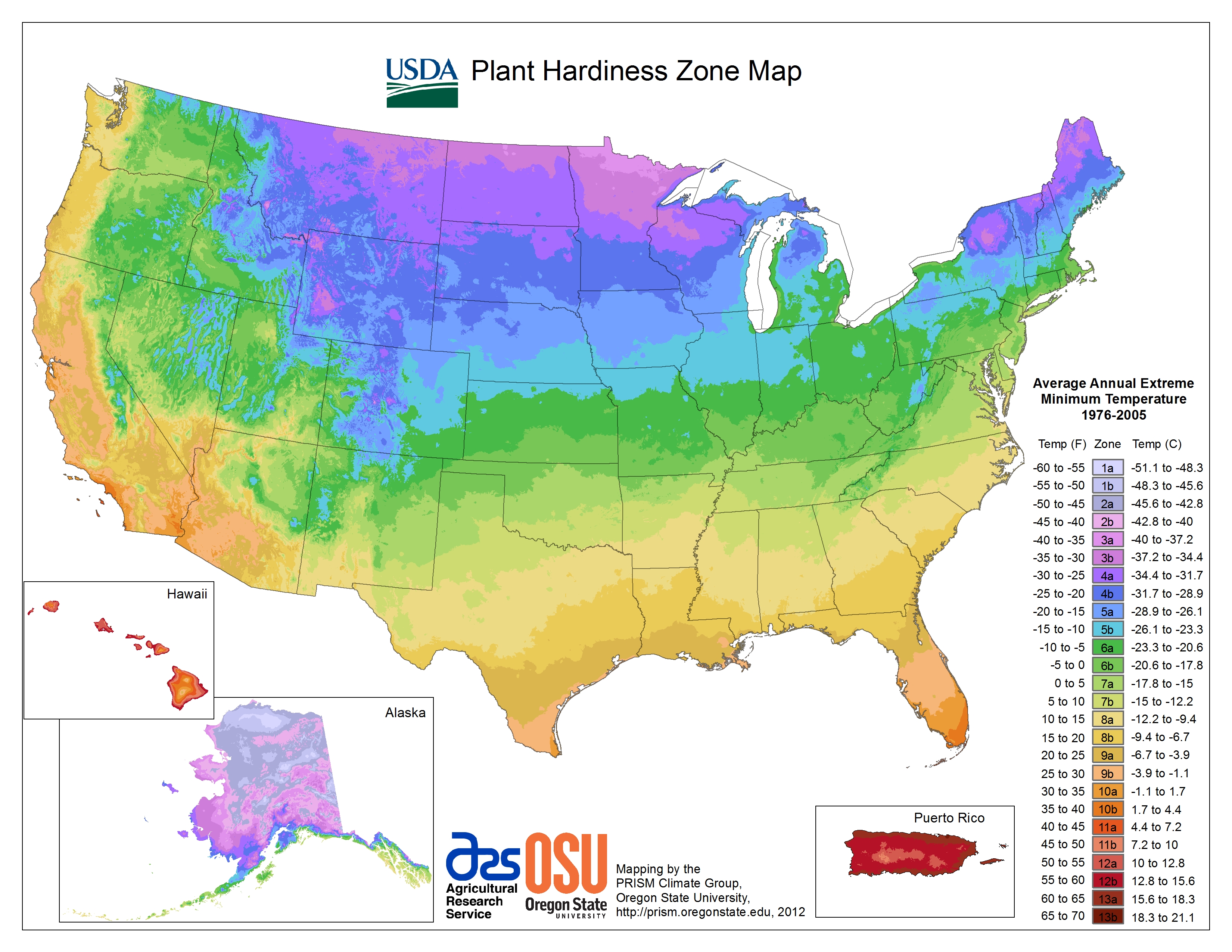
It is important to note that the USDA Hardiness Zones are now based on a great deal more data and are developed at a finer scale than previously.    Here I show the 1990, 2012, and 2023 maps, side by side. 

links to the maps are:  199020122023.

It is easy to see how coarse the map was for Alaska in the 1990 version.  The differences between 2012and 2023 are very hard to see, but they are there.   If you are in the United States, use this link and enter your zip code.

Bottom Lines:

1.  USDA  Hardiness Zones are based on “30-year averages of the lowest annual winter temperatures” – periodically, those values are re-examined and hardiness zones adjusted.

2.  The changes in the Hardiness Zones represent only changes in that average. 

3.   The lengthening of growing seasons are a net positive for the slow gentle warming as the planet comes up out of the Little Ice Age.

# # # # #

Author’s Comment:

Not only are the U.S. Hardiness Zones changing but so are the Koopen Climate Zones – but only in modeled futures.  I’ll write about that effort.

Köppen Climate Zones must be based on observations – there are no observations of the future.

Thanks for reading.

# # # # #


via Watts Up With That?

https://ift.tt/DlCqpSA

March 3, 2024 at 08:02PM

Academics For Genocide

“How many people did Genghis Khan kill? So many that it was good for the environment The genocide had major consequences for the entire planet. Genghis Khan might have been the greenest invader of all time. His bloody conquests killed … Continue reading

via Real Climate Science

https://ift.tt/xd6vQyk

March 3, 2024 at 05:28PM

UK E-BUSES IN FIRE SAFETY RECALL

Oh dear! Just as the government is trying to push electric vehicles and getting us out of our cars and along comes another battery fire story. Read it in the Daily Mail here: 

Britain’s e-bus ticking timebomb: How nearly TWO THOUSAND electric buses worth £800m face urgent recall over fears they could see burst into flames | Daily Mail Online

via climate science

https://ift.tt/JYKC35X

March 3, 2024 at 05:01PM