Month: March 2024

2024 Arctic sea ice maximum a whopping 14th below average following hottest year since 1850

From Polar Bear Science

Susan Crockford

Officially, the maximum winter sea ice extent for 2024 was 15.01 mkm2, reached on 14 March. At an unimpressive “14th lowest” on record, this is astounding news for the winter following the “hottest year on record.” Undeterred, the US government headline writers at the National Snow and Ice Data Center (NSIDC) today went for “Arctic sea ice reaches a below-average maximum.” Note the long-term average (1981-2010) is only 15.65 mkm2 and 15.01 is within 2 standard deviations (see below, screencapped 14 March 2024).

This is what the sea ice maximum extent of 15.01 mkm2 looked like on 14 March this year:

From NOAA’s 17 January 2024 report on the “hottest year on record” [my bold] on global temperatures:

The year 2023 was the warmest year since global records began in 1850 at 1.18°C (2.12°F) above the 20th-century average of 13.9°C (57.0°F). This value is 0.15°C (0.27°F) more than the previous record set in 2016. The 10 warmest years in the 174-year record have all occurred during the last decade (2014–2023). Of note, the year 2005, which was the first year to set a new global temperature record in the 21st century, is now the 12th-warmest year on record. The year 2010, which had surpassed 2005 at the time, now ranks as the 11th-warmest year on record.

According to today’s data from today’s NSIDC report (shown below), the lowest maximum extents were reached in 2015-2018 (14.82-14.52), with 2016 being an especially warm El Nino year. It makes sense that 2017 was the lowest, since it followed the very warm summer of 2016.

However, the max extent for winter 2023 was not far behind, which is odd considering that according to NOAA, warm La Nina conditions didn’t kick in until June 2023. March ice extent for 2023 (now the 5th lowest) was still being influenced by the cold La Nina conditions that prevailed in 2021 and 2022 (2021 now 8th lowest, 2022 now 11th lowest, at 14.88, not shown).

And now 2024 max extent is the 14th lowest, following the warmest global temperature since 1850 was reached in summer of 2023?

Rarely mentioned is that 2005-2007 (weak El Nino/El Nino years) were all below this year’s extent of 15.01 and 2006 and 2007 were both among the 10 lowest extents listed above (2005 was 14.95; 2006 was 14.68, 2007 was 14.77).

It’s almost like Arctic sea ice extent in winter has almost no relationship with global temperatures!

via Watts Up With That?

https://ift.tt/h6dku3b

March 28, 2024 at 08:02PM

3 More New Studies Affirm Sea Levels Were 5 to 9 Meters Higher Than Today 7000-5000 Years Ago

Modern relative sea levels are near the lowest in the last 7,000 years.

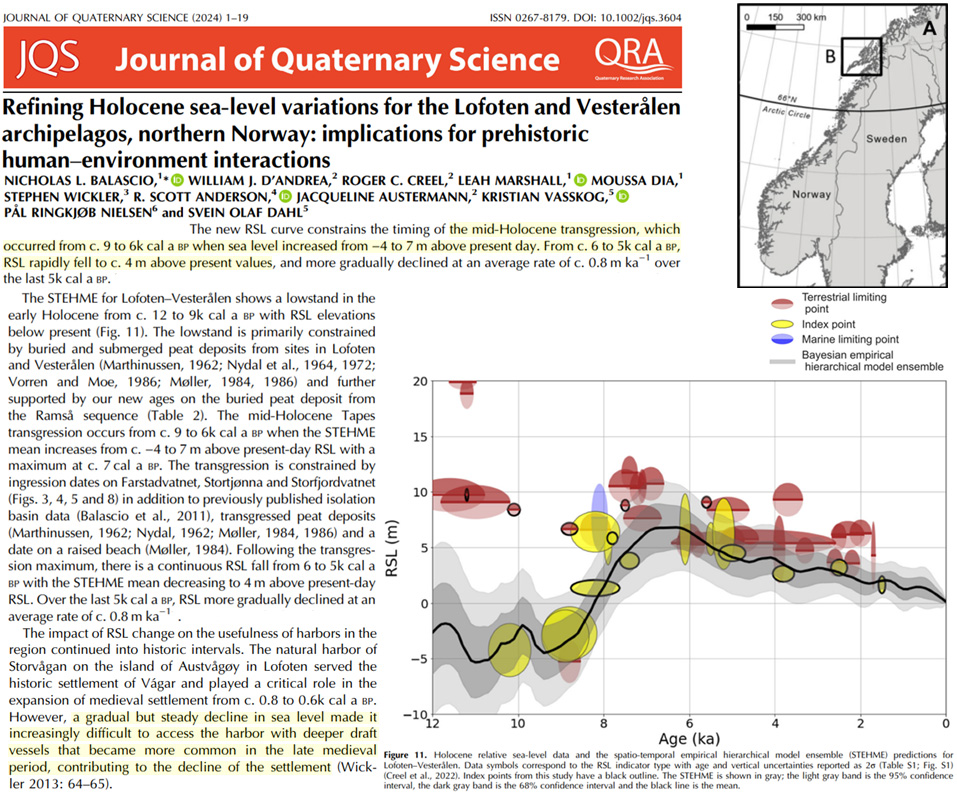
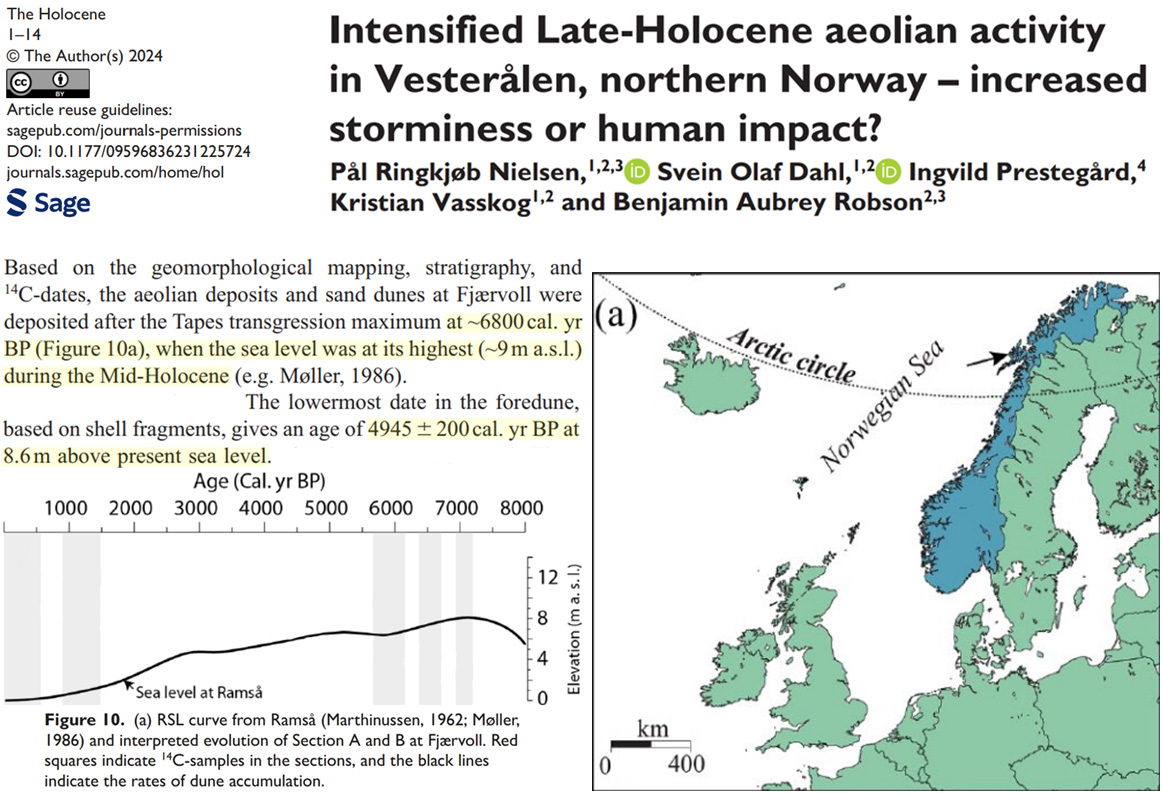
Two studies, independently published, identify Mid-Holocene sea levels in northern Norway (north of the Arctic circle) as 7 to 9 meters higher than today before declining to the present (Balascio et al., 2024, Nielsen et al., 2024).

This region of the Arctic was warm enough to support human settlements and boat harbors during the Medieval Warm Period. As the climate deteriorated into the Little Ice Age cooling centuries after the Medieval warmth, the accompanying sea level fall led to abandoned residences, ships, and harbors. The seas had become to shallow to sail in.

Image Source: Balascio et al., 2024

Image Source: Nielsen et al., 2024

It is sometimes assumed that these much higher Holocene relative sea levels are merely a function of tectonics, or post-glacial uplift. But sea levels in the tropics (for example the Malaysia-Thailand region), unaffected by ice-loading vertical land motions, were also anywhere from 2 to 5 meters higher than today during this Mid-Holocene period before declining to present levels (Punwong et al., 2024).

“The Malay-Thai Peninsula is tectonically stable and remote from isostatic ice-loading effects.”

The recent sea level rise in recent centuries is thus well within the range of natural sea level variations.

Image Source: Punwong et al., 2024

via NoTricksZone

https://ift.tt/2ozZ1id

March 28, 2024 at 05:53PM

Which Power Source is Best

Roger Caiazza

Bud’s Offshore Energy blog highlighted a new national energy report card that is of interest to readers here.  According to the Mackinac Center press release the report ranks energy sources by ranking eight key energy resource types “based on their ability to meet growing demand for affordable, reliable, and clean energy generation”.  The report concludes that “natural gas and nuclear power lead the rest of the class in generating clean and affordable energy”.

Jason Hayes and Timothy G. Nash co-authored this report from Northwood University’s McNair Center for the Advancement of Free Enterprise and Entrepreneurship and the Mackinac Center for Public Policy.  The Mackinac Center for Public Policy is a nonprofit research and educational institute that advances the principles of free markets and limited government.

Methodology

The report summarizes the scoring methodology:

Bottom Line Up Front: Each ranking area graded the energy resource on a scale of 1 to 10. If an energy source performed poorly, it received a 1, if it performed well, it received a 10.

The scores in each section were totaled and broken down from 1 to 50. The energy source was given a final letter grade of A to F based on its score out of 50. The grading system results in a comparative ranking that describes the energy resource as excellent (90-100 /A-range), very good (80-89/B-range), average (70-79/C-range), poor (60-69/D-range), and Failure (59 or below/F).  This methodology is roughly based on the American Society of Civil Engineers’ methodology described in the annual “A Comprehensive Assessment of American’s Infrastructure: 2021 Report Card for America’s Infrastructure” document.

The score card evaluated each energy source for five ranking areas:

  1. Capacity and Reliability: We estimated the capability of this energy source to produce sufficient energy to meet demand. We also considered how plans to maintain existing (or build new) infrastructure and capacity will meet growing energy demand.
  2. Environmental/Human Impact: We asked what are the environmental impacts, the human rights, or other labor issues associated with using this energy source.
  3. Cost: We asked how the energy source competes with other energy sources in terms of pricing.
  4. Technology and Innovation: We asked what technologies are used and what new technologies are being developed for this energy source.
  5. Market feasibility: We considered whether the energy source relies on free-market forces to supply energy to the public. To what extent do subsidies and/or government mandates drive its adoption and use?

The report includes recommendations for policies that could be implemented to improve this sector’s performance.

Energy Sector Rankings

The report card, ranked by the final grades, puts natural gas and nuclear at the top of the class.

The Executive Summary of the report includes a summary for each energy sector that describes the ranking rationale.

Natural gas tops the energy sectors because it not only provides electric energy but also provides the ancillary support services necessary for the transmission system at a relatively low cost.  Aside from the irrational obsession with over hyped greenhouse gas effects it also has a low, albeit not zero pollution impacts.    I agree with the concern that reliability would be improved with on-site storage.

Natural gas: 94 % (A)

Natural gas is at a unique position in our energy supply.

The nation has experienced rapid growth in energy demand for a range of activities: electricity generation, home heating, transportation, manufacturing, etc.

As governments around the nation attempt to impose a transition from traditional energy resources to energy sources often referred to as renewables, natural gas is the energy source that is best suited to integrate with the intermittency inherent in the use of wind and solar. Gas provides a reliable, affordable, and increasingly clean source of energy in both traditional and “carbon-constrained” applications.

Gas faces headwinds in the form of increasingly extreme net zero energy policies that will constrict supplies if implemented as proposed. Gas could also improve overall reliability if onsite storage was prioritized to help avoid supply disruptions that can occur in just-in-time pipeline deliveries during periods of extreme weather and demand.

The second highest energy sector was nuclear.  The report card recognizes its zero emissions, that it provides electric energy and ancillary support services necessary for the transmission system, and that it is mature technology with the potential for extensive deployment.  Were it not for high development costs and market feasibility issues it would undoubtedly be the highest rated.

Nuclear: 88% (B+)

Nuclear energy represents a best-of-all-worlds energy resource for the United States. Given its history as the nation’s safest and most reliable electricity source and its ability to produce near endless amounts of completely reliable and emission-free electricity, nuclear is an obvious choice, especially given the nation’s current hyper-focus on net zero carbon dioxide emissions.

Nuclear’s primary challenges lie in two areas: initial costs and concerns over safety related to fuel storage or the potential release of radioactive materials.

First, while initial costs to build can be high, they can be amortized over a 60- to 100-year expected life cycle. Additionally, costs can be addressed by reigning in the overactive nature of the Nuclear Regulatory Commission. Second, the industry’s record demonstrates it is the nation’s safest source of electricity.

Perhaps no better example of this technology’s safety, reliability, and usefulness exists than the nation’s fleet of nuclear-powered aircraft carriers, submarines, and cruisers. Building on Admiral Rickover’s innovations, the U.S. Navy has reliably and safely powered a significant portion of its fleet with nuclear power for decades. As we have done in many other areas, it is possible to use the knowledge gained in this area in the civilian nuclear fleet.

Given the safety and reliability of both our military and civilian nuclear, concerns over meltdowns or having the fuel used to build nuclear weapons are more in the realm of science fiction than reality. The United States was once the world leader in developing safe, reliable nuclear technologies. We should focus on rebuilding that status.

Coal and hydroelectric are ranked next with the same with a total of 40 points.  I think that ranking by electric system characteristics and not weighing environmental impacts is the reason.

Coal is a mature technology that provides electric energy and ancillary support services necessary for the transmission system and has the potential for extensive deployment.  I would have ranked the capacity reliability a point higher because coal can be stored on-site and that I think is an important characteristic too often overlooked. 

Coal: 80% (B-)

Despite its low cost, abundant domestic supply, and reliability, Western nations—USA, Canada, UK, and across Europe—have targeted coal for closure largely due to climate change concerns. While most pollution concerns associated with coal use can be addressed with widely available emissions reduction technologies, coal does emit more pollutants and CO2 than natural gas.

Due to growing regulatory pressure and effective competition from low-priced, domestic natural gas, coal use is declining in North America, as well as Europe. However, coal use worldwide— especially China and India—continues to grow rapidly. Across Asia, coal use is growing so rapidly that attempts to cease its use in the West as a climate change mitigation measure are being wholly eclipsed.

The primary challenges faced by the coal industry are 1) a long-term campaign on the part of government and green special interests to stop its use, and 2) very effective competition from low-cost fracked natural gas, which is displacing coal as a primary baseload generation option.

The grading for conventional hydroelectric recognized this is another mature technology that provides electric energy and ancillary support services necessary for the transmission system.  Unfortunately, there is little potential for further deployment and the current plans to destroy hydro dams are inconsistent with the supposed need to fight the “existential threat” of climate change.  In my opinion that is almost as stupid as shutting down nuclear plants prematurely.

Conventional hydroelectric: 80% (B-)

Hydroelectric is the one form of renewable generation that is completely dispatchable and has no emissions associated with its operations (compared with biomass).

While hydroelectric would seem to meet most of the tests of the environmental movement, it is often targeted for removal because it requires a great deal of bulk material in its construction and interrupts or changes natural river flows and floods riparian zones (displacing wildlife and human inhabitants). Given the expansive nature of large hydroelectric facilities, it is unlikely that any new developments could be permitted in North America.

In my opinion petroleum fuels were a bit under-rated.  This is another mature technology that provides electric energy and ancillary support services necessary for the transmission system.  Admittedly it is important in limited areas but provides critical support in those markets.  However, I agree the potential for any further development is very low.

Petroleum fuels: 70% (C-)

Petroleum products play a very small role in the production of U.S. electricity. They are almost a rounding error and are used primarily in older or geographically limited areas (like the Hawaiian Islands or Northeastern markets because of historical use).

I probably would have rated geothermal closer to petroleum fuels.  As noted, it suffers from the same lack of potential development.

Geothermal: 66% (D+)

Geothermal plays a limited role in the production of U.S. electricity. Much like petroleum products, geothermal is almost a rounding error and is used primarily in geographically limited areas (like the Western states and the Hawaiian Islands)

Wind and solar receive failing grades.  Both are rated lowest for similar reasons.  When they are compared to the capability of the other energy sources to provide sufficient energy to meet demand the need for energy storage and supporting ancillary services, they are appropriately ranked lowest.   Even though they are zero-emissions resources there are “numerous other grid reliability, environmental, economic (or cost), and social issues associated with its use that are often overlooked”.  When human rights impacts are included, they should be rated lower than the other sources.  Wind and solar are only relatively cheaper if the costs to provide reliable energy and transmission system ancillary services are ignored.  I think this ranking correctly scores this category.  The technology/innovation category recognized that there are limited opportunities to improve the energy output.  The market feasibility scoring considered “whether the energy source relies on free-market forces to supply energy to the public.”   I do not believe that wind and solar could survive without massive subsidies so believe this scoring is appropriate.

Wind: 56% (F)

Wind is one of two so-called renewable energy generation sources widely promoted for its claimed ability to reduce the environmental impacts of electricity generation. Wind is marketed as being able to reduce carbon dioxide emissions, protect the environment, reduce electric rates, and improve grid reliability.

While it is true that wind does not produce carbon dioxide as it produces electricity, there are numerous other grid reliability, environmental, economic (or cost), and social issues associated with its use that are often overlooked.

Given that society increasingly relies on a steady and reliable supply of affordable energy, government policies that mandate and heavily subsidize a transition to wind generation represent a growing threat to human health and well-being.

Solar: 58% (F)

Solar is the second of two so-called renewable energy generation sources (wind is the first) widely promoted for its claimed ability to reduce the environmental impacts of electricity generation. Like wind, solar is marketed as being able to reduce carbon dioxide emissions, protect the environment, reduce electric rates, and improve grid reliability.

Like wind, solar does not produce carbon dioxide as it produces electricity. However, there are numerous other grid reliability, environmental, economic, social, and human rights issues associated with its use that are often overlooked.

Given that society increasingly relies on a steady and reliable supply of affordable energy, government policies that mandate and heavily subsidize a transition to solar generation also represent a growing threat to human health and well-being.

This summary of the report is only an overview.  The report is comprehensive with 107 pages of text.  There is extensive documentation with 297 references.  As a result, the rationale for the scoring is extensive.

Conclusion

The conclusion of the report states:

Demands for a hurried transition from conventional, reliable energy sources to unreliable and expensive renewable alternatives are threatening the reliability of the North American electric grid. Pushing for increased efficiency and improved environmental performance is a laudable (and achievable) goal. However, we cannot allow misplaced environmental zeal to obscure electricity’s pivotal role in promoting human health and well-being and powering our society.

Advocates for wind and solar hold them up as essential to environmental and climate health. However, rushing a systemwide transition to these untested and unreliable energy options puts human lives and the North American economy at risk. Their inherent intermittency will strain the ability of the grid to meet growing energy demands and the ability of ratepayers to cover the high costs they impose on the grid. In contrast, the reliability and affordability of fossil and nuclear fuels cannot be ignored. Admonitions from grid managers warning about the dangers of rushing to close reliable sources of electricity generation only serve to highlight the risks associated with the premature rush to transition to wind and solar.

This research demonstrates the high environmental and economic costs of hurrying the grid transition. While fossil and nuclear fuels do have environmental costs, we also have the technological capacity to address those costs as we continue to trust their unparalleled reliability for essential energy services.

Wind and solar energy have been marketed as a means of having our energy and environmental cake and eating it, too. We are told they are clean, cheap, and reliable. However, a closer look at their real costs, growing environmental impacts, and questionable human rights records leads to serious questions about their ability to serve as a realistic energy option.

Transitioning a service as important as the nation’s electric grid cannot be rushed. It requires a far more careful and pragmatic approach than we see from elected officials and utilities nationwide. The rushed transition is neither reasonable nor prudent and must be reconsidered.


Roger Caiazza blogs on New York energy and environmental issues at Pragmatic Environmentalist of New York.  More details on the Climate Leadership & Community Protection Act are available here and an inventory of over 400 articles about the Climate Act is also available.   This represents his opinion and not the opinion of any of his previous employers or any other company with which he has been associated.

via Watts Up With That?

https://ift.tt/IoH6fs3

March 28, 2024 at 04:06PM

Hopping Mad

I am slow to comment on this story, but I have only recently returned from holiday. Nevertheless, having worked for breweries for a substantial part of my career, it’s a subject that interests me, and I thought it might be worth taking a more detailed look. The story in question is that contained in a recent BBC article titled “How do you save the pint from climate change?” (which morphs into “Fears for the future of the great British pint of beer” when you click on it).

Paul Homewood beat me to it with his piece titled “No More Beer!” His piece refers to the same BBC article (at least, it uses the same link) but in his version the BBC article is titled “Fears for the future of the great British pint of beer”, which morphed on clicking on an earlier headline: “Beer threatened by climate change but scientists helping save it”.

In other words the BBC seems to have run with four different headlines for the same story, but what they have in common is a tabloid style – fears for the great British pint; it’s due to climate change; but science (the science?) can save it!

The nub of the BBC article is a claim that a changing climate endangers British hops grown in Kent:

Hops give bitter its taste but the plant doesn’t like the hotter, drier conditions we’ve experienced in recent decades and production has plummeted.

Researchers in Kent are isolating hop genes in the hope of producing more climate-change resilient varieties…

…Warmer, drier conditions have also affected the trademark bitter flavour hops gives beer. And the worry is that because of climate change, the problem is only going to get worse…

The problem, the BBC article claims, is also extending to hops grown in Europe. In support of this claim, the BBC refers to analysis published last year, and in that connection offers a link. However, when you click on it, you are taken to another BBC article from five months ago, titled “Climate change could make beer taste worse”. If you persist to the end of the second BBC article, you will find a link to the research in question, which has the title: “Climate-induced decline in the quality and quantity of European hops calls for immediate adaptation measures”.

The report is interesting, and offers a detailed analysis of possible issues relating to hops in a changing climate. However, it is worth reading beyond the headlines, because a number of factors emerge.

First, the report notes that “there has been a recent change in consumer preference towards beer aromas and flavors [sic] that heavily depend on high-quality hops. Amplified by the ongoing craft beer popularity, this trend contrasts with previous demands for lower alpha content. The recent craft beer expansion therefore not only triggered new microbreweries but also boosted the demand for aromatic hops globally…

The problem, then, isn’t one of declining hop production. Rather it’s a problem of growing demand for a particular flavour that is dependent on a certain type of hops. And “Since the cultivation of high-quality aroma hops is restricted to relatively small regions with suitable environmental conditions…, there is a serious risk that much of the production will be affected by individual heat waves or drought extremes that are likely to increase under global climate change…”.

And so we learn that it’s actually a small problem, and one that is linked to predicitions of climate change. Furthermore,astute hop-growers are already responding:

Hop farmers can and have responded to climate change by relocating hop gardens to higher elevations and valley locations with higher water tables, building irrigation systems, changing the orientation and spacing of crop rows, and even breeding more resistant varieties. Changing the orientation of crop rows and combining irrigation with water-saving soil management practices have proven to be effective adaptation measures in viticulture. It is important that the generative phase of hop plants occurs only in the appropriate photoperiod when sunshine duration is decreasing. This can be achieved by slowing plant growth via growth inhibitors or by building protective shading structures…

The report does suggest, quite reasonably, demonstrate that hop yields decline in drought conditions, but much of the rest of it deals with models rather than reality, especially when discussing possible declines in alpha content (which “was predicted [my emphasis] to decrease considerably across all regions”).

Very properly the report also notes two rather important limitations on its findings:

In addition to the climatic factors described above, there are other external factors that can affect the yield and alpha content of aroma hops. These include the health condition of the hops, epigenetic adaptation and heredity of the hops, irrigation systems, harvest maturity, habitat conditions, and the regulation of hop growth by properly selected agricultural technology and fertilization. The location of hop fields and suitable soil are very important, especially in the valleys of rivers and smaller streams, where the water table is generally more stable. The importance of drip irrigation combined with advanced irrigation planning technologies, such as the FORHOPS initiative for stabilizing hop yields has been successfully applied in the Zatec region, where irrigated hops have become dominant since 2015. Moreover, wetter and cooler locations have often been used for new hop fields, while open plateau fields have been reduced.

While assessing future climate and environmental impacts on the quality and quantity of aroma hops, the uncertainty associated with model simulations should also be noted. Increased CO2 concentrations could partially compensate for the effects of drought and support yield growth and leaf area index while improving water use efficiency. However, this effect on hops is still under investigation, and we do not yet have enough evidence and knowledge.

I would summarise this as being a story of modest interest, that it was perfectly reasonable for the BBC to report on (as it did) when the results of the study were published over five months ago. However, to my mind there is a very real question as to why the BBC is choosing now to re-hash a five-months old story. Nothing in this month’s article suggests that there have been recent developments. It’s not news, but old news. Perhaps the BBC didn’t have enough climate scare stories this week, so it fell back on an old one.

Perhaps it’s fair for the BBC to suggest that scientists are coming to the rescue, but again, context is everything. The reality seems to be not that traditional British hops are under threat from a changing climate, but a question of whether new types of hops with more intense flavours can be grown on British soil (whether under a changing climate or not). The answer to that question is, happily, in the affirmative, as the BBC’s recent article confirms:

The master brewer told BBC News: “The great news from my perspective is that 10 years ago, I was sceptical that we could produce intense flavours in hops in our climate.”

He added: “What I have seen is that absolutely we can.”

In other words, insofar as this story represents news, it is good news, yet the BBC chooses to make it a story about climate change. Interestingly, the section of the European Commissions website dealing with agriculture and rural development has a section devoted to hops, and it tells a rather different story to the alarmist one adopted by the BBC:

All over the world, but particularly in Europe, acreage is dwindling, one reason being the increasing yield of alpha acid and its decreasing use in beer. Alpha acid is the component of hops that gives beer its bitter taste and other flavours.

The EU produces about 50,000 tonnes of hops annually. Its alpha acid output regularly exceeds 5,000 tonnes.

Annual hop production worldwide varies between 80,000 and 100,000 tonnes, corresponding to between 8,000 and 10,000 tonnes of alpha acid. Demand for alpha acid is estimated at about 8,000 tonnes, on the basis that an average of 4.1g are needed per hectolitre of beer. Hop content varies depending on the type of beer concerned, particularly how bitter it is, and the variety of hop used. As a result of technological progress and consumers’ growing preference for less bitter beers, hop content is falling year by year (it still stood at 6.3g alpha per hectolitre in 1995).

Although world beer production is on the rise, demand for alpha acid is not increasing much. Since supply currently exceeds demand, average prices on the hop contract market and the free market have been fairly low since 2009.

In short, BBC, pull the other one.

via Climate Scepticism

https://ift.tt/YdOHup3

March 28, 2024 at 03:59PM