Month: March 2024

Germany’s Alfred Wegener Institute Shows January Arctic Sea Ice Now 20 Years Stable!

Winter sea ice in Arctic stable over past 20 years…has even recovered somewhat.

Hat-tip: Klimanachrichten

Arctic sea ice extent as recorded by Germany’s Alfred Wegener Institute (AWI) in Bremerhaven, Germany, looks at the situation in January 2024. Despite the record temperatures reported, the ice in the Arctic has recovered somewhat.

The slight recovery trend since the Arctic minimum was reached is continuing at the beginning of 2024, with the sea ice extent at the beginning of the year below the average value for the years 1981 – 2010, but in the lower range of the extreme values (minimum / maximum) of this international climate normal period (Figure 1).

If we look at the new reference period 1991 – 2020 introduced by the World Meteorological Organization in 2021, January 2024 is roughly in line with the mean value of this period (see interactive graphic). The average Arctic sea ice extent in January was 13.99 million square kilometers, around 400,000 square kilometers greater than the ice cover in January over the last 20 years (Figure 2). During the month, the extent increased by approximately 29,000 square kilometers per day, which was slower than the average increase from 1981 to 2010.”
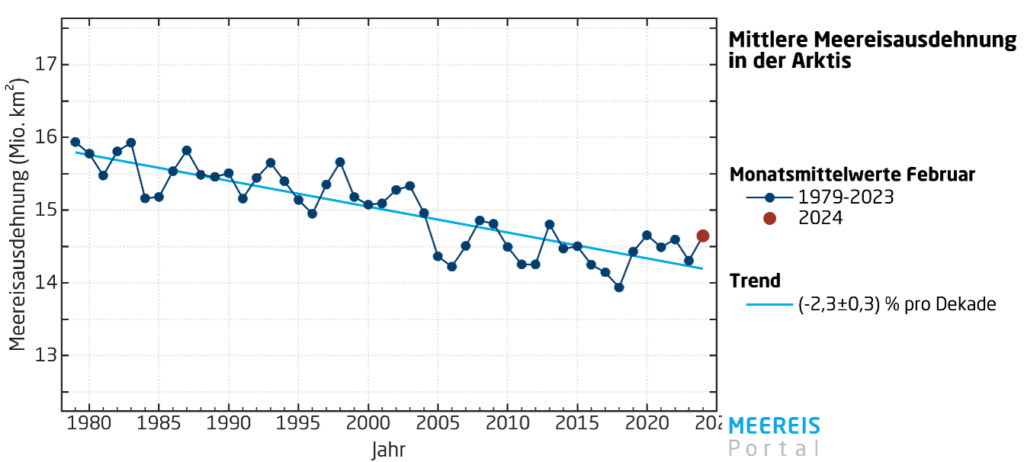
Image: Screenshot Meereisportal.de

Among highest in past 20 years

The above chart indeed shows a stable trend over the past 2 decades. According to the AWI:

This year’s maximum sea ice extent most likely occurred on February 27, at 14.94 million square kilometers. The monthly average ice extent in February was 14.65 million square kilometers.”

That makes it higher than 15 of the past 20 years.

Compared to the long-term average for the years 2003 – 2014, it is noticeable that the sea ice cover in the northern Barents Sea is lower, but the Greenland Sea and the northern Baltic Sea in the Gulf of Bothnia and the coastal zones of the Barents Sea have more extensive sea ice areas. This indicates lower and longer-lasting cold periods in these regions.”

Donate – choose an amount

via NoTricksZone

https://ift.tt/Xpz9uOG

March 27, 2024 at 12:33PM

Living Outside The Niche

Guest Post by Willis Eschenbach

I stumbled across a paper called “Future of the human climate niche“, published in the Proceedings of the National Academy of Sciences. The abstract says (emphasis mine):

Abstract
All species have an environmental niche, and despite technological advances, humans are unlikely to be an exception. Here, we demonstrate that for millennia, human populations have resided in the same narrow part of the climatic envelope available on the globe, characterized by a major mode around ∼11 °C to 15 °C mean annual temperature (MAT).

Supporting the fundamental nature of this temperature niche, current production of crops and livestock is largely limited to the same conditions, and the same optimum has been found for agricultural and nonagricultural economic output of countries through analyses of year-to-year variation.

We show that in a business-as-usual climate change scenario, the geographical position of this temperature niche is projected to shift more over the coming 50 y than it has moved since 6000 BP. Populations will not simply track the shifting climate, as adaptation in situ may address some of the challenges, and many other factors affect decisions to migrate.

Nevertheless, in the absence of migration, one third of the global population is projected to experience a MAT >29 °C currently found in only 0.8% of the Earth’s land surface, mostly concentrated in the Sahara. As the potentially most affected regions are among the poorest in the world, where adaptive capacity is low, enhancing human development in those areas should be a priority alongside climate mitigation.

Well, that seemed kinda reasonable. After all, a mean average temperature (MAT) between 11 °C to 15 °C (52°F to 59°F) sounds comfortable, and I imagined it would be a fairly wide zone. And people tend to go where it’s comfortable.

So I decided to graph out just how that plays out around the globe … here’s that result. Upper graphic shows the whole planet, lower graphic shows just the land.

Figure 1. The “human climate niche” lies between 11°C (blue line) and 15°C (red line). Berkeley Earth data

YIKES! When the Abstract said a “narrow part of the climatic envelope”, they weren’t kidding. A skinny strip across the US, a skinny strip along the Andes, a narrow band from Europe to China, a tiny part of Africa and Australia … wow.

Of course, my first question was whether the problem was with my data. So I repeated the experiment with the CERES data.

Figure 2. The “human climate niche” lies between 11°C (blue line) and 15°C (red line). CERES data.

Well, slight differences, but basically the same.

So I thought, well, maybe they’re using some special dataset. So I checked the Supplementary Information and found that they use a dataset called the “WorldClim” data. I downloaded that, spent far too long trying to figure out how to import a “GeoTiff” file into R, and took a look.

Figure 3. The “human climate niche” lies between 11°C (blue line) and 15°C (red line). WorldClim data.

Aaaand … they all agree, within the usual differences in climate datasets.

Next, I looked at where people live on this wonderful planet. Here’s that chart. I’ve overlaid the WorldClim 11°C (white) and 15°C (yellow) lines on the graphic.

Figure 4. Log base 10 of population density per square kilometer.

As you might have guessed, the biggest population centers are in India and eastern China. Other populated spots are Europe, tropical Africa, southeast Asia, eastern Brazil, Indonesia, Mexico, and the eastern US.

And the crazy part?

Not one of those centers of dense population lies within their “human climate niche” … some are too cold, some are too hot. India, packed with people, has an average annual temperature of 27°. Canada and Russia are hopeless. And cold foggy England? Fuggeddaboutit!

Not sure I can say much more about that study … have I made some curious error? I don’t think so.

Onwards, ever onwards,

w.

PS—My usual request: When you comment please quote the exact words you are discussing. It avoids endless misunderstandings. Thanks.

via Watts Up With That?

https://ift.tt/tNqbaIh

March 27, 2024 at 12:05PM

Labour’s net zero target faces £116bn ‘investment challenge’


Challenge is putting it mildly. Cloud cuckoo land beckons once again in the form of impossible but supposedly climate-related targets. Some timescales are hard to shorten just by uttering demands.
– – –
A report by Policy Exchange, supported by analysis from Aurora Energy Research, outlines challenges facing Labour’s aim to achieve a decarbonised power grid by 2030, says Energy Live News.

The report highlights a £116 billion additional investment requirement.

This finding, based on modelling, emphasises obstacles such as planning reforms, supply chain limitations and workforce shortages.

The analysis underscores difficulties in accelerating renewable energy deployment and scaling up infrastructure.

In contrast, the report suggests the Conservative-backed net zero grid 2035 scenario may offer a more feasible pathway.

Recommendations include clear timelines and budget allocations for renewable energy schemes, accelerated grid investment, and commitments to large-scale nuclear and renewable projects.

Iain Mansfield, Director of Research at Policy Exchange, commented: “To decarbonise the power grid by 2030 is simply not feasible.

“Given the state of the public finances it is hard to see how any government could find the additional £93bn required – but even if the money were made available, it is simply not possible to build new renewable generation at the pace required.”

Full article here.
– – –
Image credit: latinoamericarenovable.com

via Tallbloke’s Talkshop

https://ift.tt/6JBueX3

March 27, 2024 at 11:51AM

Fox News: Whale of a lawsuit threatens to swallow up Biden green energy agenda

The groups claim that the Virginia Offshore Wind project would threaten the North Atlantic right whale

via CFACT

https://ift.tt/25evVt4

March 27, 2024 at 11:44AM