Month: March 2024

The Best States To Buy A Family Home In

It’s no secret for everyone that the current state of the economy is somewhat worrying to most people living paycheck to paycheck. As we see inflation continue to rise with no end in sight many people have turned to more drastic solutions to resolve their money issues. This is why over the past few years we have seen many people turn to downsizing, selling their homes to move into condos and apartments. For others though their solution doesn’t exist around them but somewhere else. This is why from certain states we have seen exodus where people are simply moving out to other states that might be more welcoming to their ambition to buy a family home. So, let’s look at some of the best states to buy a family home in 2023 and 2024.

Wisconsin

To start us off let’s talk about the state of Wisconsin. During this article the way we will discuss the potential stays for you to buy a family home we will talk about the average prices but also many other things that might affect your decision. For example, when Wisconsin the average home sells for around $260,000 which is a pretty decent price when it comes to buying a home, especially in the day and age in which we live. From 2021 to 2022 Wisconsin saw its average price change when it comes to homes stagnate at around 10%. While it may not be the best rate the price balances things out. Another great part of living in Wisconsin is that if you are a first-time home buyer many programs exist on the state level to help you financially.

Kentucky

While the Bluegrass state is well known for its coal mining activities and its racehorses it is also known for having a pretty cheap cost of living when it comes to the United States of course. One of the realities is that Kentucky is a pretty poor state when it comes to resources nowadays and we’ve seen many hollers reach levels of extreme poverty over the past few decades. Nonetheless, if you are struggling Kentucky is a very cheap state to move into since home sales average at around $240,000 and the state has a pretty low effective property tax rate as well as a foreclosure rate that is below .025%, the lowest foreclosure rate of all 50 states. Wild it as fewer programs are offered to first-time home buyers than in Wisconsin the reality is that they still ask for programs that you might be able to benefit from.

Utah

Utah is of course a pretty weird state when it comes to moving and buying a home. While many know Utah is the home of the Zion National Park and one of the largest populations of Mormons in the United States it is also a great place to live. The main barrier dad comes to moving to Utah’s left cores is the very I price of average sales in the counties. One of the important things to think about when it comes to the Utah house market is that there is a very large disparity between expensive homes and low-income homes which means that higher price sales will spike up the average while many cheaper homes do not put a dent in the number. Utah has a lower effective property tax rate than Kentucky as well as Wisconsin.

North Carolina

When it comes to buying a home, North Carolina is a little bit of a doozy. On one hand, you can see lower prices than in Utah at around $350,000 but it is one of the states with the highest fluctuation rate when it comes to rising prices in the homes year by year. When it comes to property tax rates it is pretty on power with Kentucky adding a round .81%. One of the best benefits when it comes to moving to North Carolina is of course the many programs that are offered by the state to first-time home buyers. As of this year, North Carolina offers over five programs to help people who are looking to purchase their first property.

Pennsylvania

Pennsylvania is the second state with the highest effective property tax rate second only to Wisconsin on our list. Despite all this Pennsylvania offers double the state-funded help when it comes to purchasing a home that Kentucky does. The home prices are pretty comparable to the average home prices of Wisconsin which makes it a great bargain if you are trying to weigh the pros and cons of different states. One of the greatest parts of these programs when it comes to Pennsylvania is that many can work in concert with others so you might be able to benefit from multiple programs depending on your situation and the property you are looking to purchase.

As you can see many opportunities are open to you whether you are dealing with a realtor or simply a company that that buys homes. Businesses like priorityhomebuyers are a we buy houses company which means that they exist to get your property off your end so you can move somewhere else and find something that fits your needs better. What is your next destination is it Pennsylvania, Kentucky, or any other state the important thing is to find something that fits both your budget and your life quality needs. Finding the perfect family home can be quite a difficult ordeal but going through it with more knowledge is a great way to alleviate the stress caused by the many moving parts of the housing market.

via A Journey through Nature and Climate

https://ift.tt/xWsXcy8

March 24, 2024 at 09:05AM

ECB / Potsdam: Global Warming will Drive Up Food Inflation, Unless Farmers Adapt

Essay by Eric Worrall

“… in a low emission-scenario most impacts could be removed by adjustment once global temperatures stabilise …”

Global warming and heat extremes to enhance inflationary pressures

Maximilian KotzFriderike KuikEliza Lis & Christiane Nickel 

Abstract

Climate impacts on economic productivity indicate that climate change may threaten price stability. Here we apply fixed-effects regressions to over 27,000 observations of monthly consumer price indices worldwide to quantify the impacts of climate conditions on inflation. Higher temperatures increase food and headline inflation persistently over 12 months in both higher- and lower-income countries. Effects vary across seasons and regions depending on climatic norms, with further impacts from daily temperature variability and extreme precipitation. Evaluating these results under temperature increases projected for 2035 implies upwards pressures on food and headline inflation of 0.92-3.23 and 0.32-1.18 percentage-points per-year respectively on average globally (uncertainty range across emission scenarios, climate models and empirical specifications). Pressures are largest at low latitudes and show strong seasonality at high latitudes, peaking in summer. Finally, the 2022 extreme summer heat increased food inflation in Europe by 0.43-0.93 percentage-points which warming projected for 2035 would amplify by 30-50%.

Read more: https://www.nature.com/articles/s43247-023-01173-x

But farmers will apparently be able to adapt to these upheavals, “once temperatures stabilise”;

… Although the empirical evidence indicates that adaptation to temperature shocks has been limited historically, we explore the potential of adaptation via adjustment to changing temperatures to reduce these future impacts. We do so by using empirical models in which temperature shocks are defined relative to a 30-year moving average rather than a constant baseline (Fig. S6k–t), and by evaluating potential impacts using future temperatures defined in this way. This method indicates that adaptation via adjustment could substantially reduce future impacts (Supplementary Fig. S14). In particular, in a low emission-scenario most impacts could be removed by adjustment once global temperatures stabilise (Supplementary Fig. S14c, d). However, in scenarios of un-mitigated warming, persistent impacts of considerable size remain despite introducing adjustment of this type which has not been observed historically (Supplementary Fig. S14). …

Read more: same link as above

The study authors also admit renewables may be increasing sensitivity to adverse weather.

… Second, our empirical results refer predominantly to food and headline inflation, whereas we find a limited response of other price aggregates to weather changes. However, the strong response of electricity demand to temperature5,6 suggests that impacts on electricity prices are plausible. Indeed, we find that electricity prices show some consistent and persistent response to temperature increases (Supplementary Fig. S1k), but with much larger uncertainty which precludes statements of significance at conventional levels. Lesser data availability for this more detailed price aggregate as well as complex and heterogeneous electricity price-setting practices may contribute to these large errors. However, as electricity supply is increasingly met with renewable sources, the price sensitivity to weather may change. A detailed analysis of electricity and other price aggregates may be a fruitful avenue of future work. …

Read more: same link as above

Naturally the study makes heavy use of RCP 8.5.

In my opinion, citing 2022 in Europe as an example of climate disruption caused food inflation is absurd. The problems being experienced by Europe are because of EU incompetence, not climate change.

Food inflation in Europe is a problem, because European farmers are under attack by radical greens. Ongoing demands farmers restrict use of fertiliser and chemicals, and insane attempts to cut the number of farmers, by coercing farmers to sign agreements to never farm again, are probably not encouraging farmers to invest in upgrading their land. Dutch police shot live ammo at farmers protesting climate rules in 2022.

In 2022, in response to fertiliser shortages triggered by the war in Ukraine, there were crazy policy responses to the looming food shortages. The Scottish Agriculture Minister refused to release more land for agriculture to help farmers maintain food supply. “We are still in a nature emergency that hasn’t gone away… so it’s a no

Europe experienced fertiliser shortages in 2022, because of their reliance on Ukraine and Russia. Ukraine and Russia are (were?) major suppliers of fertiliser, because they have lots of cheap energy. Producing fertiliser is energy intensive.

Europe’s disastrous green energy policies have made it uneconomical to produce fertiliser in Europe, which made Europe vulnerable to the supply shock caused by the Ukraine war.

In addition the EU operates a strict tariff regime, The European Common Agricultural Policy, which taxes imports of food, and restricts Europe’s ability to combat weather shocks by importing more food from outside the EU.

I’m not disputing that in 2022 Europe suffered adverse weather conditions, but there were confounding factors. If Europe hadn’t made such a mess of their agriculture, climate and energy policies, there would have been a lot less food inflation.

As for adaption, why would a regime of continuous warming be so different to stabilisation at a higher temperature?

Are the researchers suggesting farmers are too dumb to pick up the phone? Why would persistent impacts remain in scenarios of unmitigated warming? Can’t farmers talk to their friends down South, to discover what crops and techniques work in warmer climates?

Farmers all over the world adapt the same crops to radically different temperatures. Subtropical Bundaberg can grow Maine potatoes at 25 degrees South of the Equator, a few hours drive from the 23.4 degree tropic of Capricorn, the boundary of the Southern tropics, because they plant the potatoes in Fall, then harvest them in Spring before the Summer heat kills them.

If temperature rose significantly every year, farmers would adapt by borrowing last year’s planting practices from their friends 50-100 miles South, or switch to new crops.

The Potsdam researchers are wrong about farmers not adapting to a warmer climate. Canadian Geographic admitted in 2020 that global warming is opening millions of square kilometres of new agricultural land. This is a continuation of the process which begun with the end of the Little Ice Age in 1850. Farmers will move into these lands the moment they become viable, unless agriculture hating politicians prevent them from doing so. Similar land openings would occur in Greenland and far Northern Europe, were global warming to continue.

As for drought and flood, there is no evidence extreme weather is getting worse. Upgraded water infrastructure could capture and store floodwater, and transport water to where it was needed. If Western governments spent a fraction of the cash they squander on useless renewables, on building infrastructure which is actually needed, floods and droughts would be much less of a problem.

via Watts Up With That?

https://ift.tt/TJIdnxl

March 24, 2024 at 08:02AM

Unusual Cold Plagues Both Northern, Southern Hemispheres….Arctic Sea Ice Strengthens

What follows are excerpts from EIKE

Unexpected snow in Saudi Arabia

In the desert of Afif, west of Riyadh, it snowed unexpectedly, both citizens and tourists were shocked.

The significant drop in temperatures was expected with strong north-westerly winds making it even colder. Last year (2023), parts of Saudi Arabia saw its first snowfall in 100 years.

Bolstered by the increasing snowfall in recent years (and despite the “devastating effects of climate change”), Saudi Arabia is working to improve its mountain tourism with its own ski resort to be built by 2026.

Freezing Australia

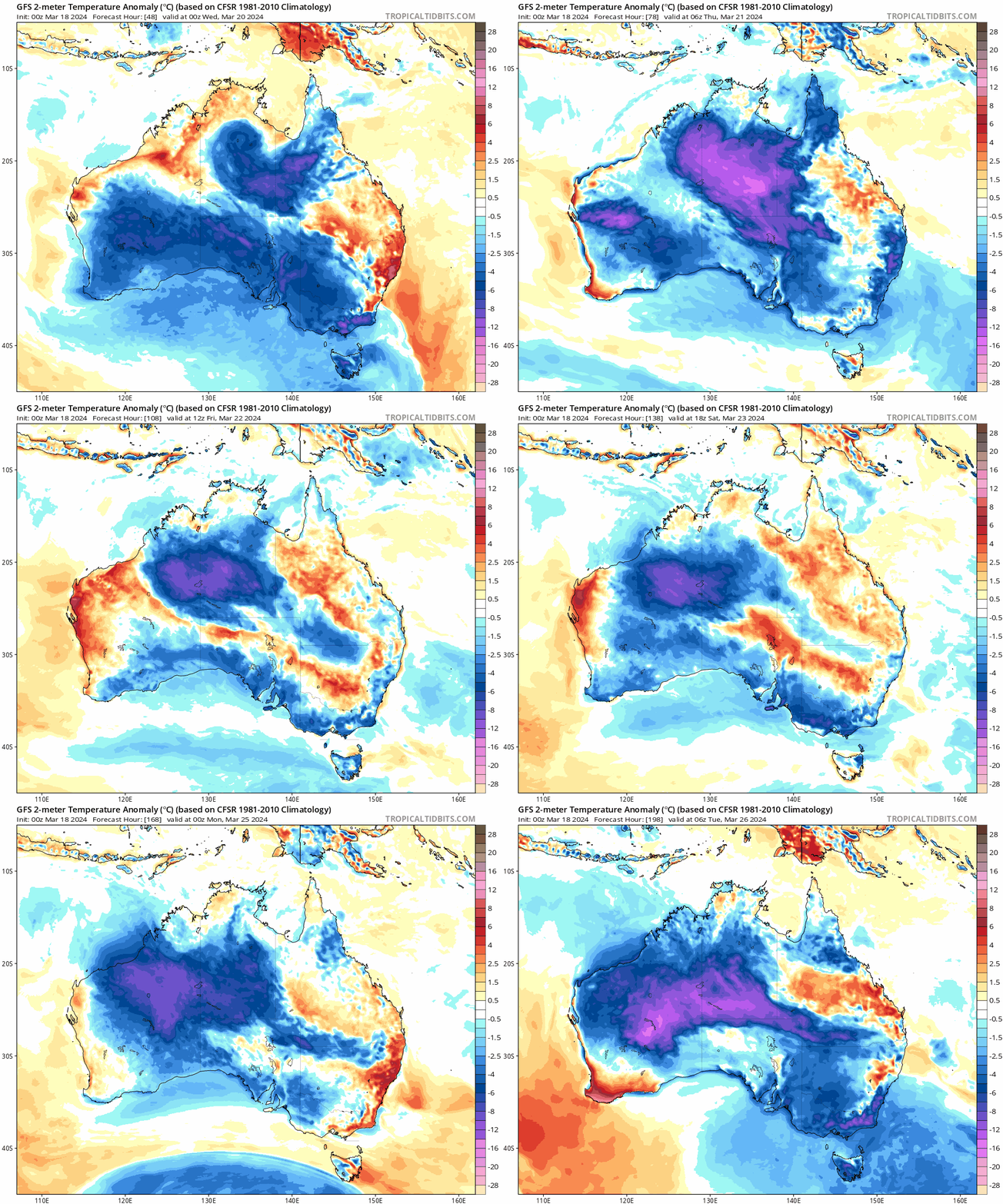
This past week, the Australian continent saw temperature anomalies of up to 28°C below the multi-decadal norm, affecting large regions:

GFS-2m temperature anomalies (°C) March 20 – 26, 2024 [tropicaltidbits.com]

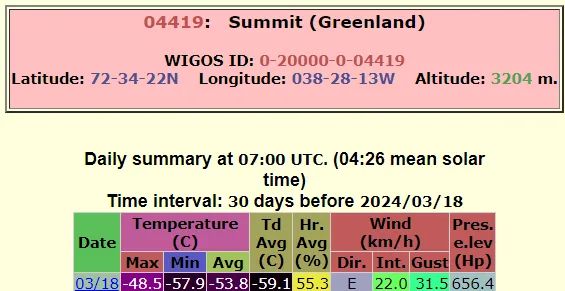
–57,9°C in Greenland

Temperatures in Greenland have fallen sharply as the thermometer in Summit showed -55.1 °C on Saturday.

On Monday it got even colder, falling to -57.9 °C, That’s about 15 °C below the seasonal norm.

Link: https://electroverse.substack.com/

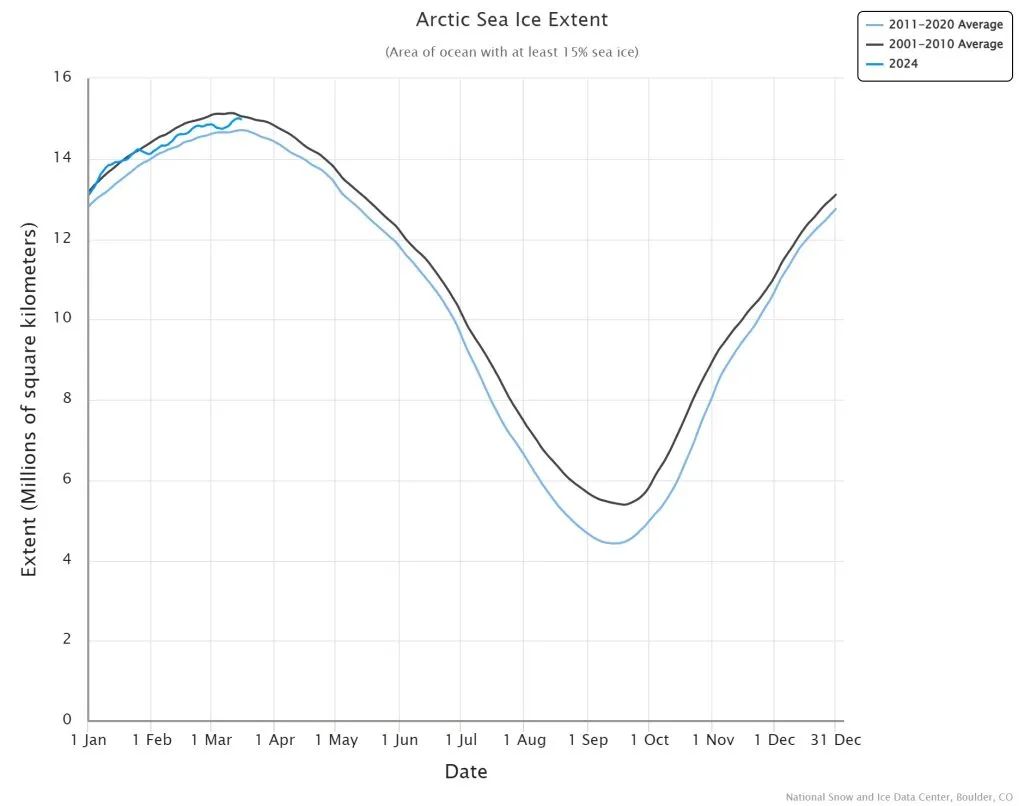
The exceptional cold in the far north has contributed to Arctic sea ice extent to be above the average for the period 2011-2020, and is rapidly approaching the average for the period 2001-2010.


Chart: https://electroverse.substack.com/

Obviously the Arctic is surprising the experts, who warned that sea ice there was supposedly in rapid decline.

Unusual, record-breaking cold in India

Intense cold persists in Indian cities like Bhubaneswar, Cuttack, Puri, Chandbali, Paradeep and Baripada, which are experiencing record-breaking low temperatures. On Wednesday, many places in the eastern state of Odisha experienced the coldest March days ever. In Bhubaneswar, a maximum temperature of only 19.2 °C was recorded yesterday, breaking the previous record of 24.3 °C by a whopping 5°C!

In northern India, snow from the north is bringing down temperatures in the lower latitudes in central and southern India. In many cities, including the eastern metropolitan cities of Bhubaneswar, Cuttack, Puri, Chandbali, Paradeep and Baripada, record low March temperatures were recorded, beating benchmarks from the 1970s and beyond.

Record low in New Zealand

In the southern hemisphere, where summer has come to an end, the temperature in Whanganui, New Zealand dropped to 4°C on Wednesday morning, the second lowest March temperature in the town’s history. The lowest March low of all time was recorded on March 28, 1985 (solar minimum of the 21st cycle) at 2.5 °C.

New lows recorded in Australia

A severe cold snap has hit southeastern Australia. In the mountains of New South Wales, there was frost in the Perisher Valley with temperatures as low as -5.7°C. This is only 1.4°C above the national record for the month of March. Thredbo recorded -4.4°C. Cooma also recorded an impressive -1.9°C.

In Mt. Hotham, Victoria, the national record was missed by just 1.2°C, at -3.1°C. Monthly records also fell in Omeo, Victoria: on Thursday morning, the temperature of -0.7°C was a whole 1°C below the previous record (2021).

And in Cleve, South Australia, the temperature of 6.8 °C also exceeded the old record by 1 °C (yet to be confirmed).

Temperature in Antarctica plummets to near -68°C

On March 21, the seasonal minimum at Concordia dropped to -67.7°C, from -67.4°C on March 20.
Antarctica is cooling, the data is clear…

Full report (in German) at EIKE here:
Compiled by Christian Freuer

Also see: electroverse.substack.com/

Donate – choose an amount

via NoTricksZone

https://ift.tt/Sbo5dUX

March 24, 2024 at 06:02AM

Climate Hoax Zapped: Northern Lights cause enough warming to lower heating bills

Here’s the study and Washington Post coverage.

via JunkScience.com

https://ift.tt/jnzGClT

March 24, 2024 at 05:11AM