
“Ebike ‘graveyard’ spotted outside Altens unit after operator pulls out of Aberdeen rental scheme” Ebike ‘graveyard’ spotted outside Altens unit after operator pulls out
via Real Climate Science
March 20, 2024 at 04:09PM
“Ebike ‘graveyard’ spotted outside Altens unit after operator pulls out of Aberdeen rental scheme” Ebike ‘graveyard’ spotted outside Altens unit after operator pulls out
via Real Climate Science
March 20, 2024 at 04:09PM
Essay by Eric Worrall
“… exchanged messages with others who shared his hatred of government in groups called Earth Militia, Total Earth Liberation and Neo Luddite Action. …”
Jacob Graham: Left-wing anarchist jailed for 13 years over terror offences after declaring he wanted to kill at least 50 people
The security services uncovered Jacob Graham’s activity as part of an investigation into the purchase of chemicals online, it can be disclosed.
By Duncan Gardham, security journalist
Tuesday 19 March 2024 09:17, UKA left-wing anarchist has been jailed for 13 years for preparing acts of terrorism by compiling and sharing a bomb-making manual, after declaring he wanted to kill at least 50 people.
Jacob Graham, 20, from Norris Green, Liverpool, dedicated his manual, called the “Freedom Encyclopaedia”, to “misfits, social nobodies, anarchists, [and] terrorists past and future, who want to fight for freedom against the government”.
The judge said the college student was a “dangerous young man”, adding that Graham described himself “as the first UK home-grown terrorist”.
The security services uncovered Graham’s activity as part of an investigation into the purchase of chemicals online, it can be disclosed.
When they raided the home he shared with his mother and sister, they discovered he had filmed bomb-making experiments in his back garden and buried supplies in a secret woodland hide in Formby, Merseyside.
…
On a wall in his bedroom, Graham had printed out a picture of a car bomb exploding with the words: “Make politicians afraid to start their cars again.”
…
The court heard Graham came to idolise an American terrorist called Theodore Kaczynski – known as the Unabomber – after watching a Netflix series called Manhunt, and pledged to “finish what he started”.
…
If Jacob was just a fantasist, he is paying a heavy price for his sick fantasy.
On one hand it doesn’t sound like Jacob actually killed anyone. But the evidence of Jacob mixing with green extremists online, drawing up kill lists, stockpiling dangerous chemicals and urging others to commit terrorist acts couldn’t be ignored.
In 2017 Manchester was the victim of a horrific mass casualty terror attack, the Manchester Arena Bombing, so Manchester police don’t have much patience with locals boasting about all the people they plan to kill.
Manchester prides themselves on their climate education programme for children. I don’t know whether any of this contributed to Jacob’s extremism, but given plentiful evidence that children are growing increasingly anxious about climate change, and the disturbing evidence revealed by this case, that young eco-extremists are freely discussing ecoterrorism online and encouraging each other to commit atrocities, perhaps education authorities should stop pouring fuel on the fire and scale back their climate messaging for kids.
via Watts Up With That?
March 20, 2024 at 04:03PM
Eight years ago, talkshop readers helped film maker Martin Durkin finance ‘Brexit the Movie‘, raising over £8000 towards the total cost of production. Now, Martin has made the long awaited sequel to ‘The Great Global Warming Swindle‘ with help from long time fellow sceptic Tom Nelson. It’s called ‘Climate the Movie: the Cold Truth’ and you can watch it for free here, right now. Enjoy!
via Tallbloke’s Talkshop
March 20, 2024 at 03:11PM
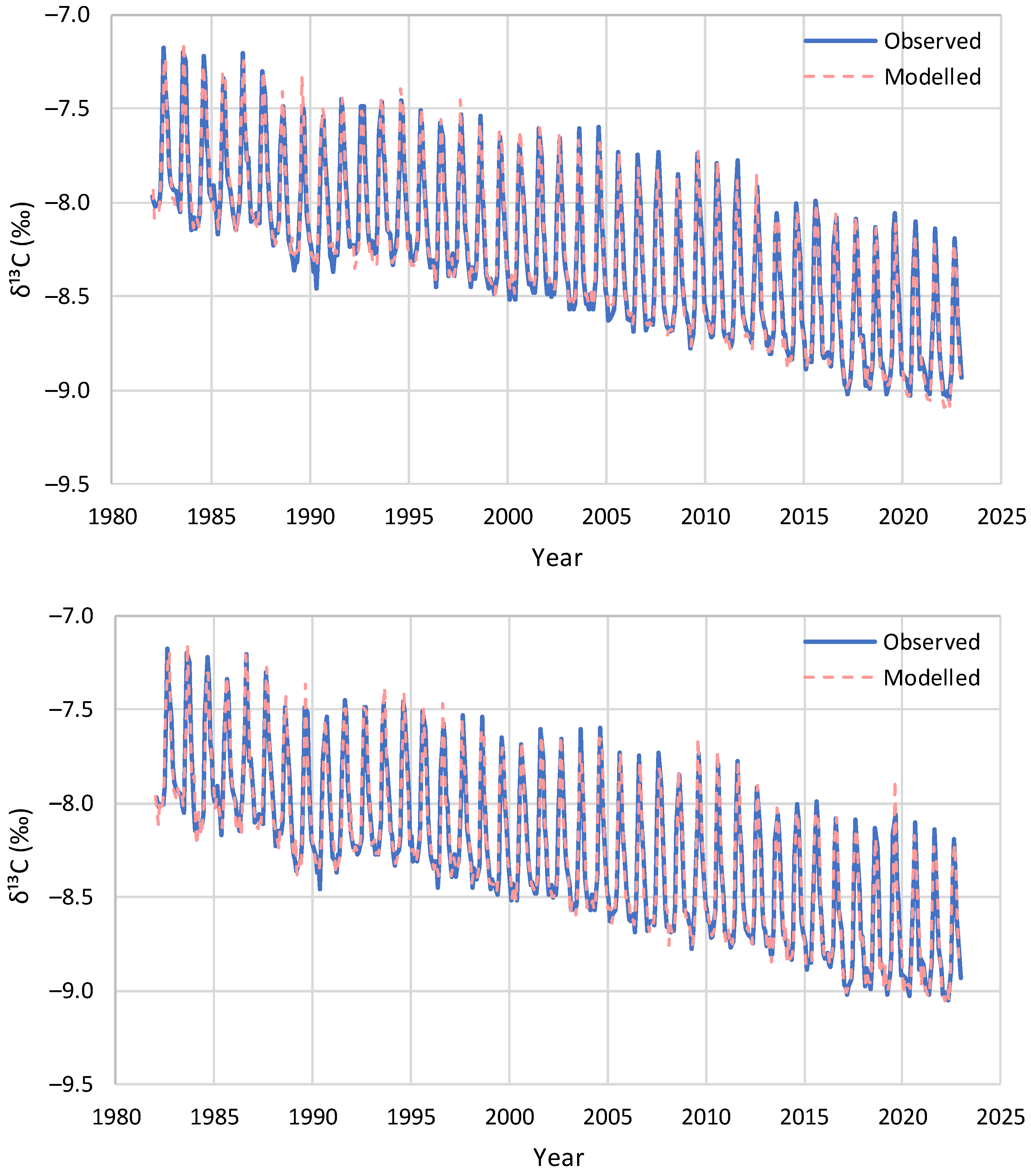
Figure 16. Model reproduction of the monthly observations of evolution of δ13C at Barrow: (upper) without update of initial conditions and (lower) with update of initial conditions in each step by the δ13C observations.
While numerous studies support the title conclusion, the most recent and thorough analysis comes in the paper Net Isotopic Signature of Atmospheric CO2 Sources and Sinks: No Change since the Little Ice Age by Demetris Koutsoyiannis. Exxcerpts in italics with my bolds and added images. H/T notrickszone
Recent studies have provided evidence, based on analyses of instrumental measurements of the last seven decades, for a unidirectional, potentially causal link between temperature as the cause and carbon dioxide concentration ([CO2]) as the effect. In the most recent study, this finding was supported by analysing the carbon cycle and showing that the natural [CO2] changes due to temperature rise are far larger (by a factor > 3) than human emissions, while the latter are no larger than 4% of the total. Here, we provide additional support for these findings by examining the signatures of the stable carbon isotopes, 12 and 13. Examining isotopic data in four important observation sites, we show that the standard metric δ13C is consistent with an input isotopic signature that is stable over the entire period of observations (>40 years), i.e., not affected by increases in human CO2 emissions. In addition, proxy data covering the period after 1500 AD also show stable behaviour.
These findings confirm the major role of the biosphere in the carbon cycle
and a non-discernible signature of humans.
The decrease [in the specific 14C activity of wood at time of growth during the past 50 years] can be attributed to the introduction of a certain amount of C14-free CO2 into the atmosphere by artificial coal and oil combustion and to the rate of isotopic exchange between atmospheric CO2 and the bicarbonate dissolved in the oceans.
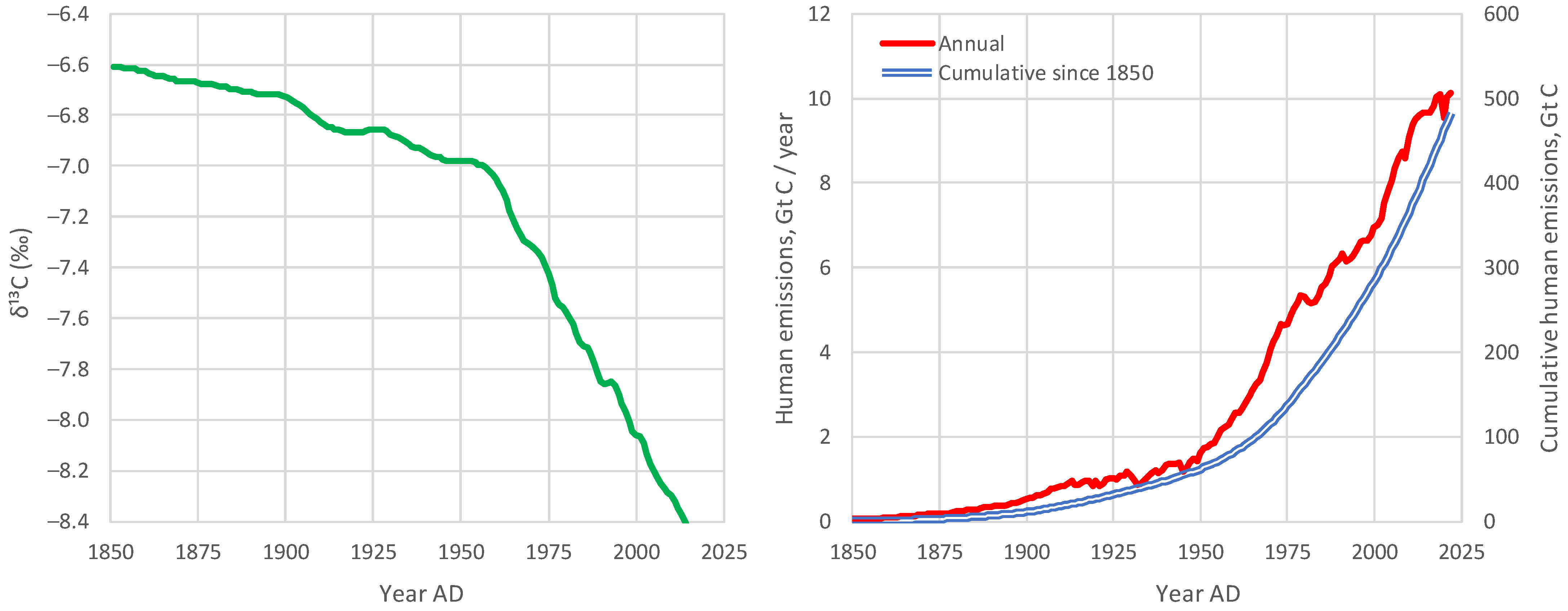
Figure 2. (left) Compiled data set of annual mean, global mean values for δ13C in atmospheric CO2, from Graven et al. [12], reconstructed after digitisation of Figure 3 of Graven et al. [8]; and (right) evolution of global human carbon emissions [13,14], after conversion from CO2 to C (dividing by 3.67).
For example, Andres et al. [15,16] stated:
The carbon isotopic (δ13C, PDB) signature of fossil fuel emissions has decreased during the last century, reflecting the changing mix of fossil fuels produced.
Also, in their recent review paper, Graven et al. [8] noted:
Since the Industrial Revolution, the carbon isotopic composition of atmospheric CO2 has undergone dramatic changes as a result of human activities and the response of the natural carbon cycle to them. The relative amount of atmospheric 14C and 13C in CO2 has decreased because of the addition of 14C- and 13C-depleted fossil carbon.
These generally accepted hypotheses, however, may reflect a dogmatic approach, or a postmodern ideological effect, i.e., to blame everything on human actions. Hence, the null hypothesis that all observed changes are (mostly) natural has not seriously been investigated. However, there are good reasons for this investigation. It is a fact that the biosphere has become more productive and expanded [5,17,18,19], resulting in natural amplification of the carbon cycle due to increased temperature. This fact may have been a primary factor for the decrease in the isotopic signature δ13C in atmospheric CO2. Note that the emissions of the biosphere are much larger than fossil fuel emissions (where the latter are only 4% of the total) [5] and, as seen in Figure 1, the biosphere’s isotopic signature δ13C is much lower than the atmospheric (see also Section 6).
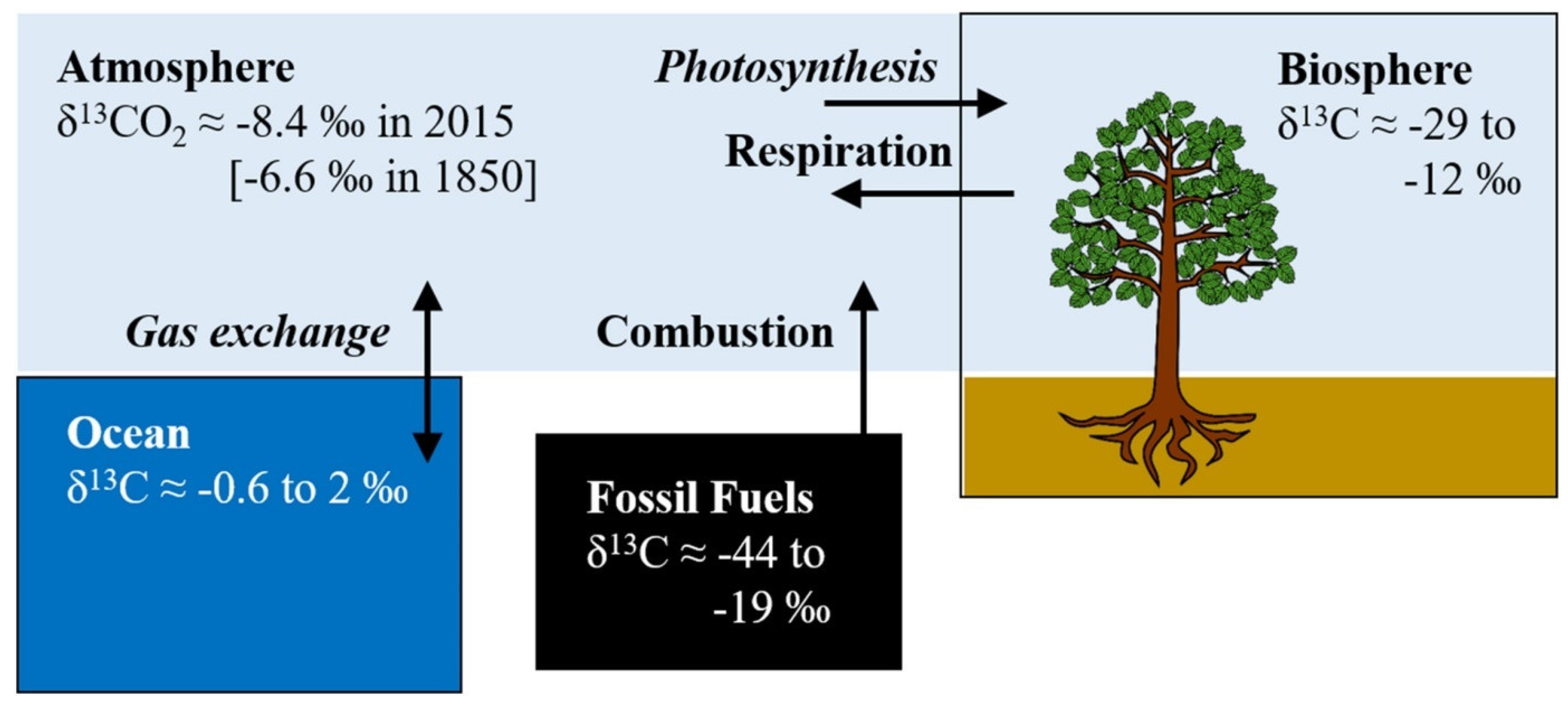
Figure 1. Typical ranges of isotopic signatures δ13C for each of the pools interacting with atmospheric CO2, and related exchange processes.
In addition to the biosphere’s action, other natural factors also affect the input isotopic signature in the atmospheric CO2. These include volcano eruptions, among which, in the recent period, the Pinatubo eruption in 1991 is regarded as the most important, as well as the interannual variability related to El Niño—Southern Oscillation (ENSO) [8].
To investigate the null hypothesis and answer the two research questions posed above, we use modern instrumental and proxy data, as described in Section 2. We develop a theoretical framework in Section 3, which we apply to the data in a diagnostic mode in Section 4, and in a modelling mode in Section 5. The findings of these applications are further discussed in Section 6 and the conclusions are drawn in Section 7.
With only two parameters, δ13CU and δ13CD, which represent the input isotopic signatures for the seasonal increasing and decreasing phases of [CO2], respectively, we are able to effectively model the isotopic signature δ13C of the atmosphere for the entire observation period. Of these parameters, δ13CD, reflecting the fractionation by photosynthesis, can be assumed as the same for the entire globe, while δ13CU varies, with smaller (more negative) values as we go north and higher (less negative) values as we go south. This spatial variation of δ13CU reflects the differences of the strength of seasonality in [CO2] and δ13C, which is at a maximum toward the North Pole and at a minimum at the South Pole.
The strong seasonality at high latitudes north is probably related to the processes in boreal vegetation, the dominance of snow and ice in winter, and the absence of photosynthesis during the 6-month night (note that Barrow, at a latitude of 71.3° N, is more north than the Artic Circle at 66.6° N). As we go south, some of these features cease to occur, and seasonality becomes less prominent, as photosynthesis occurs throughout the entire year, albeit with varying intensities. The minimal seasonality in the South Pole is probably related to the absence of vegetation due to the minimal appearance of land beyond a latitude of 43° S (with the exception of the frozen continent of Antarctica and a relatively small wedge of land in South America). All these suggest the dominance of terrestrial biosphere processes in driving [CO2] and δ13C
.
Despite differences in seasonality, the over-annual input isotopic signature δ13CI remains almost the same globally, as seen in Table 4, which summarizes the results of all analyses, diagnostic and modelling, suggesting similar values, irrespective of the method used. This is not difficult to explain as, in the long run, CO2 is well mixed in the atmosphere; thus regional differences in seasonal δ13CI tend to disappear.
In both the diagnostic and the modelling phases of this paper, the inclusion of human emissions proved unnecessary. This may contrast with common opinion, which blames all changes on humans, but is absolutely reasonable, as humans are responsible for only 4% of carbon emissions. In addition, the vast majority of changes in the atmosphere since 1750 are due to natural processes, respiration and photosynthesis, as articulated in the recent study by Koutsoyiannis et al. [5] and schematically depicted in Figure 22, reproduced from that study.
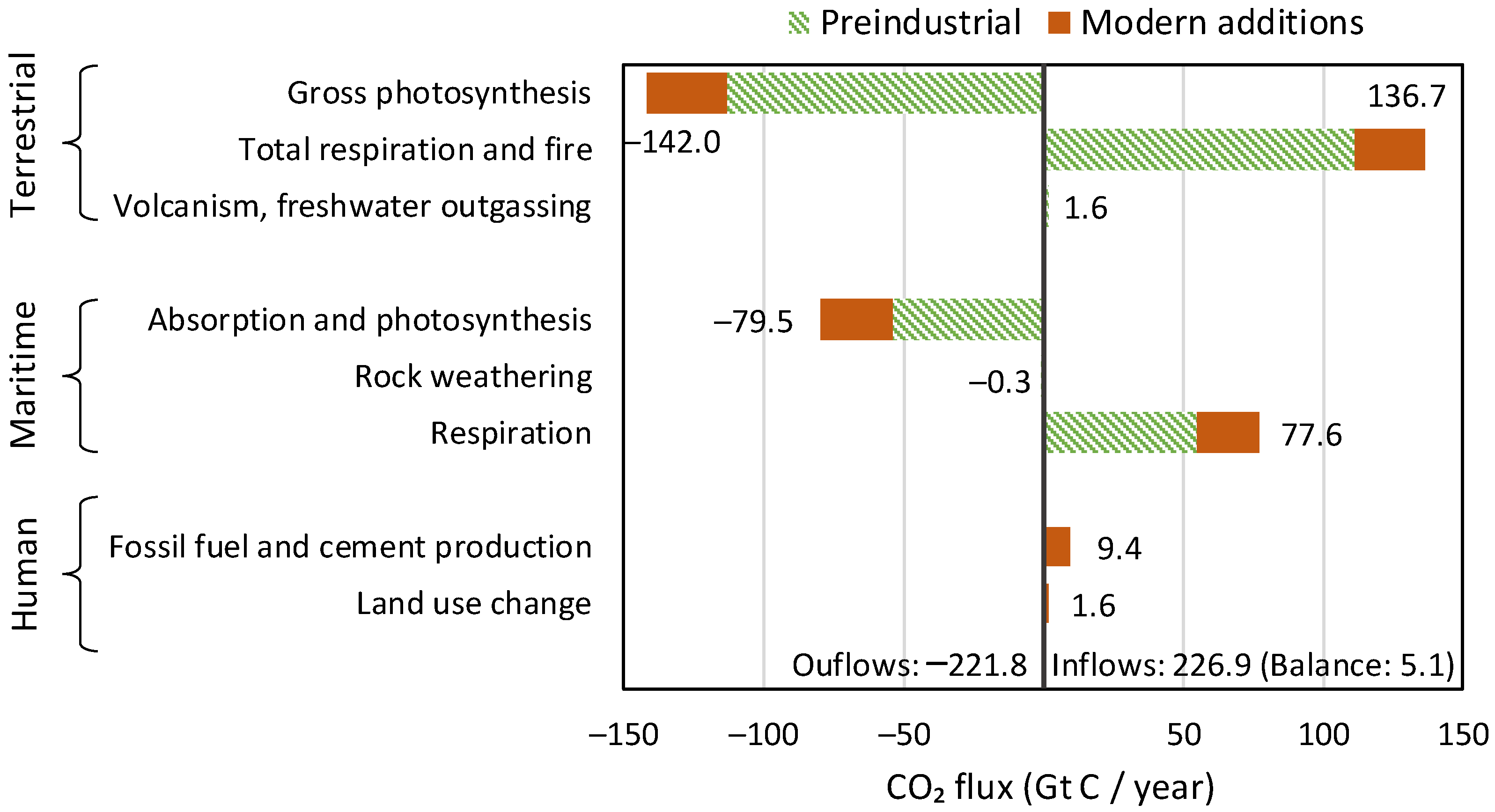
Figure 22. Annual carbon balance in the Earth’s atmosphere, in Gt C/year, based on the IPCC estimates (Figure 5.12 of [30]). The balance of 5.1 Gt C/year is the annual accumulation of carbon (in the form of CO2) in the atmosphere (reproduced from [5].).
 From modern instrumental carbon isotopic data of the last 40 years, no signs of human (fossil fuel) CO2 emissions can be discerned; Proxy data since the Little Ice Age suggest that the modern period of instrumental data does not differ, in terms of the net isotopic signature of atmospheric CO2 sources and sinks, from earlier centuries. Do these results refute the hypothesis that CO2 emissions contribute to global warming through the greenhouse effect? Do these findings, by suggesting a minimal human impact on the isotopic composition of atmospheric carbon, contradict the need to reduce CO2 emissions? Are human carbon emissions independent from other forms of pollution, such as emissions of fine particles and nitrogen oxides, which can have harmful effects on human health and the environment?
 via Science Matters
March 20, 2024 at 03:04PM
 Iowa Climate Science Education