
Gabriella welcomes back Andrew Sandstorm to discuss the latest news surrounding Bears Ears National Monument. Tune in to learn more.
via CFACT
March 20, 2024 at 02:35PM
Gabriella welcomes back Andrew Sandstorm to discuss the latest news surrounding Bears Ears National Monument. Tune in to learn more.
via CFACT
March 20, 2024 at 02:35PM
By Jo Nova
In a radical move, the CEO of an oil giant actually defended oil. For a brief moment the space-time continuum opened a worm hole to reality, and leaders of some of the worlds largest corporations briefly said sensible things.
The energy transition is falling apart so fast, even the prime targets of hate, the Big Oil Men themselves, are now openly pointing out what a waste of time and money solar and wind power are. BP was trying to cut oil production 40% until very recently when it flipped to increasing it. But now we have a whole conference of Big Oil
By Spencer Kimball, CNBC
HOUSTON — Saudi Aramco CEO Amin Nasser said Monday that the energy transition is failing and policymakers should abandon the “fantasy” of phasing out oil and gas, as demand for fossil fuels is expected to continue to grow in the coming years.
“In the real world, the current transition strategy is visibly failing on most fronts as it collides with five hard realities,” Nasser said during a panel interview at the CERAWeek by S&P Global energy conference in Houston, Texas.
We spent trillions of dollars and we have nothing to show for it:
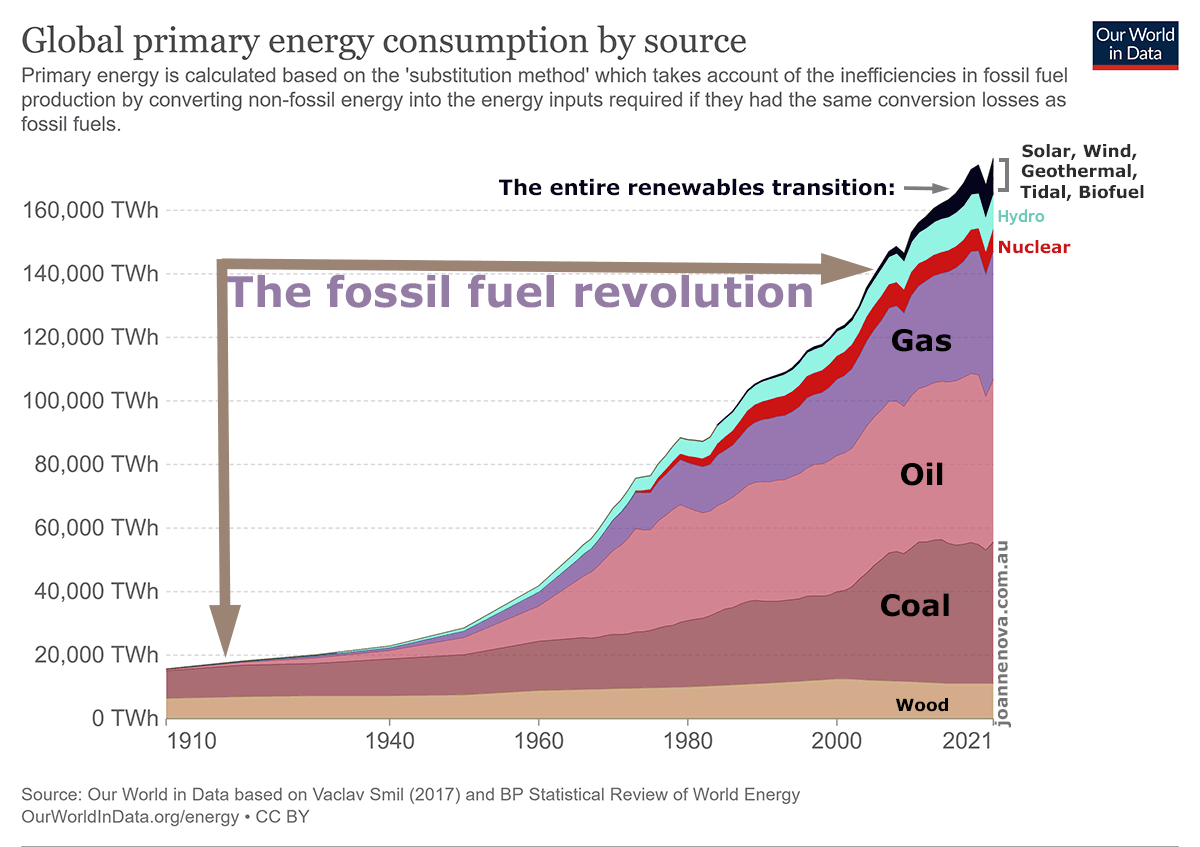
Nasser said alternative energy sources have been unable to displace hydrocarbons at scale, despite the world investing more than $9.5 trillion over the past two decades. Wind and solar currently supply less than 4% of the world’s energy…
Meanwhile, the share of hydrocarbons in the global energy mix has barely fallen in the 21st century from 83% to 80%, Nasser said.
This is the graph he was surely thinking of — the one that shows how irrelevant, inconsequential and trivial the whole “renewable energy transition” has been so far. See that black line…?
The free market cut six times as many emissions with energy efficiency measures as the socialists did with wind and solar and billions of your dollars:
The CEO said efficiency improvements alone over the past 15 years have reduced global energy demand by almost 90 million barrels per day oil equivalent. Wind and solar, meanwhile, have substituted only 15 million barrels over the same period, he said.
For thirty years it’s been obvious that we could make bigger reductions in emissions by burning coal at hotter temperatures, and using shale gas when we could, but instead of “saving the world” the Eco-Worriers really wanted to prop up their crony industries instead.
Australia is about to bolt headlong into a renewables quagmire that the rest of the world is starting to back away from. Spread the message!
0 out of 10 based on 0 rating
via JoNova
March 20, 2024 at 02:03PM
The UN Food and Agriculture Organisation (FAO), who is a little known off shoot of the UN, has published a report without mentioning that we should all be eating less meat and instead turning to bugs as an alternative. Is this a victory for our farmers? If so then it just shows what causing a bit of agro can do.
via climate science
March 20, 2024 at 01:35PM
Roger Caiazza
This is another article about New York’s climate “leadership” that I fear will trickle down to a state near you. Ken Girardin from the Empire Center breaks the story of New York’s latest attempt to shore up public support for the Climate Leadership & Community Protection Act (Climate Act). This article explains that the State “is especially concerned about certain areas of the climate program, noting they should be able to “immediately address emerging unforeseen events that draw media scrutiny”.
The Climate Act established a New York “Net Zero” target (85% reduction in GHG emissions and 15% offset of emissions) by 2050. Despite the enormous impacts to energy affordability, threats to electric system reliability, and mandates affecting personal energy choices I believe many New Yorkers are unaware of the law. In 2023 transition recommendations were supposed to be implemented through regulation, Public Service Commission orders, and legislation. Not surprisingly, the aspirational schedule of the Climate Act has proven to be more difficult to implement than planned.
NYS Seeks Spin Doctor To Fight Climate Law Critics
Girardin discovered that the New York State Energy Research and Development Agency (NYSERDA) are hiring a public relations outfit, using $500,000 per year of public money, to “maintain a positive narrative” and “respond to negative viewpoints” about the state’s Climate Act.
NYSERDA has been charged with supporting the technical analyses that are supporting the development and deployment of the Scoping Plan that outlines how to “achieve the State’s bold clean energy and climate agenda.” In brief, that plan is to electrify everything possible using zero-emissions electricity. Many aspects of the transition are falling behind, and the magnitude of the required actions is coming into focus. As a result, enough questions are being asked that the State has decided it needs to respond.
Girardin notes that the just-released request for proposal from the New York State Energy Research and Development Agency (NYSERDA) seeks:
public relations professionals or public relations firms interested in providing public relations/communications services to advance the goals of NYSERDA and the Climate Leadership Community and Protection Act (Climate Act) by building awareness of and support for the Climate Act and assisting in developing a narrative around New York State’s clean energy and climate priorities and providing rapid response communications services, if necessary.
He describes the genesis of the problem and current situation:
The law was passed without anything close to a cost estimate or feasibility study, and five years into its implementation, the Climate Act has created headaches for state officials. Among other things, the state Department of Environmental Conservation has blown off a statutory deadline to implement related regulations that would, among other things, ban replacement gas appliances and fossil-fuel furnaces and impose an economywide tax-like charge on businesses responsible for greenhouse gas emissions.
None of the reports or analyses have provided a transparent full disclosure of the assumptions, expected emission reductions, and costs for the implementation of control strategies. What is clear however is that NYSERDA has glommed on to the Climate Act funding as much as possible. NYSERDA’s payroll has doubled in the past decade. It already gets funding from a range of grants, taxes and energy-related charges, and Girardin notes that it’s not clear which would be used to fund this contract.
NYSERDA already has a sizable communications and marketing operation so this push to bring in outside help is remarkable. Girardin suggests that this proposal is tasked to what the State policy makers must think is a real problem:
The RFP doesn’t just want someone to promote the Climate Act. It specifically seeks someone who can “rapidly respond to negative viewpoints and perceptions about the State’s climate and clean energy goals under the Climate Act, the costs associated with the Climate Act, and challenges to particular policies and programs.”
Clearly, you can only hide the impacts to the state of a complete transformation of the energy system in the state for so long. Girardin points out that NYSERDA posted the RFP two weeks after a report from the Empire Center showed “how state officials had violated the law, misrepresented Climate Act costs and made fanciful assumptions about how the electric grid would function in 2030.“ I am not the only one who has been making similar arguments for many months so it is not surprising that these issues are getting traction despite the efforts of NYSERDA to date.
I thought Girardin laid out a strategy to raise issues when he described the primary concerns of the request for proposal (RFP). If these are their issues of concern then pragmatists like me should be strengthening our arguments about these topics.
The RFP suggests NYSERDA is especially concerned about certain areas of the climate program, noting they should be able to “immediately address emerging unforeseen events that draw media scrutiny” in areas including:
- “Questions and concerns on affordability for New Yorkers and direct costs to ratepayers as a result of the State’s clean energy and climate transition” including the cost of the planned “cap-and-invest” system.
- “Concerns related to the cost and practicality of supporting building decarbonization, the implementation of codes for same and a phase out of fossil fuels in new construction;”
- “Concerns related to transitioning cars, trucks, and SUVs sold in New York to zero emissions, and requiring all school buses in operation in the state to be zero-emission by 2035;” (This last policy, required by a separate state law, has given school districts sticker-shock, both with the cost premium of electric models and the unexpected cost of electricity infrastructure upgrades).
- “Challenges with the lithium-ion batteries and the scale up of stationary battery storage systems, as well as related fires, safety issues, and the work of the associated working groups.”
- “[A]ddressing the headwinds” related to the state’s large-scale renewable energy projects (and presumably NYSERDA’s decision to let offshore wind developers extort an extra $8 billion or so out of state electricity customers last month).
Girardin lays out an argument why this RFP is troubling at a higher level that I think is irrefutable.
Encouraging people to use less energy or to participate in state programs can serve the public interest by lowering costs for everyone or improving grid reliability. And educating them about a law’s existence to increase compliance is one thing, but spending public funds to “build support” and challenge accurate criticism sounds more like political speech that taxpayers should not be compelled to fund. If not unconstitutional, it certainly is illiberal.
What would the response have been if Governor George Pataki had used funds seized from low-level drug offenders to hire flacks to “maintain a positive narrative” that the Rockefeller drug laws were good and shouldn’t be changed? Or if an upstate county had used sales tax revenue to buy billboards to reduce support for the Climate Act, perhaps by telling residents how Climate Act programs to benefit New York City will soon be funded with hidden charges on their electricity bills?
It’s easy to imagine the—justifiably—breathless tantrums that would have ensued if a different administration had used NYSERDA funds to pressure lawmakers to repeal the state’s ban on natural gas fracking or obstacles to new nuclear power plants.
One of my biggest problems with the state’s implementation plan is the failure to acknowledge the misleading cost-benefit descriptions. Girardin shares my concern:
NYSERDA deserves extra skepticism because the state has gone to great lengths to keep people in the dark about the Climate Act. Legally required cost estimates for Climate Act programs were never released and the revised State Energy Plan, which would show where costs are headed, is several years overdue. NYSERDA spent a year in court fighting to block the release of a Cuomo-era study which appeared to raise doubts about the costs and feasibility of the state’s climate agenda.
He concludes that reality will eventually win out:
Ultimately it matters little what people are told about the Climate Act, by NYSERDA or otherwise. New Yorkers will in short order face higher fuel costs, higher property taxes, higher compliance costs and higher electricity rates, interspersed with news about businesses either leaving or cancelling investments because of energy concerns.
The Climate Act, on its own, will tell people exactly how it works. And that might be what NYSERDA fears most.
Conclusion
As a New Yorker this is yet another embarrassment. The State’s narrative is that everyone is on board with this fantastic plan that will “encourage other jurisdictions to implement complementary greenhouse gas reduction strategies and provide an example of how such strategies can be implemented”. It is not clear whether a plan that requires a spin doctor can serve as an example to others.
Despite the embarrassment it is encouraging that the State is scared enough that they have to go this route. The folks who have ignored this law are starting to wake up as the implementation plans roll out. Hopefully this is a sign that the inevitable pushback is starting.
Roger Caiazza blogs on New York energy and environmental issues at Pragmatic Environmentalist of New York. More details on the Climate Leadership & Community Protection Act are available here and an inventory of over 400 articles about the Climate Act is also available. This represents his opinion and not the opinion of any of his previous employers or any other company with which he has been associated.
via Watts Up With That?
March 20, 2024 at 12:05PM
 Iowa Climate Science Education