Month: March 2024

CONTRASTING VIEWS AT A COUNCIL MEETING

Members of the public have a wide range of views and in this short video we see two expressed.  Clearly a few people are very involved in campaigning for and against net zero. Most are not, but once they start to realise the true cost then I think we will see a few more sitting up and asking questions.

Net Zero is a stepping stone… (youtube.com)

via climate science

https://ift.tt/RD7m5sf

March 19, 2024 at 06:12PM

Coalition sues to block Virginia offshore wind project to protect the Right Whale

From CFACT

By CFACT Ed

Lawsuit filed by The Heartland Institute, the Committee for a Constructive Tomorrow (CFACT), and the National Legal and Policy Center

Construction of Dominion Energy’s offshore wind project comes as more and more dead whales are washing up on the Atlantic Coast

The North Atlantic right whale is so critically endangered that federal agency says it can endure not even one human-caused death a year

WASHINGTON, D.C. (March 18, 2024) – A coalition of public interest groups today is filing a lawsuit in the U.S. District Court for the District of Columbia against Biden administration officials and agencies seeking to overturn their approval of a massive wind turbine project off the shore of Virginia. The intent of the litigation is to stop Dominion Energy’s plans to start construction on May 1 in order to protect the North Atlantic right whales.

The lawsuit – which names the Bureau of Ocean Energy Management (BOEM), the National Marine Fisheries Service (NMFS), and others – claims the agencies illegally approved Dominion Energy’s offshore wind project by ignoring glaring and obvious procedural errors that subjects the endangered North Atlantic right whale to further grave harm.

At a time when incidents of dead whales washing ashore on the Atlantic coast are spiking, the lawsuit would force Dominion to cease construction of massive wind turbines for its Virginia Offshore Wind (VOW) project in the migratory and feeding waters of the North Atlantic right whale – of which experts say only about 350 individuals remain. The suit claims BOEM’s “biological opinion” issued in September 2023 wrongly determined the project would not produce any irreparable harm for the whale as a species during either the construction, operation, or decommissioning phase of the project.

READ A PRE-FILING DRAFT OF THE LAWSUIT HERE.

The VOW project consists of the 176 giant wind turbines – each tower taller than the Washington Monument, with turbine blades longer than a football field – to be constructed in the open ocean 25 miles off the coast of Virginia Beach, Virginia. If completed, the project would be the largest of its kind in the world.

This Dominion Energy project is but one of many massive offshore wind projects mandated by an executive order issued by President Biden on January 27, 2021, declaring that a “climate crisis” exists that “threatens mankind’s existence. The Biden administration has given fast-track approval to dozens of wind projects off the East Coast, with the goal of producing 30 gigawatts of electricity by 2030.

In issuing its “biological opinion” in September, NMFS only examined the impact that each of these projects, individually and in isolation, would have on the North Atlantic right whale. The agency did not, as it should have, issue a comprehensive and cumulative analysis examining the combined harm that all of the projects, together, would inflict on the whales during their annual migration path.

The courts, including the federal courts of the District of Columbia, have uniformly ruled that this approach is illegal in other endangered species cases because it misconstrues the language of the Endangered Species Act and creates, in the words of one court, “a type of slow slide into oblivion that is one of the very ills the Endangered Species Act was designed to prevent.”

The amount of federal waters leased for these projects constitutes an area larger than the states of Rhode Island and Connecticut combined. The North Atlantic right whales would be forced to navigate a gauntlet of 32 separate lease areas from Georgia to Maine twice each year.

This lawsuit would cause Dominion to halt construction on the project until BOEM has developed a new “biological opinion”, providing verifiable protection against potential harm to the North Atlantic right whale caused by these projects.

A total of 55 dead right whales have washed up on the beaches of the East Coast since 2017, causing the federal authorities to declare an “unusual mortality event” and create two areas of “critical habitat” for the whale – one off the coast of Maine and one off the coast Georgia. The North Atlantic right whale is a critically endangered species with only about 70 females capable of producing newborn calves.

The North Atlantic right whale is so critically endangered that NMFS has issued a determination for the chances of survival for the species called the Potential Biological Removal Rate (PBR). The PBR for the NARW is 0.7, which means that if the species is to survive, there must be zero human-caused mortalities of the NARW on an annual basis.

The following statements may be used with attribution. For more comments, to schedule an interview, or to speak to the attorneys handling this case, please contact VP and Director of Communications Jim Lakely at jlakely@heartland.org or call/text 312-731-9364.

Craig Rucker, president of CFACT and also one of the individual litigants, said, “This piecemeal, incremental step analysis by BOEM is a textbook violation of the Endangered Species Act. Every court, including the District of Columbia, has held this individual approach to be illegal. Dominion Energy must be prevented from engaging in any offshore construction until the NMFS issues a properly determined Biological Opinion.”

Heartland Institute President James Taylor said: “This erroneous biological opinion issued by NMFS is a classic example of abdication of its duty to provide meaningful protection for an endangered species. Playing politics with such an iconic species as the right whale is an unfortunate example of the Biden administration’s allegiance to climate alarmism.”

Peter Flaherty, Chairman of NLPC, said: “This project is not in the interests of Dominion Energy shareholders or customers. It was only approved because Dominion Energy has undue influence on Virginia politics through outsized contributions to both Democrats and Republicans. Because the political process is so tainted, we are pleased to join with CFACT and Heartland to make Dominion accountable through the courts.”

Marc Morano, founder of Climate Depot, said: “I am grateful that CFACT has stepped forward and filed a suit with such an obvious likelihood for success to halt the construction of these offshore wind monstrosities. This is nothing less than the industrialization of the habitat of the right whale, and the claim that construction of these wind factories will positively impact the climate is ludicrous.”

The plaintiffs are represented by David P. Holland, an experienced environmental lawyer with the law firm of Gatzke Dillon & Ballance LLP in Carlsbad, CA, and Paul D. Kamenar, Washington, D.C, counsel to the National Legal and Policy Center.

###

Read a pre-filing draft of the lawsuit here

via Watts Up With That?

https://ift.tt/IOExFAZ

March 19, 2024 at 04:02PM

Though Europe Was Mild, Winter’s Been A Beast Over Much Of Northern Hemisphere

Cold report No. 11 / 2024

By  Christian Freuer for EIKE.

Excerpts translated by P. Gosselin

Photo: © P. Gosselin

Heavy snowfall hit large parts of Europe recently, including southern Spain. Several provinces in the Andalusia region remain under a snow warning following a “wintry” weekend, according to the Spanish weather authority Aemet, after Storm Monica caused heavy snowfall, strong winds and/or rough seas. According to Aemet, the largest amounts of snow will accumulate in the southern foothills of the Sierra Nevada.

Another meter of snow in Newfoundland

A late winter snowstorm dumped a meter of fresh snow on Newfoundland.

Significant amounts of ice were also observed on the Avalon and Burin peninsulas.
Preliminary figures show that one meter of snow fell in Kilbride, over 80 cm in Bay Roberts and 79.7 cm in Paradise – to name just three locations.

 Antarctic sea ice recovery

Anomalous/record-breaking cold continues to affect the lower part of the world. On Sunday, March 10, values below -60 °C were measured again in Vostok: -63.1 °C, to be exact.

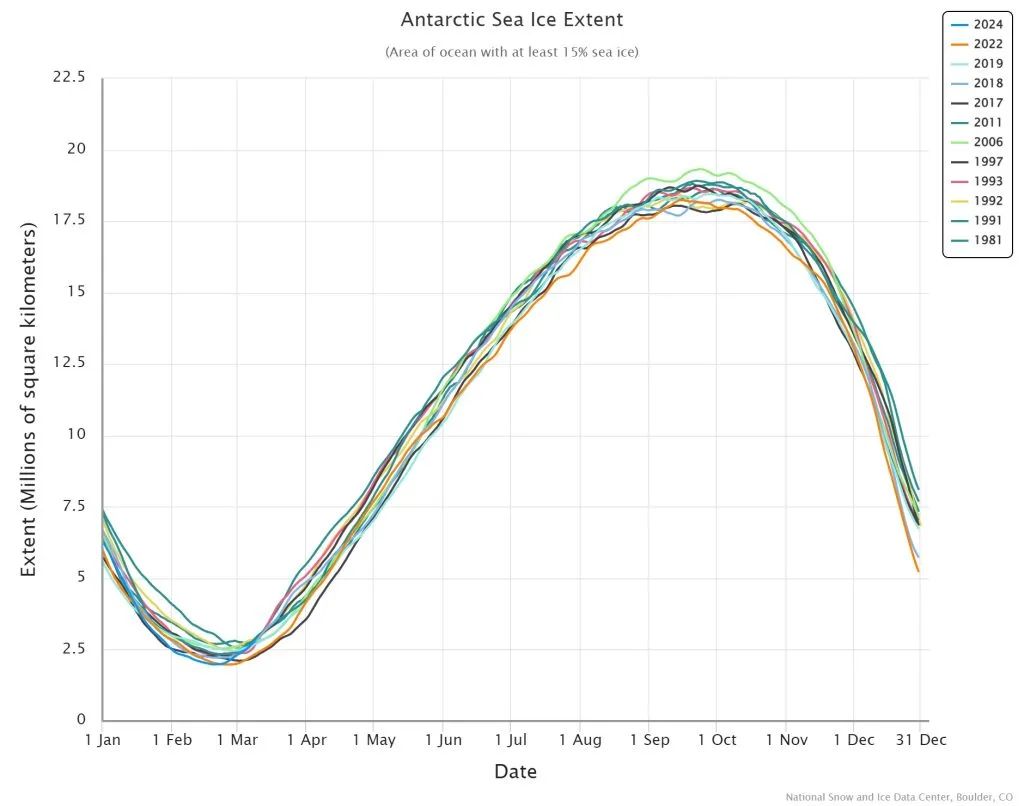
As for Antarctic sea ice, a remarkable – and “overlooked” by the MSM – reversal of fortune is taking place. The once cripplingly low extent is now higher (3,165,625 km²) than it was 27 years ago (3,075,000 km²).
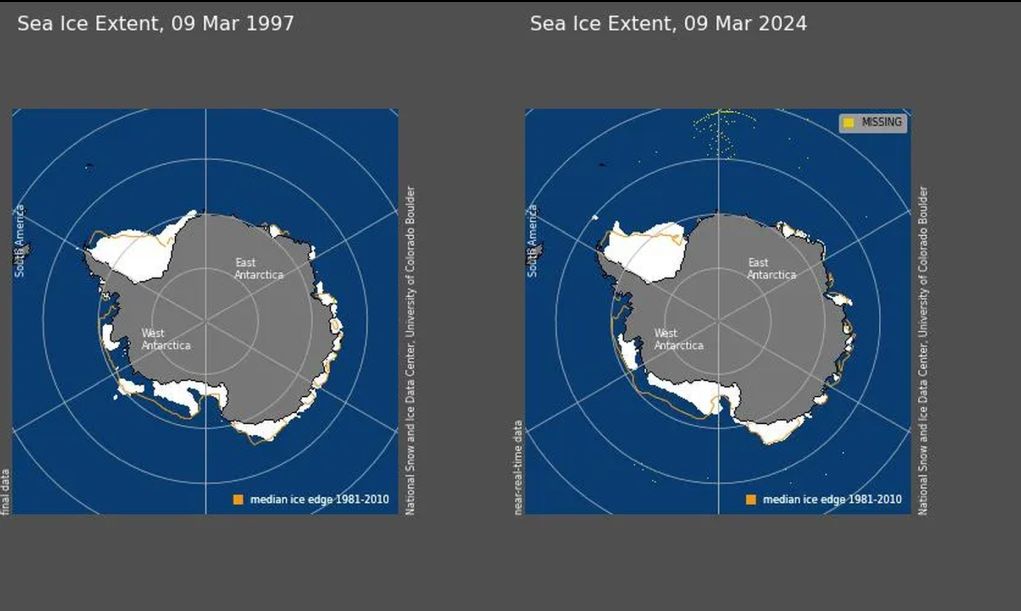
Just as in 1997, the ice extent today is greater than in 2023, 2022, 2019, 2018, 2017, 2011, 2006, 1993, 1992, 1991 and 1981:
NSIDC

Five dead from snowstorms in the Alps

Severe snowstorms have battered the European Alps in recent weeks and the death toll is rising.

Five missing skiers have “frozen to death” in the Swiss Alps while trying to build a cave to protect themselves from the elements, rescuers say. A sixth is still missing and an intensive search is underway.

It has been snowing heavily in the Alps recently, a fact barely reported by the warmth-addicted mainstream. In Macugnaga, Italy, for example, another 75 cm of fresh snow fell on Sunday, with more than 3 m accumulating at altitude.
Despite claims to the contrary by the MSM, this has been a good snow season for the European mountains, with most peaks and ski resorts above average in terms of snowfall.

Western Canadian cold wave costs 180 million dollars

According to the Insurance Bureau of Canada (IBC), the extreme cold snap in Western Canada in January led to insured losses of at least 180 million dollars.

In British Columbia, Alberta and Saskatchewan, initial estimates indicate that most of the damage was to personal property, such as water damage from burst pipes. These estimates do not include the “catastrophic losses” suffered by many farmers in places like the Okanagan Valley in British Columbia, where grape growers lost their entire crop this year.

The brutal mid-January freeze dropped temperatures to a “deadly” -27°C in key wine-growing regions in B.C.’s southern interior.

A February report from Wine Growers BC said it expected an “almost complete write-off of the 2024 vintage” with $346 million in lost revenue for vineyards and wineries.

“It was an unusual winter season with extreme variability in conditions across the country,” said Rob de Pruis of the IBC.

West gets buried by March snowstorms…

In a matter of days, a series of snowstorms that battered the Sierra Nevada changed the outlook for water supplies from a “1,200-year megadrought” to “help, we’re all going to drown,” according to federal resource managers (I’m paraphrasing a bit here).

After a four-day snowstorm that began on Leap Day, the snowpack in the Eastern Sierra increased by a record-breaking 30%.

By the end of the heavy snowstorm, above-average snowpacks were measured in the California and Nevada basins – a twist of fate that caused vehicles to get stuck and highways to be closed between the two states.

According to official data, the intensity of the four-day snowstorm was also among the strongest ever recorded. Since 1981, only three storms have brought more snow over four days than this year’s blizzard.

Nevada

Nevada also benefited from the increased snowfall in the Great Basin. Snow levels in the Upper Colorado Basin, for example, are now at 105% of normal. In addition, last year’s record snowpack has continued to buffer Nevada’s reservoirs and “allowed for some carryover,” according to Thomas Albright, interim climatologist for the state of Nevada.

The increasing snowpack this year could actually bring a longer period of rain (of more than two years in a row) for the first time this century, said Dan McEvoy of the Western Regional Climate Center.

“We’ve had more events since 2000, with some of the wettest and driest years on record in the last decade alone, but no consecutive trends,” McEvoy added.

Utah

The Alta ski area in northern Utah has also seen good snowfall in recent weeks.

After last year’s record snowfall, it may come as a surprise to hear that the snowpack on March 1, 2024 was actually two centimeters deeper than March 1, 2023 (386 cm) and only 4 centimeters away from beating the resort’s February record.

Alta averaged over 13.5 cm of snow per day last month, making it the third snowiest February on record.

“Severe snowfall” in Portugal

The Portuguese ski resort of Serra da Estrela reports that it has “the best conditions in years” after the “enormous snowfall” over the weekend.

Like most ski resorts in Europe, Serra da Estrela is experiencing a kind of post-season deluge, as a huge storm from Friday to Sunday buried lifts and buildings under meters of snow:

Serra da Estrela after a snowstorm in March 2024.

Despite the access problems, the area is fully open with 22 slopes.

Arctic sea ice above average

As with Antarctic sea ice extent – see above – the upper part of the world is doing exceptionally well, considering that this is the “hottest year in the last 125,000 years”.

The official data shows that Arctic sea ice extent is well above the multidecadal average:
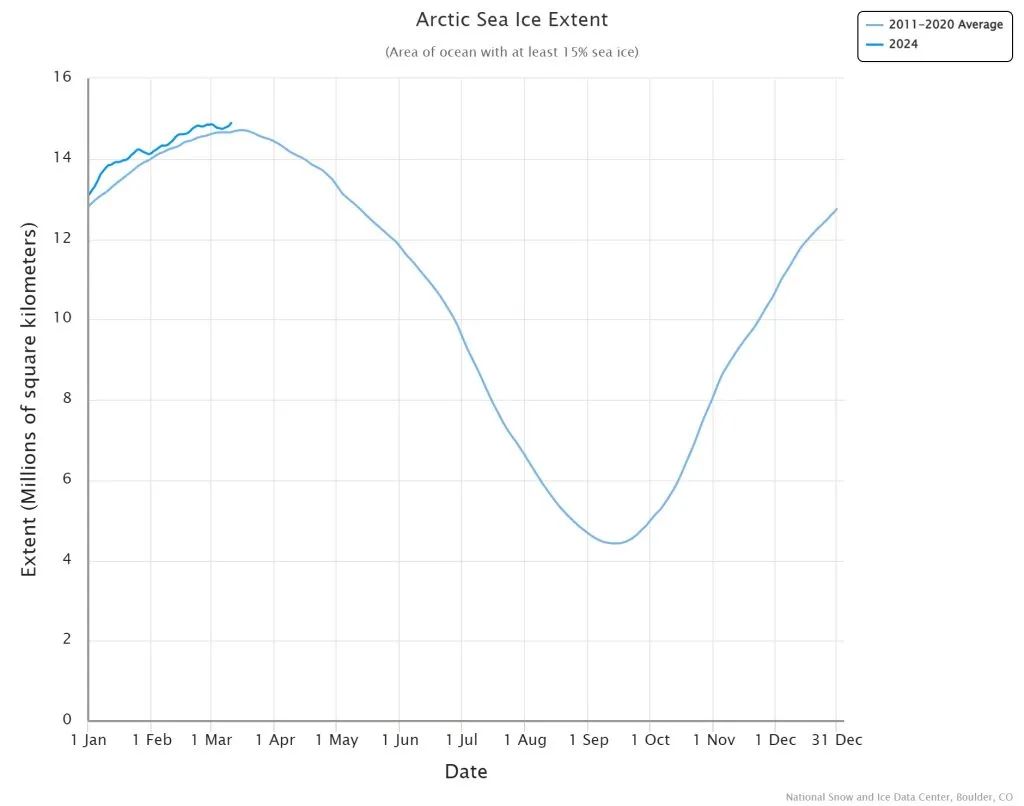
NSIDC

It is also well above the 21st century average.

To illustrate this in a way that even the most deluded alarmist can understand, the extent of Arctic sea ice today is the same as it was in 1995, when Al Gore was Vice President:

There’s a reason we haven’t heard much about the Arctic in recent months, and that’s because there’s nothing to worry about.

Heavy snowfall in Colorado

A severe storm is currently bringing meters of snow to Colorado, leading to the cancellation of flights and the closure of a major highway.

The blizzard, which began on Wednesday evening, is not expected to subside until Friday. It brought more than 90 cm of snow to the higher elevations by Thursday evening, with another 60 cm expected by Friday morning. In Denver itself, about 20 cm fell on Thursday and another 25 cm is expected.

Loveland Ski Area announced that it is closed. The other is Eldora Mountain “because the plow and grader cannot access the slopes on Shelf Road.” According to a release from the area, at least one day of work is required.

This is the first time in over 20 years that Eldora has been closed due to snow. The last time was in 2003 around St. Patrick’s Day.

Stark weather change in Toronto

From spring-like warmth to the return of winter, Toronto won’t know where it stands this week with a 24 degree Celsius temperature difference and snow in the forecast.

A chilly and wet St. Patrick’s Day on Sunday will give way to a very cold Monday. The Weather Network is predicting a daytime high of -2°C on Monday, although the actual temperature could drop as low as -4°C overnight.

Wednesday saw highs of 20°C, and within a few days we will see frost and snowfall – only a centimeter or two, but what a shock to the system, what a change between extremes.

According to the Weather Network report, “Drivers should prepare for the return of winter as the threat of snowfall in southern Ontario is not over.”

New blast of cold air in China

The Chinese region of Xinjiang recorded a remarkably low temperature of -52.3 °C in February, a new national record.

The snowfall in February was also exceptional.

Stories also at: https://electroverse.substack.com/l

Donate – choose an amount

via NoTricksZone

https://ift.tt/fKNeHbi

March 19, 2024 at 01:45PM

Academics “bewildered” that UN drops bugs, crickets and fake meat for weather-repair

Academics “bewildered” that UN drops bugs, crickets and fake meat for weather-repair

Cigarette style warnings on meat, UN.

By Jo Nova

Winning? For the moment the UN has quietly packed away plans to tell everyone to give up meat to stop bad weather

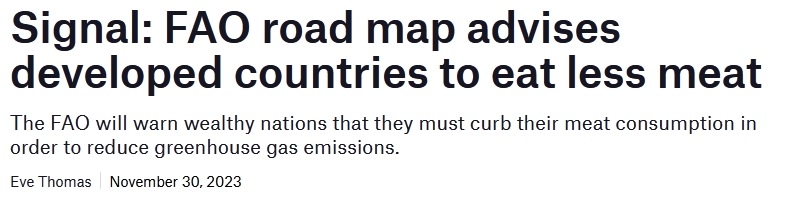
Back in November the UN was all set to boss the citizens of wealthy nations around. The plan was to badger them into giving up meat so their grandchildren would have slightly nicer weather.

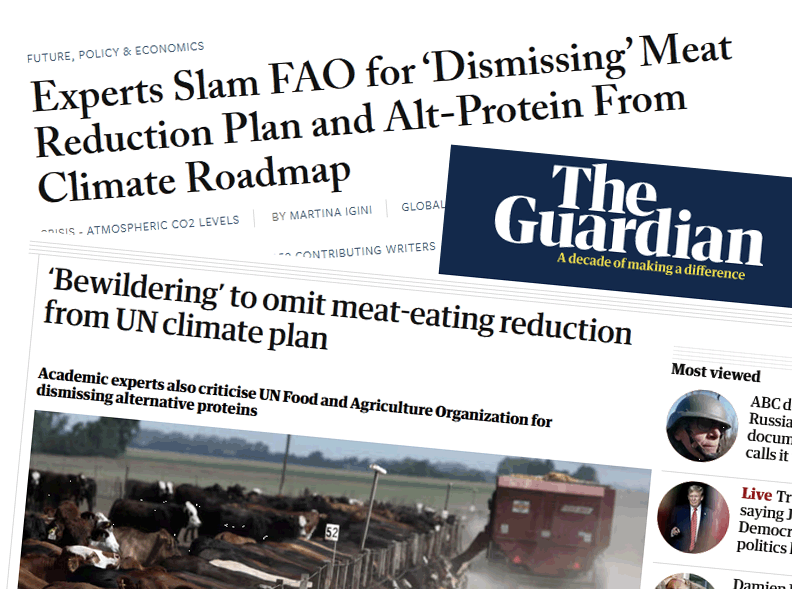
Possibly, after thousands of farmers stormed across the EU in their tractors this winter, the idea has lost its appeal.  Not that the UN has the honesty to explain why they changed their minds, or even to admit they did. But the first installment of the UN Food and Agriculture Organization (FAO) food systems roadmap has left the activists reeling.


The omission of meat-eating reduction from proposals in a UN roadmap to tackle the climate crisis and end hunger is “bewildering”, according to academic experts.

The group also criticised the UN Food and Agriculture Organization’s report for “dismissing” the potential of alternative proteins, such as plant-based meat, to reduce the impact of livestock on the environment.

For the first time ever, some activists even called for “transparency”:

In a commentary published in the journal Nature Food, experts said the FAO’s failure to include a methodology on how the 120 actions it did support were chosen, or a list of authors, was “concerning and surprising”. They called for the next instalments of the roadmap to be more transparent …

A group of academics has written a paper in Nature criticizing the UN group. They can’t believe the UN would miss an opportunity to promote vegetarian lifestyles and fake meat. The head of the FAO group defended himself, saying “Dietary change is mentioned eight times in the 50-page summary report” which sounds like nothing at all, especially when they don’t even mention “reducing meat”.

It may not last, but looks acts and smells like a win. Score 1 for the farmers…. the UN is being badgered by The People.


0 out of 10 based on 0 rating

via JoNova

https://ift.tt/HQpZdGU

March 19, 2024 at 01:21PM