
The inference being that temperatures were somewhat warmer at that period which rather undermines the current climate alarm.
via climate science
March 30, 2024 at 03:01AM
The inference being that temperatures were somewhat warmer at that period which rather undermines the current climate alarm.
via climate science
March 30, 2024 at 03:01AM
I was raised a Protestant, and from a young age it was expected I would serve, that I would be humble and that I would help other people. I can’t escape that, the values in which I was raised. My daughter has married a man, Christian Wright, who was raised with the same values, and who believes that serving other people is his highest purpose. He has spent the last almost forty years learning and working in often very remote communities, in emergency situations, and particularly with women and children. He is a nurse; a male midwife and he told me two days ago that there is a terrible disaster unfolding in the Sepik province of New Guinea. He has colleagues there who have asked for his help, so he is flying out of Seattle on Monday to assist.
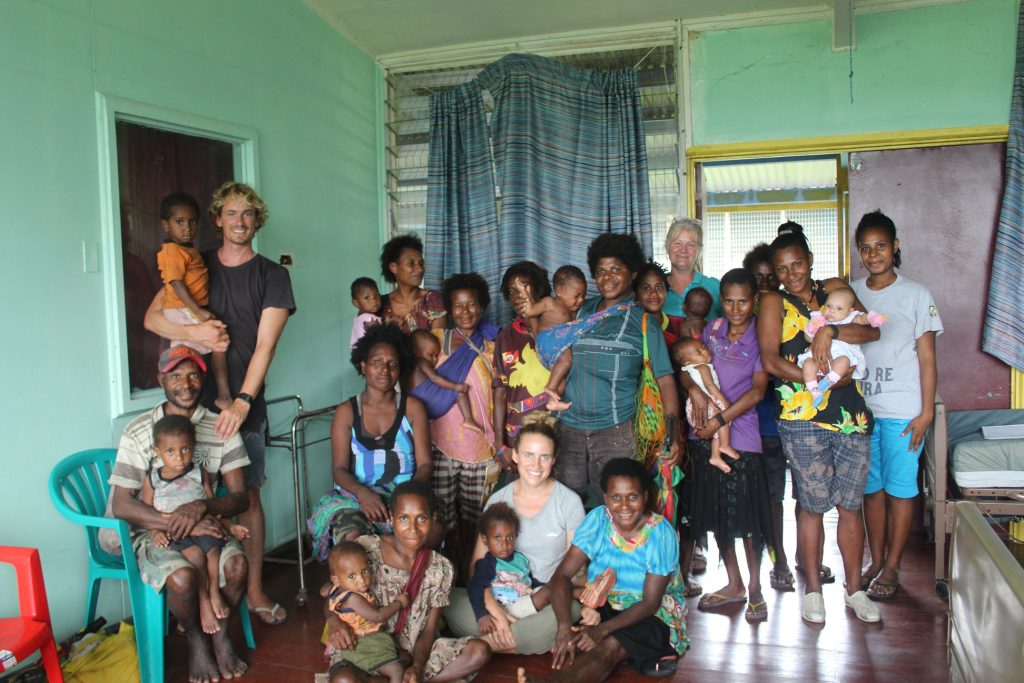
Sarah David, from Living Child Inc. explains:
Volunteers from Living Child Inc., a not-for-profit organisation supporting maternal and infant health in the province, were travelling in the area in partnership with East Sepik Provincial Health Authority, to conduct an audit of health centres, distribute clean birth kits and provide training to volunteer birth attendants, when the flood began. This region is often referred to as the ‘second Amazon,’ due to its remote nature and lack of infrastructure which present significant barriers to travel.
The Living Child/East Sepik Provincial Health team were in the vicinity of Ambunti when the earthquake struck early on Sunday morning. The houses in this area shook and water tanks were destroyed, leaving the community without a source of clean drinking water. As the team travelled back up the river, trees fell into the water. The team distributed clean birth kits and menstrual hygiene kits to villages along the river – a 9 hour boat journey upstream from Ambunti. These kits ensure that that any women who are pregnant will be able to give birth as safely as possible in the circumstances, and that women and girls who get their period will be able to manage this hygienically.
Living Child Inc. are partnering with the East Sepik Provincial Health Authorities to support sexual, reproductive, maternal, newborn, child and adolescent health during this State of Emergency. Local sources within our network have shared that there is an immediate need for food and clean drinking water, since vegetable gardens and water tanks have been destroyed.
Tomorrow is Easter Sunday, a day for reflection, for atonement, and for giving.
We are all Homo sapiens, of the one species, and we do best, and we are happiest, when we care for each other.
Consider giving to this campaign this Easter, CLICK HERE.
Thanks for your generosity.

via Jennifer Marohasy
March 30, 2024 at 02:11AM

Language matters. Orwell knew it, so does your local Ministry of Truth. Wind and solar propagandists know it too. They use ‘energy’, when consumers only care about ‘power’. They talk about wind and solar output in terms of meaningless averages, when consumers only care about having power as and when they need it, around-the-clock, whatever the weather, not when the sun is up or the wind is blowing.
They use ‘renewable’ as a mantra, conflating wind and solar power generators (which are hardly renewable) with stored or run of the river hydro and geothermal. Biomass generation (clearfelling forests and burning the timber harvested for power) somehow sneaks into the ‘renewable’ camp, too.
Rational thinkers are quick to concede that even hydro has its limits; droughts leading to empty dams (see above) or low river flows mean no power generated until the dam fills again, or the river starts flowing.
Then there’s the difference between electrical power and energy employed for other purposes. Electrical power generation is a fraction of the total energy being consumed in Western nations, on any given day.
The difference matters, particularly if the protagonists are making wild claims about powering the entire world with wind and solar. As a number of the more unhinged of their acolytes most certainly do.
Australian entrepreneur, Dick Smith found himself embroiled in a battle with the Ministry of Truth recently. The brawl began and ended with semantics, as Nick Cater explains below.
Tassie’s rich power exports damned by hydro hypocrites
The Australian
Nick Cater
25 March 2024
Dick Smith brushed shoulders with the truth police last week after claiming that Chris Bowen is attempting the impossible.
Smith claimed in an interview on 2GB that no country has managed to power an electricity grid solely with renewable energy. That is misinformation, according to the ABC’s Fact Checkers, who summoned Mark Z. Jacobson of Stanford University to testify on their behalf.
Professor Jacobson identified four national grids that ran on renewable energy: the Albanian Power Corporation, the Nepal Electricity Authority, the Bhutan Power Corporation and the National Electricity Administration of Paraguay. This is hardly good news for those who fear that chasing net zero will shrink our economy, since Paraguay, Albania, Nepal and Bhutan sit in the bottom half of world GDP rankings, while Australia is near the top. In 2022, the gross domestic product of the four economies combined was $US2550. Australia’s, for the record, was $US65,100.
The renewable energy exemplars do somewhat better when it comes to rain. Bhutan receives 1679mm in the average year, Nepal 1600, Albania 1485 and Paraguay 1270. The average annual rainfall across Australia is 433mm, according to the Bureau of Meteorology website. All four countries are powered entirely by hydro-electricity. This renders the ABC’s comparison spurious, except in Tasmania, Australia’s dampest, hilliest and poorest state, where the average rainfall on the west coast is almost double that of Paraguay.
Last year, Hydro Tasmania generated enough electricity to meet four-fifths of the state’s demand. The marginal cost of production is low, which would make electricity in the island state cheaper if not for the interstate agreement that obliges Tasmanians to share it with the energy mendicants in Victoria.
That could change if the next Tasmanian government sticks by its election promises. All this remains to be seen, however, as Labor leader Rebecca White conceded defeat on Sunday afternoon, and now caretaker premier Jeremy Rockliff seeks to strike a deal with the crossbench to form government. Whatever the case, both major parties pledged to curb sales of hydro-electricity to the mainland to bring down household power bills.
A hydro-reservation policy would undermine Bowen’s plans to turn Tasmania into the nation’s battery. It would also weaken the highly speculative business case for a second undersea cable to the mainland. The bi-directional Marinus Link has joined Snowy Hydro’s giant pumped hydro scheme and the VNI-West transmission line on the infamous list of energy mega-projects with inflated costs and embarrassingly protracted timelines.
The goal of making Tasmania energy self-sufficient grows more attractive as the cost of Marinus escalates. If a new Bass Strait link must be built, it could be built to handle one-way traffic in anticipation of the day when Tasmania will be able to export surplus clean energy to Victoria.
Yet economist Saul Eslake condemned the Tasmania-first energy policy last week as reckless. It would lead Tasmania down the Venezuelan path towards socialist disaster, Eslake told the Australian Financial Review. “They have crude oil coming out their ears, and, because of that, they think they can sell petrol to Venezuelans at 3.5¢ per litre,” he said.
Eslake argues that the loss of hydro-electricity export revenue will harm Tasmania’s economy and accelerate the exodus of Tasmanians to the mainland.
Yet Eslake’s argument is perverse. Reducing Tasmanian retail power prices relative to other states would help an incoming government attract new investment, particularly in the power-hungry digital economy. The energy demand for data processing and storage is driving the industry away from Silicon Valley towards countries such as Paraguay, where retail electricity is currently 8c a kWh, less than a third of the price in California and a quarter of the price in Australia.
There’s no use crying over spilt milk. Nevertheless, the doomed Gordon Dam above Franklin Dam would have put Tasmania on the Paraguayan path, minus the rampant corruption, human rights abuses and succession of military coups that have kept the landlocked South American nation from reaching its full potential.
In the early 1980s, when the Greens were chaining themselves to bulldozers in the Tasmanian forests, Paraguay was constructing the Itaipu Dam, named by the American Society of Civil Engineers as one of the seven modern wonders of the world.
It produces more than 40TWh of clean electricity annually, enough to meet the country’s demand four times over. Brazil, a joint partner in the project, takes the rest.
The Franklin Dam would have increased Tasmania’s hydro capacity to 4GW, comfortably more than the state’s current demand. Liberal premier Robin Grey won the 1982 Tasmanian election promising to build the dam, reduce electricity prices and attract jobs.
The Tasmanian government was overruled by the federal Labor government the following year in a decision later endorsed by the High Court. The rest is history: an effective moratorium on dam building has been in place for the past 40 years. Hydro-electricity’s role as the energy villain in the morality play of progressive politics is now played by coal. Hydro, along with solar, wind and biomass (or wood burning to the uninitiated) sits in the sacred ranks of renewable energy, an expression seldom heard outside of deep-green circles in the early 1980s.
The green movement, too, has shifted ground from its tree-hugging days. Its priority is no longer protecting the natural environment but saving the planet, which is an entirely different thing.
For example, new-wave eco-thought allows ministerial approval of Andrew Forrest’s Upper Burdekin wind turbine development in northern Queensland, despite an environmental report warning the development will have “unavoidable significant residual impact” on four endangered species: the Sharman’s rock-wallaby, the greater glider, the red goshawk and the koala. Even so, the chances of revisiting the Franklin project or any other hydro dam in Australia would probably be a step too far, even for a movement undisturbed by its own hypocrisy.
Which leaves a question hanging for the ABC’s Fact Checkers. Has anyone managed an emissions-free electricity grid in a developed economy without abundant hydro? Why, yes, claims the ABC’s expert witness. California, population 37 million, has been running entirely on WWS “for 10 out of the last 11 days for between 0.25 and 6 hours per day”, Professor Jacobson says.
By that logic, the ABC Fact Unit should be considered 100 per cent accurate, fair and balanced since, occasionally, it defies our expectations by getting something right. Last week it tested Bowen’s claim “that average build time of a nuclear power plant in the United States has been 19 years”.
Not true, the ABC’s experts ruled. The average construction time for all reactors built since 1950 was 8.1 years. For those built since 1970, it was 8.8 years.
We await the minister’s correction with bated breath.
The Australian
On the subject of build times for nuclear power plants, Nick could have made express reference to the construction of Calder Hall. Construction started in 1953 and was completed in 1956. It was the world’s first full-scale commercial nuclear power station to enter operation. The video below tells the story:
via STOP THESE THINGS
March 30, 2024 at 01:30AM
From the Cliff Mass Weather Blog
I have gotten a lot of inquiries about the weather on April 8, the day of the total solar eclipse of the sun over the eastern half of the U.S.
Our operational forecast models reach that far in time and have for a few days. But considering the uncertainty at such a long projection, I have refrained from commenting until now.
The model solutions are starting to settle down and I have increasing confidence that I can provide useful information. So let me do the first of several updates on the weather associated with the event.
The area of totality will extend from Texas to Ohio to northern Maine (see below).

Totality will occur at roughly 1800 UTC (11 AM PDT) for most of the path (earlier to the southwest, later to the northeast). Here in Seattle, only about 20% of the sun will be covered (see below). You would hardly notice this, even if the skies were clear.

Below is the forecast 700-300 hPa (10,000-30,000 ft) relative humidity, a good measure of cloud cover, at 1800 UTC 8 April based on the U.S. GFS model.
Portions of southwest Texas might have a good view, but I worry about viewing conditions over much of the Midwest. Some openings in Ohio and northern Maine.

But at this projection (270 hours), there is still substantial uncertainty. Only when we get within roughly 5 days (120 hr) will confidence be relatively high in the forecast.
To illustrate the uncertainty, let me show you are series of forecasts for the above humidity field for four different forecast projections, but verifying at the same time (1800 UTC 8 April). Specifically, you are viewing an animation of 288, 282, 276, and 270-hour forecasts of sea level pressure (solid lines) and the moisture field.
All have some kind of low-pressure system and a plume of clouds in the middle part of the country and it appears the solutions are converging. But there are significant changes between the forecasts.
For Seattle, the variations are quite large.

An animation of the precipitation forecasts valid for the same eclipse time is shown below. Enough precipitation to get a Midwest eclipse watcher nervous. And not promising for western Washington.

Another approach for such a long-term forecast is to look at the forecasts of ensembles of many forecasts.
Below is the North American Ensemble Forecast System (NAEFS) prediction of clouds over Dallas/Fort Worth Texas over time. I put a red arrow at the time of the eclipse. Remember: an ensemble forecast shows the results of many different forecasts all valid at a certain time.
10 indicates total cloud cover. The horizontal line shows the median cloud cover for that location and the yellow box around the medium shows the range of 50% of the ensemble forecast members. (remember that the median is in the middle of a distribution of many forecasts, as many above as below).
Lots of clouds and lots of uncertainty at that location.

Anyway, if you are planning to go to the eclipse, don’t expect perfect conditions and be prepared to move, depending on the closer-in forecasts.
via Watts Up With That?
March 30, 2024 at 12:03AM
 Iowa Climate Science Education

.gif)