Month: March 2024

New York Post Misses the Boat on Sea Level Rise

A story published in the New York Post (NYP) on March 3rd 2024 by Carl Campanile has the alarming headline: Sea levels around NYC could surge up to 13 inches in 2030s due to climate change: state study. The story and study cited is false, because it relies on an impossible climate model scenario known as RCP8.5, which has been debunked by actual climate scientists as we reported here and here.

Surprisingly, just a day later on March 4th, 2024 the editorial board of the NYP published this headline: NYS DEC’s ‘sky is falling, seas are rising’ lunacy. Both stories are about the same report, an assessment done by the New York state Department of Environmental Conservations (NYDEC), which claimed that sea levels could rise by more than a foot in some areas around New York City in a decade or less.

With dueling headlines a day apart, it’s hard to really know what the position of the NYP is, but of the two, the latter headline is far more measured and realistic.

As mentioned previously, the RCP8.5 climate model used to make these claims is implausible if not impossible, and has come to be accepted in the climate scenarios community as being an unrealistic projection.

To give you an idea of just how unrealistic this model projection is, lets examine one of the oldest records on sea level in the United states, The Battery tide gauge in New York City from the National Oceanic and Atmospheric Administration (NOAA). This record shows a constant and mild sea level rise going back over 150 years:

NOAA says this about the data in that chart:

The relative sea level trend is 2.92 millimeters/year with a 95% confidence interval of +/- 0.09 mm/yr based on monthly mean sea level data from 1856 to 2023 which is equivalent to a change of 0.96 feet in 100 years.

In other words, it would take just over 100 years for sea level to rise by an additional one foot in New York City. Yet, there are the claims of 13 inches of rise in about 10 years, according the the NYP article citing NYDEC. For that to occur, sea level would have to start rising at over 10 times the current rate as displayed by the data at The Battery tide gauge shown above. This is extremely unlikely if not impossible, as sea level has never demonstrated such dramatic and immediate increases that would be required in the scenario outlined by NYDEC.

In a takedown of this absurd claim, climate scientist Roger Pielke Jr. Ph.D, had this to say in an essay, Bonkers in Yonkers:

You don’t have to be a climate scientist to see that SSP5-8.5 is far more extreme than the more plausible scenarios consistent with history and the projected near-term future to 2050. Extreme, implausible scenarios have their purposes, but are misused if prioritized as the basis for policy and planning.

The real world is not headed for a RCP8.5 future, which means that planning for a RCP8.5 world is not just misguided, but bad science, poor policy, and a waste of taxpayer money.

Whatever the understandings and motivations of these experts, the continued misuse of climate scenarios in New York is an example of regulatory capture by a small group of like-minded people who sit largely out-of-sight, protected by their authority and the inscrutable complexity of climate scenarios.

Clearly the claims made by NYDEC are completely out of line with reality. But worse than that, they’re not even looking at all of the data available. For example it has been known for quite some time that New York City is actually sinking due to the weight of its own infrastructure. Last year the NYP published this headline: NYC is sinking under the weight of its buildings, geologists warn. in that article it is stated:

New geological research warns that the weight of New York City’s skyscrapers is actually causing the Big Apple — whose more than 1 million buildings weigh nearly 1.7 trillion pounds — to sink lower into its surrounding bodies of water.

The city is plopping closer to the water at a rate of 1 to 2 millimeters a year, “with some areas subsiding much faster.”

This is from a peer reviewed publication from May 2023 in the American Geophysical Union journal Earth’s Future titled: The Weight of New York City: Possible Contributions to Subsidence From Anthropogenic Sources. In that publication abstract they say:

Geodetic measurements show a mean subsidence rate of 1–2 mm/year across the city that is consistent with regional post-glacial deformation, though we find some areas of significantly greater subsidence rates. Some of this deformation is consistent with internal consolidation of artificial fill and other soft sediment that may be exacerbated by recent building loads, though there are many possible causes.

It seems far more plausible that New York City is suffering under its own weight rather than being inundated by supposedly climate driven sea level rise based on an implausible or nearly impossible climate model such as RCP 8.5.

The media does everyone a disservice when they report on these wildly irrational claims of imminent sea level danger while ignoring the complete story of why at least half of it is actually happening. Further, they are unnecessarily alarming people by not looking at real world timelines of actual sea level rise such as The Battery tide gauge right there at the tip of Manhattan Island.

Such journalism is simply cheap and irresponsible without the entire story being reported.

Anthony Watts

Anthony Watts is a senior fellow for environment and climate at The Heartland Institute. Watts has been in the weather business both in front of, and behind the camera as an on-air television meteorologist since 1978, and currently does daily radio forecasts. He has created weather graphics presentation systems for television, specialized weather instrumentation, as well as co-authored peer-reviewed papers on climate issues. He operates the most viewed website in the world on climate, the award-winning website wattsupwiththat.com.

via Watts Up With That?

https://ift.tt/eb6yqAZ

March 14, 2024 at 08:03AM

New Study: Satellite Evidence Shows Absorbed Shortwave Radiation Has Been Increasing Since 2000

The warming of the oceans since the turn of the century can easily be explained by the increasing trend in absorbed solar radiation.

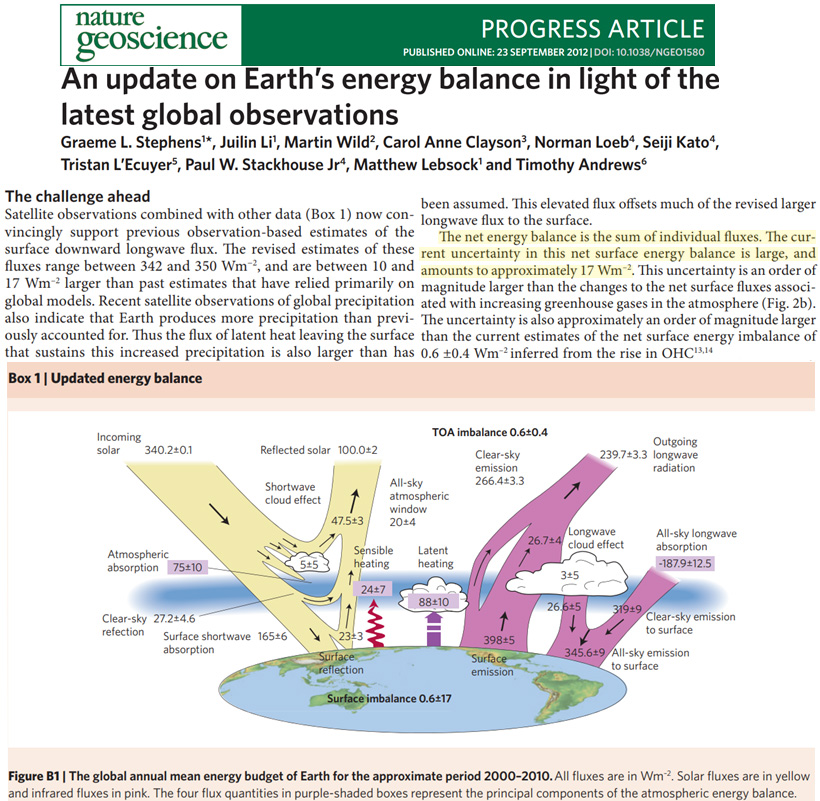
Earth’s energy imbalance was determined to be +0.6 W/m² during the first decade of the 21st century (Stephens et al., 2012) using satellite observations. However, uncertainty in this positive imbalance value is large: ±17 W/m².

Image Source: Stephens et al., 2012

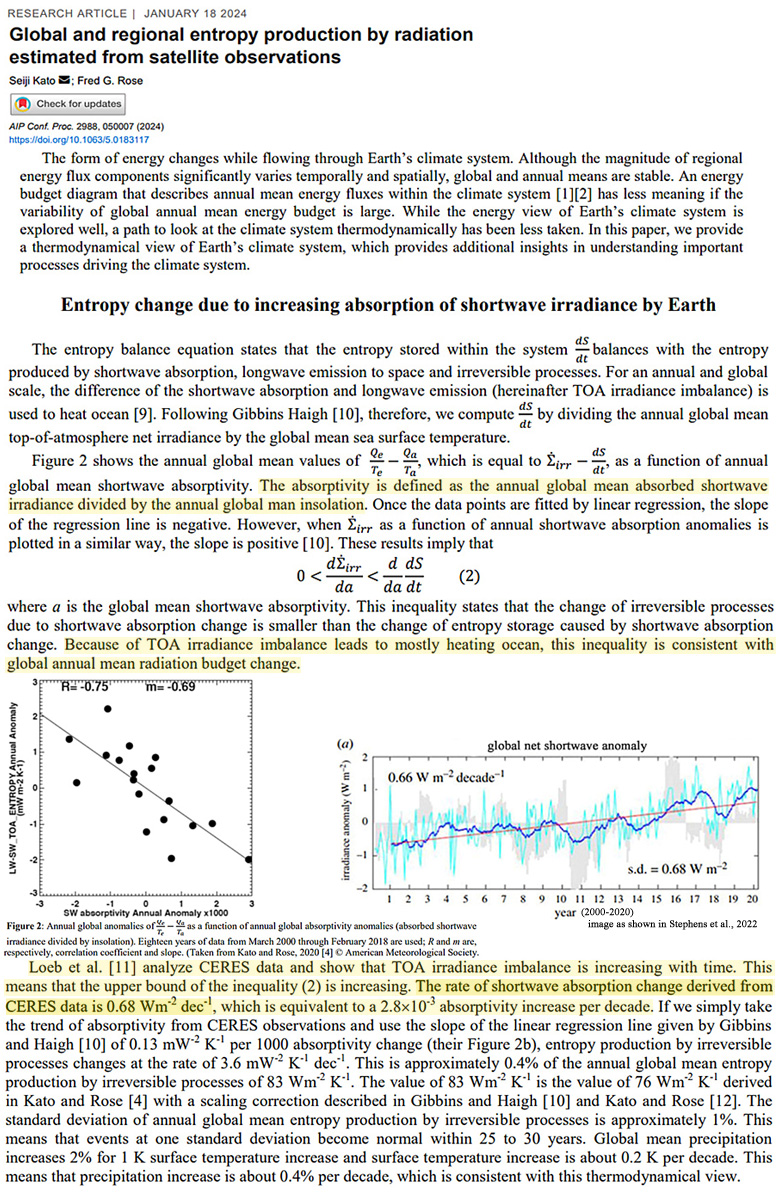
According to a new study (Kato and Rose, 2024), absorbed shortwave irradiance has been increasing since 2000 at a rate of +0.68 W/m² per decade. This can explain why the top of atmosphere (TOA) energy imbalance has been “increasing with time.”

This positive imbalance “leads mostly to heating ocean,” and it fully accounts for the surface imbalance estimate (0.68 W/m² versus 0.6 W/m²).

Image Source: Kato and Rose, 2024

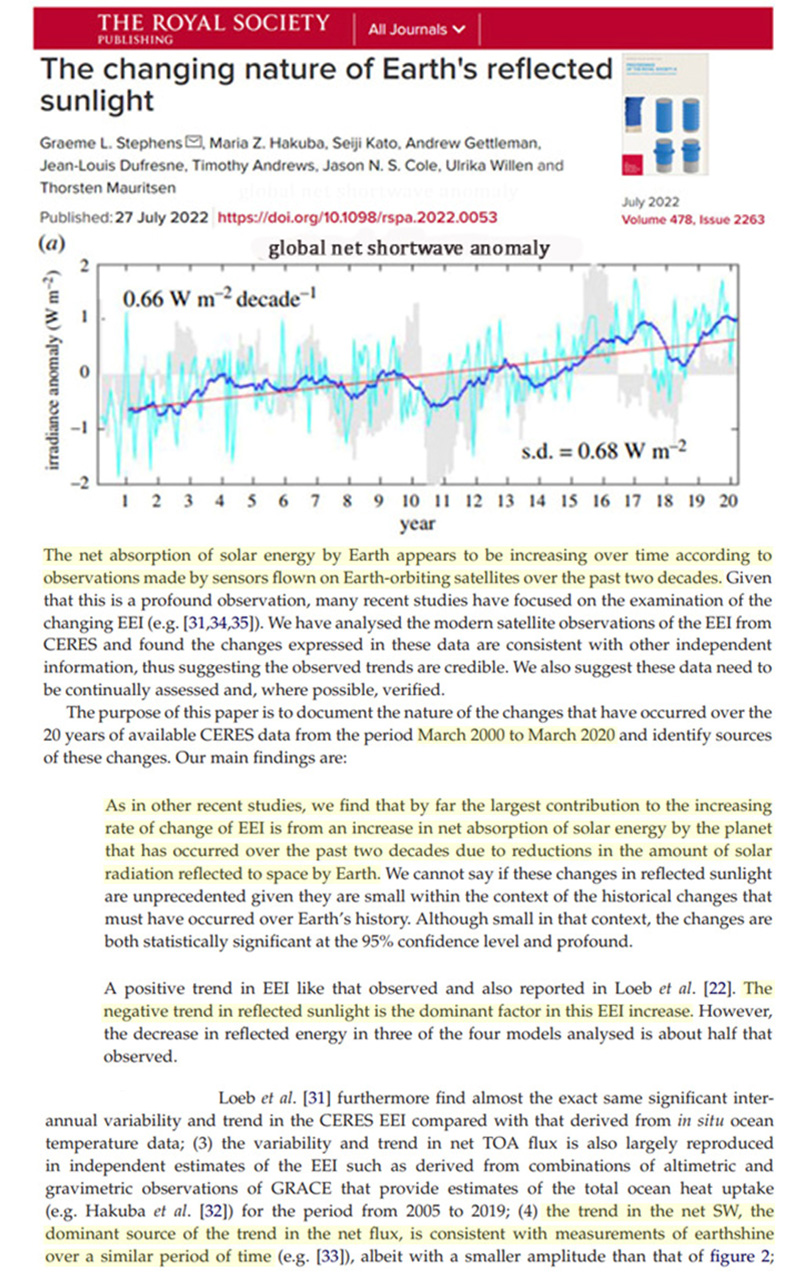
CERES data indicated a +0.66 W/m² per decade−1 (+1.3 W/m²) increase in absorbed solar radiation during the 21st century (March 2000 to March 2020) per a 2022 study (Stephens et al.).

It was determined the net absorption of solar energy that has occurred due to the reduction of solar radiation reflected to space by clouds and aerosols is “by far the largest contribution to the increasing rate of change of EEI.”

Image Source: Stephens et al., 2022

via NoTricksZone

https://ift.tt/w7uf8EO

March 14, 2024 at 07:33AM

The AI Buzz

Dave Burton

Have you noticed that, in most fields, technology tends to advance in fits and starts? For long periods, technology just creeps along, then there’s a sudden surge of progress. Well it’s happening again… I think.

For the last sixty years, computer scientists have been trying, with little success, to make programming computers more productive. The creation of high level languages in the 1950s & early 1960s yielded big productivity gains, but then progress slowed to a crawl. Despite astonishing increases in computing power (5-6 orders of magnitude increases in speed, RAM memory, disk storage, and display resolution, in my own home computers, over  five decades!), and despite improved tools, and a series of fads in programming methodology, not much really changed, and software developers have remained about as (un)productive as we were in 1975, when Fred Brooks wrote The Mythical Man-Month.

Newer programming languages, like Python, JavaScript and Rust, helped a little bit, but programmers in those languages are only slightly more productive than programmers were in Pascal and C a half-century ago. StackOverflow on the Internet is more convenient than a shelf full of paper books, but that mostly just trims the learning curve a bit. Newer tools, like the VSCode editor, are very nice (certainly nicer than punched cards!), but they don’t make computer programmers wildly more productive.

But now that has apparently finally changed. The long anticipated sudden surge has finally arrived. Cutting edge programmers are now using “AI Assistants” like Microsoft/Github CoPilot to help them write code, and they are reporting dramatic improvements in productivity, and perhaps even improvements in code quality.

It does not shock me that tools created by computer programmers are helpful to computer programmers. But, surprisingly, this technology is also very, very good at parsing, responding to, and writing “natural language” (e.g., English).

Here’s an eye-opening example. I asked ChatGPT 3.5 this question, which I’m confident the vast majority of professional “climate scientists” would not answer correctly:

“With reference to the agronomy literature, quantify how elevated CO2 helps plants use water more efficiently, and increases crops’ drought resilience, by reducing stomatal conductance and water loss through transpiration.”

ChatGPT’s answer was remarkably good:

“In agronomy, the effects of elevated CO2 on plant water use efficiency and drought resilience are extensively studied. One of the key mechanisms through which elevated CO2 levels improve water use efficiency is by reducing stomatal conductance and, consequently, water loss through transpiration.

“Stomata are small pores on the surface of plant leaves that regulate gas exchange, including the uptake of CO2 for photosynthesis and the release of water vapor through transpiration. When CO2 levels are elevated, plants can maintain the same or higher rate of photosynthesis while reducing stomatal conductance. This reduction in stomatal conductance leads to a decrease in water loss through transpiration without significantly affecting CO2 uptake, resulting in improved water use efficiency.”

Wow! I was very impressed. That answer is exactly correct, and the prose is perfect. I’ve been explaining that to people for years, and I think ChatGPT’s explanation is better than mine.

But all is not rainbows and roses, because that doesn’t always happen.  I then asked ChatGPT 3.5 what I thought was a much simpler question. It requires a trivial bit of physical and mathematical reasoning, but I think even most climate scientists could probably answer it correctly:

“How much is 5.7 PgC in ppmv of CO2?”

I expected that AI tools would have no problem answering that simple question. But they all failed. In fact, they gave me ten different wrong answers.

Conventionally, “1 ppmv CO2” is shorthand for 1 µmol/mol of dry atmosphere (“dry molar fraction”). 1 ppmv CO2 = 7.8024 Gt CO2 = 2.12940 PgC, so the correct answer to the question I asked is 5.7 / 2.1294 = 2.67681 ppmv. (Water vapor adds about 0.25% to the mass of the atmosphere, which is 0.41% by molar fraction, so the answer is very slightly larger if water vapor is not omitted.)

ChatGPT 3.5 completely fell on its face. It said:

“5.7 PgC is approximately equivalent to 61.9 ppmv of CO2 in the atmosphere.”

ChatGPT 4.0 isn’t free on the OpenAI website, but Popai has an option to use ChatGPT 4.0 as its engine, so I tried that. It gave a different wrong answer:

“5.7 PgC is approximately equivalent to 4.07 ppmv of CO2 in the atmosphere.”

I asked Mistral AI, and it also gave a wrong answer:

“5.7 PgC is approximately equivalent to 569 ppmv of CO2 when evenly distributed throughout the entire atmosphere.”

I asked Microsoft Copilot, and it also gave a wrong answer:

“5.7 PgC is approximately equivalent to 12.198 ppmv of CO₂.”

CoPilot is also integrated into the Microsoft Edge Browser. Oddly, that version gave a different wrong answer:

“Unfortunately, without knowing the specific atmospheric temperature and other factors, we cannot provide an exact ppmv value.”

I asked Llama 2, and it also gave a wrong answer:

“5.7 PgC is equivalent to 1220 ppmv of CO2.”

I asked Claude, and it also gave a wrong answer:

“5.7 PgC (petagrams of carbon) is approximately equivalent to 9.86 ppmv (parts per million by volume) of CO2 in the atmosphere.”

I asked Scite, and it also gave a wrong answer:

“5.7 PgC is equivalent to approximately 25.2 ppmv of CO2 in the atmosphere”

I asked Aria (in the Opera browser), and it also gave a wrong answer:

“5.7 PgC * 2.12 ppmv/PgC = 12.084 ppmv”

I also asked Google Gemini, and it gave the most hilariously wrong answer of all:

“5.7 PgC is equivalent to 5700000000000000000.00 ppmv of CO2.”

Two fervent advocates of the position that AI is transformative technology are Matt Welsh and Matthew Berman (both on YouTube, of course). Here’s a contrary view (profanity warning). IMO, the jury is still out, but…

👉 My first conclusion is that the AI tools are like the kids who pass their science classes by “memorizing the formulas.” They cannot “do science.”

👉 My second conclusion is that they can nevertheless be quite useful. Just always remember President Reagan’s advice for dealing with the Soviets: “Trust, but verify.”

👉 My third conclusion is that when using these tools it helps to lead them along by the nose. Be very, very specific with your questions. For instance, if you’d rather that they rely on the (robust) agronomy literature, rather than the (hopelessly politicized) climate science literature, then say so. Here’s a video with some suggestions about how to make best use of ChatGPT.

Dave Burton

https://sealevel.info/

via Watts Up With That?

https://ift.tt/LQFh3IN

March 14, 2024 at 04:06AM

NET ZERO IS DEAD

Yesterday I pointed out that the Prime Minister has at last realised that net zero would not be possible. In this article that same point I made has been made by Gordon Hughes writing in the Daily Telegraph. See below: 

Net Zero is dead. Only the fanatics haven’t realised it | NOT A LOT OF PEOPLE KNOW THAT (wordpress.com)

via climate science

https://ift.tt/bJdFsn8

March 14, 2024 at 02:34AM