
I’m back in Yeppoon. This afternoon I was at Wreck Point, and in the distance, over my left shoulder, you can see Great Keppel Island. According to the New York Times there is mass coral bleaching there (CLICK HERE). A photograph of the corals at Monkey Beach reef featured in an article in that newspaper just yesterday. It was apparently taken on March 5, 2024.
(I’m hoping to see these corals for myself this weekend. To be sure to know what I find out, to be sure to see the photographs I’m hoping to take, consider subscribing for my free email updates (CLICK HERE).)
The New York Times attributes the bleaching to extraordinarily warm ocean temperatures. Of course, there is no chart, no data – no information on actual ocean temperatures.
It is exceedingly rare for any newspaper to ever publish location specific temperature data. In fact, that is the only real type of temperature data: location specific data. Everything else is a construct – a contrived statistic.
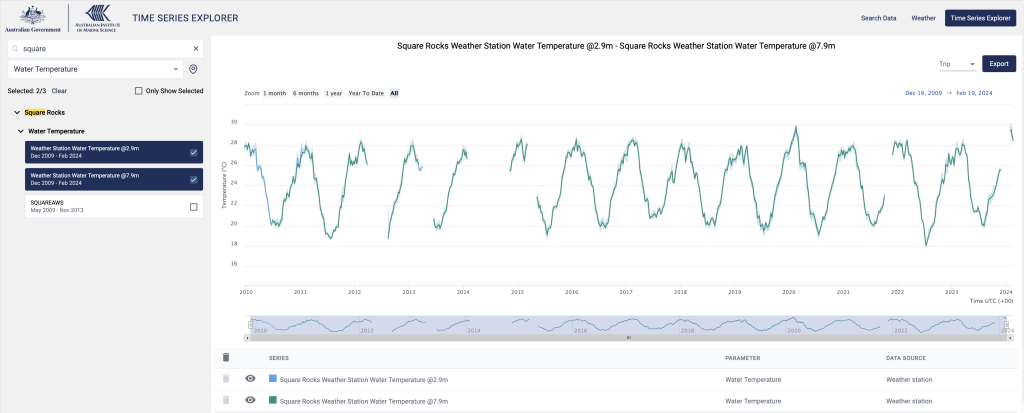
The picture of the bleached corals at Great Keppel Island, published in the New York Times, was apparently provided by AIMS (Australian Institute of Marine Sciences). Of course, they also have temperature data. One of their key weather stations is at Square Rocks just to the northwest of Great Keppel Island. There is data for the period December 19, 2009, through to February 19, 2024. This data, consistent with the information I have previously published for the central region does not suggest that ocean temperatures have been particularly warm this last summer.
There is sea level data for Rosslyn Bay, just across a little further to the east from Great Keppel Island. (I will be catching the ferry to Great Keppel Island from Rosslyn Bay marina at the end of the week, weather permitting and passing Square Rock.)
This sea level data indicates they are towards the low end of their annual cycle, and have stalled there. This is consistent with an El Nino event and the water sloshing over to the other side of the Pacific Ocean, you can read more about the phenomenon at the NOAA website, CLICK HERE.
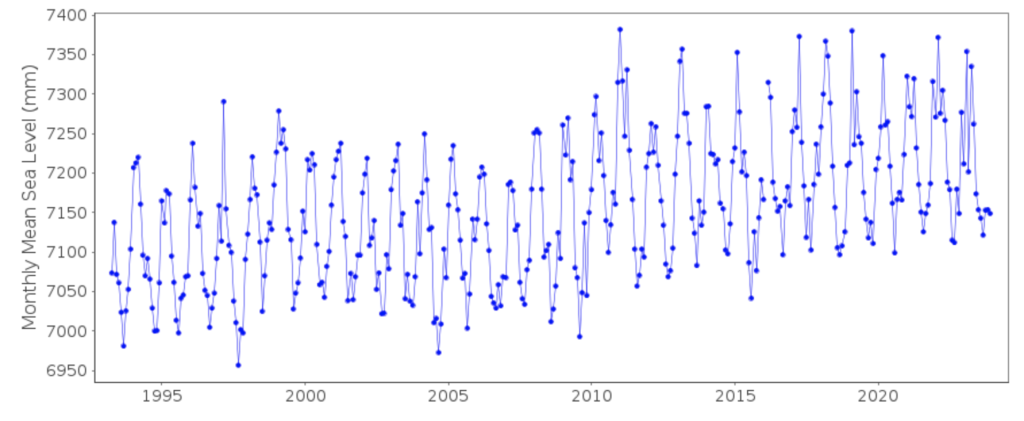
https://psmsl.org/data/obtaining/stations/1760.php
Could it be that the bleaching at Great Keppel Island has more to do with lower-than-average sea levels for this time of year – than unusually warm water? I’m just asking the question. (It is perhaps better to have questions that cannot be answered, rather than answers that cannot be questioned.)
Square Rock also has air temperature data, and, of course, the two move somewhat in unison except that the air is consistently a little cooler. This is the air that has all the greenhouse gases, that is meant to be warming the ocean.
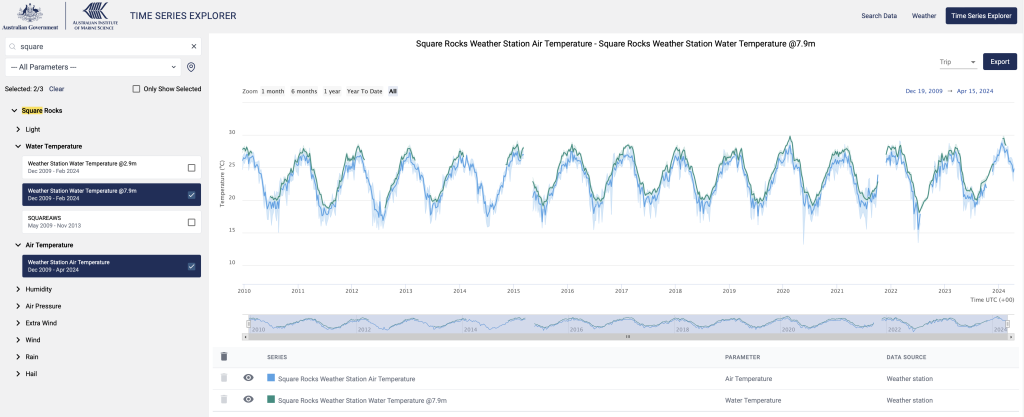
Of course, only someone who believes the nonsense from the experts and who can’t read a chart could believe that the air warms the ocean!
The sun warms the ocean that warms the atmosphere. That is what happens in the tropics at least, which is where I live.
via Jennifer Marohasy
April 16, 2024 at 04:50AM
 Iowa Climate Science Education