
There has been a lot in the press about the recent spike in global temperatures, and claims have followed about how this has caused the oceans to warm and the corals to bleach.
There has been a spike in global temperatures as measured by the satellites since 1979, and there remains much regional and seasonal variability in this data. Furthermore, the same satellite data very clearly shows that the warmth is coming from the oceans, not from the greenhouse gases in the atmosphere.
The Australian Bureau Meteorology, among others, could easily issue a press release clarifying this. Of course, they don’t – because the Bureau’s leadership have an agenda, that this misinformation supports.
My friend Bill Kininmonth is a former Bureau employee – for more than a decade he headed Australia’s National Climate Centre and was a Bureau delegate to the Second World Climate Conference that culminated in the first IPCC report.
Kininmonth hasn’t stopped thinking. He wrote a book some years ago, and I have borrowed its title (Climate Change: A Natural Hazard) for this blog post, inspired by his note to me just this morning. It reads:
Hello Jennifer,
Just to provide more evidence in support of your recent post.
The charts for the sea surface skin temperature for the zonal band Lat 10S to Lat 10N as measured by satellites.
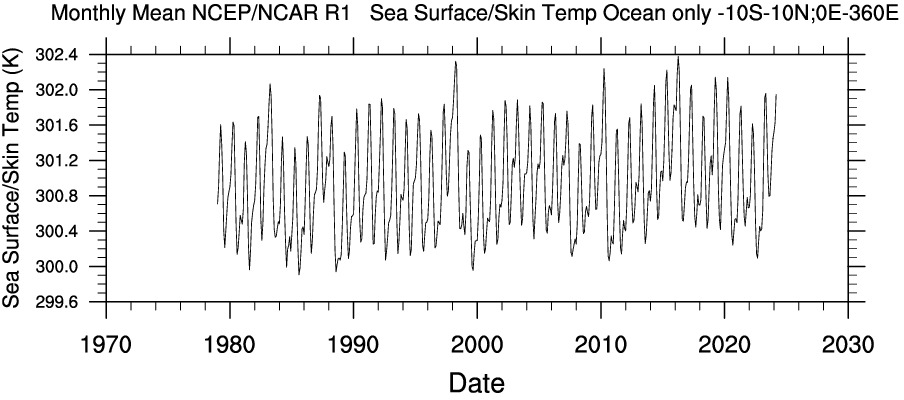
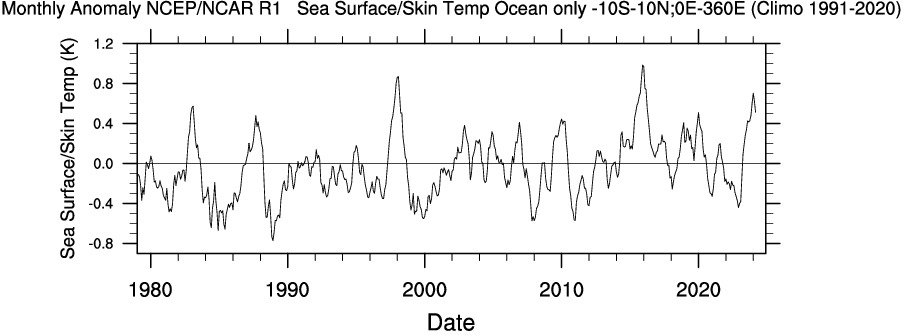
I have read media coverage of claimed ‘global’ coral bleaching that is being attributed to anthropogenic global warming. From the graphs it can be seen that neither the recent temperatures nor the temperature anomalies are the highest of the recent 45 years. The recent temperature spikes are, however, associated with a major El Nino event, which is rapidly decaying.
Your comment on the effect of spring tides is also of interest to me. I have long thought that part of the impact of El Nino, especially for the Great Barrier Reef, is that during these events sea levels across the equatorial Pacific Ocean change.
During the 1997-98 El Nino event sea level over the Western Pacific Ocean dropped about 35cm with an equivalent rise over the Eastern Pacific Ocean. Such a drop in sea level over the Great Barrier Reef would be expected to reduce the flow of cooling water over the reef and giving a greater response to solar heating of the shallow reef water. Lower spring tides would be expected to accentuate the heating of water over the shallow reefs.
On your point about SST (surface sea temperatures) being warmer than air temperature, this is confirmed in the chart of ocean skin temperatures versus air temperatures (see feature image).
The IPCC scientists do not seem to recognise that the greenhouse gases of the atmosphere radiate more energy than they absorb from the surface below.
Radiation processes are tending to cool the atmosphere at a rate of about 2C/day. This radiation cooling generates convective instability, allowing near-surface air to rise buoyantly in convective clouds. The radiation energy lost by the atmosphere is replaced by heat and latent energy flowing from the surface. As you comment, the atmosphere cannot warm the ocean!
Regards, Bill
via Jennifer Marohasy
May 1, 2024 at 03:39PM
 Iowa Climate Science Education