
By Jo Nova
The more wind turbines we have the more useless they are
There goes those plans to cover the continental shelf with talismen to the Wind Gods.
New research shows wind turbines off the East Coast of the US could end up stealing as much as a third of the energy from other wind turbines downstream. And in some conditions, the turbulent wake they leave might stretch out 55 kilometers behind them. This effect is worst on turbines in the same “farm” but could even affect other wind farms a long way off.
The wake effect will be strongest in summer. We’ll just have to ask everyone to turn off their air conditioners then?
Scientific civilizations do this sort of research before they commit $10 trillion dollars, set up a trading scheme, and blow up the coal plants. Imagine if building a coal plant near another plant made it 30% less efficient on hot days…
Hat tip to the NetZeroWatch email list:
Wind turbine ‘wake effect’ could reduce arrays’ power output by 30%
By Kirk Moore, WorkBoat
The researchers’ paper published March 14 in the journal Wind Energy Science suggests that offshore wind turbines off the U.S. East Coast could rob neighboring turbine arrays of wind speed and thus power generation depending on daily conditions, by more than 30%.
“Using computer simulations and observational data of the atmosphere, the team calculated that the wake effect reduces total power generation by 34% to 38% at a proposed wind farm off the East Coast,” according to the University of Colorado. ”Most of the reduction comes from wakes formed between turbines within a single farm.”
“But under certain weather conditions, wakes could reach turbines as far as 55 kilometers (34 miles) downwind and affect other wind farms. For example, during hot summer days, the airflow over the cool sea surface tends to be relatively stable, causing wakes to persist for longer periods and propagate over longer distances.”
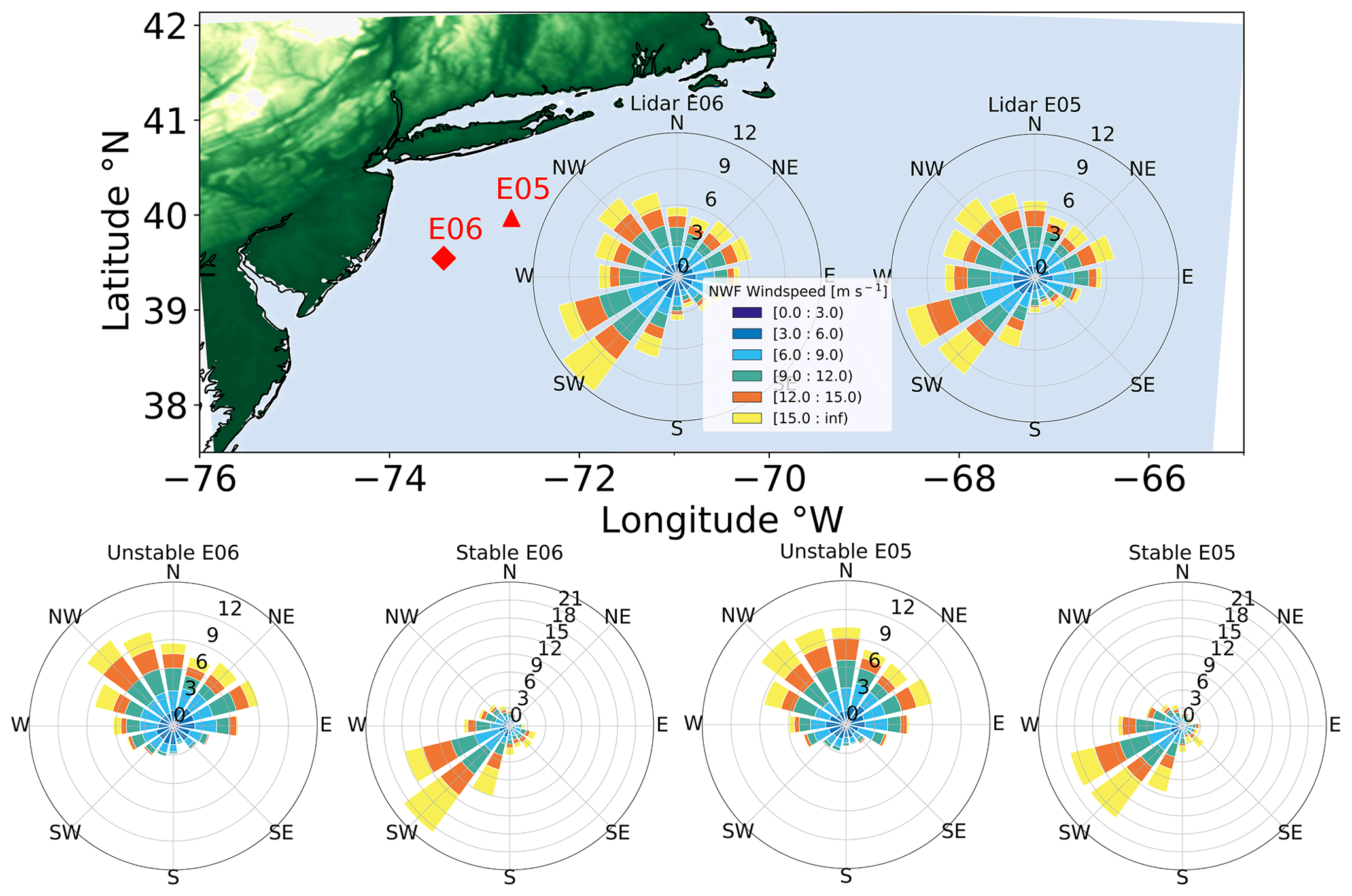
Figure 3Hub-height wind roses for the NYSERDA Hudson North (E05) and Hudson South (E06) floating lidars during the 1 September 2019 to 1 September 2020 period. The location of E06 is shown as the red diamond and E05 as the red triangle. The bottom row shows wind roses segregated by atmospheric stratification.
Ominously, the worst power deficits in these graphs are not the black spots but the red and white ones…
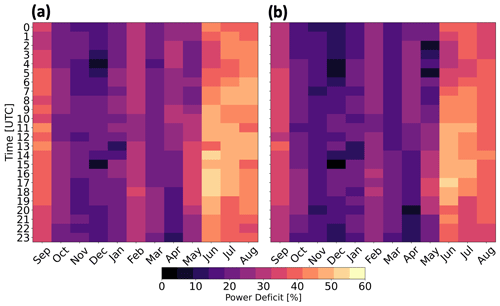
Figure 14The percentage of power loss at ONE from internal wakes at (a) TKE_0 and (b) TKE_100.
This is why the nightmare of thousands of high voltage interconnector lines will never go away.
REFERENCE
Rosencrans et al (2024) Seasonal variability of wake impacts on US mid-Atlantic offshore wind plant power production Articles, Volume 9, issue 3 WES, 9, 555–583, 2024 https://ift.tt/Hd3Bltr
10 out of 10 based on 1 rating
via JoNova
May 8, 2024 at 03:45PM
 Iowa Climate Science Education
