The Week That Was: 2024 05-11 (May 11, 2024)
Brought to You by SEPP (www.SEPP.org)
The Science and Environmental Policy Project
Quote of the Week: We do not believe any group of men adequate enough or wise enough to operate without scrutiny or without criticism. We know that the only way to avoid error is to detect it, that the only way to detect it is to be free to inquire. We know that in secrecy error undetected will flourish and subvert.” – J Robert Oppenheimer.[H/t Paul Homewood]
Number of the Week: Minus 80°C (minus 112°F)
THIS WEEK:
By Ken Haapala, President, Science and Environmental Policy Project (SEPP)
Scope: Discussed are Judith Curry’s lecture to the Global Warming Policy Foundation, an essay by Kevin Trenberth and two critical essays by Howard Hayden.
****************
Important Lectures: This week there were two lectures of considerable importance. One was given by John Clauser, the 2022 Nobel co-Laureate in physics, The other lecture was given by Judith Curry who resigned as chair of the School of Earth and Atmospheric Sciences at the Georgia Institute of Technology in 2017 when she realized that her views on climate change, based on physical evidence, were reducing her academic effectiveness. The political biases in climate science were dominating by then. The Wikipedia entry is an example of the erosion of science standards.
“Social scientists who have studied Curry’s position on climate change have described it as “neo-skepticism”, in that her current position includes certain features of denialism; on the one hand, she accepts that the planet is warming, that human-generated greenhouse gases like carbon dioxide cause warming, and that the plausible worst-case scenario is potentially catastrophic, but on the other hand she also proposes that the rate of warming is slower than climate models have projected, emphasizes her evaluation of the uncertainty in the climate projection models, and questions whether climate change mitigation is affordable. Despite the broad consensus among climate scientists that climate change requires urgent action, in 2013 Curry testified to the United States Congress that, in her opinion, there is so much uncertainty about natural climate variation that trying to reduce emissions may be pointless.” [Boldface added] https://en.wikipedia.org/wiki/Judith_Curry
Whoever wrote that has no knowledge of the climate history of Earth and ignores the economic prosperity of China and the rest of south Asia that is based on industrialization using coal. What social scientists have to say on a complex problem involving many areas of physical science is of little value.
Since the transcript of the Curry lecture is available and the one by Clauser is not, TWTW will comment on the Curry lecture this week and reserve comment on the Clauser lecture until next week.
Engineer Ken Gregory of Friends of Science (Canada) has a good synopsis. He wrote:
“Annual GWPF Lecture: Climate Uncertainty and Risk – Judith Curry
Dr. Judith Curry gave the annual lecture to the Global Warming Policy Foundation (GWPF) about climate uncertainty and risk. She gave a brief history of the climate movement and the net zero targets. She wrote “With the help of a small number of well-positioned activist climate scientists, a 1988 UN conference in Toronto recommended that the world ‘reduce CO2 emissions by approximately 20% by the year 2005 as an initial global goal.’” CO2 emissions actually increased by 34% over that period. The first assessment report (FAR) from the IPCC in 1990 concluded that the recent warming was within the magnitude of natural variability. Despite this finding, 196 countries signed a UN treaty in 1992 to restrict emissions to prevent dangerous climate change. The second IPCC assessment in 1995 found much the same thing as the FAR. However, the policy makers changed the proposed summary to claim that CO2 had a “discernible” effect, and the main report was changed to agree with the summary report. At that point, the IPCC lost any pretense of being independent or uninfluenced by politics.
Curry goes on to show how activist climate scientists misuse policy-relevant science. They conflate expert judgment with evidence, entangle disputed facts with values and intimidate scientists whose research interferes with their political agendas. Climate scientists associated with the IPCC have oversimplified the climate change problem and its solution. The climate change includes natural causes such as the sun, volcanoes, slow circulations in the ocean and unknown processes. It is now known that the extreme emissions scenario RCP8.5 is implausible. The IPCC’s latest report acknowledges that human caused climate change can’t be attributed to most extreme weather events. Reducing emissions exacerbates energy poverty and unreliability, which increases emergency risk. UN climate policies are hampering the UN Sustainable Development Goals that focus on currently living humans. International funds are being redirected away from reducing poverty to reducing carbon emission, which increases energy poverty and increases the harm of weather events. World hunger is being worsened by restrictions on livestock and fertilizer. Many people fear a future without cheap, abundant fuel and continued economic expansion, far more than they fear climate change. Rather than reducing carbon emissions, the goal should be abundant, secure, reliable, cheap & clean energy.”
To this TWTW adds that the changing of the Summary of Policymakers in the 1995 assessment report prompted the late Fredrick Seitz to write an editorial stating it was the worse abuse of “peer reviewed” science he had witnessed in the previous more than 50 years. Later, Seitz (who was the Chairman of SEPP) and Fred Singer (the founder of SEPP) were accused of taking money from oil, tobacco, and chemical companies without evidence. (Seitz managed a grant to the Rockefeller University by the Reynolds Foundation for medical research that led to the discovery of prions, for which a Nobel in Medicine was awarded.) The lead author of the major book containing the accusations without evidence received a professorship at Harvard.
In her lecture, Curry mentions other issues such as the 97% consensus. She states:
“Don’t 97% of climate scientists agree on all this? Doesn’t climate science demand that we urgently eliminate fossil fuel emissions? Here is what all scientists actually agree on:
- Surface temperatures have increased since 1880.
- Humans are adding carbon dioxide to the atmosphere.
- Carbon Dioxide and other greenhouse gases have a warming effect on the planet.
However, there’s disagreement and uncertainty about the most consequential issues:
- How much of the recent warming has been caused by humans.
- How much the planet will warm in the 21st century.
- Whether warming is ‘dangerous’
- And whether urgently eliminating the use of fossil fuels will improve human well being
Nevertheless, we are endlessly fed the trope that 97% of climate scientists agree that warming is dangerous, and that science demands urgent reductions in CO2 emissions.
So how did we come to the point where the world’s leaders and much of the global population think that we urgently need to reduce fossil fuel emissions in order to prevent bad weather? Not only have we misjudged the climate risk, but politicians and the media have played on our psychological fears of certain types of risks to ramp up the alarm.
Psychologist Paul Slovic describes a suite of psychological characteristics that make risks feel more or less frightening, relative to the actual facts. In each of the risk pairs below, the second risk factor in bold is perceived to be worse than it actually is.
- natural versus manmade risks
- controllable versus uncontrollable risks
- voluntary versus imposed risks
- risks with benefits versus uncompensated risks
- future versus immediate risks
- equitable versus asymmetric distribution of risks.
For example, risks that are common, self-controlled, and voluntary, such as driving a car, generate the least public apprehension. On the other hand, risks that are rare and imposed and lack potential upside, like terrorism, invoke the most dread.
Activist communicators emphasize the manmade aspects of climate change, the unfair burden of risks on poor people, and the more immediate risks of severe weather events. The recent occurrence of an infrequent event such as a hurricane or flood elevates perceptions of the risk of low probability events. This then translates into perceptions of overall climate change risk. And so, our perceptions of climate risk are being cleverly manipulated by propagandists.
Curry discusses the deeply polarizing views of the UN, its followers, and supporting scientists. In the UN climate change is an issue that they can control and manage. She compares this thinking to that required for what she calls a wicked problem. She concludes with:
“Once you separate energy policy from climate policy, the way forward for energy policy is fairly straightforward. A more pragmatic approach to dealing with climate change drops the timelines and emissions targets, in favor of accelerating energy innovation. The goal is abundant, secure, reliable, cheap & clean energy.
The energy transition can be facilitated by: accepting that the world will continue to need & desire much more energy; developing a range of options for energy technologies; removing the restrictions of near-term targets for CO2 emissions; and using the next 2-3 decades as a learning period with intelligent trial & error. All technologies should be evaluated holistically for abundance, reliability, lifecycle costs and environmental impacts, land and resource use. Without focusing on CO2 emissions, odds are that this strategy will lead to cleaner energy by the end of the 21st century than by urgently attempting to replace fossil fuels with wind and solar power.
The wickedness of the climate problem is related to the duality of science and politics in the face of an exceedingly complex problem. There are two common but inappropriate ways of mixing science and politics. The first is scientizing policy, which deals with intractable political conflict by transforming the political issues into scientific ones. The problem with this is that science is not designed to answer questions about how the world ought to be, which is the domain of politics. The second is politicization of science, whereby scientific research is influenced or manipulated in support of a political agenda. We have seen both of these inappropriate ways of mixing science and politics in dealing with climate change.
There’s a third way, which is known as “wicked science.” Wicked science is tailored to the dual scientific and political natures of wicked societal problems. Wicked science uses approaches from complexity science and systems thinking in a context that engages with decision makers and other stakeholders. Wicked science requires a transdisciplinary approach that treats uncertainty as of paramount importance. Effective use of wicked science requires that policy makers acknowledge that control is limited and the future is unknown. Effective politics provides room for dissent and disagreement about policy options, and includes a broad range of stakeholders.
My book Climate Uncertainty and Risk provides a framework for rethinking the climate change problem, the risks we are facing, and how we can respond. This book encompasses my own philosophy for navigating the wicked problem of climate change. As such, this book provides a single slice through the wicked terrain. By acknowledging uncertainties in the context of better risk management and decision-making frameworks, and with abundant energy, there’s a broad path forward for humanity to thrive in the 21st century. [Boldface added]
A wicked problem can be considered one in which a solution cannot be tested before it is implemented. Curry proposes a common ground where the most critical and obvious problems can be addressed, while we learn more about climate change and what is more likely to happen in the future. The intensity in which the UN leadership is demanding action shows that it is incapable of providing the common ground needed to mesh known (rather than speculative) physical science with politics.
See links under Challenging the Orthodoxy.
******************
Deviant Vocabulary: The UN Intergovernmental Panel on Climate Change (IPCC) and climate advocates have repeatedly changed the meaning of terms they use in making its claims to the point that the language has become ambiguous and arbitrary. For example, global warming once meant a general warming of Earth, primarily due to increasing atmospheric carbon dioxide (CO2) concentrations. But it is now called climate change, meaning changing weather which can either directly or indirectly be attributed to humanity. Now, is virtually all changes in weather: floods, droughts, hot periods, cold periods, sea level rise, storms, and so on. The modified language is essentially meaningless.
AMO physicist Howard Hayden authored an essay in the May issue of The Energy Advocate giving a bit of history on the deviant vocabulary used by modern climate scientists. He briefly describes the development of 19th century physics that led to the creation of the Stefan Boltzmann law that allows for the calculation of heat radiated by square meter from a surface at absolute temperature. This law applies to Earth. Hayden writes:
“It is a shameful fact that climate modelers have never—repeat, NEVER—applied the Stefan-Boltzmann law to any of their predicted surface temperatures. At present temperatures, each increase of 1ºC would increase the amount of IR leaving the surface by about 5.5 watts per square meter. Climate models predict both the ‘radiative forcing’ (increase in IR-stopping ability) and the average increase in surface temperature for various times in the future. In no case is the former enough to account for the 5.5 W/m2 increase in surface IR due to temperature increase. [Boldface added]
The Stefan-Boltzmann law does not apply to gases or to shiny metallic surfaces; in particular, it does not apply to the planet as a whole, because radiation to space is largely dependent on those heat-absorbing (and emitting) gases in the atmosphere. That is, the heat emitted to space, calculated from astronomical measurements, is not pure blackbody radiation.”
See link under Challenging the Orthodoxy. The link to the essay on the SEPP website may not work using Chrome, but with another browser.
******************
Changing Horses Mid-Stream? Atmospheric scientists have gotten into the word games. Traditionally it was recognized that most radiation from the sun passed through a cloudless atmosphere with little disruption. The radiation emitted by the surface of Earth is invisible long wave infrared radiation. That radiation can be blocked by greenhouse gases in various frequencies, whether it is incoming from the sun or outgoing from the surface of Earth. Now lead author of three IPCC reports and scientist at the US National Center for Atmospheric Research (NCAR/UCAR) (sponsored by the US National Science Foundation) Kevin Trenberth has tried to confuse the public further. His paper “Characterizing Climate Change from Heating, Not Merely Temperature” was published by the Journal of Climate Action, Research, and Policy.
The abstract of the paper states:
“Current human-induced climate change arises primarily from the heating of the planet mainly from changes in atmospheric composition, and temperature change is one manifestation. The increasing greenhouse gases, notably carbon dioxide from burning fossil fuels, lead to Earth’s Energy Imbalance (EEI), altering the flow of energy through the climate system, and the dissemination of excess energy is partly what determines how climate change is manifested. Some of the extremes being experienced, especially those involving drought, convection, storms, flooding, and the water cycle, are mostly driven by aspects of heating and, while temperature contributes through the water-holding capacity of the atmosphere, it is more a consequence than a cause. Afterall, water is the air conditioner of the planet. The United Nations, and especially the Intergovernmental Panel on Climate Change (IPCC) in their Summary for Policy Makers, focus on global temperature targets rather than broader facets of climate change including EEI, and do not always adequately discriminate between temperature and heating. This also has consequences for future climate if or when heating is brought under control by cutting emissions. Improvements are needed in expressing how the climate is changing by properly accounting for the flow of energy through the climate system.” [Boldface italics in original]
Certainly, proper accounting of the flow of energy is needed, but it is doubtful it will come from global climate modelers. The global climate models use water vapor to double the modest temperature increase that has been calculated to occur from increasing CO2. However, the claimed increase in water vapor was speculative, and it is not occurring. Now Trenberth is claiming water is an air conditioner for Earth? Further, the UN goals are completely contrived, and no IPCC agreement has been ratified by the US Senate.
Writing in The Energy Advocate, and repeated on the SEPP website, AMO physicist Howard Hayden discusses why Trenberth’s new position and those of other “popular” commentators on climate science are inconsistent with ongoing physical research. Hayden writes [emphasis in original]:
“The mission of the CERES satellite system, begun in 1997, is to measure the Earth’s Energy Imbalance (EEI) (equivalent to Trenberth’s “heating”). The project involves enormous amounts of high-precision data.
Unlike the usual reports coming from Trenberth, Schmidt, the IPCC and others, Norman Loeb’s CERES report makes no reference to CO2 whatsoever. The really important fact found in the Conclusions is:
The EEI trend is primarily associated with an increase in absorbed solar radiation (ASR) partially offset by an increase in OLR [Outgoing longwave radiation). … Large ASR trend primarily driven by reductions in low and middle clouds.
Let us emphasize this point. The increase in Earth’s Energy Imbalance (EEI; Trenberth’s “heating”) is due primarily to the increase in absorbed solar radiation—the difference between the sunlight incident upon the earth and the amount of reflected sunlight. Further, the solar irradiance (incident sunlight averaged over the spherical shape of the earth) increased only very slightly—from 340.14 W/m2 for 2000 to 2010 to 340.17 W/m2 for 2013-2023. The Loeb report clarifies that the change is due to the decrease in low and middle clouds. [Boldface added]
In other words, the increase in EEI is due to a decrease in albedo (less reflected sunlight), contrary to IPCC’s calculations that always show an increase in albedo. [Boldface added]
In yet other words, the heating of our planet that we’re seeing is not due to an increase in atmospheric CO2. This conclusion of the CERES project, which was designed expressly to determine the heat imbalance of the earth and its causes, has been ignored by “climate scientists,” investigative journalists, and politicians, and will continue to be ignored.
Still, this one fact rings the death knell of the “climate crisis.” Unequivocally, it says that the worries about CO2, “carbon pollution,” “carbon emissions,” and so forth are entirely misplaced. The one fact that the warming we are experiencing is due to changing albedo—NOT CO2—means that the UN’s COPs (Conferences of Parties), the IPCC’s Assessment Reports, the restrictions on coal, oil, and natural gas, and the belief that we help “save the climate” by killing our cattle are all based on sham science.”
See links under Challenging the Orthodoxy (for graph and references) and Defending the Orthodoxy. The link to the essay on the SEPP website may not work using Chrome, but with another browser.
******************
DDP 2024: The 42nd Annual Meeting of Doctors for Disaster Preparedness is scheduled for July 5-7, 2024, in El Paso, Texas. The speakers include a number of outstanding scientists such as John Clauser, the 2022 Nobel Laureate in Physics for contribution to the foundations of quantum mechanics, Stephen McIntyre and Ross McKitrick, recipients of the 2023 Fredrick Seitz award by SEPP for upholding integrity in using the scientific method, Willie Soon, Michael Connolly, and Ronan Connolly of the Center for Environmental Research & Earth Science (CERES) and Patrick Moore, former Greenpeace co-founder. See link under Challenging the Orthodoxy.
******************
Number of the Week: Minus 80°C (minus 112°F) According to P Gosselin, the Russian run Vostok Station in Antarctica recorded a temperature of almost minus 80°C (minus 112°F) on April 29. Vostok Station is 1,301 kilometers (808 mi) from the Geographic South Pole at an elevation of 3,488 meters (11,444 feet). It is considered the coldest place on Earth, colder than the US-run South Pole Station. Vostok Station has the coldest temperature ever recorded at minus 89.6°C in 1983. See link under Changing Weather.
NEWS YOU CAN USE:
Science: Is the Sun Rising?
NOAA Forecasts Severe Solar Storm: FIVE CMEs (/Coronal Mass Ejections) Are Heading for Earth.
By Charles Rotter, WUWT, May 10, 2024
Censorship
The Authoritarian Assault on Free Speech
By Augusto Zimmermann & Gabriël Moens, Quadrant [AU], May 4, 2024
Challenging the Orthodoxy — NIPCC
Climate Change Reconsidered II: Physical Science
Idso, Carter, and Singer, Lead Authors/Editors, Nongovernmental International Panel on Climate Change (NIPCC), 2013
Summary: https://www.heartland.org/_template-assets/documents/CCR/CCR-II/Summary-for-Policymakers.pdf
Climate Change Reconsidered II: Biological Impacts
Idso, Idso, Carter, and Singer, Lead Authors/Editors, Nongovernmental International Panel on Climate Change (NIPCC), 2014
http://climatechangereconsidered.org/climate-change-reconsidered-ii-biological-impacts/
Climate Change Reconsidered II: Fossil Fuels
By Multiple Authors, Bezdek, Idso, Legates, and Singer eds., Nongovernmental International Panel on Climate Change, April 2019
http://climatechangereconsidered.org/climate-change-reconsidered-ii-fossil-fuels/
Why Scientists Disagree About Global Warming
The NIPCC Report on the Scientific Consensus
By Craig D. Idso, Robert M. Carter, and S. Fred Singer, Nongovernmental International Panel on Climate Change (NIPCC), Nov 23, 2015
http://climatechangereconsidered.org/why-scientists-disagree-about-global-warming/
Nature, Not Human Activity, Rules the Climate
S. Fred Singer, Editor, NIPCC, 2008
http://www.sepp.org/publications/nipcc_final.pdf
Challenging the Orthodoxy – Radiation Transfer
The Role of Greenhouse Gases in Energy Transfer in the Earth’s Atmosphere
By W.A. van Wijngaarden and W. Happer, Preprint, Mar 3, 2023
Challenging the Orthodoxy
Annual GWPF lecture: Climate Uncertainty and Risk
By Judith Curry, Climate Etc., May 4, 2024
Text with links to video and slides,
Annual GWPF Lecture: Climate Uncertainty and Risk – Judith Curry
Summary by Ken Gregory, Friends of Science, May 7, 2024
Review of the above
The cloud thermostat is the dominant climate controlling mechanism
Video of John Clauser addressing the Irish Climate Science Forum, May 8, 2024
Deviant Vocabulary
By Howard “Cork” Hayden, The Energy Advocate, May 2024
A Startling Revelation
By Howard “Cork” Hayden, The Energy Advocate, May 2024
The Story of Climate Change
By Kirby Schlaht, His Blog, Feb 14, 2024
Million-year timescale cycles driven by our galactic orbital out-of-plane oscillations produce the climatological “heartbeat” we see in the geologic record – warming then cooling again and again for billions of years. Over the hundreds of millions of years, the climate cycle that produces the geological Hothouse and Icehouse periods marks the orbital passage of our planetary system across the structure of the Milky Way galaxy.
The Great Global Warming Swindle and Climate the Movie: The Cold Truth
By Seok Soon Park, Epoch Times Korea, Via WUWT, May 6, 2024
ClimateMovie Fact Check: Exaggerated warming in the Northern Hemisphere land record
By John Robson, Climate Discussion Nexus, May 8, 2024
Climate Ideology Ignores Science, Threatens Humanity
By Lee Garhart, WUWT, May 5, 2024
Humanity is deprived of precious learning when so many favor the ideology and fearmongering of climate alarmists over the meticulous research of eminent physical scientists such as Richard Alley, professor of geoscience at Pennsylvania State University, who pioneered studies of ice cores, and Richard Lindzen, professor emeritus of meteorology at the Massachusetts Institute of Technology, who explored the incredible complexity of atmospheric physics.
Climate Alarmist Claim Fact Checks
By Joseph D’Aleo, ICECAP, May 8, 2024
http://icecap.us/index.php/go/political-climate/alarmist_claim_rebuttals_updated/
DDP 2024 Annual Meeting
42nd Annual Meeting of Doctors for Disaster Preparedness, July 5-7, 2024
Defending the Orthodoxy
Characterizing Climate Change from Heating, Not Merely Temperature
By Kevin Trenberth, Journal of Climate Action, Research, and Policy, Feb 27, 2024
Global warming due to increasing absorbed solar radiation
By Kevin E. Trenberth and John T. Fasullo, Geophysical Research Letters, Apr 14, 2009
Stark lunacy
By John Robson, Climate Discussion Nexus, May 8, 2024
“world is on edge of climate abyss, UN warns”
By Tony Heller, His Blog, May 10, 2024
1989 headlines
Climate Deniers Don’t Deny Climate Change Any More
By Simon Clark, Real Clear Energy, May 8, 2024
Video: Ambitious national policy is needed to stop climate change!
[SEPP Comment: This air-head analysis starts with a false premise that uses arguments based on YouTube comments and ignores physical evidence.]
Defending the Orthodoxy – Bandwagon Science
Climate Homicide
By Tony Heller, His Blog, May 7, 2024
Link to: Climate Homicide: Prosecuting Big Oil For Climate Deaths
By David Arkush and Donald Braman, Harvard Environmental Law Review, Last revised Mar 11, 2024
Climate “Reparations” Numbers Are Rigged
By Paul Mueller, American Institute for Economic Research, May 10, 2024 [H/t Ron Clutz]
Nobel Laurate in economics Esther “Duflo claims that climate change creates costs, specifically through ‘excess’ deaths due to excessive heat. Poorer countries from the global south near the equator will see more days of extreme heat, and so will see a disproportionate increase in excess deaths.
Other economists translated those deaths into an externality cost of $37 per ton of CO2. Multiply that by the roughly fourteen billion tons of CO2 emitted by the US and Europe and voila, wealthy countries generate $500 billion in externality costs per year.”
[SEPP Comment: Apparently, Duflo and others do not understand photosynthesis and the enormous benefits to life on Earth from increasing atmospheric CO2.]
Questioning the Orthodoxy
Alarmism Now – and Then (Modern Malthusianism in its 6th Decade)
By Robert Bradley Jr., Master Resource, May 9, 2024
“If all the policies instituted in 1975 in the previous figure are delayed until the year 2000, the equilibrium state is no longer sustainable. Population and industrial capital reach levels high enough to create food and resource shortages before the year 2000.” – MIT/Club of Rome (1972)
What The Media Won’t Tell You About The Energy Transition
The hype, and the reality, about the energy transition in 10 charts
By Robeert Bryce, His Blog, May 7, 2024
Global Cooling and a New Ice Age: Never Forget (humility required in science, change)
By Robert Bradley Jr., Master Resource, May 7, 2024
The long-term tolerance of giant panda habitat to climate change
By John Robson, Climate Discussion Nexus, May 8, 2024
From the CO2Science Archive:
Newly Discovered 90,000-Year-Old Human Footprints Reveal How Much Higher Sea Levels Used To Be
By Kenneth Richard, No Tricks Zone, May 6, 2024
Link to one article: A Late Pleistocene hominin footprint site on the North African coast of Morocco
By Mouncef Sedrati, et al., Nature Scientific Reports, Jan 23, 2024
[SEPP Comment: The previous interglacial period ended about 115,000 years ago.]
Racist Gas
By Tony Heller, His Blog, May 10, 2024
Protecting people from heat by making air conditioning unaffordable.
Social Benefits of Carbon Dioxide
GREGORY WRIGHTSTONE: Scientific Report Pours Cold Water On Major Talking Point Of Climate Activists
By Gregory Wrightstone, The Daily Caller, Via CO2 Coalition, May 6, 2024
A Nuanced Argument for The Benefits of Global Warming
By Kyle Schutter, WUWT, May 10, 2024
Problems in the Orthodoxy
An update on Earth’s energy balance in light of the latest global observations
By Graeme L. Stephens, et al., Nature Geoscience, Sep 23, 2012
Seeking a Common Ground
Is the End Near? Victor Davis Hanson Ponders Threat of Annihilation
By Rob Bluey, The Daily Signal, May 07, 2024
Britain’s Royal Society Defies the Green Blob
By Ron Clutz, His Blog, May 8, 2024
Climate change is for the birds
By John Robson, Climate Discussion Nexus, May 8, 2024
“In a moment of uncharacteristic enthusiasm Scientific American forgot the iron rule that climate change ruins everything and blurted out ‘We Are in the Golden Age of Bird-Watching/ There has never been a better time to be or become a birder’.”
Science, Policy, and Evidence
A green embargo by China will trigger a financial crisis that will implode the US economy!
By Ronald Stein, America Out Loud News, May 6, 2024
Measurement Issues — Atmosphere
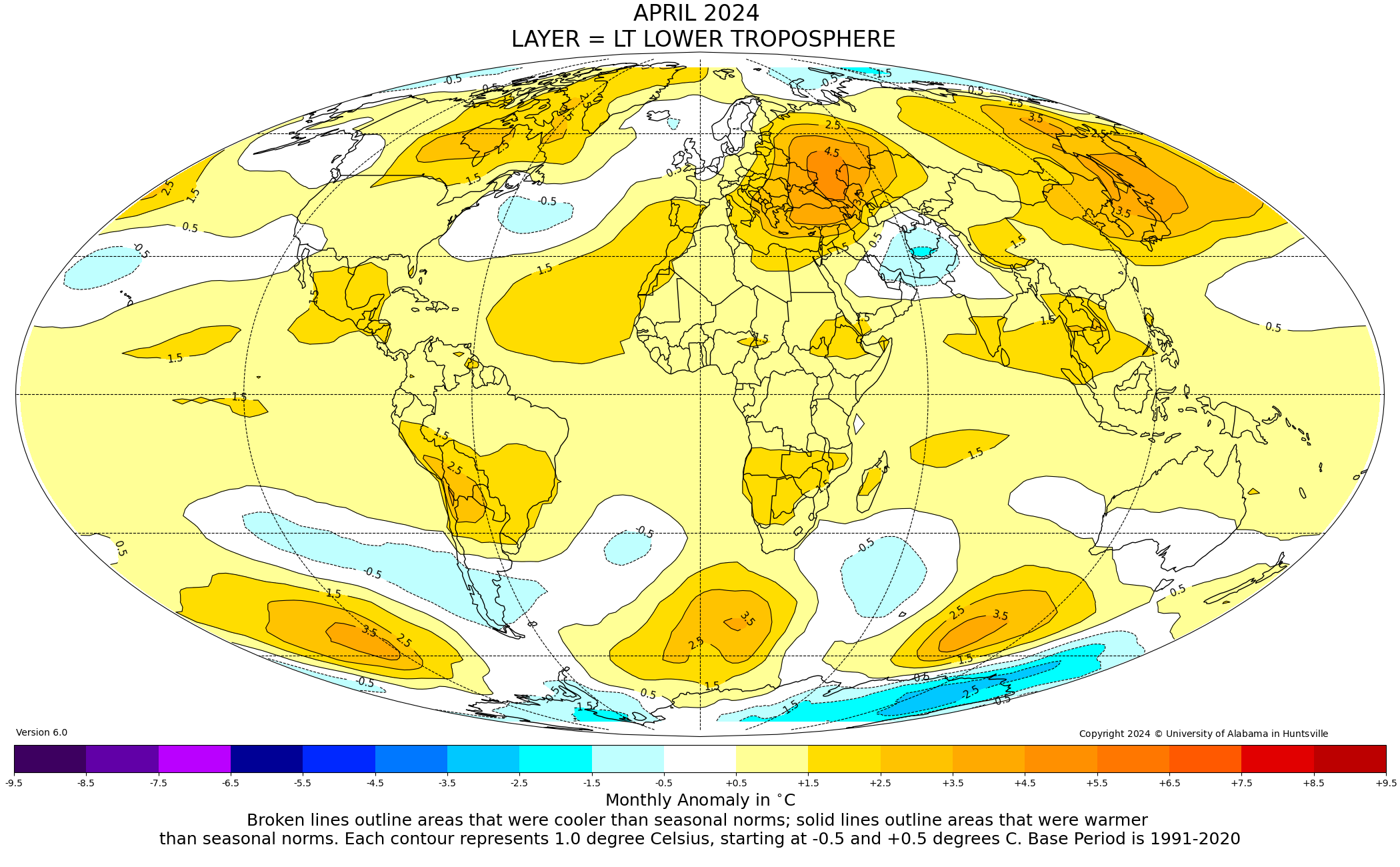
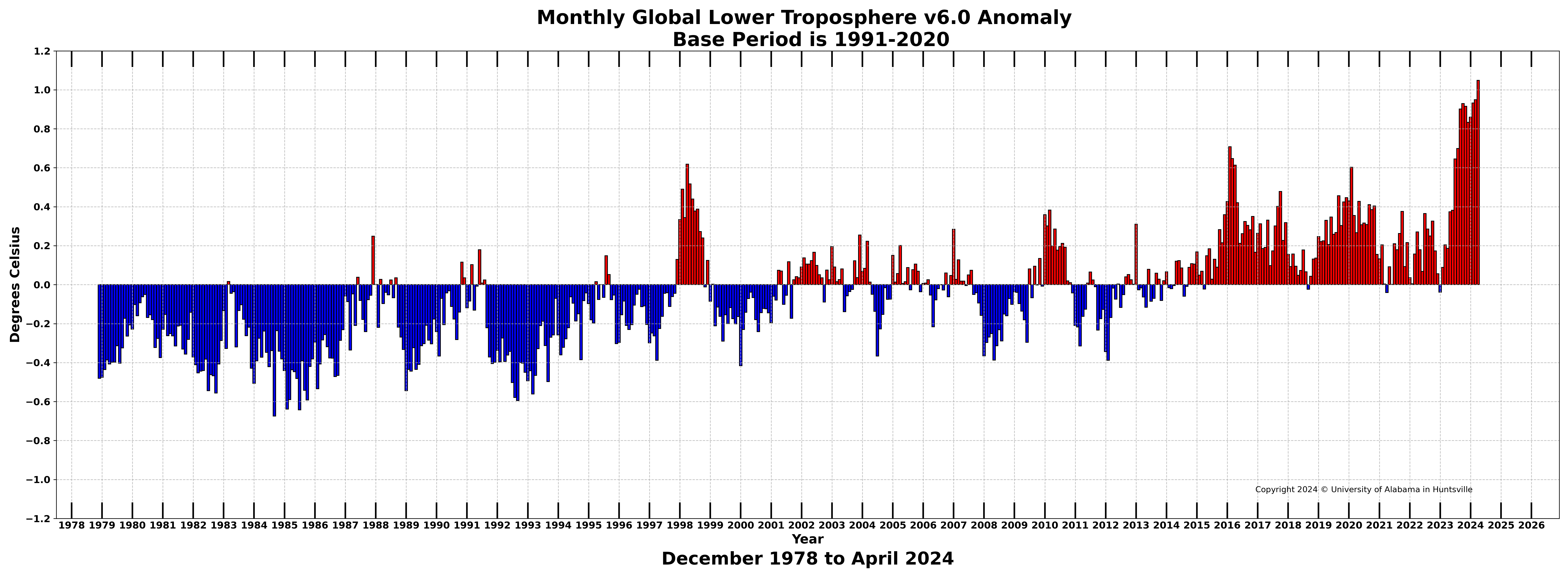
Global Temperature Report, April 2024
By John Christy, Roy Spencer, and staff, Earth System Science Center, University of Alabama in Huntsville, May 4, 2024
Map: https://www.nsstc.uah.edu/climate/2024/April/202404_Map.png
Graph: https://www.nsstc.uah.edu/climate/2024/April/202404_Bar.png
Text: https://www.nsstc.uah.edu/climate/2024/April/GTR_202404APR_v1.pdf
April’s global temperature anomaly rose above last month’s record-setting value to +1.05 °C (+1.89 °F), bucking the anticipated decline since the current El Niño is waning fast. Indeed, the area of increased warmth was not in the tropics or Southern Hemisphere, both of which declined, but in the Northern Hemisphere where the departure from average reached +1.24 °C (+2.23 °F).
We now have an answer to the question posed last fall as to whether the temperature peak would occur earlier than usual because the El Niño started earlier – the temperature did not peak early.
Changing Weather
-80°C: Antarctic Vostok Station Records “Extreme Winter Cold”…Not Even Winter Yet!
By P Gosselin, No Tricks Zone, May 8, 2024
Is UK Rainfall Becoming More Extreme? Not at Oxford.
By Paul Homewood, Not a Lot of People Know That, May 9, 2024
Panama Canal Drought: Not Caused by Climate Change
By Kip Hansen, WUWT, May 7, 2024
Changing Climate
Tipping Point?
By Kirby Schlaht, WUWT, May 7, 2024
“Fossil foraminifera can be used to identify the conditions in which the enclosing sediments accumulated. We can use the oxygen-18 ratios to recognize glacial and warm episodes during the current Ice Age. We know that during the last million years of the Late Pleistocene Ice Age the planet has continued to cool initiating a glacial-interglacial period of around 100 thousand years. The Milankovitch 100k year orbital Eccentricity cycle appears to modulate this longer period.”
Cats, dogs, rabbits, geese and frogs lived in the high Arctic during a hotter era 9,000 years ago
By Jo Nova, Her Blog, May 11, 2024
Link to paper: Ancient DNA and osteological analyses of a unique paleo-archive reveal Early Holocene faunal expansion into the Scandinavian Arctic
By Aurelie Boilard, et al., AAAS Science Advances, March 29, 2024
Changing Seas
Sea Surface Temperatures: West Versus East Coast.
By Cliff Mass, Weather Blog, May 4, 2024
“The eastern Pacific near the West Coast is cold (about 50F), with central California’s waters a bit cooler than ours [Washington]. You must head to the southern tip of the Baja Peninsula to find the water warm enough for comfortable swimming.
The East Coast is a study in contrasts. The water off of New England is crazy cold (dropping below 7C), [45F] while the uber-warm Gulf Stream is found along the west coast of Florida, moves past the Carolinas, and then heads northeastward into the Atlantic.
[SEPP Comment: Strong cooling along the Atlantic Coast from North Carolina to Canada.]
Changing Cryosphere – Land / Sea Ice
#GettingWorse: Polar bears edition
By John Robson, Climate Discussion Nexus, May 8, 2024
Speaking volumes on Arctic ice
By John Robson, Climate Discussion Nexus, May 8, 2024
In many other ways the pattern evident from their researches is not what the people parroting half-understood talking points claim it is. It’s not direct measurement, it’s “reanalysis” and yes, they compare data from the same date each year “to remove the annual cycle.”
Agriculture Issues & Fear of Famine
NZ agriculture has already reached “net zero”: leading climate scientist contends in climate bombshell
By Staff, Centrist, NZ News, May 4, 2024
“However, climate scientist Kevin Trenberth questions the scientific basis for stringent methane reduction goals and has challenged the widely held belief that these emissions significantly contribute to global warming.”
Communicating Better to the Public – Use Yellow (Green) Journalism?
Evaluating Claims of Increasing Floods Due to Climate Change
By Charles Rotter, WUWT, May 7, 2024
No, Sun Sentinel, Florida Isn’t Under Future “Climate Threats”
By Anthony Watts, Climate Realism, May 3, 2024
Communicating Better to the Public – Exaggerate, or be Vague?
Time Up For The Thames Barrier?
By Paul Homewood, Not a Lot of People Know That, May 9, 2024
Homewood: “Annual rainfall has not become more extreme, and neither has monthly rainfall.”
Communicating Better to the Public – Make things up.
BBC Lies About Mediterranean Wildfires Exposed
By Paul Homewood, Not a Lot of People Know That, May 9, 2024
“It’s been protecting London from costly and potentially deadly flooding since 1984.”
Communicating Better to the Public – Do a Poll?
Fewer Americans see climate change as very serious problem: Survey
By Sarah Fortinsky, The Hill, May 6, 2024
Link to press release: Climate Change Concerns Dip
By Staff, Monmouth University, May 6, 2024
Younger adults express less urgency than in prior polls.
Communicating Better to the Public – Go Personal.
Papering over dissent
By John Robson, Climate Discussion Nexus, May 8, 2024
Communicating Better to the Public – Use Propaganda
The Climate Industry’s Misdirection Campaign
How to delegitimize institutions in service of catastrophism
By Jessica Weinkle, The Breakthrough Institute, May 3, 2024 [H/t Kip Hansen]
Sea Level! Everyone Panic!
By Willis Eschenbach, WUWT, May 5, 2024
Scientists sound alarm as growing threat looms over coastal states: ‘We are preparing for the wrong disaster’
By Doric Sam, Yahoo, May 6, 2024 [H/t Bernie Kepshire]https://www.yahoo.com/news/scientists-sound-alarm-growing-threat-020000701.html?guce_referrer=aHR0cDovL21haWwuaGFhcGFsYS5jb20v&guce_referrer_sig=AQAAAA-B5nMkFlaEMAfLGHNhubr_k94qa66Izmx6MYe3Su-Mayp5zyTkZV5cxco_f11koVROuYzK_BwYr4B1MIp0Mvrq56F7sarhy1pfgFgFaNIzDp9oOVQnW2p2VZSleeeLhIjMkjliZ-j7EIYxmCoHNLRI_yZhTRG-eJO2zWxZBnr1
Coastal communities in the U.S. are experiencing one of the most rapid sea level surges on Earth, with the Gulf of Mexico seeing twice the global average rate of rising sea levels since 2010.
[SEPP Comment: So, the rising seas are picking on the US more than other countries?]
“Powerless in the storm” Climate Industry Misdirection
By Roger Caiazza, WUWT, May 6, 2024
Communicating Better to the Public – Use Children for Propaganda
Choosing our future: Adapting education for climate change
By Sirgio Venegas Martin, Luis Benveniste & Shwetlena Sabarwal, The World Bank, May 1, 2024
“So, what will it take to boost climate resilience within the education sector? Though no global figures exist to summarize the additional financing needed for this effort, scattered estimates give a sense of the scale. Looking at just damages due to tropical cyclones, global estimates indicate the education sector experiences financial losses of $4 billion annually. In the Philippines alone, over 10,000 classrooms per year are damaged due to typhoons and floods.”
Communicating Better to the Public – Protest
Just Stop Oil Nutcases Glue Themselves To Magna Carta Case
By Paul Homewood, Not a Lot of People Know That, May 10, 2024
Expanding the Orthodoxy
Biden Administration locking up public lands from West to East
By Gabriella Hoffman, CFACT, May 9, 2024
Questioning European Green
Rupert Darwall & Smart Meters
By Paul Homewood, Not a Lot of People Know That, May 9, 2024
Interview on video
Renewable energy passes 30% of world’s electricity supply
By Paul Homewood, Not a Lot of People Know That, May 9, 2024
Homewood: “The share of renewables in the electricity mix did rise slightly last year, from 29.4% to 30.2%. Hardly Earth shattering!”
Non-Green Jobs
The Economic Impact of Proposed Wind Turbines on Long Beach Island, NJ’s Tourism
By Charles Rotter, WUWT, May 8, 2024
Link to report: Potential Economic Losses of Reduced Tourism Attributable to Proposed Wind Turbines in Long Beach Island, NJ
By Staff, Tourism Economics, March 2024
[SEPP Comment; Loss of business sales of $668 million, 6,700 jobs, and $48 million in taxes are nothing to environmental zealots and their politicians.]
Funding Issues
DAVID BLACKMON: Biden Treasury Could End Up Vaporizing Billions Of Dollars With Activist-Driven Rule
By David Blackmon, The Daily Caller, May 8, 2024 [H/t Bernie Kepshire]
Climate Crisis Inc. Takes a Hit
By Kip Hansen, WUWT, May 4, 2024
The Political Games Continue
The Climate Cult Reacts As Its Political Position Begins To Slip
By Franics Menton, Manhattan Contrarian, May 5, 2024
Bonner Cohen: Biden White House starts end run around Supreme Court WOTUS ruling.
By Bonner Cohen, Daily Caller, Apr 30, 2024
Brown to join Manchin on measure to undo electric car tax credit exemption.
By Zack Budryk, The Hill, May 10, 2024
Litigation Issues
Republican-led states ask court to overturn EPA power plant rule
By Rachel Frazin, The Hill, May 9, 2024
Cap-and-Trade and Carbon Taxes
Tidbits
By John Robson, Climate Discussion Nexus, May 8, 2024
Including impenetrable ignorance even about itself. Recently Canadian Prime Minister Justin Trudeau blathered that his carbon tax was an alternative to the “heavy hand” of government with its “regulations” and “subsidies”. But something called the 440megatonnes.ca Policy Tracker lists no fewer than 113 federal climate initiatives with no end of, uh, regulations and subsidies (and another 371 provincial and territorial ones). So just imagine the smooth policy coordination and intellectual coherence involved in the government saving us from the heavy hand of government.
Subsidies and Mandates Forever
Major Hydrogen Project Breaks Ground in Arizona, While Dispute Over Tax Credit Looms
By Darrell Proctor, Power Mag, May 6, 2024
Dr. Andrew Forrest, executive chair and founder of Fortescue, at the May 3 groundbreaking for the Arizona Hydrogen facility praised U.S. officials for supporting projects to produce hydrogen and support decarbonization, while also saying some Biden administration policies could stall investment.
[SEPP Comment: And how much did he get from Australia before going to Arizona to get more?]
Biden’s New Carbon Capture Mandates Will Cause Blackouts, Increases Prices
By Mish Shedlock, Viz Zero Hedge, May 6, 2024
EPA and other Regulators on the March
The (Anti) Social Cost of Carbon
By Jonathan Lesser, Real Cler Energy, May 07, 2024
Today, another mystical number, the so-called social cost of carbon (SSC), is providing the excuse for the Environmental Protection Agency and green-energy-enamored state regulators to enact crippling energy policies.
How Significant Is The Methylene Chloride Ban?
By Susan Coldhaber, ACSH, May 6, 2024
However, the EPA carved out exceptions to the ban for methylene chloride used:
- in the production of other chemicals that are important to reduce global warming
- in the production of battery separators for electric vehicles…
Energy Issues – Non-US
The Net Zero juggernaut grinds relentlessly onwards
By John Constable, Net Zero Watch, May 7, 2024
Surprise! The World’s biggest bankers are suddenly energy pragmatists
By Jo Nova, Her Blog, May 6, 2024
Energy Issues – Australia
Australian “Local Manufacturing” Solar Subsidies to Go to China?
By Eric Worrall, WUWT, May 6, 2024
China dominates solar manufacturing because they have cheap coal energy. Low wages helped their competitive advantage, but the real key advantage is their low-cost energy.
Energy Issues — US
Power Political Monopoly: Bottom Lines
By Jim Clarkson, Master Resource, May 6, 2024
“It is time to end this marriage of vested privilege and authoritarian ideology and abolish the monopoly-regulator system.”
Green transition is stitched into the tax code: White House economist
By Tobias Burns, The Hill, May 10, 2024
By building the energy transition into the tax code and incentivizing businesses and households to change their behaviors rather than compelling them to do so with more top-down spending initiatives, the Inflation Reduction Act is insulated from any quick-and-dirty policy corrections that may be desired by a new Congress or presidential administration, Brainard argued Friday.
[SEPP Comment: Partially right. Those who receive tax subsidies will fight those who are outraged that the deficit increasing subsidies are called inflation reduction.]
How Grid Enhancing Technologies Are Expanding Electric Power Transmission System Capabilities
By Aaron Larson, Power Mag, May 8, 2024
[SEPP Comment: No discussion of costs.]
Oil and Natural Gas – the Future or the Past?
Milei’s Argentina is fast becoming the Texas of Latin America
By Paul Homewood, Not a Lot of People Know That, May 9, 2024
Return of King Coal?
Asia Embraces Coal as the U.S. Rejects It
By Vijay Jayaraj, Real Clear Energy, Via CO2 Coalition, May 8, 2024
Vietnam’s projected 2024 growth rate for Gross Domestic Product (GDP) stands at 5.8%, the sixth highest in Asia. Among the biggest contributors to GDP is the industrial sector (38 percent), especially manufacturing…It is an irony that U.S. miners are able to meet Asian needs while their own government rejects them as a fuel source for cheap electricity!
Nuclear Energy and Fears
Italy’s Strategic Embrace of Nuclear Power: A Calculated Move Towards Energy Security
By Charles Rotter, WUWT, May 5, 2024
The Folly of an SMR-Only Nuclear Strategy
By Jeff Luse, Real Clear Energy, May 07, 2024
Alternative, Green (“Clean”) Solar and Wind
The World’s Largest Floating Solar Farm Wrecked by a Storm Just Before Launch
By Eric Worrall, WUWT, May 9, 2024
From the Lokmat Times (in Marathi – India) “A summer storm on Tuesday damaged a floating solar plant at Madhya Pradesh’s Omkareshwar dam. The floating solar plant, situated in the backwater of the dam, is the biggest of its kind in the world.”
May Be Problematic’: New Study Highlights Another Potential Roadblock For Biden’s Offshore Wind Push
By Nick Pope, Daily Caller, May 6, 2024
Link to paper: Seasonal variability of wake impacts on US mid-Atlantic offshore wind plant power production
By David Rosencrans, et al., Wind Energy Science, European Academy of Wind Energy, Mar 14, 2024
[SEPP Comment: Bermuda highs during the summer have long spoiled sailing off the Atlantic Coast.]
Wind turbines could steal as much as 38% of the power off turbines downwind and even from ones 50 kilometers away
By Jo Nova, Her Blog, May 9, 2024
Wind Turbine-Related Radiation
By John Droz, Jr. Maser Resource, May 10, 2024
Radioactive wastes from processing Rare Earth Elements.
Alternative, Green (“Clean”) Energy — Other
The H Stands For Hype
The New York Times calls hydrogen a “renewable energy source” and other silliness about using an element that’s “a thermodynamic obscenity”
By Robert Bryce, His Blog, May 9, 2024
The [1975] hearing was chaired by Mike McCormack, a Democrat from Washington state, who claimed hydrogen “has the potential of playing the same kind of role in our energy system as electricity does today.”
Alternative, Green (“Clean”) Vehicles
The electric car crash will rival the dotcom bubble
By Paul Homewood, Not a Lot of People Know That, May 9, 2024
EVs: The Reckoning Begins
By Roger Caiazza, WUWT, May 8, 2024
Wall Street Journal: Companies are Balking at the High Cost of Running Electric Trucks.
By Charles Rotter, WUWT, May 8, 2024
Where Unsold EVs Go To Die: Belgium’s Ports Drowning Under Glut Of Chinese Imports
By Paul Homewood, Not a Lot of People Know That, May 9, 2024
Concerns Mount Over Exploding Electric Vehicles
By Chris Morrison, The Daily Sceptic, May 8, 2024
Ford boss says it may restrict petrol models in the UK to hit EV targets
By Paul Homewood, Not a Lot of People Know That, May 9, 2024
The German E-Vehicle Nightmare, 2024 Q1 Sales Plummet 14%… “Graveyard” For Unsold Cars
By P Gosselin, No Tricks Zone, May 7, 2024
EV Sales Flatline Again In April
By Paul Homewood, Not a Lot of People Know That, May 9, 2024
Carbon Schemes
Green Blob Tells Government to Spend £30 Billion on Machine to Remove CO2 From the Air
By Ben Pile, Daily Sceoptic [UK] May 5, 2024
In other words, the green agenda has produced a useless machine whose only function is to produce designs for useless machines.
The Cost of EPA’s Senseless CO2 Capture
By Frits Byron Soepyan, Newsmax, Apr 6, 2024
California Dreaming
Water Czars Ignore Solutions to Scarcity
By Edward Ring, What’s Current, May 7, 2024
Like the bullet train and offshore wind, it [the Delta Tunnel] is a grandiose megaproject that checks all the political boxes while flunking any reasonable cost/benefit analysis. But it creates jobs for California’s construction trades union members at the same time as it manages to keep California’s environmentalist lobby neutral if not actually supportive.
Other News that May Be of Interest
Venus’ extreme dryness linked to specific atmospheric reactions, study suggests
By Clarence Oxford, Space Daily, Los Angeles CA (SPX) May 07, 2024
Link to paper: Venus water loss is dominated by HCO+ dissociative recombination
By M. S. Chaffin, et al., Nature, May 6, 2024
[SEPP Comment: “What about the “runaway greenhouse effect”?]
BELOW THE BOTTOM LINE
Radical leftists say oil companies are committing climate murder!
By Paul Driessen, WUWT, May 4, 2024
Even more bizarre and frightening, major philanthropies like the Rockefeller Foundation and Walton Family Foundation support this craziness! So do the World Bank and many UN agencies.
[SEPP Comment: How many would last a year in the north woods without benefits of petroleum and the products from it?]
Claim: San Diego Should be a “Sponge City” to Soak up Climate Crisis Floodwater
By Eric Worrall, WUWT, May 8, 2024
Study: Venomous snakes likely to migrate en masse amid global heating
By Eric Worrall, WUWT, May 6, 2024
Link to paper: Climate change-related distributional range shifts of venomous snakes: a predictive modelling study of effects on public health and biodiversity
By Prof Pablo Ariel Martinez, et al., Lancet, March 2024
Worrall: “In venomous snake filled Australia, we’ve developed a very simple solution to the snake threat: Buy a cat.”
Mark Zuckerberg shows exactly how worried he is about climate change on his new diesel 5,000-ton Mega-yacht
By Jo Nova, Her Blog, May 7, 2024
ARTICLES
1. When the Only Problem Was Climate Change
After the Cold War, the West took a vacation from history. Now it’s urgent that we get back to work.
By Bjorn Lomborg, WSJ, May 8, 2024
The president of the Copenhagen Consensus and visiting fellow at the Hoover Institution writes:
“Rich countries, global institutions and the private-jet set haven’t always been obsessed with climate change. Their preoccupation began in the early 1990s, at the end of the Cold War. That wasn’t a coincidence. The Soviet Union fell, communism was vanquished, and peace prevailed among major powers. As Francis Fukuyama brashly claimed, history had ended. All that remained was fixing climate change.
Proponents of climate action advocated ending reliance on the fossil fuels that had powered two centuries of astonishing growth. These activists conceded that this would cost hundreds of trillions of dollars but insisted that massive renewable-energy growth was in the pipeline. This would be the last great push to a glorious future.
How naive. Time hasn’t been kind to the idea that climate change was humanity’s last problem or that the planet would unite to solve it. A rapid global transition from fossil fuels is, and always has been, impossible. There are several reasons that make it so.
Many developing nations never shared the Western elite’s obsession with reducing emissions. Life for most people on earth is still a battle against poverty, hunger and disease. Corruption, lack of jobs and poor education hamper their futures. Tackling global temperatures a century out has never ranked high among the priorities of developing countries’ voters—and without their cooperation, the project is doomed.
Geopolitical changes since the 1990s have also limited climate ambitions. Russia, Iran and North Korea have emerged as a destructive and destabilizing axis opposed to global security. Despite their occasional claims to the contrary, none of these nations will support global climate-change-mitigation efforts. According to a McKinsey report, achieving the vaunted net-zero emissions target by 2050 would require Russia to adopt policies that cost more than a quarter of a trillion dollars a year—around three times as much as Moscow spent on its military last year. Don’t hold your breath.
Beijing talks a good game about climate change, but China’s economic growth has relied on burning ever more coal. China is the world’s pre-eminent greenhouse-gas emitter and produced the largest increase of any nation last year. Renewables made up 40% of China’s primary energy in 1971. By 2011 they had fallen to about 7%, as coal use increased. Renewables have since inched up to 10%. Strong climate action could cost China nearly a trillion dollars annually. No wonder Beijing is dragging its feet.
This dynamic means that most of the world, particularly India and much of Africa, will continue to focus on becoming richer through fossil fuels. Russia and its allies will ignore the West’s fixation on climate change. China will simply make money from selling the West solar panels and electric cars while only modestly curbing its emissions. As rich countries attempt to export the cost of climate policy to poor countries through carbon-adjustment taxes, they will further drive a wedge into an already fractured world.
Meantime, Western countries have less money left for the climate fight. Annual per capita growth in the West declined from 4% in the 1960s to 2% in the 1990s. Since 2000, on average, it has hovered slightly above 1%. This comes as Western countries must spend more on defense, with conflicts brewing in Europe and the Mideast. They must also put more investment into healthcare as their populations age, beef up education to counter Covid-learning losses, and retool their infrastructure to prepare for the future.
The economics of ambitious climate action have always been deficient. More politicians are realizing what Claire Coutinho, Britain’s secretary for energy and net-zero, has acknowledged: ‘You cannot heap costs onto struggling families to meet climate targets.’
Others haven’t awakened to this reality. Zealots born in a time of relative calm continue to push for deindustrialization—and immiseration—to tackle climate change. They are failing, not least because carbon reductions need to be sustained across decades and through shifting majorities.”
Lomborg argues that forcing voters into costly deindustrialization may result in a backlash. A better way forward is investment in new technologies, whatever they are. He then concludes with:
“The West won the Cold War in large part by making economic growth a priority. Western nations need to stop hemorrhaging their resources on climate policies that enrich China. We still excel at innovation. Taking a fraction of the trillions green advocates want to spend and directing it toward climate research and development could fix the problem in the long run. That would allow us to use the unspent trillions on better things and drive economic growth through broad-based innovation in defense, health, and education.”
*****************
2, Europeans Ditch Net Zero, While Biden Clings to It
Unaffordable climate commitments have two leftist British parties racing to exit stage left.
By Joseph C. Sternberg, WSJ, May 2, 2024
The journalist begins with:
You know you’ve stumbled through the looking glass when European politicians start sounding saner on climate policy than the Americans do. Well here we are, Alice: Europeans are admitting the folly of net zero quicker than their American peers.
The latest example—perhaps ‘victim’ is more apt—is Humza Yousaf, who resigned this week as Scotland’s first minister. That region within the U.K. enjoys substantial devolved powers over its own affairs, including on climate policy. An administration led by Mr. Yousaf’s left-leaning Scottish National Party had hoped to rush ahead of the national government in London in slashing carbon emissions.
Until, that is, someone noticed the costs. A recent report from the U.K.’s Climate Change Committee noted Scotland had fallen far behind on its climate goals. The government aimed to reduce by 20% the aggregate distance driven by Scottish motorists, compared with 2019 levels, but had no plan to accomplish the reduction in personal mobility by the 2030 deadline. To get back on track with the government’s goal of a transition to home electric heat pumps, Scotland would have to replace natural-gas fire boilers at a rate of more than 80,000 households a year by the end of the decade. That’s a big ask considering that in 2023 it managed 6,000 boiler replacements. The government resisted imposing an aviation tax to discourage excess flying. And so on.
Mr. Yousaf did the only thing he could under the circumstances: He all but abandoned net zero. His administration announced it is ditching firm annual emission-reduction targets in favor of fuzzier ‘carbon budgets.’ The Green Party, with which Mr. Yousaf’s SNP governed in a coalition, balked. After a series of political machinations that were one part ‘Macbeth’ and two parts ‘Comedy of Errors,’ Mr. Yousaf’s administration collapsed and he was forced to resign.
Observe two salient details. First, the specific list of targets the country was missing. Scotland had reached the point where further net-zero progress would have made obvious and material demands of household budgets. That isn’t counting the additional costs of renewable power hidden in utility bills. Apparently in Scotland as elsewhere, voters insist that Something Must Be Done to control global temperatures until the moment some hapless soul points out that Households Will Have to Pay for It.
Which leads to the other detail. Mr. Yousaf gets a bad press in Britain for his political incompetence but give him credit for this at least: He saw trouble brewing and didn’t wait for a mass protest movement to erupt before trying to change course.
Other European politicians can’t say the same. In the Netherlands, Germany and the European Union’s headquarters in Brussels, among other places, farmers have blocked streets with tractors in opposition to climate-related and other environmental diktats whose costs they weren’t willing to bear. This after the French yellow vests in 2018 forced President Emmanuel Macron to abandon an increase in the diesel tax.
After discussing that UK politicians may be faster learners of popular views then others, the journalist concludes with:
The puzzlement is that the U.S. is headed in the opposite direction. President Biden is pressing ahead with aggressive net-zero policies such as an electric-vehicle mandate and pouring trillions of dollars of borrowed government and hard-earned household money into climate boondoggles.
Perhaps Mr. Biden believes Donald Trump is sufficiently frightening that centrist voters will overlook the president’s climate flights of fancy. Perhaps he’s right. But it’s a big risk to assume voters won’t care about net zero’s costs. Notable for the many Europhiles on the American left, it’s also a risk fewer and fewer European politicians are willing to take themselves.”
via Watts Up With That?
May 13, 2024 at 04:01AM
 Iowa Climate Science Education