
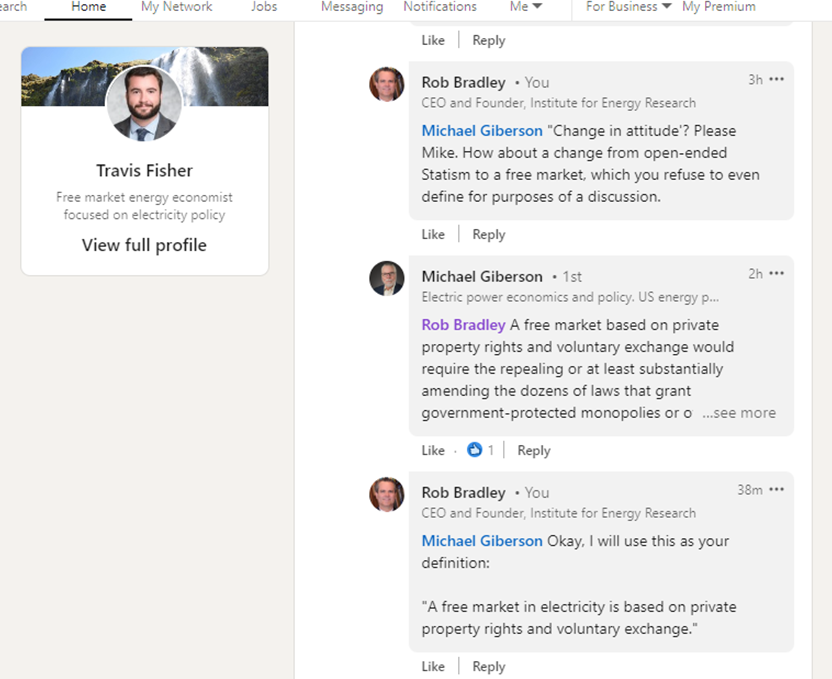
“A free market in electricity is based on private property rights and voluntary exchange.”
– Michael Giberson, May 19, 2024
It took me a few dozen tries, but the definition has come from a (not-so) free market electricity advocate. Maybe Lynne Kiesling, woman of system and “The Queen of Electricity Markets,” will be next.
Fake free marketeers at the Niskanen Center and at R Street Institute are a plague on sound public policy analysis regarding electricity and other climate/energy issues. (The sad case of Jerry Taylor of Cato and Niskanen is recounted here and here.)
Mike Giberson knows his energy stuff and was/is free market in many areas, except for electricity. Yes, he works around the edges to improve power “markets” using basic economics. But he is firmly in the camp of mandatory open access and central wholesale planning, with nary a thought to the free market alternative, which he very reluctantly (and finally!) defined above.
This is much to like about Mike. He corrects me in my specialty, the history of U.S. petroleum intervention. He has had notable free market moments, such as his rejoinder to the notion that the U.S. Department of Energy invented the fracking of natural gas from shale. On price gouging, he has been my guest at MasterResource. He reviewed Meredith Angwin’s book Shorting the Grid with a moment of candor:
By the end of the book, I could no longer shake the feeling she just might be right on the big thing. RTOs may be producing an increasingly fragile grid.”
Duh, one might say. But would Lynne Kiesling agree?
Consider his reporting on negative wind pricing at least as far back at 2008. Great stuff, but he downplayed the same in the ruined economics of thermal generation leading up to the Great Texas Blackout of February 2021, another story (here and here).
I disagree with Giberson on electricity policy, but it goes much deeper than this. The rules of classical liberal scholarship include taking opposing arguments seriously and being transparent. And focusing on opportunity cost, the most attractive option foregone. Mike, and Kiesling more so, have violated that in spades, preferring to be obscure and to disengage at the most important moments (ask Travis Fisher).
Only after a lot of effort have I gotten Giberson to admit to the simple definition of a free market in regards to electricity (which he contradicts in his work, it can now be said). I have applauded his admission that ISO/RTO’s are “a very regulated market.” And I do so now.
And I have rebutted his criticisms of me for being a stooge for oil and gas; and for sullying my reputation. A lot of hit-and-misses from him, in my opinion. This said, Giberson and I have debated wind/solar zoning versus private property rights with reasonable differences. (But why his defense of private property here and not with electrical transmission?)
But overall, the electricity program of Giberson (Kiesling) is Stealth Statism. As I once asked:
So will Michael Giberson and Lynne Kiesling ever consider the opportunity cost of their politicized electricity ‘market’? Will they consider a real free market that was at the center of the classical liberal debate before mandatory open access (etc.) came along? How much failure–and how far on the ‘road to serfdom’ does U.S. energy policy have to go before mid-course corrections?
All this said, much progress has been made with his definition, fresh from yesterday, that can be used as a benchmark for evaluating public policy positions in electricity. I hope Lynne Kiesling (who still refuses to provide a definition) approves.
The post Giberson Defines a Free Market in Electricity! appeared first on Master Resource.
via Master Resource
May 20, 2024 at 01:07AM
 Iowa Climate Science Education