Month: May 2024

Ford explains it will have to stop selling petrol cars to poor people so it can meet government EV rules

By Jo Nova

Call it an anti-subsidy to kill the product the customers want, and call it an anti-tariff to help foreign manufacturers

The Suicide of The West continues apace.

All around the West governments are concocting rules that force car manufacturers to sell a certain ratio of EV’s to petrol cars. In the UK if they breach the ratio they’ll be fined a savage £15,000 for every petrol car. In other words, if customers don’t voluntarily want to buy as many EV’s as the government thinks they should, the rules will force the car manufacturers to restrict the petrol car sales. Obviously, what’s left of the free market will pay big money for the rare and desirable petrol cars that are permitted to be sold.  Soon only the wealthy will be able to afford them, while the riff raff have to catch a bus.

One Ford manager is helpfully telling the world what these rules mean:

By Tom Jervis, Auto Express

Introduced at the start of this year, the ZEV mandate requires manufacturers to ensure that a minimum percentage of their overall sales are battery-powered, or face fines of up to £15,000 for every ICE car sold over the limit. This year, the target is set at 22 per cent, however, while EV sales continue to grow due to fleet demand, private buyers are proving reluctant to make the transition and EV targets are looking hard to meet. According to the latest industry figures, fewer than 17 per cent of models registered in April boasted zero-emissions powertrains.

Martin Sander, told the Financial Times’ Future of the Car Summit: “We can’t push EVs into the market against demand. We’re not going to pay penalties. We are not going to sell EVs at huge losses just to buy compliance. The only alternative is to take our shipments of [engine-powered] vehicles to the UK down, and sell these vehicles somewhere else”.

It’s so Soviet:

Matthew Lynn, The Telegraph

The fear must now be that the electric car carnage has only just begun – with Net Zero turning into a sledgehammer for the deindustrialisation of the West, and China the only clear winner.

The trouble is, quotas don’t work any better in Britain than they did in communist Russia.

In effect, Ford will limit its sales of cars in the UK. If you had your eye on a new model, forget it. You will have to put your name on a waiting list, just as East Germans had to wait years for a Trabant. Heck, we may even see a black market in off-the-books Transit vans. Ford is the first to spell it out in public, but we can be confident all the other manufacturers are thinking the same thing. They can’t absorb huge fines. The only alternative is to limit the sales of petrol cars.

It’s worse than Soviet, it’s not helping the motherland, its serving China

Paul Homewood explains the Zero Emission Vehicle (ZEV) scheme in the UK decrees that this year 22% of all cars sold need to be electric vehicles (and hybrid ones don’t count). But last year EV’s only made up 16% of all sales, and at that rate car manufacturers will be 113,000 electric car sales short of the target this year. That works out to be a very expensive £1.7 billion fine. Worse, foreign companies like Tesla and BYD (the Chinese EV company) won’t have to pay the fine, but they will score an “allowance” credit for every EV sold in the UK. In turn, they’ll theoretically be able to sell those credits to the hapless local car producers, meaning effectively people buying petrol cars in the UK will be subsidizing foreign EV manufacturers.

Just to recap, this is how the scheme works, as set out by the government:

‘Each year, vehicle manufacturers are set a target as a percentage of their total annual sales that must be zero emission. The regulation will require that for each non-ZEV sold, the manufacturer must have a ZEV allowance, the unit in which compliance will be measured. Manufacturers will receive enough allowances that if they meet their target, they will not need additional allowances. If a manufacturer sells more ZEVs than their target, they will have a surplus of allowances they can sell, bank, or convert their excess allowances. If a manufacturer sells fewer ZEVs than their target, they can buy, borrow, use banked allowances or convert CO2 emissions allowances to meet their obligation or make a final compliance payment.’

This means, for example, that Tesla and all the Chinese companies selling EVs here will be given allowances, which they can then sell at a profit. Based on last year’s sales, these surplus allowances could be worth £570million for Tesla and £400million for Chinese-owned MG and Polestar.

With China’s BYD, who are already challenging Tesla in global EV sales, ready to invade the UK market, more and more subsidies will end up being sent to China.

If somebody had suggested a few years ago that the UK would be paying billions in subsidies to China so they could undercut our own car industry, they would have been laughed at.   — Read it all The Conservative Woman

Ford possibly recognises that selling too many petrol cars could send dollars to rivals in China.

It’s almost like the CCP had two million sympathetic communist party members helping them out throughout the West to create the policies they wanted.


Paul Homewood blogs at Notalotofpeopleknowthat.

Image by brands amon from Pixabay

0 out of 10 based on 0 rating

via JoNova

https://ift.tt/bBmduAn

May 10, 2024 at 04:32PM

A Nuanced Argument for The Benefits of Global Warming

Kyle Schutter

For an audio discussion of the pros/cons of global warming, listen to this podcast with Kyle, Partner @Grant&Co fundraising consultant in Africa, and Amo Rebecca, Behavioral Scientist.

People often ask me, “Do you believe in global warming?” as if it’s a religion. But “belief” is not how reality works. More useful questions could be: What’s the probability that the

  1. climate is changing?
  2. change is bad?
  3. change is worse than the alternative?

It’s worth thinking about to see if we understand the world properly. I researched this topic for strategic reasons for our business—is climate something we want to invest in? Anyone who has a more accurate prediction of the future has an advantage.

The discussion of climate has become muddied due to conflicts of interest. We can’t trust the coal miner or the conservative politician when they say “Global warming is a non-issue,” nor can we trust the left-wing or solar startup that global warming is the biggest threat to humanity.

“You cannot get a man to understand something that his salary depends upon him not understanding.”

Meanwhile, we sit somewhere in the middle: environmentalists in the traditional sense and we do raise funding from climate-related groups.

Is the climate changing?

Climate activists say 99% of scientists agree that the climate is warming and humans are responsible for it. But that disguises the consensus. Are all of those scientists 100% convinced? Or are they 51% convinced? If they are truly 100% convinced, then I’ll happily make a 100:0 bet with them as I would have no downside. No one so far has taken me up on this offer.

Is it bad?

The Dutch have built dykes since the 1300s. 40% of the Netherlands was reclaimed from the sea, and even today, some of their land is still as much as 7 meters below sea level. Can we, with 21st-century technology, also build dykes to protect land that is 1 meter below sea level?

But, people say, what about places like Africa, which are most affected? Yes, but a well and irrigation would make people resilient to decreased or unreliable rains. These are known, albeit costly, solutions, and thus, it wouldn’t be the end of the world.

We can handle the immediate effects of a warmer climate, but, people argue, global warming can spiral out of control: the warm weather melts more ice, less ice means less sunlight reflected and a positive feedback loop that makes the planet warmer ad infinitum until the whole planet is drier than the Sahara.

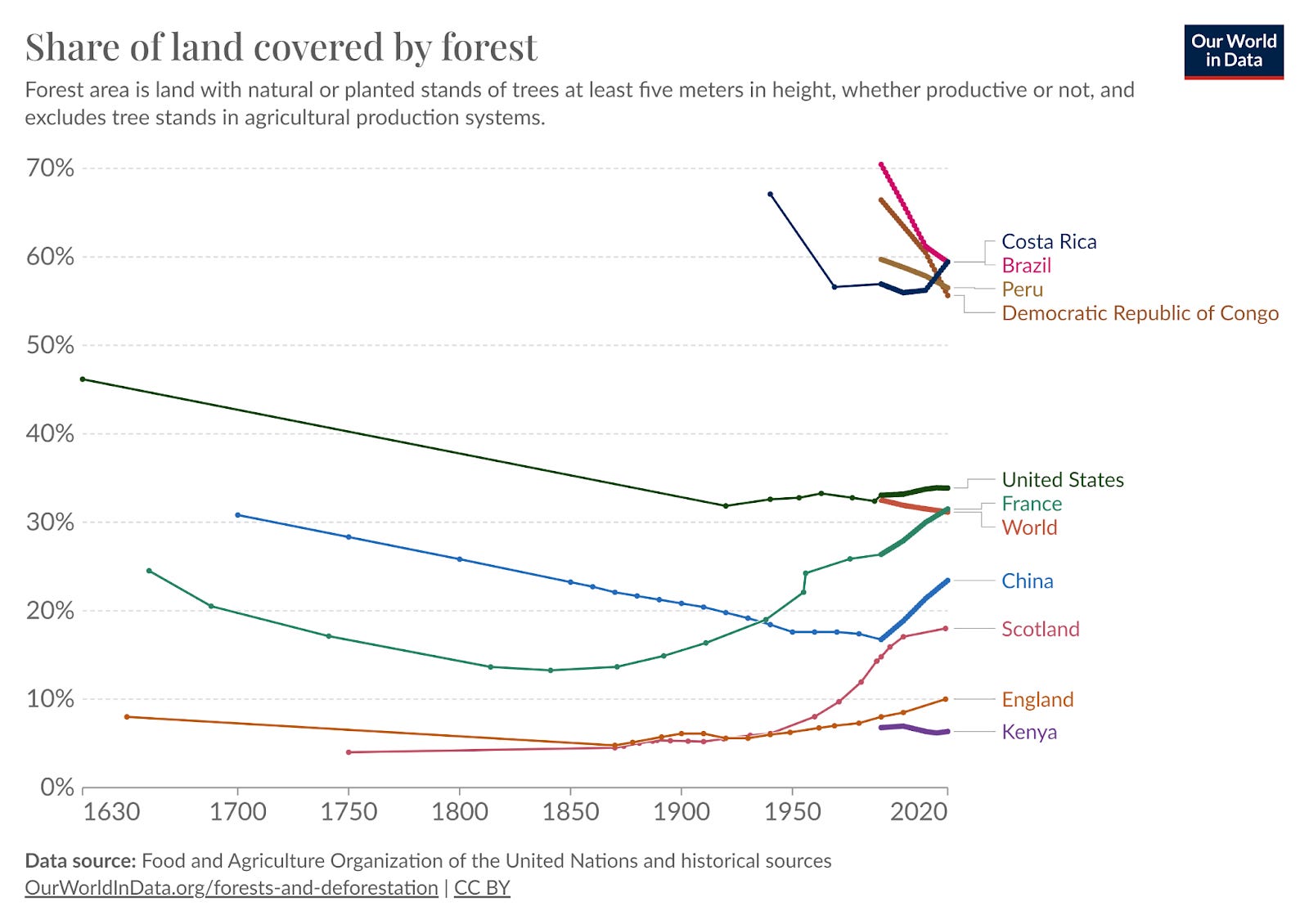
But there are also negative feedback loops; more carbon dioxide and warmer weather means more plant growth. Plants sequester carbon and reduce temperatures. In fact, the world has become greener over the last few decades with increased forestation in Europe, North America and China, and more greening (think tree crops+forest) in Brazil and Southeast Asia.

Forests in China, Scotland, France, Costa Rica and the US bounced back. Brazil, Peru, and DRC forests are still in steep decline. The world’s net forest cover is in decline, but the decline is slowing with every decade; at this rate, there will be a net increasing forest cover by 2050.

So climate change is possibly neutral to possibly very bad. But good and bad don’t exist in isolation. There are pros and cons of every choice…

Was there a better alternative?

We did pump a lot of carbon into the atmosphere, but carbon-based fuels have saved billions of lives in the last 2 centuries through advances in medicine and sanitation, not to mention improved quality of life for billions more. There wasn’t a viable alternative to carbon-based fuels to have saved those lives at that time. So would we rather have a 1-3°C temperature increase or 1-5 billion dead?

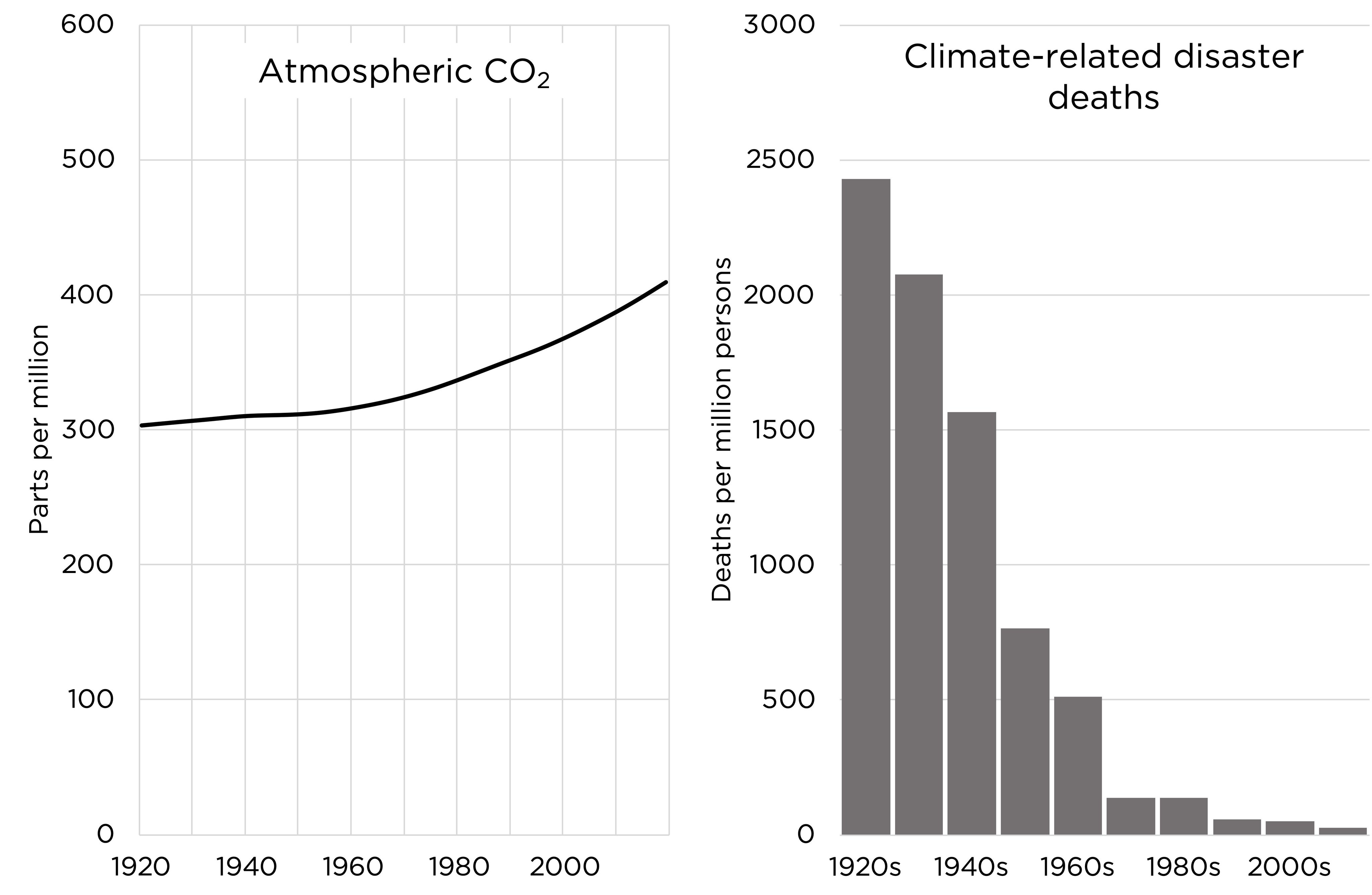
People often say climate change could kill millions of people. But what if it’s more complicated than that. What if modern technology, made possible by fossil fuels, saves millions of people. Just look at the data.

It’s almost as if the same thing that increases CO2 levels also decreases climate disasters. Based on 1920s Climate-related Death Rate of ~0.25% and considering there are 8b people on earth now, 20m people each year are saved compared to 1920s levels. EM-DAT, CRED / UCLouvain (2023)

This is not just a question of the past—billions still remain in energy poverty. Is it fair to prevent them from saving perhaps a billion more lives?

Let’s look at the environmental alternative. Is global warming better than global cooling? This is not an idle remark. In the 1950s, climate scientists noticed there was global cooling. In fact, due to the predictable changes in the earth’s orbit and axis of rotation, we can (very roughly) predict when we would possibly have had an ice age. The period of ice ages is about 21,000 years. The last ice age started about 21,000 years ago. Did we just narrowly miss having another ice age? We can never know for sure. But would we rather have 1-3°C warming than an ice age where the average global temperature dropped by 14°C and glaciers came all the way down to New York?

I just read Why the West Rules…For Now, detailing human development from 14,000BCE to present and a shocking number of times civilization collapsed right as we had a mini ice age. A worthwhile read.

Maybe we don’t want the world to get 1-3°C warmer. But we definitely don’t want it to get 14°C colder. If we could modulate the amount of carbon dioxide in the atmosphere to stay somewhere around what we have now AND relieve energy poverty around the world, that would be great. If only there was a way to maintain our current lifestyle AND carbon dioxide concentration…

When will we get this magical zero-carbon energy?

We already have it! Nuclear power is abundant, reliable, safe and cheap (if the government just allows a plant to be built). Climate change is a solved problem (technically). Politically, there are still roadblocks. But politics is just made up of people like you and me. If you say let’s use nuclear and I do too and a billion other people do, then we could maintain slightly elevated levels of carbon dioxide to stave off an ice age. I have little sympathy for environmentalists against nuclear power; We can have our cake and eat it, too. At COP28, 22 countries committed to increasing Nuclear Power 3x by 2050.

What should we actually worry about?

I’m concerned that by 2100, we will have moved from a Military-Industrial Complex to a Carbon-Industrial Complex; we will have created an entrenched group of lobbyists and special interests that incentivize removing carbon from the atmosphere even though doing so is no longer needed. This could create a bullwhip effect that overcompensates and pushes us back towards too little carbon dioxide in the atmosphere, causing low plant growth and another ice age. I have not heard anyone talk about a Carbon-Industrial Complex before, and hopefully, people a century from now will laugh at my wrong-headed theory. But maybe not… History rhymes—if there’s one thing I’m 100% sure of, it’s that humans have proven repeatedly successful at overcompensating.

Closer to home than 2100, consider the parable of the Baptists and the Bootleggers. The religious baptists wanted to ban alcohol in the US in the 1910s to 1920s. Who could blame them? Less alcohol abuse seems like a good thing. But whenever there is someone with good intentions there is someone else who hides under good intentions. Who else wanted alcohol to be banned? The bootleggers! Originally environmentalists had good intentions. Hell, I’m an environmentalist who previously ran a biogas company and attempts permaculture farming when I can. But then the “bootleggers” (*ahem* power-hungry statists) saw the opportunity to centralize power by applying a moral purity test under the guise of environmentalism. It’s too soon to really sort out who are baptists and who are bootleggers but people who conveniently became concerned about the climate right when it benefitted them are suspect. Just like communism, “we need to control people for their own good.” How many climate bootleggers are there? We don’t know. But we know there are power hungry people who would do anything to get what they want so there are certainly some.

I try to be pragmatic. If carbon credits can raise capital for entrepreneurs who can replant trees or provide funding for rural solar projects, I’m all for it—for better or worse, such projects are a drop in the bucket for global carbon. However, I have not heard the unintended consequences of carbon credits discussed. Like giving away free clothes in Africa, thereby destroying nascent textile businesses, there are always unintended consequences.

What do you think?

via Watts Up With That?

https://ift.tt/Mpl9Z6w

May 10, 2024 at 04:05PM

“The world began to end on 12th May 2024”

Interesting article about solar storms from three years ago. “The world began to end on 12th May 2024, though another 309 years would pass before our species finally went extinct. The apocalypse was not the result of one thing, unless … Continue reading

via Real Climate Science

https://ift.tt/BPe6UuQ

May 10, 2024 at 03:22PM

Aurora on display

By Jo Nova

Just in case you happen to be near clear night skies… they are being reported in NZ, East and West Australia. Check the Glendale App.

BBC NEWS For the first time since 2005, the National Oceanic and Atmospheric Administration’s Space Weather Prediction Center (SWPC) has issued a G4 geomagnetic storm watch for this weekend, the second highest on its scale.

h/t CO2 Lover


0 out of 10 based on 0 rating

via JoNova

https://ift.tt/jLEHPNZ

May 10, 2024 at 02:19PM