Month: May 2024

What The Media Won’t Tell You About The Energy Transition

Reposted from Robert Bryce’s Substack

The hype, and the reality, about the energy transition in 10 charts

Cooling towers at India’s Mahatma Gandhi Super Thermal Power Project, a 1,320 MW coal-fired power plant in Haryana. Photo: Wikipedia

Over the past few days, I’ve searched the NewsBank archive for uses of “energy transition.” One of the earliest uses of that now-ubiquitous phrase occurred in the Christian Science Monitor in 1981. In a dispatch from Nairobi, a reporter named Richard Critchfield explained that some “4,000 delegates from 154 countries” were gathering in the Kenyan capital for a two-week United Nations conference on new and renewable sources of energy. “The purpose of the conference,” Critchfield explained, was to “promote better understanding of the global energy transition from oil to such new sources as geothermal, solar, wind, ocean, and hydropower or energy from biomass, fuelwood, charcoal, peat, draught animals, oil shale, and tar sands.”

The article doesn’t mention climate change. Instead, it focuses on Kenya’s reliance on imported energy, the country’s geothermal potential, and the “classic third-world poverty trap of soaring oil costs and stagnant export earnings.”

Today, 43 years later, we are inundated with news reports about climate change and claims that we are in the midst of an energy transition that will eliminate our need for hydrocarbons. Myriad examples can prove that point, but consider the Earth Day press release from the White House. The April 22 release included the word “climate” 52 times and references the energy transition three times. For instance, it said President Joe Biden has launched a new “Clean Energy Supply Chain Collaborative to work with international partners to diversity supply chains that are critical to a clean and secure energy transition.” It continued, saying the president is “mobilizing other governments to follow the U.S. lead and commit to achieve net zero government emissions by 2040.”

Before going further, let me be clear about my politics. I’m not a Democrat. I’m not a Republican. I am Disgusted. I have no truck with either party. As a journalist focused on energy and power systems, my affiliation is with the math and the physics. My job is to spotlight the trends and the numbers and to separate the hype from the reality. Unfortunately, much of the media coverage about the energy transition is just that: hype. As I will show in these charts, the hype has soared during the Biden administration.

Last month, the EPA announced rules to “reduce pollution from fossil fuel-fired power plants.” In the agency’s April 25 press release announcing the new regulations, the word “transition” appears three times. The EPA said  it was providing “regulatory certainty as the power sector makes long-term investments in the transition to a clean energy economy.” It also quotes the BlueGreen Alliance’s Jason Walsh as saying the EPA mandate provides a “toolbox of critical investments targeted to the workers and communities experiencing the economic impacts of energy transition.”

In these 10 charts, I abide by W. Edwards Deming’s commandment: “In God we trust, all others must bring data.” The numbers I’m presenting aren’t my numbers, they are the numbers. Here’s what the media won’t tell you about the energy transition.

Chart 1

I’ve said it before, but I’ll repeat it: the concept of the energy transition is essentially a Western conceit. The U.S. and Western European countries are spending hundreds of billions of dollars on programs like the Inflation Reduction Act and the Energiewende to fund buildouts of solar, wind, batteries, and tutti-fruity-colored hydrogen, but that doesn’t mean the rest of the world will do the same. There is no evidence that China and India are going through an energy transition. Instead, the numbers show those two countries are building staggering amounts of new coal-fired capacity. That capacity is far greater than the amount of nuclear capacity they are building. This chart, which I first published last December, uses updated figures from the International Energy Agency and Global Energy Monitor.

Chart 2

On April 30, Reuters reported, “India’s coal production and generation shattered records in March as miners and power producers made a Herculean effort to avoid a repetition of the fuel shortages and blackouts that hit the country two years ago. Domestic coal production soared to an unprecedented 117 million tonnes in March 2024, up from 108 million in March 2023 and 96 million in March 2022, according to data from the Ministry of Coal.”

The following two charts show that whatever emissions reductions are achieved in the U.S. and other big economies are being swamped by what’s happening in India and China.

Chart 3

This chart uses the same numbers as those in the previous chart, but putting them in a horizontal format makes them easier to comprehend. It also underscores the challenge of decarbonizing the Indian and Chinese economies.

Chart 4

I have published this graphic before. But I am using it again here because it spotlights the staggering growth of hydrocarbons compared to the growth of the two politically favored sources of power generation, wind and solar.

Chart 5

As mentioned above, the EPA’s new mandates could force the closure of all the remaining coal-fired power plants in the U.S. by the mid-2030s. The mandate, which faces a years-long legal battle before it could become law, claims the U.S. must act on climate change. However, the mandate will not affect China and India, which generate eight times more electricity from coal than the U.S.

Chart 6

More coal-fired capacity is being built in developing countries. And those new plants will result in more emissions. On March 1, the International Energy Agency reported that energy-related CO2 emissions “grew by 1.1% in 2023, increasing 410 million tonnes to reach a new record high of 37.4 billion tonnes.  This compares with an increase of 490 Mt in 2022 (1.3%). Emissions from coal accounted for more than 65% of the increase in 2023.”

That last line is critical. According to Global Energy Monitor, Bangladesh, China, Indonesia, India, and Vietnam are all building new coal plants. That new capacity, totaling nearly 188 gigawatts, is roughly equal to all existing U.S. coal-fired power plants (200 GW).

Furthermore, since 2019, according to Global Energy Monitor, China and India have added some 216 GW of coal capacity. One more number is relevant here: Those five countries have a combined population of 3.4 billion, or about 42% of all the people on the planet. Their electricity use is a fraction of the 12,000 kilowatt-hours per capita per year we use here in the U.S. For instance, in Bangladesh and Indonesia, electricity use is paltry: less than 500 and 1,200 kWh/capita/year, respectively.

Chart 7

I published this chart last month in “Natty Nation.” I’m using it again here because it illustrates the point at hand. Yes, China, India, and other countries are burning more coal. The U.S. is reducing its use of coal. And yet, despite massive federal subsidies and numerous mandates at the local and state levels, wind and solar energy aren’t keeping pace with the growth in natural gas.

Chart 8

The surging use of the term “energy transition” can easily be seen by searching the New York Times archives. Between 2019 and 2023, the use of that phrase jumped 10-fold.

Chart 9

The same 10-fold increase can be seen in NewsBank’s newspaper database, which has the full text of over 10,000 newspapers

Chart 10

Perhaps the most straightforward way to observe the surge in the marketing of the “energy transition” is to look at the number of times it has been used during the presidential terms of Barack Obama and Joe Biden. Both, of course, are Democrats, and both, of course, have focused on climate. According the National Archives, Obama “believes that no challenge poses a greater threat to our children, our planet, and future generations than climate change — and that no other country on Earth is better equipped to lead the world towards a solution.” However, as seen in the graphic below, the Obama era had far fewer mentions of the energy transition than what has occurred under Biden. Indeed, that phrase has appeared more than 75,000 times during Biden’s presidency. Thus, the media has used the phrase “energy transition” 36 times more during Biden’s three-and-a-half years in the White House than during eight years of Obama’s presidency.

We can think this as the “Woozle Effect,” named after a Winnie The Pooh story by A.A. Milne. The Woozle Effect is also known as “evidence by citation,” which occurs when a source “is widely cited for a claim it does not adequately support, giving said claim undeserved credibility.”

Conclusion

The punchline here is obvious: We are not in the midst of a major energy transition. Instead, what we are seeing is the media echo chamber at work. Media outlets are giving undeserved credibility to the idea of the energy transition despite a metric ton of evidence that shows no such transition is happening, particularly in developing countries like Bangladesh, China, India, Indonesia, and Vietnam. Indeed, the surge in the use of the phrase by the Biden administration — and its many allies in big media outlets — shows that we’re being bombarded by a public relations campaign that’s designed to convince the public and policymakers that an energy transition is happening and that we should be spending staggering sums of money on it.

A decade ago, energy analyst and polymath Vaclav Smil wrote, “hope for a quick and sweeping transition to renewable energy is fueled mostly by wishful thinking and a misunderstanding of recent history.” He explained that “for any new energy source to capture a large share of the market require[s] two to three generations: 50 to 75 years.” He concluded, “Energy transitions on a national or global scale are inherently protracted affairs.” That statement was true in 2014. And will be true for decades to come. Just don’t expect to read about it in major media outlets.

via Watts Up With That?

https://ift.tt/cdJ37oS

May 8, 2024 at 08:01AM

Where Unsold EVs Go To Die: Belgium’s Ports Drowning Under Glut Of Chinese Imports

By Paul Homewood

h/t Russell Hicks


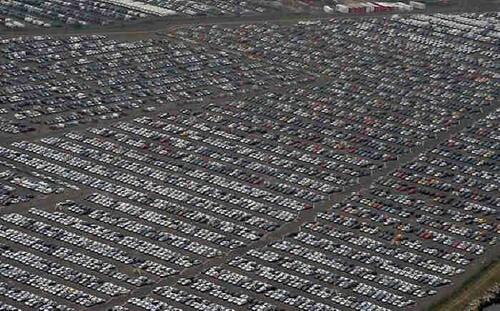
image

Ten years ago this week, we posted one of out most viral stories, highlighting the over-capacity in the auto industry:  "Where the World’s Unsold Cars Go To Die," which highlighted the ‘endgame’ of automakers’ ‘channel stuffing’ efforts to disguise the sudden lack of demand for all the exciting new models that they had forecast would boom to the moon..

And now, as MishTalk’s Mike Shedlock reports,  we are seeing similar pictures across Europe…

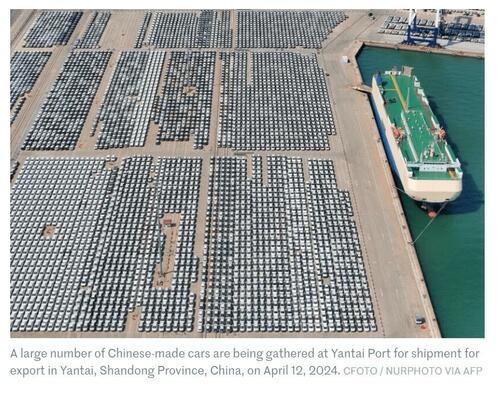
Le Monde reports Belgium’s ports drowning under glut of Chinese electric cars: ‘Some are parked here for a year, sometimes more’

Due to China’s overcapacity in production – as it aims to capture a quarter of the European electric vehicle market – the ports of Antwerp and Zeebrugge are inundated.

You probably need to see it to appreciate the challenges the automobile industry faces in transitioning to electricity. You also need to come here to understand how the Chinese industry’s overcapacity has flooded the European market. That morning, as the sun unexpectedly lit up the maze of highways leading to this remote arm of the port of Antwerp, Belgium, a huge cargo ship from the Norwegian company Höegh Autoliners unloaded thousands of cars at one of the terminals of International Car Operators (ICO), a subsidiary of the Japanese group Nippon Yusen Kaisha.

Alongside Swedish-Norwegian Wallenius Wilhelmsen, it is one of the main operators of the now merged port of Antwerp-Bruges, the world’s largest automotive terminal, through which the production of some 40 brands used to transit. But that was before the emergence of their Chinese competitors.

Car Parks

Quartz reports Cars are piling up at European ports at an alarming rate

Imported vehicles are seriously piling up at European ports, turning them into “car parks.” Automakers are distributors are struggling with a slowdown in car sales as well as logistical bottlenecks that make it hard to alleviate the buildup of new, unsold vehicles.

Some Chinese brand EVs had been sitting in European ports for up to 18 months, while some ports had asked importers to provide proof of onward transport, according to industry executives. One car logistics expert said many of the unloaded vehicles were simply staying in the ports until they were sold to distributors or end users.

“It’s chaos,” said another person who had been briefed on the situation.

This is another part of the escalating trade war between China and the rest of the world.

https://www.zerohedge.com/economics/where-unsold-evs-go-die-belgiums-ports-drowning-under-glut-chinese-imports?utm_source=daily_newsletter&utm_medium=email&utm_campaign=2607

via NOT A LOT OF PEOPLE KNOW THAT

https://ift.tt/VYpWjRA

May 8, 2024 at 04:41AM

Renewable energy passes 30% of world’s electricity supply

By Paul Homewood


h/t Patsy Lacey

I see Silly Jilly is still shilling for renewables!


image

Renewable energy accounted for more than 30% of the world’s electricity for the first time last year following a rapid rise in wind and solar power, according to new figures.

A report on the global power system has found that the world may be on the brink of driving down fossil fuel generation, even as overall demand for electricity continues to rise.

Clean electricity has already helped to slow the growth in fossil fuels by almost two-thirds in the past 10 years, according to the report by climate thinktank Ember. It found that renewables have grown from 19% of electricity in 2000 to more than 30% of global electricity last year.

“The renewables future has arrived,” said Dave Jones, Ember’s director of global insights. “Solar, in particular, is accelerating faster than anyone thought possible.”

https://www.theguardian.com/environment/article/2024/may/08/renewable-energy-passes-30-of-worlds-electricity-supply

So wind and solar power are soon going to drive out fossil fuels then?

Well maybe not!

The share of renewables in the electricity mix did rise slightly last year, from 29.4% to 30.2%. Hardly Earth shattering!


electricity-prod-source-stacked

https://ourworldindata.org/electricity-mix

And what Silly Jilly conveniently forgot to tell you was that hydro power makes up nearly half of the renewable generation. There is of course little room for any further significant increase in hydro capacity.

Biomass also contributed 8% of renewable output.

As for solar and wind power, they only accounted for 13.3% of the world’s electricity, up from 11.9% in 2022.

Fossil fuel generation also increased in absolute terms in 2023, by 1%, and still supplies 61% of the world’s electricity.

The chances of that coming down anytime soon is for the birds.

via NOT A LOT OF PEOPLE KNOW THAT

https://ift.tt/fmb3S0I

May 8, 2024 at 04:12AM

GREGORY WRIGHTSTONE: Scientific Report Pours Cold Water On Major Talking Point Of Climate Activists

From the DAILY CALLER

Daily Caller News Foundation

Gregory Wrightstone
Author of Inconvenient Facts: The Science That Al Gore Doesn’t Want You To Know

The purveyors of climate doom will not tolerate the good news of our planet thriving because of modest warming and increasing atmospheric carbon dioxide. However, a recent scientific paper concludes that an optimistic vision for Earth and its inhabitants is nonetheless justified.

Widely accepted data show an overall greening of Earth resulting from a cycle of natural warming that began more than 300 years ago and from industrialization’s additions of CO2 that started in the 19th century and accelerated with vigorous economic activity following World War II.

Also attributed to these and other factors is record crop production, which now sustains 8 billion people—ten times the population prior to the Industrial Revolution. The boost in atmospheric CO2 since 1940 alone is linked to yield increases for corn, soybeans and wheat of 10%, 30% and 40%, respectively.

The positive contribution of carbon dioxide to the human condition should be cause for celebration, but this is more than demonizers of the gas can abide. Right on cue, narrators of a planet supposedly overheating from carbon dioxide began sensationalizing research findings that increased plant volume results in lower concentrations of nutrients in food.

“The potential health consequences are large, given that there are already billions of people around the world who don’t get enough protein, vitamins or other nutrients in their daily diet,” concluded the The New York Times, a reliable promoter of apocalypse forever. Among others chiming in have been The LancetHarvard T.H. Chan School of Public Health and the National Institutes of Health.

Of course, such yellow journalism lacks context and countervailing facts —elements provided in “Nutritive Value of Plants Growing in Enhanced CO2 Concentrations,” published by the COCoalition, Arlington, Virginia.

Any deficiency of nutrients from the enhancement of plant growth by elevated carbon dioxide “are small, compared to the nutrient shortages that agriculture and livestock routinely face because of natural phenomena, such as severe soil fertility differences, nutrient dilution in plants due to rainfall or irrigation and even aging of crops,” says the paper.

And while there is evidence of marginal decreases in some nutrients, data also show that higher levels of CO2 “may enhance certain groups of health-promoting phytochemicals in food crops” that serve as antioxidants and anti-inflammatory compounds, says the paper, which lists seven authors and more than 100 references. The lead author is Albrecht Glatzle, a member of the Rural Association of Paraguay and a former international researcher of plant and animal nutrition.

Among other points made by the paper are the following: Throughout a majority of geological history, atmospheric CO2 concentrations have been several times higher than today’s, which are less than optimum for most plants; atmospheric warming from even a quadrupling of CO2 concentrations would be small compared to natural temperature fluctuations since the last glacial advance more than 10,000 years ago.

Having virtually no scientific basis, the “green” movement’s hostility to carbon dioxide seemingly ignores the gas’s critical role as a plant food. As the paper notes, “CO2 is the only source of the chemical element carbon for all life on Earth, be it for plants, animals or fungi and bacteria — through photosynthesis and food chains.”

The so-called greenhouse effect of carbon dioxide— perversely exaggerated to support climate fearmongering—  is a life-saving temperature moderator that keeps Earth from freezing over.

The obvious benefits of CO2 is “an embarrassment to the large and profitable movement to ‘save the planet’ from ‘carbon pollution,’” write the authors. “If CO2 greatly benefits agriculture and forestry and has a small, benign effect on climate, it is not a pollutant at all.

More CO2 is good news. It’s not that complicated.

Gregory Wrightstone is a geologist; executive director of the CO2 Coalition, Arlington, Va.; author of “Inconvenient Facts: The Science That Al Gore Doesn’t Want You to Know” and “A Very Convenient Warming: How modest warming and more CO2 are benefiting humanity” and a co-author of “Nutritive Value of Plants Growing in Enhanced CO2 Concentrations.”

The views and opinions expressed in this commentary are those of the author and do not reflect the official position of the Daily Caller News Foundation.

All content created by the Daily Caller News Foundation, an independent and nonpartisan newswire service, is available without charge to any legitimate news publisher that can provide a large audience. All republished articles must include our logo, our reporter’s byline and their DCNF affiliation. For any questions about our guidelines or partnering with us, please contact licensing@dailycallernewsfoundation.org.

via Watts Up With That?

https://ift.tt/lQMZyTe

May 8, 2024 at 04:05AM