Month: May 2024

Alaska Energy Future Needs Informed Voters (gas, hydro under political assault)

“We do not have a gas shortage problem; we have a gas contract renewal ‘problem’ that the incumbents on the board refuse to address.”

“How can a board member do both; support green unreliable energy and meet their fiduciary responsibilities of lowest cost, highest reliability, best service, and safety?”

Chugach Electric Association members face politicized, expensive, and unreliable power options that are certainly not the fault of rich, local resources that have proven their worth for many decades. Only inaction in the face of nefarious “green” can make it happen. Will Chugach members wake up to what economists call the concentrated benefit/diffuse cost problem?

Radical green politicization of electric co-op boards has been a long time in the making, specifically for the 90,000 members of Anchorage-area Chugach Electric Association (CEA). Here is the latest.

Green’ Incumbents CEA Board

Sam Cason and Mark Wiggin, green incumbents on the CEA board, are endorsed by the Alaska Center.  The Alaska Center supports a carbon tax and is funded by the Sixteen Thirty Fund, which is managed by Arabella Advisors, the largest political dark money network in the country. The Alaska Center is advocating for the removal of the Eklutna Dam, Chugach’s single largest source of clean and firm renewable energy, accounting for 24% of the renewable energy portfolio and 5-6% of the total electricity for the Railbelt. 

The Eklutna Dam provides the lowest cost of firm power in the Southcentral region.  Aside from removing the lowest-cost clean energy, dam removal would affect Anchorage’s drinking water as 90% of the water comes from Eklutna Lake.

Cason and Wiggin are also endorsed by Renewable Energy Alaska Project (Renewable Energy Alaska Project, which is supported monetarily by National Renewable Energy Laboratory, a federally funded program with an annual budget of over half a billion dollars. NREL’s mission is heavily geared towards “Energy Justice”, aiming to convince folks that windmills and solar panels equate to equity and diversity.

According to the endorsement 

These two candidates have each shown their commitment to REAP’s mission of increasing the development of renewable energy and energy efficiency in Alaska throughout their time on the Chugach Board. And together they have pledged to address this Cook Inlet Gas Crisis in a transparent manner by diversifying Chugach Electric’s generation portfolio away from a dangerous dependency on natural gas towards a mix of local, reliable, stably-priced renewable energy sources.

Unfortunately for ratepayers, REAP has nothing to gain by advocating to keep clean, reliable, affordable power from Eklutna Dam. In fact, REAP stands to benefit from the removal of the dam under the proposal to deactivate “as soon as a different renewable energy source replaces the hydroelectric project’s output.”

Eighty percent (80%) of the power generation for CEA members is provided by natural gas. CEA has raised the red flag on dwindling gas supplies and the need to find “alternative sources” of energy to fill the gap. This “gap” is due to natural gas contracts expiring. New contracts need new provisions, an everyday practice. But green board members do not want to extend/renew natural gas contracts if their friends and current board members are all in the business of providing wind and solar solutions.

The conflict-of-interest at the expense of ratepayers is obvious. Unfortunately, the coop has decarbonization goals at odds with their primary duty of providing price-competitive, reliable power. The incumbents grasp at proposals such as a coal plant with carbon capture–a policy of distraction and delay. And proponents of wind and solar welcome just that.

We do not have a gas shortage problem; we have an economic problem that the incumbents on the board refuse to own. Instead, board members sit on their hands, allowing ENGOs to infiltrate our state government to draft and lobby legislation that will hold them harmless from liability for their terrible decisions to come. These ENGOs such as REAP are regularly invited to Juneau to testify on green bills enacting renewable mandatescentral planning organizationsgreen banks, and to further subsidize and “level the playing field” for for-profit renewable independent power producers.

In turn, there is no one invited to testify as to the true economical impacts of this legislation. While these ENGOs such as REAP and Launch Alaska (energy transition accelerator) claim to be non-profit, they are implementing profiteering.

At the end of the day, the totality of the “all of the above” energy legislation that is cycling through our capital will result in no accountability from the boards that represent the rate payers, as well as higher costs – either the board members know this and do not care to represent ratepayers, or they are not paying attention. How can a board member do both; support green unreliable energy and meet their fiduciary responsibilities of lowest cost, highest reliability, best service, and safety? We are well on our way to becoming ratepayers without representation with a very expensive utility bill.

All of the Above = Bad

The “all of the above” approach to energy is a terribly misinformed mantra that is repeated at all levelsincluding by Governor Mike Dunleavy, who is the primary champion for all of these green policies.  When they openly tell us what their plans are, we should listen to and believe them. Including ALL power alternatives implies unreliable, very expensive, and environmentally destructive sources will be put on our grid. As physicist John Droz sagaciously asks

How do we advance our economy and our society by allowing unreliable, expensive, and environmentally ruinous power sources on the grid? Who really benefits from an “All of the Above” policy? Well it certainly is not taxpayers, ratepayers, or the environment. The primary beneficiaries are foreign conglomerates who supply us with energy sources that are unreliable, expensive and environmentally devastating — plus China who we will owe an even larger debt to!  All of the Sensible is the obvious answer.”

Yes indeed, sensible options needed for the ratepayers, please.
Folks, if you like representation in your power co-op, we need to elect board members who are not driven by green politics and greed, and who are prepared and willing to do the job – no matter how tough it gets. What will it look like when Chugach members are battling with .45¢/kwh power rates and social justice billing? Will we be forced to eat it like Californians? 

Today we have an advantage over models in the lower-48 where we have representation and nonprofits that provide our power; it is ours to keep. It is through ignorance or corruption that our nonprofit energy infrastructure is being dismantled.

Election Opportunity

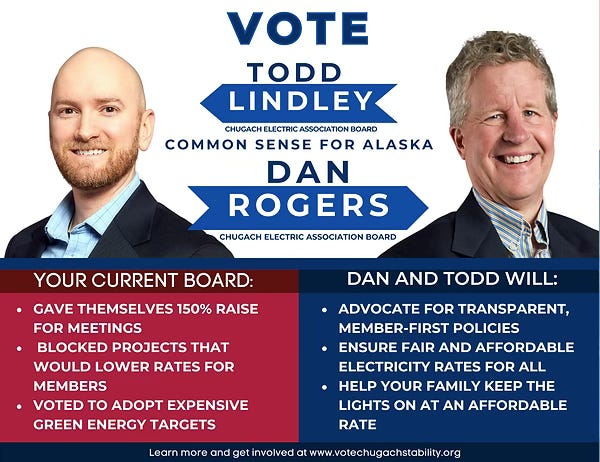
The incumbents believe decisions they are responsible for are better left up to the government, ENGOs and bureaucracies. As Alaskans, we’ve lived through this progressive reliance on government as it has become a costly impediment to our way of life and our freedoms. In this election, we have a unique opportunity to keep our representation and align it with our values as Alaskans. Neither candidate running against the incumbents are beholden to special interests – they see the train coming and their background, experience and dedication to transparency equip them to deal with our challenges ahead.

Dan Rogers is an engineer and business owner with decades of experience in improving power system reliability and cost.  Dan was once employed with Chugach and is the co-founder of one of the largest power system engineering companies in Alaska.  He has been involved in many projects including the firm and reliable Bradley Lake Project.  His clear-eyed take is that renewable projects can be done at Chugach, “but only if a dispassionate look is taken at the options available.”

Todd Lindley is an engineer and business owner with a firm understanding of economics, energy systems and many years of applying logic driven solutions.  Todd has an extraordinary breadth of experience at home in the United States and abroad in design and evaluation/risk scoring on projects large and small.  Todd has been actively involved in the study of carbon legislation and energy policy.  He brings a unique perspective to the electrical utility realm as so much of our firm power is reliant on the oil and gas industry where he has spent his career as a Mechanical Engineer.

Ballots are in the mail – Retrieve your election passcode from your ballot packet and vote online here through May 17th. Watch the Anchorage Chamber “Make it Monday” forum with the candidates here.
Kassie Andrews is a Principal at MasterResource who regularly comments on Alaska energy policy.

The post Alaska Energy Future Needs Informed Voters (gas, hydro under political assault) appeared first on Master Resource.

via Master Resource

https://ift.tt/sHZwPuf

May 8, 2024 at 01:08AM

Sea Surface Temperatures: West Versus East Coast

From the Cliff Mass Weather Blog

Cliff Mass

Perhaps, this blog spends too much time talking about the atmosphere, so to make amends today, let’s see what is happening to the temperature of the ocean surface.  And see whether anything unusual is going on. Let’s start with yesterday’s sea surface temperatures around North America (below).  Sorry, it is all in °C.   Keep in mind that 10°C is roughly 50F,  20°C is around 68F, and 30°C is approximately 86F.

The eastern Pacific near the West Coast is cold (about 50F), with central California’s waters a bit cooler than ours. You must head to the southern tip of the Baja Peninsula to find the water warm enough for comfortable swimming.

The East Coast is a study in contrasts.  The water off of New England is crazy cold (dropping below 7C), while the uber-warm Gulf Stream is found along the west coast of Florida, moves past the Carolinas, and then heads northeastward into the Atlantic.    

There is a HUGE temperate contrast between the Gulf Stream current and the cold water of the Northeast.    A blow-up of the sea surface temperatures off the Northwest really shows the amazing horizontal temperature changes north of the Gulf Stream

Look closely and you will waves in the interface between warm and cold water in the Atlantic and a fascinating loop in the warm water over the Gulf of Mexico (first image above).    Very warm water over the Caribbean and west of Central America

Your next question is probably:  is the current pattern of sea surface temperature unusual?  

To evaluate this, the next map shows the difference between yesterday’s sea surface temperature and normal conditions (also called the SST anomaly).

Pretty close to normal off the Northwest coast.  A few degrees colder than normal for California’s coastal waters. And near normal on Mexico’s west coast.   Most of the Gulf and Atlantic coast is slightly above normal. Temperature is cooler than normal north of the Gulf Stream, which suggests that the Gulf Stream is south of its normal position by a hundred miles or so.

The biggest sea surface temperature story is what is happening in the tropical Pacific.  Last year, a strong El Nino brought MUCH warmer than normal sea surface temperatures from South America, westward into the central Pacific.  

But something major has happened.  The tropical Pacific surface waters are rapidly cooling, resulting in cooler than normal waters in many locations (see map, with arrows showing you some of the coolest spots).

El Nino is dead.  Long live La Nina, its frigid cousin!

via Watts Up With That?

https://ift.tt/UrVI8Bi

May 8, 2024 at 12:02AM

Evaluating Claims of Increasing Floods Due to Climate Change

In his recent article in the LIBERAL PATRIOT, Patrick Brown explores the prevalent assertion that climate change is directly causing an increase in flooding events around the globe. This commentary delves deeper into Brown’s analysis, challenging the simplicity of media narratives and examining the multifaceted nature of flood risks as outlined in his piece.

Media’s Simplified Narratives vs. Complex Realities

Brown points out how media outlets often leap to attribute every major flooding event to climate change, suggesting a “new era” of weather-related disasters. He writes:

“When rivers overrun their banks or flash floods occur from extreme rainfall, many media outlets will reflexively report on the flooding as though we are in a fundamentally new situation due to climate change.”

This observation raises crucial questions about the accuracy of media reports and the responsibility they bear in shaping public perception. It suggests that there is often a disconnect between journalistic narratives and the nuanced scientific understanding of climate events.

Scientific Framework for Understanding Flood Risks

The article emphasizes the importance of using a comprehensive framework to assess flood risks, as adopted by the IPCC. Brown explains:

“The risk of impacts from a natural disaster can be thought of as resulting from the combination of natural hazards, exposure, and vulnerability.”

This framework highlights that the risk associated with floods is not only about increasing hazards (such as more intense rainfalls) but also about where and how people live (exposure) and how well societies can respond to these events (vulnerability).

The Complex Science of Flooding

Discussing the specific factors influencing flooding, Brown elaborates on the Clausius-Clapeyron relationship, which predicts that a warmer atmosphere will hold more moisture. However, he also notes the uncertainties in how this relationship translates into real-world phenomena:

“Studies have shown that, on average, globally, we do indeed see increases in extreme precipitation roughly in line with this seven percent per °C. All else is not necessarily equal, though, and the degree to which warming affects other parts of rainstorm dynamics can also play a role.”

This quote underscores the complexity of attributing flood events to climate change alone, suggesting that other dynamic factors also significantly influence these occurrences.

The Role of Countervailing Influences

Brown discusses how other factors might counteract the straightforward relationship between warmer air and more frequent floods. He points out:

“The same mechanisms that allow more rain to fall out of a warmer atmosphere will also cause more water to evaporate from the land surface prior to the rainfall event. This means that as the atmosphere warms, soil will often have more capacity to absorb the additional rainfall when it does occur.”

This aspect introduces another layer of complexity in understanding flood dynamics and challenges the assumption that more extreme precipitation will invariably lead to more severe flooding.

Revisiting Global Flood Data

Brown reflects on the global data on flooding, which does not show a consistent increase in flood events worldwide. He cites findings that:

“Most observational studies show no increase in floods globally and, if anything, show decreases.”

This statement is pivotal, as it highlights the discrepancy between popular perceptions fueled by media and the actual data observed by scientists. It also reinforces the IPCC’s stance, which holds “low confidence” in global trends concerning high river flows due to human activities.

Conclusion: A Call for Nuanced Understanding

Patrick Brown’s article is a critical reminder of the complexity and media distortion surrounding the discourse on climate change and natural disasters. While there is a knee-jerk tendency to link flood events directly to global warming, a serious approach that considers multiple factors—natural, human, and technological—is necessary for a comprehensive understanding and effective policy-making.

It is crucial to approach this topic with a balanced perspective, recognizing the multi-dimensional nature of flood risks. This approach will not only enhance our understanding but also improve our resilience and adaptive capacities in the face of future challenges.

Read Patrick Brown’s complete article here.

And for more information on floods visit our Everything Climate page here.

via Watts Up With That?

https://ift.tt/wbvaG6H

May 7, 2024 at 08:03PM

Young adults losing the climate faith in the US, and only one third of voters think the IPCC experts are right

By Jo Nova

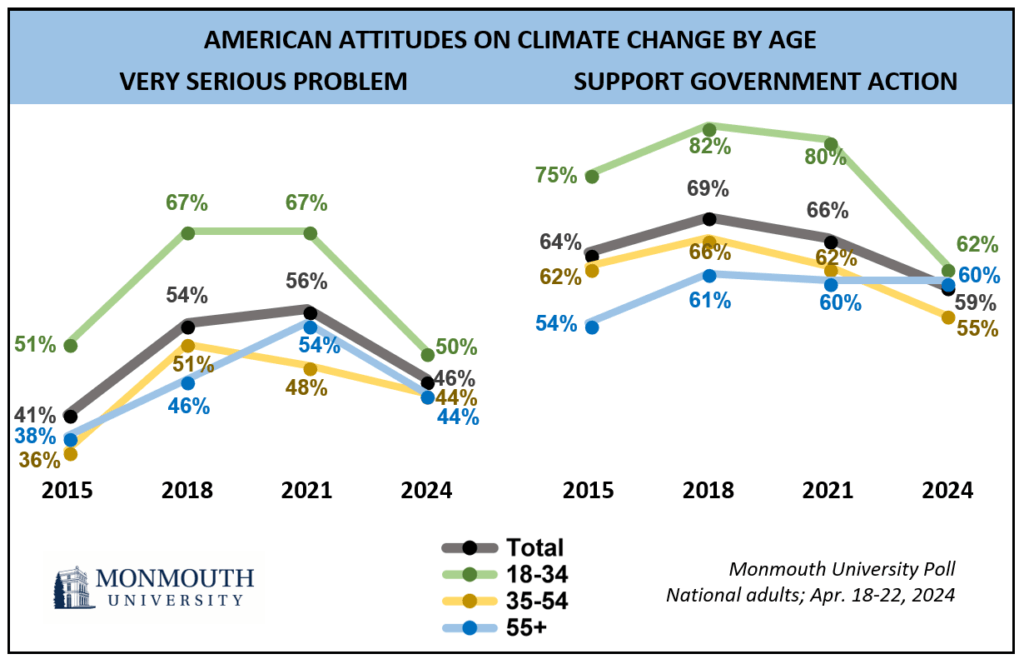
Good news: despite 2023 being the hottest year since Homo Erectus, there was a 17% fall in the number of 18 to 34 year olds who call “Climate change”  a very serious problem. Even though there were hottest ever headlines month after month, the punters lost the faith.

No one is cracking champagne, because 50% of young adults still tell pollsters they think it is a “very serious problem”. But when all is said and done, at least half the generation that was drip-fed the dogma since kindergarten can not only see through the catastrophism but they are brave enough to tell a pollster that too.

For the most part, after a few hot El Nino years, “climate fear” is back where it was in 2016 or so. Most people still want the government to solve the weather with someone else’s money. But where younger people were once much more enthusiastic about a Big Government fix than older people were, now the gap is almost closed.What was a 21% difference between those age groups is now only 2%. That’s a whopping fall in faith in the government to change the weather.

Looks like young adults are learning to be cynical adults faster?

The Monmouth university group polled 804 people in late April:

The percentage of Americans between the ages of 18 and 34 who see climate change as a very serious problem has fallen by 17 points in the past three years (50%, down from 67% in 2021), compared with smaller declines among those who are 35 to 54 years old (44%, down from 48%) and those age 55 and older (44%, down from 54%).

But what does “a very serious problem” even mean?

Anyone can say “it’s serious” but only 1 in 6 people can even be bothered pretending to a pollster that climate change influences their vote:

A Monmouth poll released last month found only 15% of voters view climate change as a determinative issue in how they will vote in the 2024 presidential election, ranking far lower than inflation, immigration, and abortion.

People used to lie to pollsters and say they cared, but now most don’t even pretend. In 2019 in the UK two-thirds of people agreed climate was the biggest issue facing humankind. The Guardian writers were sure that climate change would determine how most of the voters would vote, but the party promising to give them better weather lost in a landslide.

In 2015, when nearly half of US voters said climate was a “very serious problem”, other surveys showed only 3% ranked climate change as the most important issue.

If a twenty-something really believed the Antarctic ice cap was about to melt, wouldn’t it rate as a voting issue?

So let’s be clear, year after year, we see the same results. The voters don’t want to spend money on climate change and won’t change their vote, but the politicians act as though their career depends upon it.

After years of surveys like this, we know the politicians know the voters don’t care, but they go and force climate action on  the voters anyway. Who are they really working for? Last year a survey showed more then half of the US thinks the people who really “run” the country are not known to voters.

Fully 92% of Democrat voters says they think climate change is real. (What else could they say, they’ve be excommunicated from friends and family if they said anything else.)  Only 51% of Republicans tell pollsters they think climate change is real. But imagine how fast that would plummet if skeptical professors were interviewed on TV, and half of Republican politicians spoke for half the Republican voters?

Only a third of voters agree with the UN Experts that climate change is mainly a human driven thing

Despite the UN experts being 97% certain, only one third of voters completely agree with them. That’s really quite astounding.

Public opinion remains mixed on the degree to which human behavior contributes to change in the climate. Just over one-third (34%) say climate change is caused mainly by human activity while 31% say human activity and natural changes in the environment play equal roles. Another 7% put climate change down mainly to natural causes, with the remainder saying climate change is not happening (23%) or are not sure if it is happening (4%). Just over half of Americans (51%) say there is still time to prevent the worst effects of climate change while just 17% say it is too late.

After thirty years of scientific and media purity, only one third think climate change is “mostly human”. Another third think the UN must be exaggerating, and the last third know the UN is wrong.

REFERENCE

The Monmouth University poll, Climate Change Concerns Dip, May 6th, 2024


0 out of 10 based on 0 rating

via JoNova

https://ift.tt/HgDdrJ0

May 7, 2024 at 04:15PM