
0 out of 10 based on 0 rating
via JoNova
May 3, 2024 at 10:07AM

Having been told by the UN-IPCC that nature’s own carbon cycle isn’t up to the job any more, the manufactured problem for climate-obsessed governments seems to be the lack of any ‘carbon removal’ method that is (a) affordable and (b) effective, in terms of the scale of the supposed need. Such is the strange world of climate policy today.
– – –
New research involving the University of East Anglia (UEA) suggests that countries’ current plans to remove CO2 from the atmosphere will not be enough to comply with the 1.5ºC warming limit set out under the Paris Agreement, says Phys.org.
Since 2010, the United Nations environmental organization UNEP has taken an annual measurement of the emissions gap—the difference between countries’ climate protection pledges and what is necessary to limit global heating to 1.5ºC, or at least below 2ºC [Talkshop comment – according to unproven IPCC climate theories].
The UNEP Emissions Gap Reports are clear: climate policy needs more ambition. This new study now explicitly applies this analytical concept to carbon dioxide removal (CDR)—the removal of the most important greenhouse gas, CO2, from the atmosphere.
The study, published in the journal Nature Climate Change, was led by the Berlin-based Mercator Research Institute on Global Commons and Climate Change (MCC) and involved an international team of scientists.
“In the Emissions Gap Reports, carbon removals are only accounted for indirectly,” said lead author Dr. William Lamb, of the MCC Applied Sustainability Science working group.
“After all, the usual benchmark for climate protection pledges is net emissions, i.e., emissions minus removals. We are now making transparent the specific ambition gap in scaling up removals.
. . .
Lead author Dr. William Lamb said:
“This much is clear: without a rapid reduction in emissions towards zero, across all sectors, the 1.5ºC limit will not be met under any circumstances.”
Full article here.
– – –
Image: Carbon cycle [credit: NASA Earth Observatory]
via Tallbloke’s Talkshop
May 3, 2024 at 06:04AM
The “greener” Germany gets, the bloodier its economy becomes. How much can an economy bleed before it dies?
Since Germany has become hostile to industry and its Green Revolution has made energy prices among the world’s highest, it’s no wonder that the country’s economy is hemorrhaging economically. Companies are shutting down and moving out.
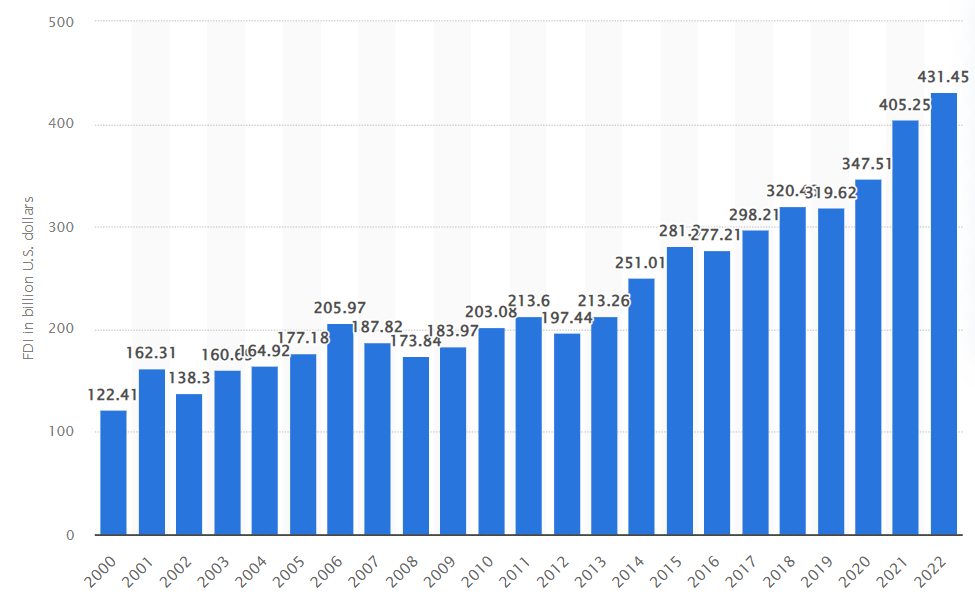
Foreign direct investment from Germany into the United States from 2000 to 2022 (in billion U.S. dollars, on a historical-cost basis). Source: statista
For example, German online Blackout News here reports on how automotive supplier IHI has announced the closure of its plant at Erfurter Kreuz, Thuringia, and that around 300 employees will be affected in a region that is already struggling.
The company is an manufacturer of turbochargers for cars and intends to close the plant in 12 to 15 months, reports Blackout News.
The announcement is just the latest in a long, seemingly unending series of closures.
“In recent months, several automotive suppliers have had to close their doors or file for insolvency. This development shows the volatile challenges facing the industry,” comments Blackout News.
Analysts expect the demand for turbochargers, outfitted on internal combustion engines, will be less in the long term due to e-mobility.
Alarming economic pessimism trend
In more economic bad news for Germany, pessimism among small to medium size enterprises (SMEs), once the backbone of the German economy, has risen as the business climate index has fallen steeply to minus 1.4.
“The business climate index, an important barometer for the mood in small and medium-sized enterprises, fell to an alarming low of minus 1.4 points in February,” Blackout News reports here. “This is the lowest level since the financial crisis 15 years ago. A survey of around 1250 companies conducted by Creditreform Wirtschaftsforschung shows that the majority of respondents forecast a gloomy future for the SME sector.”
The latest figures show that there are no signs of hope for a recovery, “after the third year of crisis.”
Analysts blame a number of factors, such as the current weak construction and industrial production, geopolitical conflicts and “unclear economic policies”. The current Socialist-Green coalition government blames everyone else except for themselves.
The German government has shut down its remaining nuclear power plants after lying to the country in claiming that they weren’t needed – just after experts had concluded the opposite was in fact true. The government plans to phase out coal power plants as well, which will only further exacerbate Germany’s energy woes and its hostile business environment.
Donate – choose an amount
via NoTricksZone
May 3, 2024 at 05:31AM
 Iowa Climate Science Education