Month: May 2024

Build It, And The Wind Won’t Come

From Robert Bryce’s Substack

Robert Bryce

Weather-dependent generation sources are…weather dependent: Last year, despite adding 6.2 GW of new capacity, U.S. wind production dropped by 2.1%.

Damaged wind turbines at the Punta Lima wind project, Naguabo, Puerto Rico, 2018. Photo: Wikipedia.

Three years ago, in the wake of Winter Storm Uri, the alt-energy lobby and their many allies in the media made sure not to blame wind energy for the Texas blackouts. The American Clean Power Association (2021 revenue: $32.1 million) declared frozen wind turbines “did not cause the Texas power outages” because they were “not the primary cause of the blackouts. Most of the power that went offline was powered by gas or coal.”

NPR parroted that line, claiming, “Blaming wind and solar is a political move.” The Texas Tribune said it was wrong to blame alt-energy after Winter Storm Uri because “wind power was expected to make up only a fraction of what the state had planned for during the winter.” The outlet also quoted one academic who said that natural gas was “failing in the most spectacular fashion right now.” Texas Tribune went on to explain, “Only 7% of ERCOT’s forecasted winter capacity, or 6 gigawatts, was expected to come from various wind power sources across the state.”

In other words, there was no reason to expect the 33 GW of wind capacity that Texas had to deliver because, you know, no one expected wind energy to produce much power. Expectations? Mr. October? Playoff Jamal? Who needs them?

But what happens when you build massive amounts of wind energy capacity and it doesn’t deliver — not for a day or a week, but for six months, or even an entire year? That question is germane because, on Wednesday, the Energy Information Administration published a report showing that U.S. wind energy production declined by 2.1% last year. Even more shocking: that decline occurred even though the wind sector added 6.2 GW of new capacity!

A hat tip to fellow Substack writer Roger Pielke Jr., who pithily noted on Twitter yesterday, “Imagine if the U.S. built 6.2 GW new capacity in nuclear power plants and after starting them up, overall U.S. electricity generation went down. That’d be a problem, right?”

Um, yes. It would. And the EIA made that point in its usual dry language. “Generation from wind turbines decreased for the first time since the mid-1990s in 2023 despite the addition of 6.2 GW of new wind capacity last year,” the agency reported. The EIA also explained that the capacity factor for America’s wind energy fleet, also known as the average utilization rate, “fell to an eight-year low of 33.5%.” That compares to 35.9% capacity factor in 2022 which was the all-time high. The report continued, “Lower wind speeds than normal affected wind generation in 2023, especially during the first half of the year when wind generation dropped by 14% compared with the same period in 2022.”

Read that again. For half of last year, wind generation was down by a whopping 14% due to lower wind speeds. Imagine if that wind drought continued for an entire year. That’s certainly possible. Recall that last summer, the North American Electric Reliability Corporation warned that U.S. generation capacity “is increasingly characterized as one that is sensitive to extreme, widespread, and long duration temperatures as well as wind and solar droughts.”

According to Bloomberg New Energy Finance, corporate investment in wind energy between 2004 and 2022 totaled some $278 billion. In addition, according to data from the Treasury Department, the U.S. government spent more than $30 billion on the production tax credit over that same period. Thus, over the last two decades, the U.S. has spent more than $300 billion building 150 GW of wind capacity that has gobbled up massive amounts of land, garnered enormous (and bitter) opposition from rural Americans, and hasn’t gotten more efficient over time.

Wednesday’s EIA report is a stark reminder that all of that generation capacity is subject to the vagaries of the wind. Imagine if the U.S. had spent that same $300 billion on a weather-resilient form of generation, like, say, nuclear power. That’s relevant because Unit 4 at Plant Vogtle in Georgia came online on Monday. With that same $300 billion, the U.S. could have built 20, 30, or maybe even 40 GW of new nuclear reactors with a 92% capacity factor that wouldn’t rely on the whims of the wind. In addition, those dozens of reactors would have required a tiny fraction of the land now covered by thousands of viewshed-destroying, bat-and-bird-killing wind turbines.

If climate change means we will face more extreme weather in the years ahead — hotter, colder, and/or more severe temperatures for extended periods — it’s Total Bonkers CrazytownTM to make our electric grid dependent on the weather. But by lavishing staggering amounts of money on wind and solar energy, and in many cases, mandating wind and solar, that’s precisely what we are doing.

While chasing Moby Dick, Captain Ahab uttered a line that seems to fit the current moment: “Were I the wind, I’d blow no more on such a wicked, miserable world.”

via Watts Up With That?

https://ift.tt/LjY5vkW

May 1, 2024 at 04:01PM

Climate Change: A Natural Hazard – A Note from Bill Kininmonth

There has been a lot in the press about the recent spike in global temperatures, and claims have followed about how this has caused the oceans to warm and the corals to bleach.

There has been a spike in global temperatures as measured by the satellites since 1979, and there remains much regional and seasonal variability in this data.  Furthermore, the same satellite data very clearly shows that the warmth is coming from the oceans, not from the greenhouse gases in the atmosphere.

The Australian Bureau Meteorology, among others, could easily issue a press release clarifying this.  Of course, they don’t – because the Bureau’s leadership have an agenda, that this misinformation supports.

My friend Bill Kininmonth is a former Bureau employee – for more than a decade he headed Australia’s National Climate Centre and was a Bureau delegate to the Second World Climate Conference that culminated in the first IPCC report.

Kininmonth hasn’t stopped thinking.  He wrote a book some years ago, and I have borrowed its title (Climate Change: A Natural Hazard) for this blog post, inspired by his note to me just this morning.  It reads:

Hello Jennifer,

Just to provide more evidence in support of your recent post.

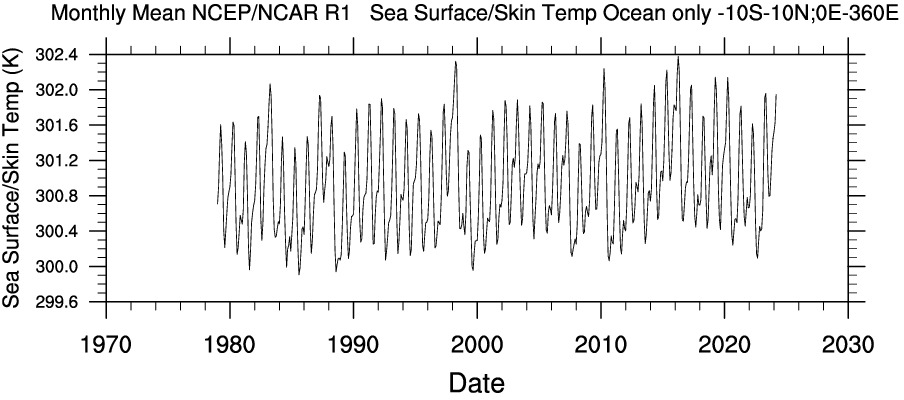
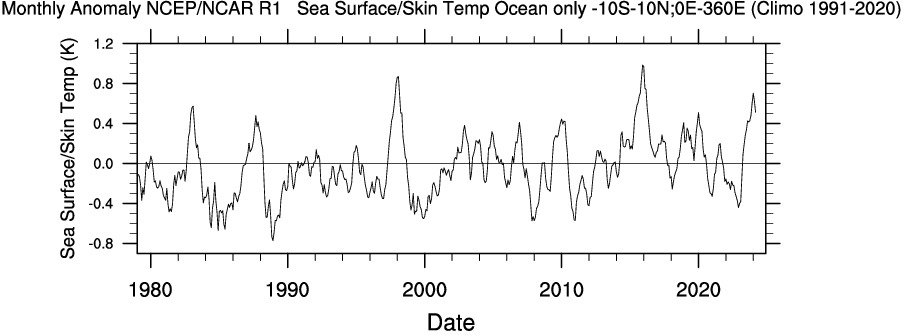
The charts for the sea surface skin temperature for the zonal band Lat 10S to Lat 10N as measured by satellites.

I have read media coverage of claimed ‘global’ coral bleaching that is being attributed to anthropogenic global warming. From the graphs it can be seen that neither the recent temperatures nor the temperature anomalies are the highest of the recent 45 years. The recent temperature spikes are, however, associated with a major El Nino event, which is rapidly decaying.

Your comment on the effect of spring tides is also of interest to me. I have long thought that part of the impact of El Nino, especially for the Great Barrier Reef, is that during these events sea levels across the equatorial Pacific Ocean change.

During the 1997-98 El Nino event sea level over the Western Pacific Ocean dropped about 35cm with an equivalent rise over the Eastern Pacific Ocean. Such a drop in sea level over the Great Barrier Reef would be expected to reduce the flow of cooling water over the reef and giving a greater response to solar heating of the shallow reef water. Lower spring tides would be expected to accentuate the heating of water over the shallow reefs.

On your point about SST (surface sea temperatures) being warmer than air temperature, this is confirmed in the chart of ocean skin temperatures versus air temperatures (see feature image).

The IPCC scientists do not seem to recognise that the greenhouse gases of the atmosphere radiate more energy than they absorb from the surface below.

Radiation processes are tending to cool the atmosphere at a rate of about 2C/day. This radiation cooling generates convective instability, allowing near-surface air to rise buoyantly in convective clouds. The radiation energy lost by the atmosphere is replaced by heat and latent energy flowing from the surface. As you comment, the atmosphere cannot warm the ocean!

Regards, Bill

A drone aerial taken of me from an altitude of 40 metres a few years ago. I am looking down on a lot of very healthy coral, but you need to be in the water to actually see the coral. This aerial was taken by Stuart Ireland above Pixie Reef to the north east of Cairns, that Stuart regularly features at his Facebook page, including very recently, CLICK HERE. I am receiving emails about how I should realise that the scientists have done the aerial surveys and these prove that the Great Barrier Reef is 75% bleached. In fact, these surveys are done from an altitude of 150 metres from which it is difficult to actually conclude very much about the corals, even to see them.

via Jennifer Marohasy

https://ift.tt/Be72RoA

May 1, 2024 at 03:39PM

ELECTRIC CAR TIME BOMB

It has become apparent for a long time that the most expensive part of an EV is the battery which has a limited life. This fact is becoming widely known and is a major factor in putting people off buying one. This has now been picked up by the major national press here in the UK, see the link below: 

The used electric car timebomb –  EVs could become impossible to sell on because battery guarantees won’t last – find out if you are affected | Daily Mail Online

via climate science

https://ift.tt/AD75RMG

May 1, 2024 at 02:57PM

EV Hell continues: Crash victims might have to be “left to die”, Hertz dumps another 10,000 cars, Tesla sacks whole charging team

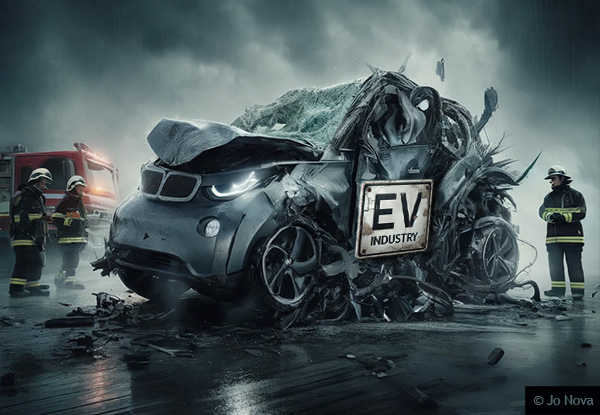
EV doom. The collapse of an industry. AI assisted.

By Jo Nova

Chronicling the collapse of the Big-Government-made EV bubble

In today’s EV obituary column, Elon Musk has dropped a bombshell. Two months after Telsa chargers became the industry standard (which promised to save the other car makers) his profits fell, and he’s fired the entire EV charging team overnight. Hertz, meanwhile, has realized that dumping 20,000 electric cars in January was not enough, and it has to offload another 10,000 electric cars, which now amounts to half its EV fleet. And then comes the news that there might be a secondhand “timebomb” coming at the eight year mark when most EV battery warrantees run out and cars will become “impossible to sell”.

As if that’s not enough, this week the fire and rescue experts in NSW are warning in the politest possible way, that they might have to do a “tactical disengagement” of a car accident victim, which means leaving them to die in an EV fire if the battery looks likely to explode. They say that first responders need more training, as if this can be solved with a certificate, but the dark truth is that they’re talking about training the firemen and the truck drivers to recognize when they have to abandon the rescue.

Jennifer Dudley-Nicholson, The Driven

The NSW government’s Electric and Hybrid Vehicle Batteries Inquiry heard testimony from fire and rescue services, paramedics, the Motor Traders’ Association, and TAFE on Tuesday in its second public hearing.

In the most serious incidents, firefighters said crews could be forced to abandon rescues or crudely rescue passengers from vehicles, and were being left “flying blind” at battery fires.

VRA Rescue NSW Commissioner Brenton Charlton told the inquiry worse outcomes were also possible, including battery explosions in which a rescue operation would put emergency workers at risk.

“We need to prepare ourselves and our volunteers… for the point in time we have to do a tactical disengagement, meaning if someone’s trapped and it does high order (explode) you might not be able to do anything,” he said.

“That will be a tragic, horrible thing to take part in.”

Just like that, Elon Musk fired the whole Tesla EV charging team, throwing the industry into chaos because Tesla network is the best by far and the bedrock of the so called “transition”. Tesla had agreed to open its charging network to other EV makers only recently, and Joe Biden was delighted. Tesla is getting subsidies to expand it’s North American Charging Standard (NACS) system. But this move

By David Ferris, E&E News

In a single stroke, CEO Elon Musk called his company’s vaunted charging reliability into question when he laid off most or all of Tesla’s Supercharger team, the people who made Tesla the envy of the EV industry. The network they built is bigger, faster, smarter and more reliable than any other company’s — and has become the linchpin of the auto industry’s plan to persuade millions of Americans to buy EVs and turn the tide on climate change.

“It feels like the rug just got pulled out from under a lot of the industry alignment that has been built in the last 12 months,” said Matt Teske, an industry veteran and CEO of Chargeway, an EV-charging software platform. “And leaves us on shaky ground.”

In 2022, as traditional automakers finally started delivering a substantial number of EVs to the roadways, they ran into a problem. Their drivers couldn’t use Tesla’s chargers, because they were meant only for Teslas. And the public networks had an array of reliability problems.

Ford was the first automaker to hit on the solution. Last spring, it struck a deal with Tesla to use its 12,000 U.S. charging stations and committed to building Tesla’s charging technology called the North American Charging Standard, or NACS, into its future vehicles.

Other automakers followed suit in short order. By February, Tesla’s NACS had become the industry standard, with virtually every automaker planning to redesign their charging systems to meet Tesla’s specifications.

The Hertz debacle truly might become an obituary

Hertz logo

Originally Hertz was going to buy 100,000 wonder-cars which would be cheap to fix and popular with punters. But the future fleet only reached 60,000 cars and is now reversing back to 30,000 cars which tourists apparently don’t want to rent much, and which cost twice as much to repair.

Not surprisingly, it’s a financial ruin. Hertz shares have lost three quarters of their value since 2022.

The company was an $11 billion dollar company in 2021 when it announced the mass EV purchases — it is now a $1.4 billion dollar company.

RENTAL car giant Hertz, has announced that it is selling off 10,000 more EVs than it planned in January when it set out to stem the tide of massive depreciation that hit its fleet of 60,000 EVs.

Rental car companies need to be able to sell off their ex-rentals for a reasonable sum, but just as Hertz realized it couldn’t afford to repair these cars, it also realized it couldn’t sell them either:

…the program came under stress when Tesla began discounting its cars last year.

This set off a tsunami of depreciation for existing Tesla owners; including Hertz, which had the biggest exposure of anyone. In turn, other EV makers followed suit with discounts and retained values for all EVs became a race to the bottom.

And as word spreads, possibly no one else will be able to sell them either. What is an 8 year old EV with no battery warrantee worth? It’s pot luck whether it will keep going or suddenly need a £15,000 repair…

The used electric car timebomb –  EVs could become impossible to sell on because battery guarantees won’t last – find out if you are affected

By TOBY WALNE, This is Money

Money Mail can today reveal a timebomb looming in the second-hand market for electric vehicles (EVs).

Our investigation found that many EVs could become almost impossible to resell because of their limited battery life.

Experts said that the average EV battery guarantee lasts just eight years. After this time, the battery may lose power more quickly and so reduce mileage between charges.

In some cases, the cost of a replacement battery is as much as £40,000. For certain EVs, the cost of replacing the battery could be ten times the value of the vehicle itself on the second-hand market.

Yet geniuses in government still want to push us all into EV’s.

Thanks to Paul Homewood of Notalotofpeopleknowthat


0 out of 10 based on 0 rating

via JoNova

https://ift.tt/sZKm1fJ

May 1, 2024 at 02:48PM