Electric car buyers should be aware of the “astronomical” costs required to regularly replace short-lived tyres, owners have warned.
Car lover Jim Bassett managed just 7,500 miles in his brand new Volkswagen ID.3 before being quoted more than £300 to replace the rear rubber.
The 80-year-old stumped up the cash after being told it was common practice for tyres on his rear-wheel model to degrade rapidly due to the weight of the vehicle .
Due to its heavy battery, the £35,000 hatchback weighs around 1,800kg – the same as a Jeep Wrangler 4×4.
Fellow ID.3 owners have taken to online forums to also complain of short tyre life, blaming degradation on the hefty weight and instant torque of the car.
Mr Bassett, of Hitchin, Hertfordshire, said: “I couldn’t believe it when I was told they needed replacing.
“I’m quite old and have had cars all my life – I’ve never had to change tyres this early, it’s normally been at around 25,000 miles.
“It amazed me, as at 7,500 miles tyres are virtually new.
“The VW dealership expressed no surprise or concern that they needed replacing so soon, saying that ‘the car is rear-wheel drive and very heavy’.”
The strain on EV tyres comes as a result of both the extra weight and higher torque, the twisting power that launches a car from a standing start.
Road safety charity Tyresafe said: “All that power at any speed in a heavy vehicle means if the driver regularly accelerates hard, the tyres are put under tremendous strain, fighting to grip the road and not spin.”
Due to the greater acceleration speed, manufacturers advise drivers to be delicate on the throttle to prolong tyre life.
Volkswagen, which first launched the ID.3 in 2019, said that driver performance is the key factor impacting tyre wear.
A spokesman said: “Tyre longevity is influenced by a wide range of factors, most importantly the way in which the vehicle is driven, for example, hard cornering, braking and acceleration can cause more wear than gentle driving.”
VW also said that “types of road surfaces, temperature, correct maintenance of tyre pressures; care when parking; and the amount of load the vehicle carries” all impact the level of degradation.
Tyre manufacturer Michelin has previously said that conventional tyres wear out around 20pc faster in an electric vehicle, while Goodyear said they can degrade as much as 50pc faster.
Last year, research by technology firm Epyx found that, on average, tyres fitted to EVs lasted 6,350 fewer miles than those on petrol or diesel cars. The first tyre change for electric cars takes place after an average of 17,985 miles, compared to 24,335 miles for petrol and diesel cars.
Tyre makers are continuing to develop bespoke EV rubber suited to the heavier vehicles, but they can come at a greater cost for drivers. Epyx found that the average tyre cost £207 for larger electric vehicles – £77 higher than the cost for larger petrol cars.
The Government must urgently make low-carbon heating systems cheaper if it wants to reach its goal of net zero emissions by 2050, according to a report by the Public Accounts Committee (PAC).
Almost all of the UK’s 28 million households must ditch their gas boilers and decarbonise their heating systems for ministers to achieve their goal of net zero emissions.
Nearly a fifth (18pc) of all UK greenhouse gas emissions come from heating the nation’s homes, the vast bulk of it from burning natural gas.
The Government wants to phase out gas boilers by 2035 and the Department for Energy Security and Net Zero (DESNZ) has a target for Britain to be installing 600,000 heat pumps per year by 2028, up from just 55,000 in 2021.
But high costs for households mean uptake has so far been slow and the Government is not on track to meet this target.
The PAC report said: “The cost of buying and running heat pumps is a substantial barrier to take-up for most households, at a time when incomes are already stretched.”
An average heat pump costs £11,600, four times more than a gas boiler.
The Government aims to reduce heat pump installation costs by 25pc by 2025, but so far they have only fallen by 6pc since 2021.
The PAC report said: “Costs need to come down much quicker.”
Heat pumps are also more expensive to run than traditional boilers because they use electricity, which costs more than gas, the report said.
The costs are so high that government grants are likely only being used by rich people.
What is most significant in this latest report is that MPs are now admitting that running costs for heat pumps are also higher then a gas boiler, something I have been pointing out for years.
Wind power is described as the pinnacle of ‘distributed’ generation systems – watching 250m turbines being distributed far and wide by Cyclones, Typhoons and Hurricanes certainly gives that impression. Although, we’re not sure that wind acolytes really had disintegrating and self-immolating turbines in mind when they began mouthing off these things being spread from horizon to horizon.
On America’s Great Plains, you can forget about getting any power from these things when the wind picks up.
Wind speeds barely need to reach gale force and these things go into automatic shutdown, as appears on German turbine maker, Siemen’s website – which has this to say about the automatic shutdown of wind turbines when wind speeds hit 25m/s (90km/h):
Nature presents us with different kinds of challenges. High wind can create extremely high loads, and as a result wind turbines are normally programmed to shut down if the 10-minute mean wind speed exceeds 25 m/s. This may pose a significant challenge for the grid system – for example, if turbines in large wind farms shut down simultaneously.
It was precisely that feature of their ‘design’ that led to South Australia’s Statewide blackout on 28 September 2016.
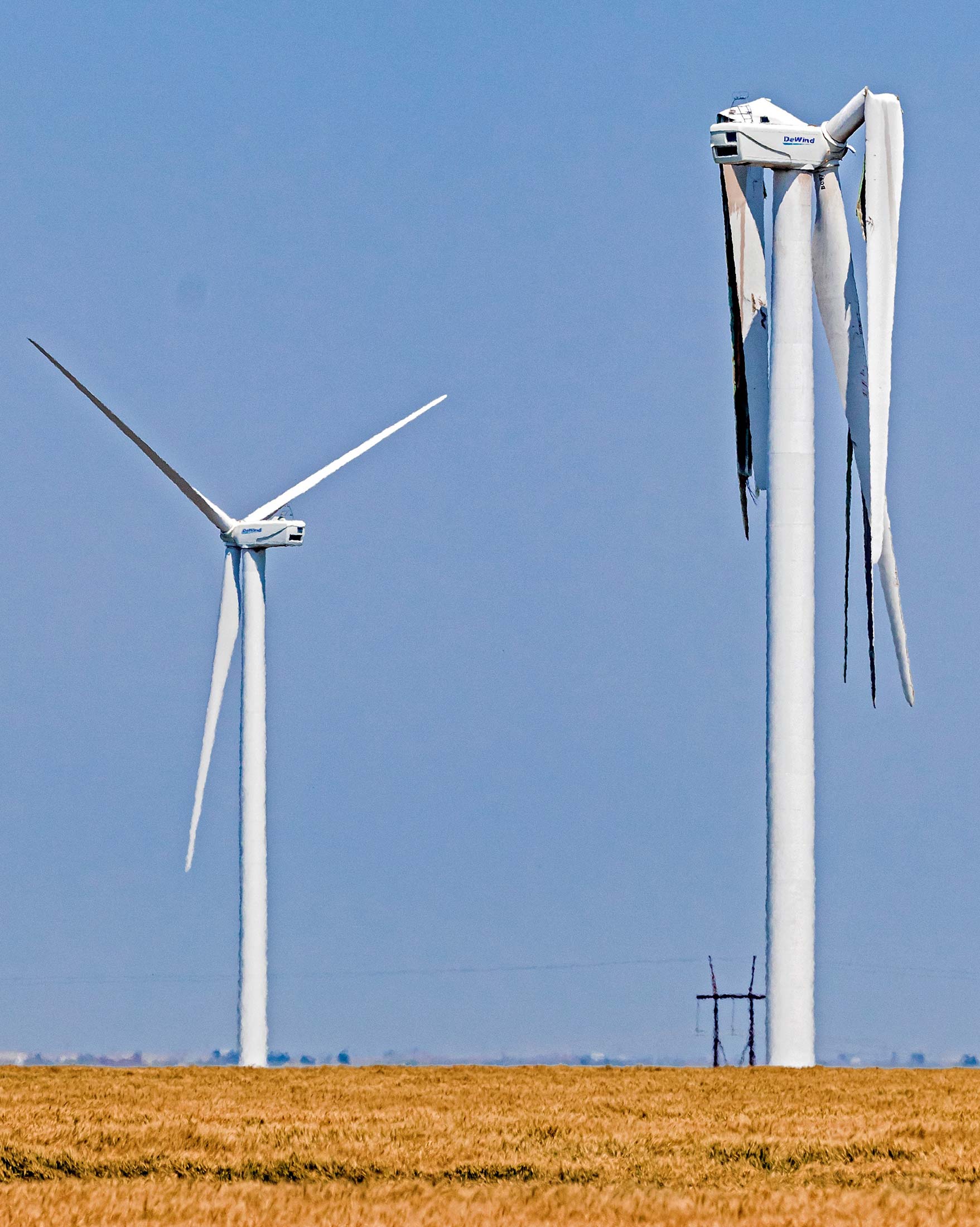
And when a serious tornado gets to work, these things won’t be doing very much at all. Other than spraying their 20 tonne blades and other components tall points of the compass. As this recent event in Iowa makes plain.
Tornado Destroys Wind Turbines in Adams County
Bucoa
Mike
21 May 2024
A tornado swept through a wind turbine field in Adams County, Iowa during yesterday’s severe weather outbreak, destroying multiple wind turbines. At least three turbines were destroyed. At least one of those turbines caught fire and burned after being blown over. Witnesses said the turbine towers snapped like twigs and there are blades and debris strewn across a large area.
Our hearts and prayers also go out to the multiple people who lost their lives and their loved ones in Greenfield from this same tornado.
Here is storm chasing video of the tornado destroying the wind turbines, as well as some aftermath footage:
This is a 26 sec video of the turbine tornado battle





 Iowa Climate Science Education