Month: May 2024

We have World Class windless weather: Today 95% of wind turbines on the continent of Australia are failing

We have World Class windless weather: Today 95% of wind turbines on the continent of Australia are failing

By Jo Nova

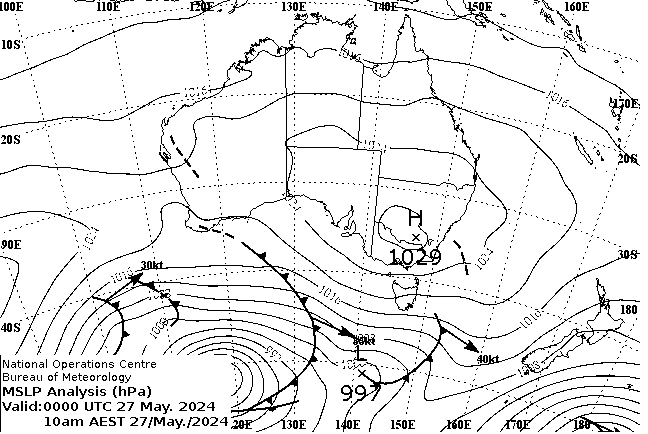
There is no saving the Australian grid from a high pressure cell.

Right now 19 out of 20 wind turbines are essentially towers of fiberglass waste

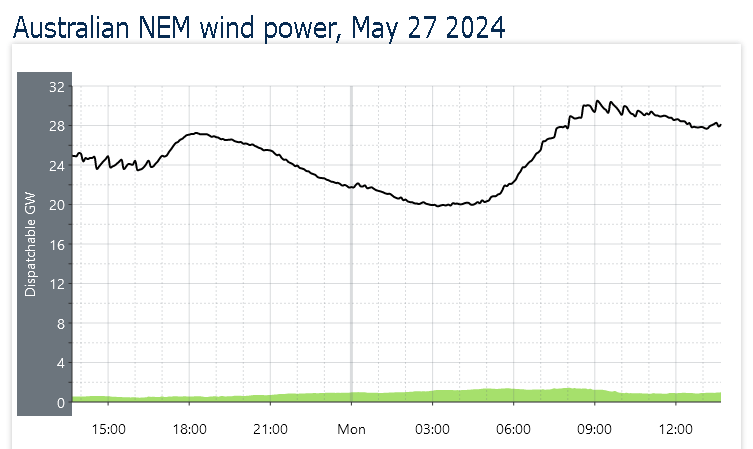
Australia has built 11.5 GW of theoretical total wind power capacity on the National Energy Market (NEM) spread across 80 locations on the Eastern Seaboard, and at one point today only 4.1% of it was working.  Another gigawatt of generation on the Western side is only generating at 3 – 5% capacity.

NEM Wind generation May 27, 2024. Australia.

Total wind generation for the NEM in Australia.

The Australian government is dismissing comparisons with costs of running grids based on unreliable wind and solar power overseas because we supposedly have “world-class resources” and “natural advantages in renewables“. But we also have world-class high pressure cells that stop wind generation across the entire nation simultaneously.

We have a natural disadvantage in wind power — we’re surrounded by vast oceans which make interconnectors prohibitively long, expensive and a strategic security risk for communist ships that might drag anchors accidentally-on-purpose

‘Where exactly can we build another thousand wind turbines that would work on a day like today? Macquarie Island? Antarctica?

High pressure weather cell stops all wind production May 2024


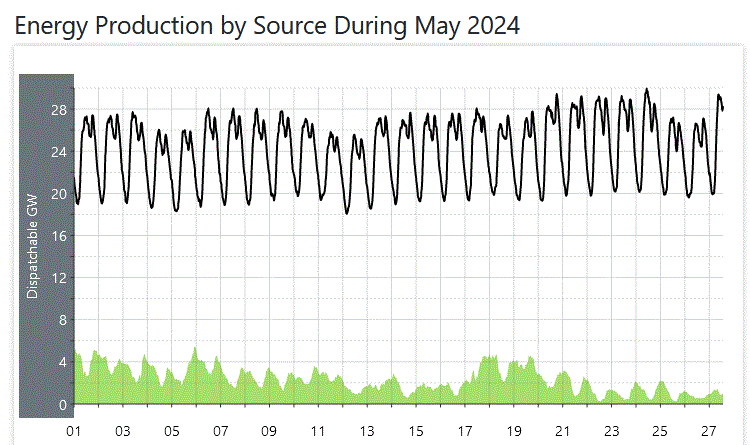
And it’s not just one day. So far for May 2024 wind generation has been low half the time.

On May 25th at one point the entire generation was just 221MW or 2% of total capacity.

Wind power production for the month of May 2024, Australia. Graph.

Australia has 11GW wind power “capacity” and 5% of that is working.


There’s no extension cord long enough to get to the land of the Faraway tree and dependable wind

Over in Western Australia, total wind production is 30MW. So even a new cable 2,000 kilometers long from Perth to South Australia won’t save the national grid. Wind power is only supplying 1.5% of the total electricity on the Western Wholesale Market for Perth and South West Australia. The total installed capacity of wind power in the West is about 1 GW, so it is supplying only 3 to 5% of that.

Macquarie Island is 2,500 kilometers from the closest Australian capital city, and Casey base Antarctica is 3,500 kilometers away.  It’s 2,000 kilometers direct to New Zealand, which is bad enough, but parts of the Tasman Sea are 5km deep. They don’t call it the “abyss” for nothing.

In any case, wind speeds over New Zealand right now are only 1 – 7 km/hr.


0 out of 10 based on 0 rating

via JoNova

https://ift.tt/iAKyV9B

May 27, 2024 at 12:54AM

German Green Movement “A Run Amok At The Expense Of People And Nature”

From the NoTricksZone

By P Gosselin

Wind energy is an environmental destruction machine, warns veteran center-left columnist.

After the collapse of the Soviet Union and its communist block satellite countries in 1989, the West stood in awe, amazed by the environmental and economic wasteland left behind by the inefficient collective socialist system.

But since then, green radicals have taken over and it’s safe to say that the next generation, in about 2060, will also stand in amazement before a similar mass wreckage left behind by the “Green New Deal”.

The future generation will be asking: “What the hell were they thinking?”

Source: Windwahn

German journalist Georg Etscheit explains why in a commentary at Achgut.com here as Germany moves ahead at full speed with wind energy. Etscheit names 5 environmental reasons why wind energy is leading to a Communist-scale environmental disaster in his article: “Wind power and its devastating consequences for people and nature.”

“The ruthless way in which wind power is being pushed through in Germany is reminiscent of the brutal way in which the “concrete faction” wrecked many German cities in the post-war period. A wind madness inventory..,” comments Etscheit, calling Germany’s drive into wind energy “a run amok at the expense of people and nature.

Germany plans to add another 10,000 wind turbines in addition to its current 30,000, which means 2% of Germany’s land area will be completely destroyed and industrialized, according to Etscheit.

What follows are Etscheit’s 5 environmental reasons why Germany’s wind energy insanity is a major threat:

  1. Landscape will be blighted by the addition of 10,000 wind turbines, with a height of up to 250 meters. The natural biotope surrounding these turbines will be irreversibly ruined.
  2. Endangered bird, like the red kite, will lose their habitats. It’s estimated that an absolute collision rate of around 21 per year and wind turbine. “With 40,000 or more wind turbines planned in Germany, the million mark would soon be exceeded.”
  3.  Bats and insects severely decimated. “Wind turbines also pose a significant threat to the 25 or so species of bat found in Germany…”. …”Wind turbines also have a significant impact on flying insects, as a study published in 2017 by the German Aerospace Center (DLR), Institute of Atmospheric Physics in Oberpfaffenhofen shows … an estimated five to six billion insects per day at all German wind turbines during the warm season (200 days from April to October).”
  4. Hazard also for marine fauna. Wind turbines have a negative impact from pressure and sound waves on some animal species with an extremely sensitive sense of hearing. The industrialization of the oceans could displace native marine mammals. “If more and more offshore wind farms are built, this will have an enormous impact on the harbor porpoise populations in the North and Baltic Seas,” reads a statement from the Society for the Rescue of Dolphins.
  5. Infrasound harming people. People near wind turbines often complain of “severe health complaints such as insomnia, dizziness, headaches, depression, tinnitus, hearing and vision problems and cardiac arrhythmia”, and experts warn this will increase dramatically, and turbine setback regulations in Germany are being watered down.

Etscheit argues for a moratorium on the construction of new turbines, but doesn’t see this happening in Germany, where officials are pressing on with the madness, “no matter the costs.”

===============================

Georg Etscheit is an author and journalist based in Munich. He worked for the dpa agency for almost ten years, but since 2000 has preferred to write “freelance” on environmental issues as well as on business, gourmet food, opera and classical music for the Süddeutsche Zeitung, among others. He also writes for www.aufgegessen.info, the gastrosophical blog for free enjoyment that he co-founded, and a culinary column on Achgut.com.

via Watts Up With That?

https://ift.tt/6Xt7H0I

May 27, 2024 at 12:06AM

Fact checking the fact checkers on my Prager U video

by Judith Curry

Last January, I visited Prager U in California.  I recorded several videos.  Science.feedback.org has done a fact check on my 5 minute video, which is the topic of this post

Here is information about Prager U.

Here are links to my two videos.

The Good News About Climate Change 

Stories About Us: Climate Scientists Can’t Intimidate Me

JC’s Prager U text

Let’s start with the good news.

All things considered, planet earth is doing fine.  Humans are doing better than at any other time in history.  Over the last hundred years, when temperatures have warmed by about two degrees Fahrenheit:

  • Global population has increased by 6 billion people
  • Global poverty has substantially decreased
  • And the number of people killed from weather disasters has decreased by 97% on a per capita basis.

We are obviously not facing an existential crisis.

Anyone who tells you that we are, is not paying attention to the historical data.  Instead, they are concerned about what “might” happen in the future, based on predictions from inadequate climate models, driven by unrealistic assumptions.

I offer this positive diagnosis after a lifetime of study on the issue. Until recently, I was a professor of climate science and Chair of the School of Earth and Atmospheric Sciences at the Georgia Institute of Technology.

But it’s not all good news.

The biggest problem with climate change is not climate change, per se, it’s how we’re dealing with it.

We’re attempting to control the uncontrollable, at great cost, by urgently eliminating fossil fuels. We’ve failed to properly place the risks from climate change in context of other challenges the world is facing.

Climate change has become a convenient scapegoat.  As a result, we’re neglecting the real causes of these problems.

There are countless examples, but let me give you just one.

Lake Chad in Africa is shrinking. Nigeria’s president Muhammadu Buhari blames it on you-know-what.  “Climate change,” he pronounced, “is largely responsible for the drying up of Lake Chad.”

But it’s not.

Yes, the initial water level decline was caused by long droughts in the 1970s and 1980s. But the lake has remained virtually empty over the past two decades, even while rainfall has recovered. During this time, rivers flowing into the lake from Cameroon, Chad, and Nigeria have been diverted by government agencies to irrigate inefficient rice farms.

In short, climate change has little to do with the declining water level of Lake Chad. Rather, bad human decisions do. Climate Change is just a convenient excuse, hiding poor management and governance.

Blaming every major weather disaster on man-made global warming defies common sense, as well as the historical data record.

For the past 50 years, the global climate has been fairly benign.  In the US, the worst heat waves, droughts and hurricane landfalls  occurred in the 1930s – much worse than anything we’ve experienced so far in the 21st century.

Population growth, where and how people live, and how governments manage resources are much more likely to create conditions for a disaster than the climate itself. We’ve always had hurricanes, droughts and floods, and we always will.

Maybe you think I’m being too cavalier about the dangers we face. Isn’t it true that 97% of scientists agree that humans are causing dangerous climate change?

Well, here’s what all climate scientists actually agree on:

  • The average global surface temperature has increased over the last 150 years.
  • Humans are adding carbon dioxide to the atmosphere by burning fossil fuels.
  • And carbon dioxide emissions have a warming effect on the planet.

However, climate scientists disagree about:

  • How much warming is associated with our emissions
  • Whether this warming is larger than natural climate variability.
  • And how much the climate will change in the future.

There’s a lot that we still don’t understand about how the climate works.  Ocean circulation patterns and variations in clouds have a large impact. But climate models do a poor job of predicting these.  Variations in the sun and volcanic eruptions also have a substantial impact, but these are simply unpredictable.

The fact is, we can’t predict the future climate. It’s simply not possible. And everybody should acknowledge that. And every scientist does.

While humans do influence the climate, we can’t control the climate. To think we can is the height of hubris, the Greek word for overconfidence.

What we can do is adapt to whatever mother nature throws our way. Human beings have a long history of being very good at that. We can build sea walls, we can better manage our water resources, and implement better disaster warning and management protocols.

These are things we can control.

If we focus on that, there’s every reason to be optimistic about our future.

I’m Judith Curry for Prager University.

Science.feedback.org

Here is the link to the ‘factcheck

The ‘fact checkers’ include Ella Tilbert, Georg Feulner, Ian Richardson, Kerry Emanuel.

“Verdict:  MISLEADING”

“Claim:  Climate scientists disagree about how much warming is associated with our emissions and whether this warming is larger than natural climate variability from the sun and volcanic eruptions”

“Key takeaway:  Scientific evidence shows that modern global warming is primarily driven by increasing CO2 emissions from human activities. There is no evidence that solar variations or volcanic activity are substantial drivers of recent climate change.”

Their objections are focused on two of my statements:

“However, climate scientists disagree about . . .  whether this warming is larger than natural climate variability.”

“But climate models do a poor job of predicting these.  Variations in the sun and volcanic eruptions also have a substantial impact, but these are simply unpredictable.”

I could cite hundreds of papers published in refereed science journals that question whether the recent warming is larger than natural climate variability (many of these papers have been discussed on this blog).  The IPCC chooses to ignore these papers.  This does mean that disagreement among scientists does not exist.  In fact, the IPCC AR4 and AR5 conclusions about attribution are framed in terms of “most of the warming” and “more than half of the global average surface temperature increase”.  So >50%.  Imagining 49% is not farfetched.  The IPCC AR4 talks about “unresolved internal variability” to justify using the relatively weak “most”.

With regards to the potential impact of future volcanic eruptions, the IPCC AR6 WG1 has this to say (Cross-Chapter Box 4.1):

“A low likelihood high impact outcome would be several large eruptions that would greatly alter the 21st century climate trajectory compared to SSP-based ESM projections.”

Plenty to disagree about on these topics (they didn’t mention natural internal variability, which IMO is the biggest deal).  But that is the point of my statement: SCIENTISTS DISAGREE (for details, see Chapter 8 of my book Climate Uncertainty and Risk).

JC comments

The fact checkers ignore the main points of my statement, and focus on trying to emphasize the consensus that natural climate variability doesn’t matter.

Since the fact checkers essentially ignored the rest of my statement, presumably they have no objections to these statements:

“All things considered, planet earth is doing fine.  Humans are doing better than at any other time in history.”

“We are obviously not facing an existential crisis.”

“The biggest problem with climate change is not climate change, per se, it’s how we’re dealing with it.”

“We’re attempting to control the uncontrollable, at great cost, by urgently eliminating fossil fuels. We’ve failed to properly place the risks from climate change in context of other challenges the world is facing.”

“Blaming every major weather disaster on man-made global warming defies common sense, as well as the historical data record.”

“Population growth, where and how people live, and how governments manage resources are much more likely to create conditions for a disaster than the climate itself. We’ve always had hurricanes, droughts and floods, and we always will.”

“However, climate scientists disagree about:

  • How much warming is associated with our emissions
  • And how much the climate will change in the future.”

“The fact is, we can’t predict the future climate. It’s simply not possible. And everybody should acknowledge that. And every scientist does. “

“While humans do influence the climate, we can’t control the climate. To think we can is the height of hubris, the Greek word for overconfidence.”

“What we can do is adapt to whatever mother nature throws our way. Human beings have a long history of being very good at that. We can build sea walls, we can better manage our water resources, and implement better disaster warning and management protocols.”

Seems they can’t refute these statements.

I’ll take that as a ‘win.’

via Climate Etc.

https://ift.tt/jsLSCwr

May 26, 2024 at 09:13PM

Biden Goes All-In With War on Coal

By Emily Arthun

May 21, 2024

The Biden administration’s war on coal came out of the shadows recently, with the release of a new series of regulations that have the clear intent of locking up millions of acres of federal land from coal mining and drilling for oil and natural gas, as well as shutting down the nation’s remaining coal-fired power generation fleet.

The Bureau of Land Management released a new rule that will effectively make it impossible to continue to mine coal or drill for oil and gas anywhere on federally owned lands. This will cripple coal mining in the Powder River Basin and other western reserves, which provide most of the nation’s thermal coal used for energy production. This action alone would have been devastating, but it was just part of a much larger and far-reaching series of regulatory actions.

The new tranche of regulations was an 11th hour assault, issued literally days before the close of a window of time allowing a new President to reverse the decision by executive order. With this announcement, any reversal will have to come through action by both houses of Congress or by litigation in court.

These actions come despite the clear warnings by some of the Biden Administration’s own electric utility regulators that further closures of baseload energy capacity (such as coal) could result in the failure of the nation’s electric grid.

The new regulations effectively make it impossible for utilities to continue to operate coal-fired power plants without investing in new, largely unproven commercially and highly expensive, carbon capture technologies capable of cutting 95% of carbon dioxide emissions. It would also require the same of any new natural gas-powered facilities. However, existing natural gas facilities would be exempt from the requirement.

Make no mistake about it, this new series of regulations has one intent – to force the shutdown of the nation’s coal-fired generation fleet, starving it of much of its fuel source, and making it economically impossible to continue to operate these units.  Far from some panacea, these actions will ripple through the entire economy. They will drive already staggering electric bills out of reach for millions of American families, leaving them struggling with the choice of putting food on the table or heating and cooling their homes. Many of those on fixed incomes, such as retirees on social security, will be the hardest hit.

And even if you can afford to pay for electricity, it may not be there when you need it most. Further closure of baseload generation could (and likely will) push the electric grid past the breaking point during the very times when they need electricity the most – the heat of summer and the cold of winter.  It will result in the de facto rationing of energy and will also play out across the rest of the economy, driving inflation even higher and forcing many companies out of business.

Frankly, I do not understand this “damn the torpedoes, full steam ahead” approach to regulation. It seems allegiance to a radical green agenda is all that matters to the Biden Administration and the needs of average American families are not even on the radar.

America needs ready access to reliable and affordable energy. It is what built this great nation. There is no shortage of coal. There is no shortage of gas or oil. However, there does appear to be a shortage of common sense on the part of this administration.

Rather than using our vast resources of coal, oil, and gas, the Biden Administration seems intent on committing economic suicide. Over the next few decades, demand for electricity is projected to skyrocket. How will we meet that demand if we continue this administration’s reckless pursuit of a green fairy tale?

Emily Arthun is president and CEO of the Washington, D.C.-based American Coal Council.

This article was originally published by RealClearEnergy and made available via RealClearWire.

via Watts Up With That?

https://ift.tt/uIWPiy3

May 26, 2024 at 08:06PM