Wind energy is an environmental destruction machine, warns veteran center-left columnist.
After the collapse of the Soviet Union and its communist block satellite countries in 1989, the West stood in awe, amazed by the environmental and economic wasteland left behind by the inefficient collective socialist system.
But since then, green radicals have taken over and it’s safe to say that the next generation, in about 2060, will also stand in amazement before a similar mass wreckage left behind by the “Green New Deal”.
The future generation will be asking: “What the hell were they thinking?”
“The ruthless way in which wind power is being pushed through in Germany is reminiscent of the brutal way in which the “concrete faction” wrecked many German cities in the post-war period. A wind madness inventory..,” comments Etscheit, calling Germany’s drive into wind energy “a run amok at the expense of people and nature.
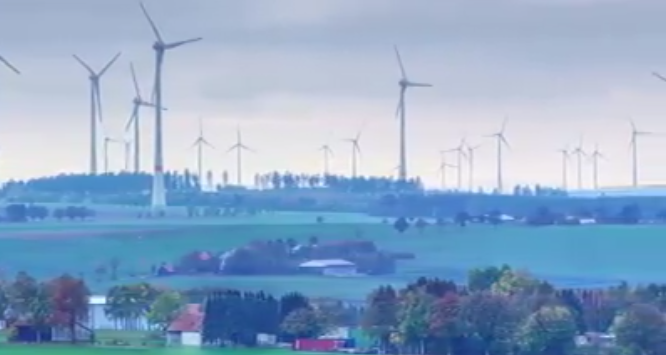
Germany plans to add another 10,000 wind turbines in addition to its current 30,000, which means 2% of Germany’s land area will be completely destroyed and industrialized, according to Etscheit.
What follows are Etscheit’s 5 environmental reasons why Germany’s wind energy insanity is a major threat:
Landscape will be blighted by the addition of 10,000 wind turbines, with a height of up to 250 meters. The natural biotope surrounding these turbines will be irreversibly ruined.
Endangered bird, like the red kite, will lose their habitats. It’s estimated that an absolute collision rate of around 21 per year and wind turbine. “With 40,000 or more wind turbines planned in Germany, the million mark would soon be exceeded.”
Bats and insects severely decimated. “Wind turbines also pose a significant threat to the 25 or so species of bat found in Germany…”. …”Wind turbines also have a significant impact on flying insects, as a study published in 2017 by the German Aerospace Center (DLR), Institute of Atmospheric Physics in Oberpfaffenhofen shows … an estimated five to six billion insects per day at all German wind turbines during the warm season (200 days from April to October).”
Hazard also for marine fauna. Wind turbines have a negative impact from pressure and sound waves on some animal species with an extremely sensitive sense of hearing. The industrialization of the oceans could displace native marine mammals. “If more and more offshore wind farms are built, this will have an enormous impact on the harbor porpoise populations in the North and Baltic Seas,” reads a statement from the Society for the Rescue of Dolphins.
Infrasound harming people. People near wind turbines often complain of “severe health complaints such as insomnia, dizziness, headaches, depression, tinnitus, hearing and vision problems and cardiac arrhythmia”, and experts warn this will increase dramatically, and turbine setback regulations in Germany are being watered down.
Etscheit argues for a moratorium on the construction of new turbines, but doesn’t see this happening in Germany, where officials are pressing on with the madness, “no matter the costs.”
===============================
Georg Etscheit is an author and journalist based in Munich. He worked for the dpa agency for almost ten years, but since 2000 has preferred to write “freelance” on environmental issues as well as on business, gourmet food, opera and classical music for the Süddeutsche Zeitung, among others. He also writes for www.aufgegessen.info, the gastrosophical blog for free enjoyment that he co-founded, and a culinary column on Achgut.com.
Weather is made possible because transfer of heat also makes available some amount of mechanical work. The view of the atmosphere being akin to a Carnot heat engine has a long history involving many famous names in atmospheric science – Sverdrup, Brunt, Oort, and Lorenz. To say that the literature around this topic is vast is an understatement.
Related views, rarely mentioned, hold the atmosphere’s working to be a refrigerator or a thermostat or even air-conditioning. WUWT guest blogger, Willis Eschenbach, often makes reference to these ideas, as he did here recently and even more recently here. The Winter Gatekeeper hypothesis belongs here, too.
Two simple models, heat engine and refrigerator, compliment one another. If, for example, one is interested in how heat transfer produces the observed weather, a heat engine is a good place to begin. If, on the other hand, one’s focus is how the atmosphere works to produce a stable climate, free of CO2 terror, then perhaps the refrigerator makes a better starting place.
Carry this idea further to realize that the atmosphere is less like a heat engine than it is like a self-acting refrigerator/dehumidifier. As Paulius and Held [1] conclude regarding dissipation of available work, in cases where convective heat transport is mostly due to the latent heat, “…convection acts more as an atmospheric dehumidifier than as a heat engine….”
Dehumidifying the air makes it more transparent to long wave radiation, some of which originates right at the surface. This acts to cool our Earth.
Observations about Heat Transport
It is common for people to think that heat is carried all the way from equator to poles. Yet, most refrigeration seems to me local, as Figure 1 shows. Averages of outgoing longwave radiation (OLR) exceeds or is a large fraction of average local solar irradiance. The only exception being in the polar night where there is no solar irradiance to be had. Once heat is in motion by multiple means (ocean currents, wind, radiation) it is difficult to identify where it originated. So, my view is that most outgoing radiation occurs near where heat was absorbed and is accomplished by the characteristics of the regional weather.
Figure 1. Zonal annual mean incoming SW solar radiation against outgoing longwave IR. Modified from [2] (CC BY 3.0 DEED)
Another idea, reinforced by the near-obsession with the infrared properties of CO2, is that radiation is the predominant vertical heat transport mechanism. Figure 2 comes from Figure 1 in an WUWT essay from last December. The radiation transport is calculated using MODTRAN and the temperature/humidity structure of a mid-latitude summer atmosphere free of clouds. It illustrates clearly that vertical radiative transport calculated from the Schwarzchild transport equation using observed temperature profiles, is not adequate to explain vertical heat transport – the reason being, as explained in the essay, is that a full transport equation must satisfy the First Law of Thermodynamics and account for all transport mechanisms. The red curve of Figure 2 shows that radiation in this case accounts for less than half of net heat transport from the surface, but grows to encompass all transport toward the tropopause. The blue curve shows heat transport contributed by advection, convection, and latent heat.[3]
Figure 2, mid-latitude summer profile of upward heat transport by radiation (red curve) and other mechanisms (blue curve).
A model of heat engine and refrigerator
When people propose a heat engine model of the atmosphere, they typically draw a comparison to a Carnot engine. This is limiting for several reasons. First. because the Carnot engine is an abstraction. It is a “black-box”. It accepts heat energy input and delivers a fraction of this energy as mechanical work according to Carnot’s formula – (1-Th/Tc). It is more efficient than any real machine but contains no details about its workings. Second, the Carnot cycle imagines heat being exchanged with reservoirs. Yet, reservoirs are difficult to find. On Earth there is only one real reservoir to speak of and that is radiation to free space which is not reversible. Just identifying someplace like the Earth’s surface, or anvil of a thunderstorm as a reservoir is not convincing.
Figure 3. Blue arrows indicate refrigeration. Red arrows denote a heat engine.
Finally, the atmosphere doesn’t work like a heat engine. Three panels in Figure 3 illustrate the issue. Panel A) in the figure shows a heat engine as people usually think of one. In addition to its usual components there is a control surface which defines the system versus its surroundings. This is true whether the engine produces work, or whether it consumes work like a refrigerator or heat pump. In its typical form, the work made available by the engine travels beyond the control surface. The first law of thermodynamics then is Qc = Qh – W; and using the second law result that reversible heat exchange between two isentropes makes heat quantity proportional to absolute temperature of reservoirs produces the efficiency of the Carnot engine – n = (1-Tc/Th); or the coefficient of performance of a Carnot refrigerator – COP = Tc/(Th-Tc).
However, for the atmosphere as a whole and for most distinct weather events working within, the control volume encloses the work as in panel B). Now, there is no result as simple as the Carnot efficiency. The value of Qc depends on the final disposition of the work. Is the work dissipated to heat, or, is some destroyed in another way? Even if entirely dissipated to heat, does this add to Qc or could some be recycled back into more work?[4]
Panel C) shows an engine operating off flow work provided by some external source. Flow work includes mechanical energy. Ocean waves raised by wind provide an example. Perhaps the tornado, or forward flank downdraft of cooled air in a thunderstorm are examples too.
The concepts of heat engine and refrigerator shouldn’t be taken too literally. The atmosphere differs from a heat engine and greatly differs from a Carnot engine. A refrigerator consumes work to move heat against temperature. As a refrigerator the atmosphere moves heat from hot to cold which would occur on its own – COP is nonsensical in this case.
Calculating heat transferred
Entropy, as Clausius originally envisioned it, is simply a state variable. A differential element of a path (Tds) equals the amount of heat absorbed or gained on a small section of a (T,s) path describing a process. A very general way of showing the relationship between heat and work in a weather feature, then, is to construct a diagram showing temperature and entropy (T,s) of the air passing through.
The prescription for building this diagram is as follows: First, draw a schematic diagram showing the essential elements of a particular atmospheric phenomenon; that is, a diagram showing all substantial modifications to the working fluid. Then, at the same time, build a thermodynamic state graph from the schematic. Imagine following a representative parcel of fluid (i.e. a kilogram of moist or dry air) as it passes through the diagram. Path sections with positive Tds denote absorption of heat; negative Tds denotes rejected heat. Net of the complete path is available work; or it would be if this were an engineered machine.
Calculating S
Temperature is measured but entropy we must calculate. In my examples, I use this formula which captures most entropy changes except for entropy of mixing water vapor with dry air:
S = (Cd+Cw*r)Ln(T)-RLn(P)-r*L/273+S0 Eq. 1)
Where; Cd and Cw are heat capacities of dry air and water vapor, T is absolute temperature, P is total pressure, R is gas constant of dry air (0.287), r is mixing ratio (kg/kg), and L is latent heat of vaporization at (2495-2.5(273-T) kJ/kg).[5] S0 is a constant to set relative entropy to zero at a convenient place in T-S space.
An example: The Polar Low
The schematic diagram in Figure 2 is that of an Arctic Low. I modeled it on the description and measurements of one such storm that occurred in the Barents Sea plus a recent review article.[6] Figure 3 shows this working fluid path.
Figure 4. A cross-sectional model of a Polar Low. Air properties are provided at each of four points along the machine process path.
Start the analysis at point 1 in the figure. This is cold, dry polar air that has come off an ice sheet. Surface air temperature and dew point are -10C and -13C, respectively, which translates to a mixing ratio of 0.0006 kg/kg. This air now travels along the sea surface, probably below an inversion which aids in preventing dissipating the modifying air, picking up heat and moisture as it goes.
There is often a steep gradient of sea surface temperature in the Barents Sea at the ice edge. Some of the sea surface is as warm as 8C courtesy of the North Atlantic drift. By the time air reaches the center of the storm at point 2 it has been modified to be substantially warmer and more humid than when it left the ice edge – about 12C warmer with a mixing ratio many times as great (0.0021). This is so modified that it is buoyant and can rise through the inversion (undoubtedly gone within the storm).
On our thermodynamic diagram (Figure 3), the path (1->2) shows this modification of polar air. Path (2->3) shows the rise of moist air within the storm. It is a dry adiabatic rise for around 1200 meters, then saturated pseudo adiabatic above. I have placed the storm top around 500mb where a sounding recorded an environmental temperature of -46C. The saturation pseudo adiabat is about 3C warmer (231K), but quite dry (a mixing ratio probably less than 0.0002).
Closing the cycle
Closing the cycle of working fluid in Figure 3 is needed for two reasons. First, we need a closed path on our T-S diagram in order to calculate heat transfer and net work. Second, an open diagram would suggest air accumulating in places. Closing the diagram allows one to imagine a steady-state global atmosphere.
Air ejected from the storm top at 3 cools through radiation to space for some unknown time to eventually descend to the ice sheet again. The higher air so lacks humidity that cooling to space likely continues during the descent of air to the surface and there is radiation cooling of the surface too. Some process, perhaps sublimation of ice, adds humidity. There are no adiabatic paths to be had. Maybe, temperature declines at a rate something like 1-1.5C per day. The details don’t matter. What is required to close the cycle is that air returns to the ice surface at conditions equal to how it began. Path 3->4, then path 4->1, accomplishes this.
Figure 5. Simple calculations of the Tds path integral. Path 3->1 is speculative, but closes the cycle; that is, takes the working fluid properties from point 3 back to 1.
Results
The path 1->3 is entirely positive entropy change and therefore heat added to our engine (22.3 kJ/kg); the 3->4->1 is entirely negative and therefore heat expelled (or rejected) from our engine (19.4 kJ/kg). The net, which is the enclosed area, amounts to 2.9 kJ/kg of work made available by the machine; or that is how a person would interpret the diagram if this were a heat engine like Figure 3A. More generally a person would like to know the disposition of the 2.9kJ/kg of available work. Nonetheless, even without knowing this, interesting observations are possible.
For example, in contrast to the tropical hurricane in which ⅔ of heat input comes from latent heat; this arctic hurricane obtains only ⅓ from latent heat. The balance is from sensible heat. This polar cyclone runs on warm water transported from lower latitude. If more warm water were transported, then these cyclones would be more frequent or persist longer. The total absorbed heat during the steady state of this storm can be twice the heat input to the Nordic Seas by the North Atlantic Drift.
The dissipation of work
When we say the word “engine” what we usually mean is some contraption that produces external work. Yet, storm engines are different. They mainly serve to move heat. This one we have just analyzed takes 22.3 kJ of heat per kilogram of air flowing through it, and immediately rejects 19.4 kJ of it quickly to space. It uses the balance to run itself – to run the weather. Now, as the work output is actually contained within the control volume of Figure 3B, what becomes of it?
The short answer is that it is dissipated. But to answer this question more completely, think about the evolution of any weather event.
It begins as a small disturbance with a much smaller cycle than Figure 5. If dissipation of work at this scale is less than available work, the excess work can increase the intensity and scale of the storm. This continues until dissipation equals available work. During this steady state of the storm, which the Arctic hurricane might run for 18 hours, dissipation equals available work. As the reservoir of energy becomes depleted late in the storm life, intensity and scale decline to match available work. All work is eventually dissipated.
Here is a short list of dissipation and irreversible processes.
Fluid friction all along the surface path raises waves and associated spray on the sea. Raising waves is easy to see as an irreversibility since wind raises waves, which are eventually dissipated, but waves cannot raise wind.
Mechanical work is dissipated through drag of precipitation which occurs even as updrafts are operating to maintain the storm.
Dissipation through turbulence in the updraft and in the outflow above the storm.
Mixing (entrainment).
Many moist processes, such as evaporation into unsaturated air, are irreversible.
Radiation heat transfer over a finite temperature difference.
What matters in the limit is that all of the heat input to the working fluid is rejected and that air is dehumidified. The most common winter condition over the central Arctic Ocean, occurring during some 13% of weather conditions, Nygård, et al, refer to as circulation type 10.[7] It consists of the strongest and most persistent high pressures, a water content that is low, with subsidence and warming of the air, while surface radiation cools the air from below. It is coincidental with high latent and sensible heat transfer from the North Atlantic drift. Perhaps Figure 5 explains this condition.
Another example: Boundary Layer in Fair Weather
Figure 6. The outlines of an invisible column of rising air capped by a small cumulus cloud.
Renno and Williams [8] made measurements in dry-air convection over open ground near Albuquerque in 1993. They employed a remotely piloted vehicle (RPV) to stay within rising air parcels to make measurements. Rising parcels maintained a potential temperature 1C higher than descending parcels. The data were noisy because of both a tendency of the RPV to drift outside a parcel and noisiness of the instrumentation. Near the ground surface readings became increasingly variable, but there was a distinct group of measurements with a temperature about 6C above that of a rising parcel. This presumably was a superadiabatic layer at the ground surface.
Air parcels rose and fell 3.4m/s and 1.7m/s respectively, suggesting through mass conservation a 2:1 ratio of updraft to subsidence area. Mixing ratio of the updraft near ground was 0.0095 and declined to 0.009 at 800m altitude perhaps from entrainment. The downdraft approached the surface with a mixing ratio of 0.0091, although there is substantial variation in this data. Pressure is probably 835mb at ground surface (1600m).
There is simply not enough information about the atmosphere above flight level of the RPV to figure the relationship between rising and falling parcels. However, the point of this essay is that the heat absorbed at high temperature is equal to that rejected by the sum total of all operations of the refrigerator/dehumidifier. We focus, then, on heat absorbed.
Figure 7 shows (1->2) that absorbed heat is 3.4 kJ/kg. Without being able to close the diagram the net available work is unknown but probably very small because of small temperature differences. Even if only 1%, though, it amounts to 34J/kg which is sufficient to generate buoyancy and account for kinetic energy of 7.5 J/kg.
Figure 7. T-s diagram of mixing air in a descending parcel with air in the superadiabatic layer near the ground surface.
By mixing 17% of air in the superadiabatic layer with 83% of air in a descending parcel, we conserve mass, enthalpy and moisture to end up with air exactly like that at point 3. The rate of heat absorbed far exceeds what is required to remove solar insolation from the surface in this instance. The entity that is not conserved in this mixing is entropy. It increases because of this mixing. I figure this value as 1.5 J/KgK, which sounds small, but when multiplied by a dead-state temperature (around 300K) becomes 0.45 Kj of lost potential work. What this means is that one-half kilojoule of additional work would have been available for more vigorous convection if the mixing of air had been done in a reversible manner. The 1.5 J/kgK of increased entropy has to be exported to space eventually.
Climate change
Nowadays, the twenty-four thousand dollar question is: “How does this relate to climate change?” I will offer two views from the literature.
On the one hand Renno and Ingersoll formulated a model of fraction of Earth surface covered by convection cells.[9] They conclude that a climate warming will increase the intensity of updrafts, but areal coverage decreases, meaning the region of slowly descending dry air then increases. I haven’t analyzed how convincing this argument is, but it certainly sounds like the negative feedback of the adaptive iris.[10]
On the other hand, F. LaLiberte, et al, built an ambitious T-S diagram for the general circulation and concluded that the intensity of the hydrological cycle in warmer climates might limit the heat engine’s ability to generate work.[11] My reading of their supplementary materials showed meticulous completeness and attention to details. Nevertheless one cannot escape these observations: 1) the baseline and future forecast depends on a climate model (CESM) using RCP4.5, 2) the effect itself is small, amounting to 1% of available work per century in the presence of larger interannual noise, and perhaps most significantly 3) the baseline comparison between the climate model and MERRA reanalysis showed discrepancies attributed to parameterization of atmospheric convection.[12] They refer to this as the water in the gas problem. However, latent heat of water is so large that Rankine cycle plants show better efficiency with some water in their gas (i.e. outlet steam quality of 92%), and the weather can’t possibly run in any other way.
Conclusion
The atmosphere is less a heat engine than a collection of many self-running refrigerators/dehumidifiers operating in different ways to carry heat largely from surface to tropopause locally and the balance from equator to poles. An important, but perhaps underappreciated, effect of dehumidification is to make the atmosphere broadly more amenable to cooling by LWIR.
References:
1- Olivier Pauluis and Isaac M. Held, Entropy Budget of an Atmosphere in Radiative–Convective Equilibrium. Part I: Maximum Work and Frictional Dissipation, Journal of the Atmospheric Sciences,Volume 59: Issue 2, Jan 2002, Page(s): 125–139
2-Salzmann, Marc. (2017). The polar amplification asymmetry: role of Antarctic surface height. Earth System Dynamics. 8. 323-336. 10.5194/esd-8-323-2017.
3- An occasional visitor to WUWT, pdquondam, in his essay “HBC_model.pdf” caused me to think of this graph.
4-Hewitt, McKenzie, and Weiss, 1975 Dissipative heating in convective flows, J. Fluid Mech., v. 68, part 4, 721-738.
5-There are other minor terms omitted involved in mixing water vapor with dry air. In addition, the process must have reached steady state and there isn’t strict conservation of mass in the cycle because of condensed water or snow carried in the air flow.
6-See for example: Rasmussen, E, 1985, A case study of a polar low development over the Barents Sea, Tellus, 37A, 407-418, Or Emanuel, K, and Rotunno, R, 1989, Polar Lows as Arctic Hurricanes, Tellus, 41A, 1-17, and Marta Moreno-Ibanez, Rene Laprise, and Philippe Gachon, Recent advances in polar low research: current knowledge, challenges and future perspectives, Tellus A: 2021, 73, 1890412, https://ift.tt/q107CG8
7- Tiina Nygård, Michael Tjernström and Tuomas Naakka, Winter thermodynamic vertical structure in the Arctic atmosphere linked to large-scale circulation, Weather Clim. Dynam., 2, 1263–1282, 2021
8-Renno and Williams Quasi-lagrangian measurements in convective boundary layer plumes and their implications for the calculation of CAPE, 1995, Mon. Weather Rev., September, 2733.
9-Nilton Renno, Andrew Ingersoll, Natural convection as a heat engine:a theory for CAPE,
J atmos sci, v 53, n.4, 572
10-Lindzen, Chou, and Hou, Does the Earth Have an Adaptive Iris? Bulletin of the American Meteorological Society, vol 82, no. 3, March 2001.
11-Constrained work output of the moist atmospheric heat engine in a warming climate
F. LaLiberte , et al, SCIENCE, 30 Jan 2015, Vol 347, Issue 6221, pp. 540-543
DOI: 10.1126/science.125710
12-Parameterization of processes that should be based on physics is the Achilles heel of modeling; creating energy ex nihilo, destroying entropy in the universe, or masking forbidden features – all bad. See, for example, Jay D. Schieber and Markus Hutter, Multiscale modeling, beyond equilibrium, Physics Today, March 2020, p.36.
Electric car buyers should be aware of the “astronomical” costs required to regularly replace short-lived tyres, owners have warned.
Car lover Jim Bassett managed just 7,500 miles in his brand new Volkswagen ID.3 before being quoted more than £300 to replace the rear rubber.
The 80-year-old stumped up the cash after being told it was common practice for tyres on his rear-wheel model to degrade rapidly due to the weight of the vehicle .
Due to its heavy battery, the £35,000 hatchback weighs around 1,800kg – the same as a Jeep Wrangler 4×4.
Fellow ID.3 owners have taken to online forums to also complain of short tyre life, blaming degradation on the hefty weight and instant torque of the car.
Mr Bassett, of Hitchin, Hertfordshire, said: “I couldn’t believe it when I was told they needed replacing.
“I’m quite old and have had cars all my life – I’ve never had to change tyres this early, it’s normally been at around 25,000 miles.
“It amazed me, as at 7,500 miles tyres are virtually new.
“The VW dealership expressed no surprise or concern that they needed replacing so soon, saying that ‘the car is rear-wheel drive and very heavy’.”
The strain on EV tyres comes as a result of both the extra weight and higher torque, the twisting power that launches a car from a standing start.
Road safety charity Tyresafe said: “All that power at any speed in a heavy vehicle means if the driver regularly accelerates hard, the tyres are put under tremendous strain, fighting to grip the road and not spin.”
Due to the greater acceleration speed, manufacturers advise drivers to be delicate on the throttle to prolong tyre life.
Volkswagen, which first launched the ID.3 in 2019, said that driver performance is the key factor impacting tyre wear.
A spokesman said: “Tyre longevity is influenced by a wide range of factors, most importantly the way in which the vehicle is driven, for example, hard cornering, braking and acceleration can cause more wear than gentle driving.”
VW also said that “types of road surfaces, temperature, correct maintenance of tyre pressures; care when parking; and the amount of load the vehicle carries” all impact the level of degradation.
Tyre manufacturer Michelin has previously said that conventional tyres wear out around 20pc faster in an electric vehicle, while Goodyear said they can degrade as much as 50pc faster.
Last year, research by technology firm Epyx found that, on average, tyres fitted to EVs lasted 6,350 fewer miles than those on petrol or diesel cars. The first tyre change for electric cars takes place after an average of 17,985 miles, compared to 24,335 miles for petrol and diesel cars.
Tyre makers are continuing to develop bespoke EV rubber suited to the heavier vehicles, but they can come at a greater cost for drivers. Epyx found that the average tyre cost £207 for larger electric vehicles – £77 higher than the cost for larger petrol cars.
Chris Morrison keeps the pressure up on the Met Office:
Interest and concern continues to grow about the numerous retrospective adjustments that the U.K. Met Office has made to its global HadCRUT temperature database. Often the adjustments cool earlier periods going back to the 1930s and add warming in more recent times. The adjustments are of course most convenient in promoting the global warming narrative surrounding Net Zero fantasies. There is particular interest in the 0.15°C cooling inserted in the 1940s and the greater warming added in more recent decades. The scientific blog No Tricks Zone (NTZ) has recently returned to the story noting the state-controlled Met Office has “corrected” the data to “align with their narrative”.
In suggesting a narrative, NTZ traces the adjustments back to the 2009 leak of ‘Climategate’ emails from academic staff at the University of East Anglia working on the HadCRUT project. In one email speculating on ‘correcting’ sea surface temperatures to partly explain the 1940s ‘warming blip’, it is noted that “if we could reduce the ocean blip by, say, 0.15°C, then this would be significant for the global mean”. It would be good to “remove at least part of the 1940s blip”, it is suggested. Just as they have said they would do, comments NTZ, 0.15°C of warmth has gradually been removed from the 1940s HadCRUT global temperature data over the last 15 years.
The Daily Sceptic report also maintains the pressure on the Met Office for failing to respond to concerns about the poor quality of its temperature recording network, following revelations, both here and in the Daily Sceptic, that most of the Met Office’s weather stations are junk status Class 4 and 5, totally inappropriate for climatological use:
Complaints about this have been studiously ignored by the Met Office.
According to the WMO, Class 3 stations can overstate underlying temperatures by 1C. Class 4 and 5 are even worse, artificially adding up to 2C and 5C respectively.
The WMO could not be clearer. Temperatures recorded at Class 3, 4 and 5 sites should never be used where they are intended to be representative of a wider area, only for local purposes, such as to give temperatures at airports for aviation purposes.
Only 24 of the 380 stations used by the Met Office to calculate UK temperatures are fit for purpose, Class 1.
Why are the Met Office still using the others? Could it be that they help to inflate the warming trend?
As the WMO says, we do not live in a perfect world. Nevertheless, there is no reason why the Met Office cannot do what NOAA do, and that is to dump their existing network, which is totally unfit for purpose, and replace it with a small number of pristine, Class 1 stations. These must be visually inspected at least once a year, to ensure they are properly maintained. They should also have long records, in order to provide a long dataset.
Finally they must ensure that the environment around the site has not materially changed over the period of record. For instance, a perfect local siting may be compromised by urban encroachment during preceding decades. The WMO classification system, of course, makes no allowance for this.
It maybe that there are no stations which meet these criteria, in which the Met Office should admit that it cannot accurately measure UK temperatures in the past and therefore cannot make claims about record high temperatures or quantify how much the UK has warmed in the last century or so, if at all.



 Iowa Climate Science Education