Month: May 2024

So much for “peer review” — Wiley shuts down 19 science journals and retracts 11,000 gobblygook papers

By Jo Nova

Proving that unpaid anonymous review is worth every cent, the 217 year old Wiley science publisher “peer reviewed” 11,300 papers that were fake, and didn’t even notice. It’s not just a scam, it’s an industry. Naked gobbledygook got past peer review, and the expert reviewers didn’t so much as blink.

Big Government and Big Money has captured science and strangled it. The more money they pour in, the worse it gets. John Wiley and Sons is a US $2 billion dollar machine, but they got used by criminal gangs to launder fake “science” as something real.

Things are so bad, fake scientists pay professional cheating services who use AI to create papers and torture the words so they look “original”. Thus a paper on  ‘breast cancer’ becomes a discovery about “bosom peril” and a ‘naïve Bayes’ classifier became a ‘gullible Bayes’. An ant colony was labeled an ‘underground creepy crawly state’.

And what to make of the flag to clamor ratio? Old fashioned scientists might call it ‘signal to noise’. The nonsense never ends.

A ‘random forest’ is not always the same thing as an ‘irregular backwoods’ or an ‘arbitrary timberland’ — especially if you’re writing a paper on machine learning and decision trees.

The most shocking thing is that no human brain even ran a late-night Friday-eye over the words before they passed the hallowed peer review and entered the sacred halls of scientific literature. Even a wine-soaked third year undergrad on work experience would surely have raised an eyebrow when local average energy became “territorial normal vitality”. And when a random value became an ‘irregular esteem’. Let me just generate some irregular esteem for you in Python?

If there was such a thing as scientific stand-up comedy, we could get plenty of material, not by asking ChatGPT to be funny, but by asking it to cheat. Where else could you talk about a mean square mistake?

Wiley — a mega publisher of science articles has admitted that 19 journals are so worthless, thanks to potential fraud, that they have to close them down. And the industry is now developing AI tools to catch the AI fakes (makes you feel all warm inside?)

EMIL LENDOF THE WALL STREET JOURNAL

By Nidhi Subbaraman, May 14, 2024

Fake studies have flooded the publishers of top scientific journals, leading to thousands of retractions and millions of dollars in lost revenue. The biggest hit has come to Wiley, a 217-year-old publisher based in Hoboken, N.J., which Tuesday will announce that it is closing 19 journals, some of which were infected by large-scale research fraud.

In the past two years, Wiley has retracted more than 11,300 papers that appeared compromised, according to a spokesperson, and closed four journals. It isn’t alone: At least two other publishers have retracted hundreds of suspect papers each. Several others have pulled smaller clusters of bad papers.

Although this large-scale fraud represents a small percentage of submissions to journals, it threatens the legitimacy of the nearly $30 billion academic publishing industry and the credibility of science as a whole.

Scientific papers typically include citations that acknowledge work that informed the research, but the suspect papers included lists of irrelevant references. Multiple papers included technical-sounding passages inserted midway through, what Bishop called an “AI gobbledygook sandwich.” Nearly identical contact emails in one cluster of studies were all registered to a university in China where few if any of the authors were based. It appeared that all came from the same source.

One of those tools, the “Problematic Paper Screener,” run by Guillaume Cabanac, a computer-science researcher who studies scholarly publishing at the Université Toulouse III-Paul Sabatier in France, scans the breadth of the published literature, some 130 million papers, looking for a range of red flags including “tortured phrases.”

Cabanac and his colleagues realized that researchers who wanted to avoid plagiarism detectors had swapped out key scientific terms for synonyms from automatic text generators, leading to comically misfit phrases. “Breast cancer” became “bosom peril”; “fluid dynamics” became “gooey stream”; “artificial intelligence” became “counterfeit consciousness.” The tool is publicly available.

Generative AI has just handed them a winning lottery ticket,” Eggleton of IOP Publishing said. “They can do it really cheap, at scale, and the detection methods are not where we need them to be. I can only see that challenge increasing.”

The ABC in Australia even wrote about this, but only because it worries about the loss of public faith in its pet universities:

For the ABC, peer review is like the Bible, and universities are the church. The public must believe!

So the ABC makes excuses… Oh! Those poor poor universities, forced to become billion dollar businesses.  If only they got more money their Vice Chancellors wouldn’t have to make do with million dollar salaries and they’d have time to do research….

Wiley’s ‘fake science’ scandal is just the latest chapter in a broader crisis of trust universities must address

By Linton Besser, ABC News

It [the Wiley debacle] also illustrates what is just another front in a much broader crisis of trust confronting universities and scientific institutions worldwide.

For decades now, teaching standards and academic integrity have been under siege at universities which, bereft of public funding, have turned to the very lucrative business of selling degrees to international students.

Grappling with pupils whose English is inadequate, tertiary institutions have become accustomed to routine cheating and plagiarism scandals. Another fraud perfected by the internet age.

This infection — the commodification of scholarship, the industrialisation of cheating — has now spread to the heart of scientific, higher research.

With careers defined by the lustre of their peer-reviewed titles, researchers the world over are under enormous pressure to publish.

Suffer the researchers who are forced to pay for fake papers just so they can “do their job”!

The ABC is part of the reason science is corrupt to the core. The ABC Science Unit is paid to hold junk-science’s feet to the fire, instead it provides cover for the pagan witchcraft that passes for modern research.

The rot at Wiley started decades ago, but it got caught when it spent US $298 million on an Egyptian publishing house called Hindawi. We could say we hope no babies were hurt by fake papers but we know bad science already kills people. What we need are not “peer reviewed” papers but actual live face to face debate. Only when the best of both sides have to answer questions, with the data will we get real science:

In March, it revealed to the NYSE a $US9 million ($13.5 million) plunge in research revenue after being forced to “pause” the publication of so-called “special issue” journals by its Hindawi imprint, which it had acquired in 2021 for US$298 million ($450 million).

Its statement noted the Hindawi program, which comprised some 250 journals, had been “suspended temporarily due to the presence in certain special issues of compromised articles”.

Many of these suspect papers purported to be serious medical studies, including examinations of drug resistance in newborns with pneumonia and the value of MRI scans in the diagnosis of early liver disease. The journals involved included Disease Markers, BioMed Research International and Computational Intelligence and Neuroscience.

The problem is only becoming more urgent. The recent explosion of artificial intelligence raises the stakes even further. A researcher at University College London recently found more than 1 per cent of all scientific articles published last year, some 60,000 papers, were likely written by a computer.

In some sectors, it’s worse. Almost one out of every five computer science papers published in the past four years may not have been written by humans.

Even if one in five computer science papers are written by computers, this is just the tip of the iceberg of the rot at the core of “peer reviewed research”. The real rot is not the minor fraudsters making papers that no one reads to pad out their curriculum vitae. It’s the institutional parasites taking billions from taxpayers to create modeled garbage to justify the theft of trillions. But that’s another story.

PS: Who knew, academic journals were a $30 billion dollar industry?

h/t SharperinOz


0 out of 10 based on 0 rating

via JoNova

https://ift.tt/oqU8Z6j

May 24, 2024 at 02:12PM

Claim: Trump’s Anti-Science Climate Denial Threatens the Foundations of Prosperity

According to a review of a book by Kings College Professor Daniel Susskind, President Trump is the harbinger of a new age of superstition and prejudice, which threatens to derail science driven economic growth.

Long-term growth is more vulnerable than it looks

A new book argues the belief that economies should always expand is relatively new, and threats to the future of growth are as large now as any time in the post-Industrial Revolution era.

Guy Debelle Former Central Banker
May 23, 2024 – 5.00am

We have taken economic growth for granted for much of the past century. When the economy isn’t growing it dominates the news cycle, because those periods of decline have very much been the exception, not the rule. Even the slightest prospect of a recession can generate reams of tomorrow’s fish and chip wrappers.

Daniel Susskind provides a timely and thought-provoking book on the history of economic growth in Growth: A Reckoning. Timely, because a number of the critical factors that Susskind argues underpin growth are currently under threat. This is most apparent in the US in the form of Donald Trump, where science is being supplanted by superstition, reason by assertion, experience by prejudice.

This bears on the Future Made in Australia debate. The government can provide the policy framework to support the market in taking advantage of Australia’s comparative advantage. The market will not always provide the right price signals. The market will not embody all the things that society cares about, though it can be shaped that way.

Read more: https://www.afr.com/policy/economy/long-term-growth-is-more-vulnerable-than-it-looks-20240506-p5fp5a

The “Future Made in Australia debate” is a reference to the pushback against an absurd far left attempt to kickstart Aussie manufacturing, without addressing any of the fundamental factors which led to the original decline, such as Australia’s expensive and increasingly unreliable energy.

My question – what if the climate crisis is pseudoscience, like the many great pseudoscience movements which came before it, and the rise of Donald Trump is a desperate attempt to restore an age of evidence based decision making, before the rise of climate superstition plunges us into a new dark age?

Obviously this is pretty much the opposite position to that expressed by Guy Debelle, who wrote the article above, and I assume Daniel Susskind have taken. SO how do we tell who is right?

Weight of numbers is no defence against the suggestion the climate crisis is superstition – pseudoscience movements don’t rise to prominence because they lack support. When Einstein was told about the book “100 authors against Einstein”, Einstein is reported to have replied “If I were wrong, then one would have been enough!”.

The real tell of a pseudoscience is the inability of the pseudoscience to make worthwhile predictions, and the desperation of advocates to excuse away its failures.

Any examination of climate predictions reveals a dismal track record of failure. WUWT has accumulated 12 pages of failed or failing climate predictions, such as a prediction made before the US senate in 1986 by the Grandaddy of the global warming scare, James Hansen, that by now we would have experienced 3-4C of global warming.

As for the desperation to excuse away failures, we see that every day, as politicians pour billions into failed green energy policies which are designed to address a non problem, or the way climate modellers urge we accept their predictions as a source of truth, despite the decades long failure of climate models to accurately predict future climate trends.

This failure is easy to demonstrate – the diagram at the top of this page, which shows the divergence between reported confidence levels and climate model predictive failure, was created by former NASA scientist Dr. Roy Spencer.

But I doubt professor Daniel Susskind or former merchant banker Guy Debelle will be moved by any of the arguments I just presented. If I am right, they are deep in the grip of pseudoscientific superstition, a superstition which ironically convinces them that they are actually the champions of reason, and are therefore all but impervious to arguments based on logic and reason which contradict their prejudices.

Of course, in our world it doesn’t matter what the Daniel Susskind and Guy Debelles of the world believe.

What matters is what voters believe. One of the great strengths of the US Republic and other nations where people get to vote for their leaders is protection from elitist groupthink. We don’t have to accept the prejudices of people who call themselves experts, we can make up our own minds who we believe.

via Watts Up With That?

https://ift.tt/9FuyiKH

May 24, 2024 at 01:07PM

UAH April 2024: NH Pushes Global Warming by Land and Sea

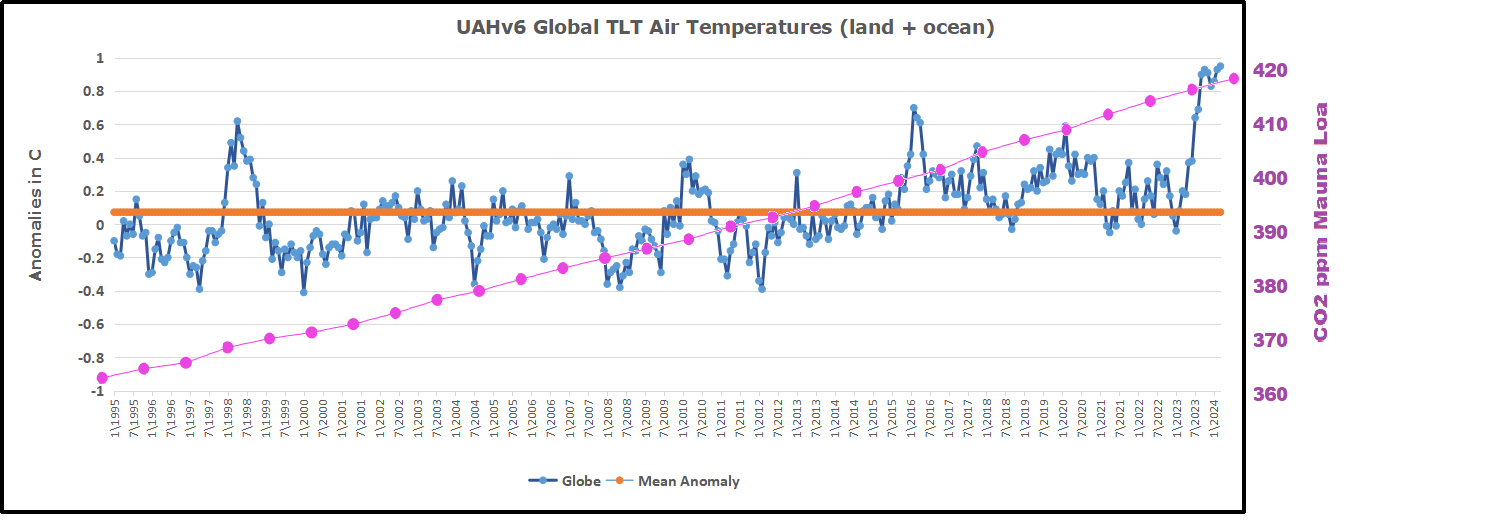
The post below updates the UAH record of air temperatures over land and ocean. Each month and year exposes again the growing disconnect between the real world and the Zero Carbon zealots.  It is as though the anti-hydrocarbon band wagon hopes to drown out the data contradicting their justification for the Great Energy Transition.  Yes, there has been warming from an El Nino buildup coincidental with North Atlantic warming, but no basis to blame it on CO2.  

As an overview consider how recent rapid cooling  completely overcame the warming from the last 3 El Ninos (1998, 2010 and 2016).  The UAH record shows that the effects of the last one were gone as of April 2021, again in November 2021, and in February and June 2022  At year end 2022 and continuing into 2023 global temp anomaly matched or went lower than average since 1995, an ENSO neutral year. (UAH baseline is now 1991-2020). Now we have an usual El Nino warming spike of uncertain cause, but unrelated to steadily rising CO2.

For reference I added an overlay of CO2 annual concentrations as measured at Mauna Loa.  While temperatures fluctuated up and down ending flat, CO2 went up steadily by ~60 ppm, a 15% increase.

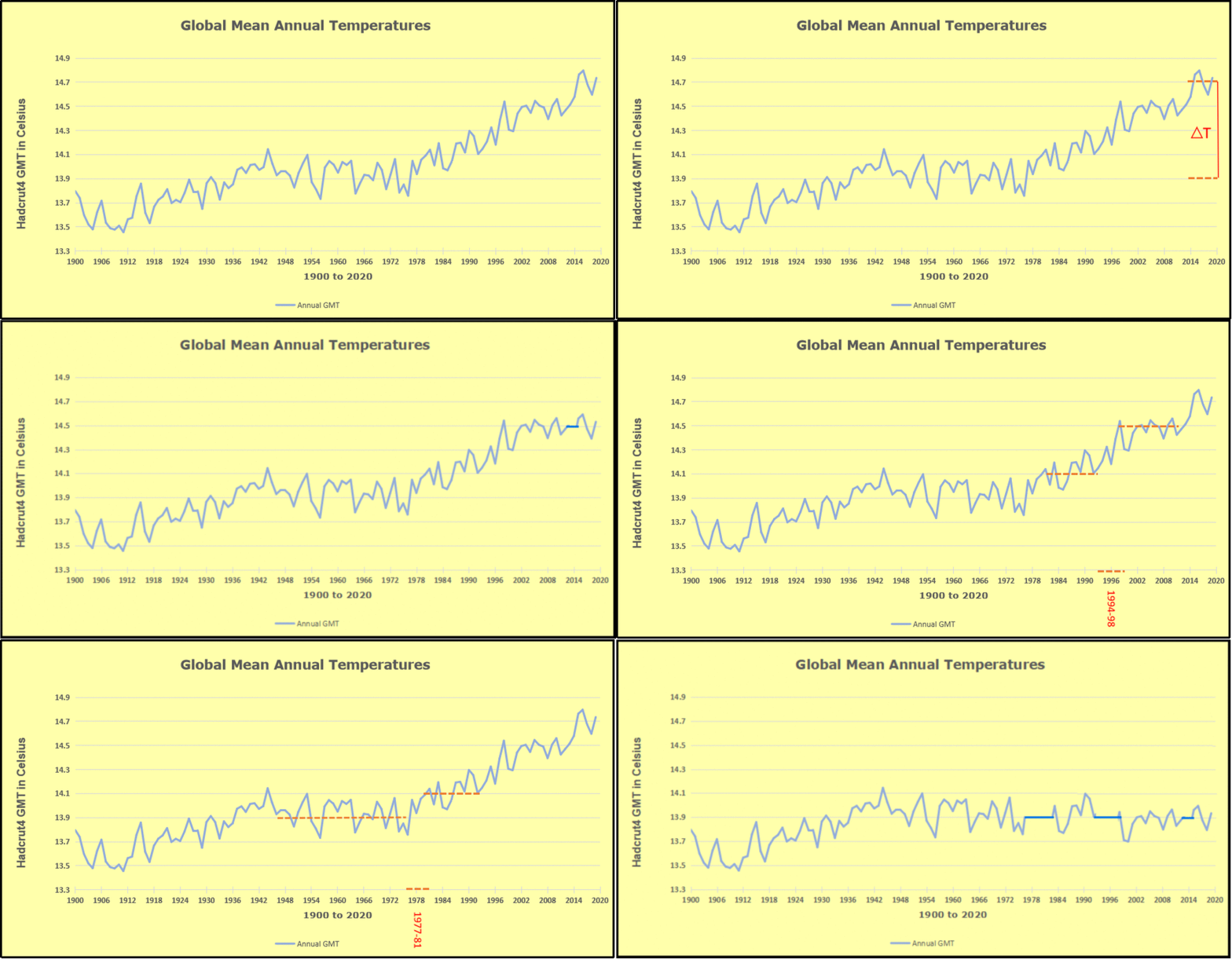
Furthermore, going back to previous warmings prior to the satellite record shows that the entire rise of 0.8C since 1947 is due to oceanic, not human activity.

gmt-warming-events

The animation is an update of a previous analysis from Dr. Murry Salby.  These graphs use Hadcrut4 and include the 2016 El Nino warming event.  The exhibit shows since 1947 GMT warmed by 0.8 C, from 13.9 to 14.7, as estimated by Hadcrut4.  This resulted from three natural warming events involving ocean cycles. The most recent rise 2013-16 lifted temperatures by 0.2C.  Previously the 1997-98 El Nino produced a plateau increase of 0.4C.  Before that, a rise from 1977-81 added 0.2C to start the warming since 1947.

Importantly, the theory of human-caused global warming asserts that increasing CO2 in the atmosphere changes the baseline and causes systemic warming in our climate.  On the contrary, all of the warming since 1947 was episodic, coming from three brief events associated with oceanic cycles. And now in 2024 we are seeing an amazing episode with a temperature spike driven by ocean air warming in all regions, along with rising NH land temperatures.

Update August 3, 2021

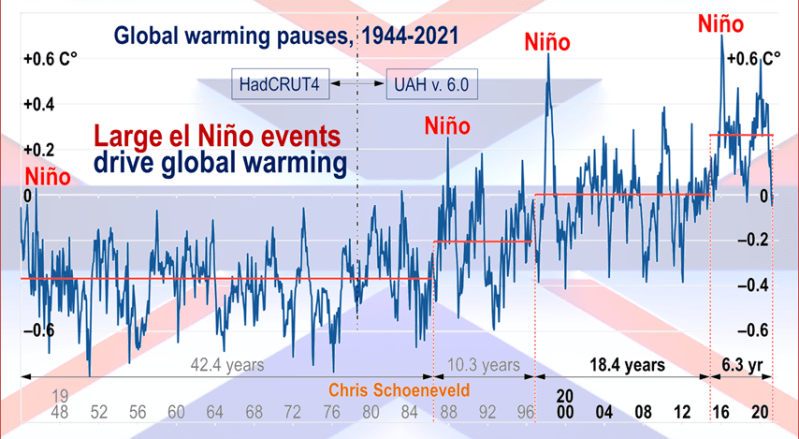
Chris Schoeneveld has produced a similar graph to the animation above, with a temperature series combining HadCRUT4 and UAH6. H/T WUWT

image-8


mc_wh_gas_web20210423124932

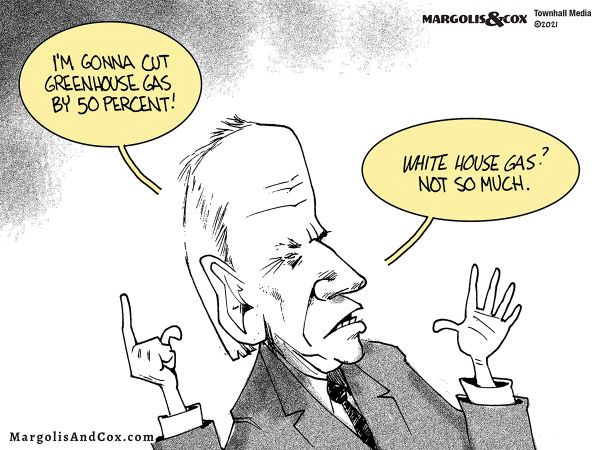
See Also Worst Threat: Greenhouse Gas or Quiet Sun?

April 2024 El Nino Recedes While Oceans and NH Land Warmsbanner-blog

With apologies to Paul Revere, this post is on the lookout for cooler weather with an eye on both the Land and the Sea.  While you heard a lot about 2020-21 temperatures matching 2016 as the highest ever, that spin ignores how fast the cooling set in.  The UAH data analyzed below shows that warming from the last El Nino had fully dissipated with chilly temperatures in all regions. After a warming blip in 2022, land and ocean temps dropped again with 2023 starting below the mean since 1995.  Spring and Summer 2023 saw a series of warmings, continuing into October, but with cooling since. 

UAH has updated their tlt (temperatures in lower troposphere) dataset for April 2024. Posts on their reading of ocean air temps this month comes after the April update from HadSST4.  I posted this week on SSTs using HadSST4 Nino Recedes, NH Keeps Ocean Warm April 2024. This month also has a separate graph of land air temps because the comparisons and contrasts are interesting as we contemplate possible cooling in coming months and years.

Sometimes air temps over land diverge from ocean air changes. Last February 2024, both ocean and land air temps went higher driven by SH, while NH and the Tropics cooled slightly, resulting in Global anomaly matching October 2023 peak. Then in March Ocean anomalies cooled while Land anomalies rose everywhere. Now in April, Ocean anomalies rose NH and SH, while Tropics moderated.  Meanwhile NH land spiked up and Global land warmed, despite SH spiking down

Note:  UAH has shifted their baseline from 1981-2010 to 1991-2020 beginning with January 2021.  In the charts below, the trends and fluctuations remain the same but the anomaly values changed with the baseline reference shift.

Presently sea surface temperatures (SST) are the best available indicator of heat content gained or lost from earth’s climate system.  Enthalpy is the thermodynamic term for total heat content in a system, and humidity differences in air parcels affect enthalpy.  Measuring water temperature directly avoids distorted impressions from air measurements.  In addition, ocean covers 71% of the planet surface and thus dominates surface temperature estimates.  Eventually we will likely have reliable means of recording water temperatures at depth.

Recently, Dr. Ole Humlum reported from his research that air temperatures lag 2-3 months behind changes in SST.  Thus cooling oceans portend cooling land air temperatures to follow.  He also observed that changes in CO2 atmospheric concentrations lag behind SST by 11-12 months.  This latter point is addressed in a previous post Who to Blame for Rising CO2?

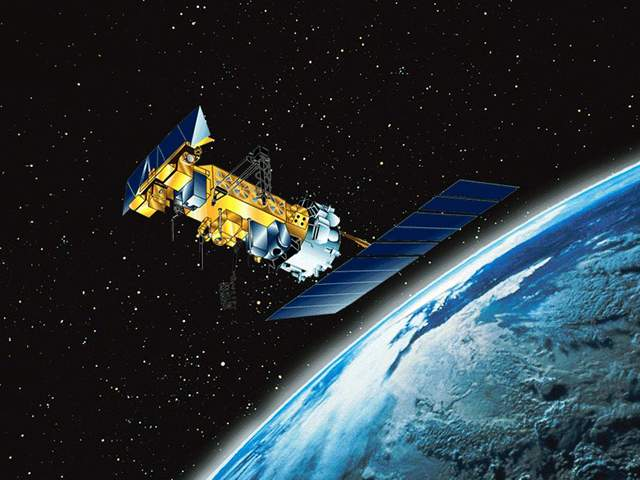
After a change in priorities, updates are now exclusive to HadSST4.  For comparison we can also look at lower troposphere temperatures (TLT) from UAHv6 which are now posted for April.  The temperature record is derived from microwave sounding units (MSU) on board satellites like the one pictured above. Recently there was a change in UAH processing of satellite drift corrections, including dropping one platform which can no longer be corrected. The graphs below are taken from the revised and current dataset.

The UAH dataset includes temperature results for air above the oceans, and thus should be most comparable to the SSTs. There is the additional feature that ocean air temps avoid Urban Heat Islands (UHI).  The graph below shows monthly anomalies for ocean air temps since January 2015.

Note 2020 was warmed mainly by a spike in February in all regions, and secondarily by an October spike in NH alone. In 2021, SH and the Tropics both pulled the Global anomaly down to a new low in April. Then SH and Tropics upward spikes, along with NH warming brought Global temps to a peak in October.  That warmth was gone as November 2021 ocean temps plummeted everywhere. After an upward bump 01/2022 temps reversed and plunged downward in June.  After an upward spike in July, ocean air everywhere cooled in August and also in September.   

After sharp cooling everywhere in January 2023, all regions were into negative territory. Note the Tropics matched the lowest value, but since have spiked sharply upward +1.7C, with the largest increases in April to July, and continuing through adding to a new high of 1.3C January to March 2024. In April that dropped to 1.2C.  NH also spiked upward to a new high, while Global ocean rise was more modest due to slight SH cooling. In February, NH and Tropics cooled slightly, while greater warming in SH resulted in a small Global rise. Now in April NH is back up to match its peak of 1.08C and SH also rose to its new peak of 0.89C, pulling up the Global anomaly, also to a new high of 0.97 despite a drop in the  Tropics.

Land Air Temperatures Tracking in Seesaw Pattern

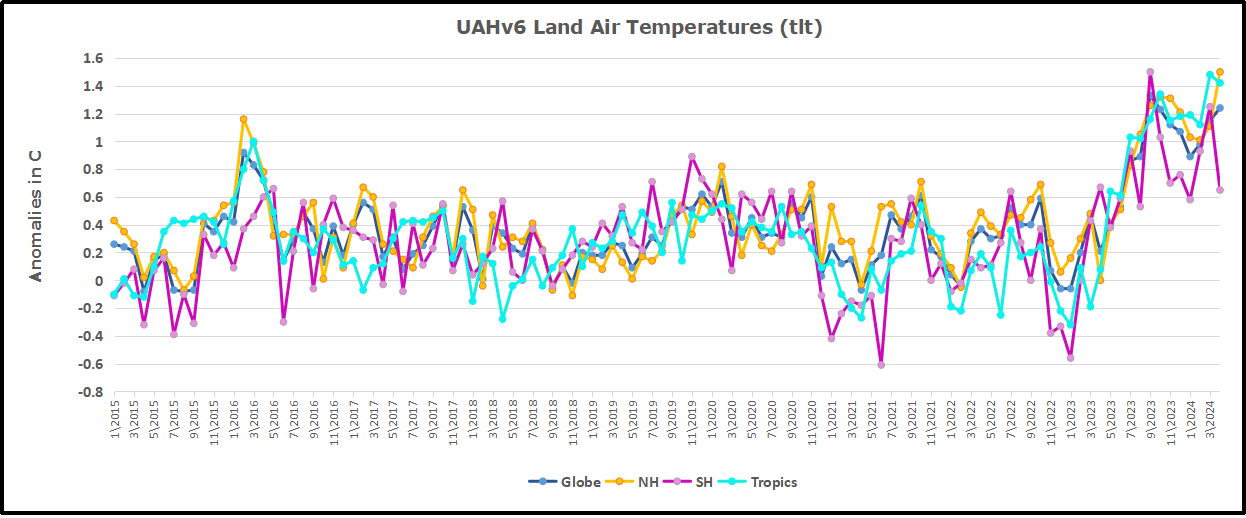
We sometimes overlook that in climate temperature records, while the oceans are measured directly with SSTs, land temps are measured only indirectly.  The land temperature records at surface stations sample air temps at 2 meters above ground.  UAH gives tlt anomalies for air over land separately from ocean air temps.  The graph updated for April is below.

Here we have fresh evidence of the greater volatility of the Land temperatures, along with extraordinary departures by SH land.  Land temps are dominated by NH with a 2021 spike in January,  then dropping before rising in the summer to peak in October 2021. As with the ocean air temps, all that was erased in November with a sharp cooling everywhere.  After a summer 2022 NH spike, land temps dropped everywhere, and in January, further cooling in SH and Tropics offset by an uptick in NH. 

Remarkably, in 2023, SH land air anomaly shot up 2.1C, from  -0.6C in January to +1.5 in September, then dropped sharply to 0.6 in January 2024, matching the SH peak in 2016. Then in February and March SH anomaly jumped up nearly 0.7C, and Tropics went up to a new high of 1.5C, pulling up the Global land anomaly to match 10/2023. Now in April SH dropped sharply back to 0.6C, Tropics cooled very slightly, but NH land jumped up to a new high of 1.5C, pulling up Global land anomaly to its new high of 1.24C.

The Bigger Picture UAH Global Since 1980


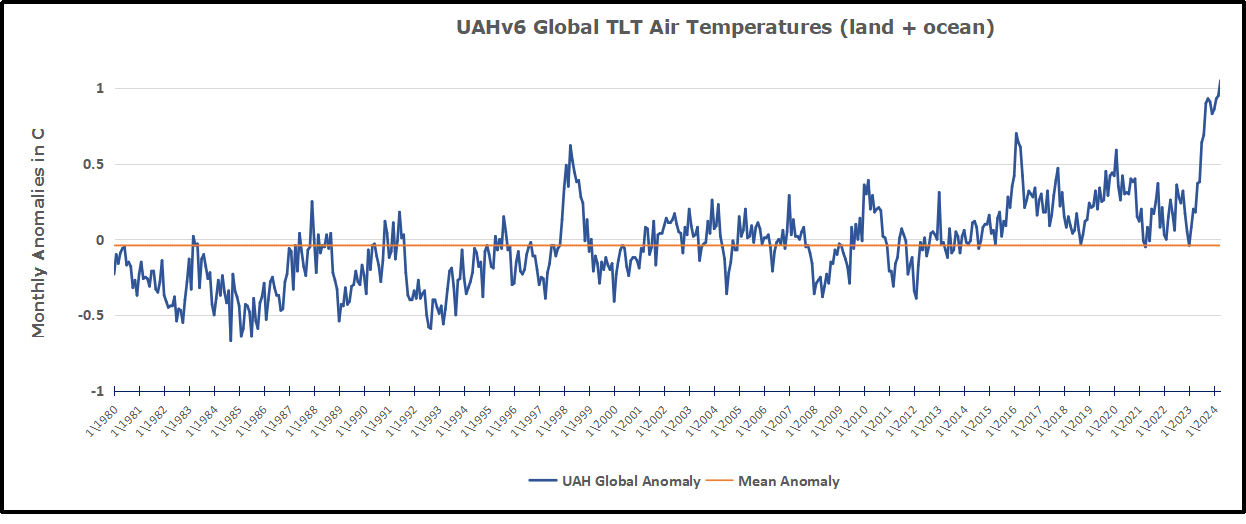
The chart shows monthly Global anomalies starting 01/1980 to present.  The average monthly anomaly is -0.04, for this period of more than four decades.  The graph shows the 1998 El Nino after which the mean resumed, and again after the smaller 2010 event. The 2016 El Nino matched 1998 peak and in addition NH after effects lasted longer, followed by the NH warming 2019-20.   An upward bump in 2021 was reversed with temps having returned close to the mean as of 2/2022.  March and April brought warmer Global temps, later reversed

With the sharp drops in Nov., Dec. and January 2023 temps, there was no increase over 1980. Then in 2023 the buildup to the October/November peak exceeded the sharp April peak of the El Nino 1998 event. It also surpassed the February peak in 2016.  December and January were down slightly, but now March and April have taken the Global anomaly to a new peak of 1.05C. Where it goes from here, up further or dropping down, remains to be seen, though there is evidence that El Nino is weakening.

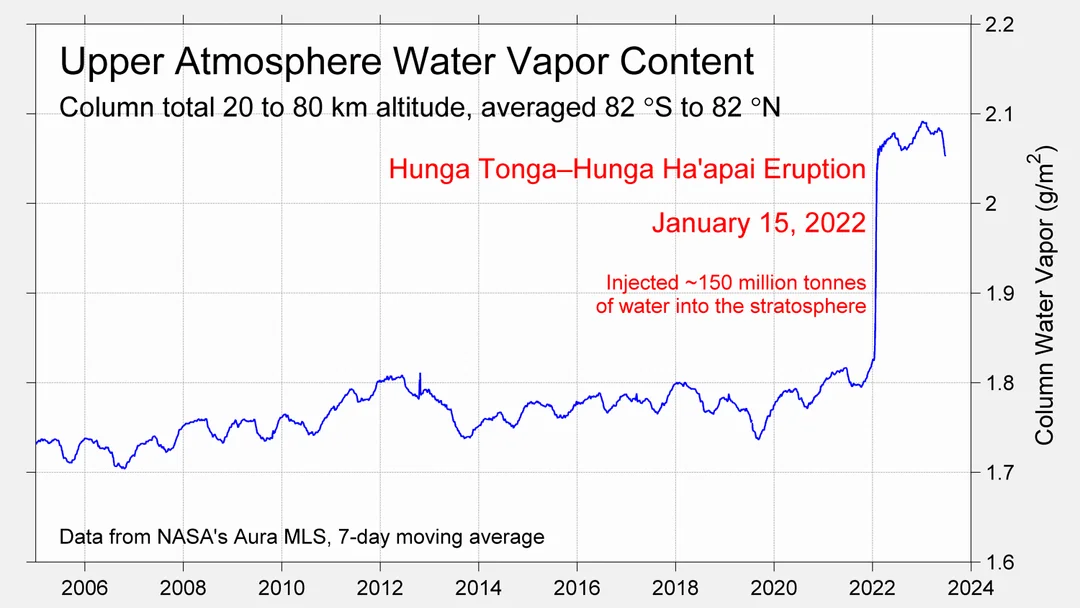
The graph reminds of another chart showing the abrupt ejection of humid air from Hunga Tonga eruption.

TLTs include mixing above the oceans and probably some influence from nearby more volatile land temps.  Clearly NH and Global land temps have been dropping in a seesaw pattern, nearly 1C lower than the 2016 peak.  Since the ocean has 1000 times the heat capacity as the atmosphere, that cooling is a significant driving force.  TLT measures started the recent cooling later than SSTs from HadSST4, but are now showing the same pattern. Despite the three El Ninos, their warming has not persisted prior to 2023, and without them it would probably have cooled since 1995.  Of course, the future has not yet been written.


via Science Matters

https://ift.tt/UKmAYcI

May 24, 2024 at 12:41PM

ClimateTV: Biden Climate Rules Onslaught: Coming to a Household Near You – The Climate Realism Show #111

On episode 111 of The Climate Realism Show, we are going to review many of the eco policies that amount to Biden’s war on homeowners and the citizenry for the sake of “saving the planet” from climate change.

We’ll be discussing the Biden power plant rule, auto emissions rule, new ESA restrictions in Texas for a lizard, appliance rules, and more. The rules restricting gas stove and light bulbs and others supposedly to prevent so-called climate catastrophes affect our everyday choices and lives.

Joining us will be Marlo Lewis, Jr. who is a senior fellow at the Competitive Enterprise Institute. Lewis writes on global warming, energy policy, and public policy issues and will comment of the onslaught by Biden which appears geared to meet the 180 day deadline for such things before the November election.

Join host Anthony Watts, the Heartland Institute’s H. Sterling Burnett, and Marlo Lewis for the big list of FAIL. And, as always, we have the Crazy Climate News of the Week. Join us LIVE at 1 p.m. ET (12 p.m. CT) for the kind of climate realism you can’t find anywhere else, and join the chat to get your questions answered, too.

Follow us on Instagram 👉@HeartlandInstitute

We’re on Facebook 👉 The Heartland Institute

Follow Linnea on Twitter 👉 https://twitter.com/LinneaLueken

Support this content 👉Donate – The Heartland Institute

via Watts Up With That?

https://ift.tt/c4DtRkI

May 24, 2024 at 11:35AM