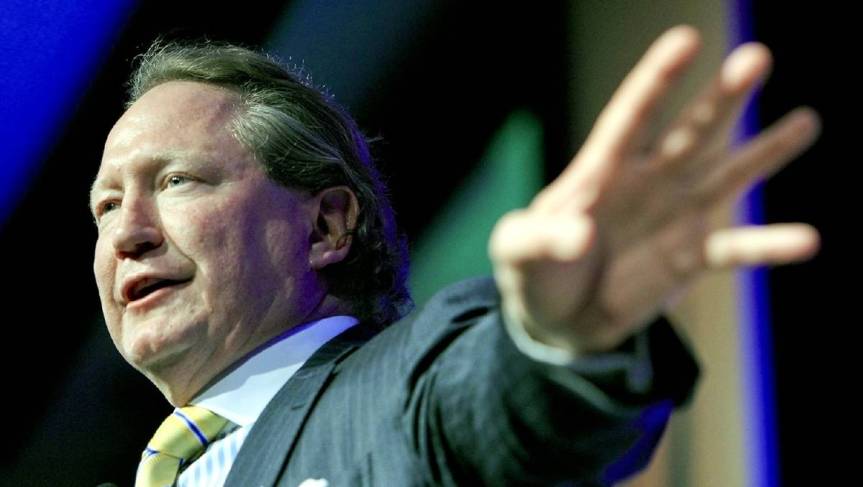
The myth of producing ‘green’ hydrogen using nothing but wind and solar is yet another effort by crony capitalists to separate taxpayers from their money.
If ‘green’ hydrogen was economically feasible, then entrepreneurs would be throwing every penny they could muster at something with so much (apparent) promise.
The fact that their first port of call is government-backed subsidy slush funds says it all, however.
Putting aside the (woeful) economics, the physics of producing, storing and distributing a highly volatile and corrosive gas means none of this has a hope of coming to fruition. It’s the reason why there is not one single commercial green hydrogen producer anywhere in the world.
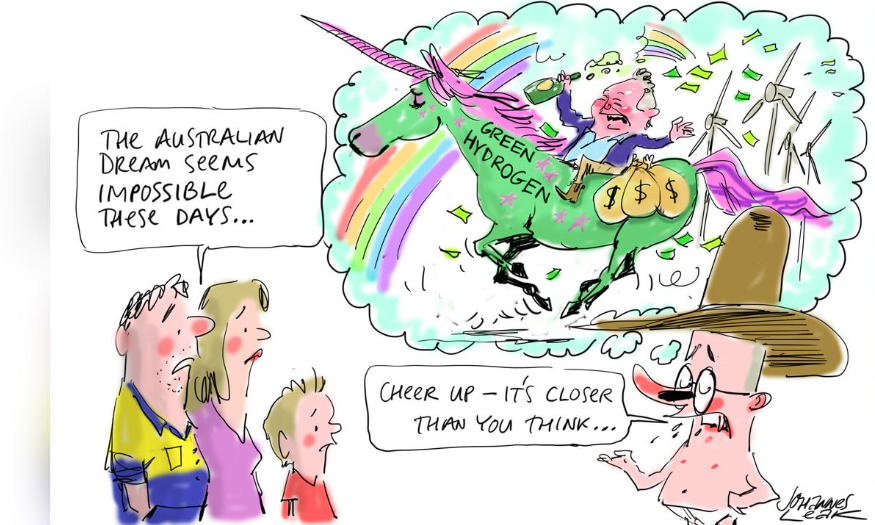
The King of Australia’s crony capitalists, Andrew Twiggy Forrest – this Country’s leading mouthpiece for green hydrogen – is long on rhetoric, but short on rational argument, and even shorter of the desire to put his own money where his mouth is.
As the team from Jo Nova and Eric Worrall explains below, Forrest’s grand green hydrogen plans haven’t a snowball’s chance in Hades of ever getting off the ground.
Renewable energy is too expensive to make “green hydrogen” — Twiggy goes to Arizona instead
Jo Nova Blog
Jo Nova
30 April 2024
Only 18 months ago the Australian government gave $14 million dollars to Andrew “Twiggy” Forrest to figure out if his team could build a 500MW electrolyser to make hydrogen gas on an island near Brisbane. It was going to be a glorious Australian green-techno future, the largest hydrogen plant in the world, but it’s missed three deadlines in the last three months to greenlight the project. Instead the Australian company is going overseas.
As Nick Cater points out this part of the made-in-Australia renewable superpower is going to be made-in-Arizona because they still have cheap electricity — a miraculous 7.5c a kilowatt hour!
Australia’s manufacturing decline is a story of broken promises and failed industry welfare programs
Nick Cater, The Australian
Bowen described the project’s success as “critical” to Australia’s ambition to be a green energy superpower.
It turns out abundant sun was not such a competitive advantage in the manufacture of green hydrogen. Low taxes, fiscally responsible government and cheap and reliable carbon-free energy are far more appealing drawcards for investors.
The future is already being built in Buckeye, Arizona, where Fortescue is investing $US500m ($765m) in a green hydrogen plant it says will be up and running by 2026.
In 2023, manufacturing in Arizona grew faster than in any other state. It includes energy and water-intensive industries such as silicon chip manufacturing, with Arizona coming from nowhere to fourth place among US states.
..It isn’t hard to work out why. Arizona’s top state income tax rate is 2.98 per cent. … For energy-hungry industries such as hydrogen and the IT sector, however, the biggest attraction is the industrial electricity price: 7.47 cents a kWh in Arizona compared to 18 cents in California.
Our electricity prices are twice as high as any hydrogen industry could bear
We are so far out of the running. Last month the boss of Fortescue Energy said he was hoping our prices would fall (by half!), and cites Norway as an example of “cheap renewable energy” as if we could emulate that. It’s a bit rich given that the only renewable energy Norway uses is hydropower (96%). Norway has 31GW of hydropower while we have 4GW and can’t even tack on a 2GW pumped hydro dessert. To put it bluntly, Norway has a thousand fjords and a half million lakes and Australia has no fjords and about fifty salt lakes.
Fortescue says hydrogen hopes rest on a halving of power prices
Peter Kerr, Australian Financial Review, March 11 2024
Mr Hutchinson [Fortescue Energy boss] told The Australian Financial Review Business Summit that high power prices were the main impediment at Gibson Island. “We’ve been working very, very hard on it,” he said. “But it’s tough based on the current power prices when we’re looking at competing globally. It’s a tough decision.
The company expects to approve a green hydrogen project in Norway this year which would be powered by carbon-free hydroelectricity. “If you look around the world where you can get cheap renewable power, competitive renewable power is below $US30 a megawatt hour,” he said.
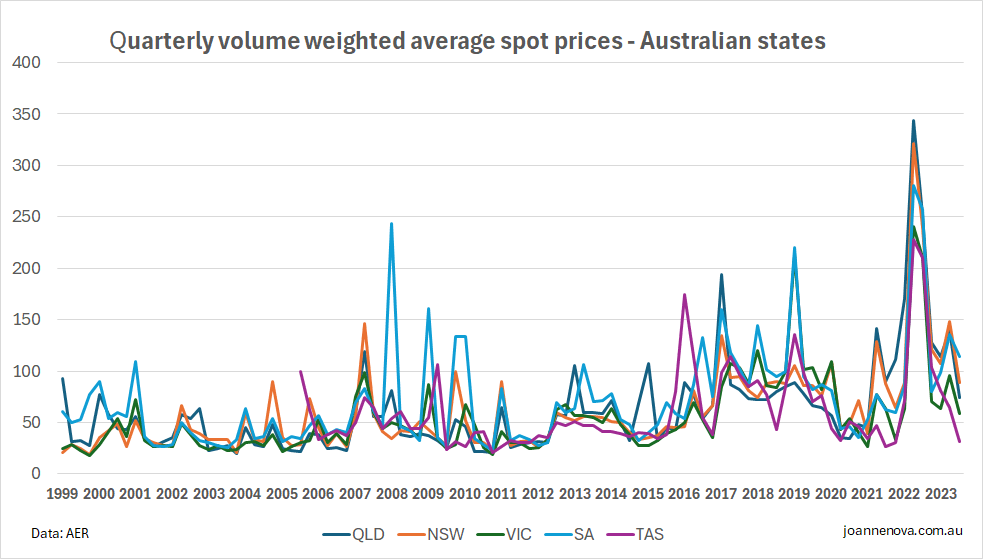
Impossible Triangle Puzzle.The irony is that to make hydrogen he needs the cheap power we used to have on the Australian national grid before we started adding renewables (after 2008 when Kevin Rudd was elected). For twenty years the whole Australian grid price was about $30 a megawatt hour. At a point after 2012, when the carbon tax was added, electricity prices rose up beyond the $50 per megawatt hour price limit that makes hydrogen industry unrealistic, and never came back down.
Once upon a time, Australia had electricity so cheap no one would have bought hydrogen. Now electricity is so expensive, hydrogen might be competitive, except no one can afford to make it.
Like the Penrose impossible triangle, just keep going left and it never makes sense.

Reference: AER quarterly wholesale electricity prices 1999- 2023
Jo Nova Blog
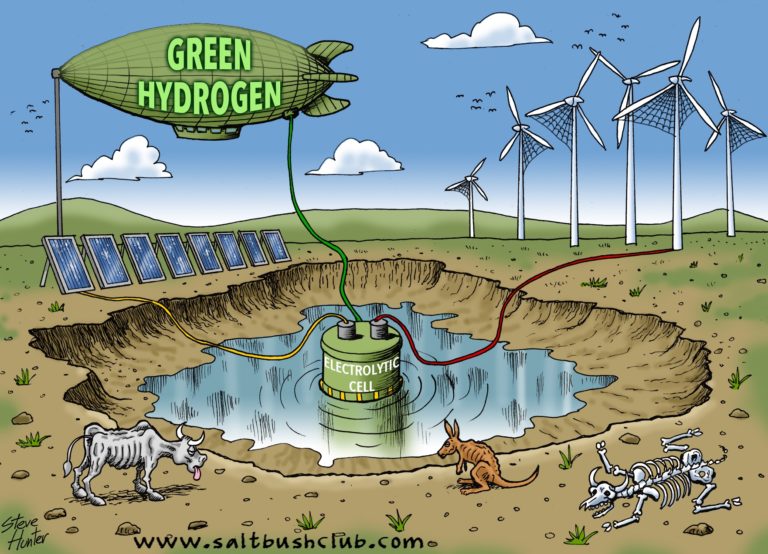
Fortescue: Biden Forcing Green Hydrogen Producers to Use Renewables Drives Up Prices
Watts Up With That
Eric Worrall
24 April 2024
“… The “hourly matching” rule will force hydrogen producers to either cease production when renewables are not available … or sign up for excess renewable power …”
Fortescue slams Biden administration’s green hydrogen tax rules
Peter Ker Resources reporter
Updated Apr 21, 2024 – 2.09pm, first published at 2.00pm
Fortescue says the proposed design of the Biden administration’s green incentives scheme could triple the cost of low-carbon hydrogen projects …
The iron ore group has an ambitious strategy to become a major force in hydrogen and renewable energy …
…
But Fortescue’s enthusiasm has waned since the US Treasury issued draft regulations known as “45V” which provide the detail on eligibility for the tax credits. Fortescue’s biggest problem is the requirement that companies must match each hour of production to an hour of renewable power generation and consumption to be eligible.
The rule is designed to ensure that subsidies are not given to hydrogen made from fossil fuel power during times when solar and wind power are not available.
The “hourly matching” rule will force hydrogen producers to either cease production when renewables are not available – an option that would undermine productivity and viability – or sign up for excess renewable power from diverse sources to improve the chances of having clean energy available from at least one source at all times.
…
“If I am building a gigawatt of electrolysers in Texas I may only need a gigawatt of energy at any time, but I have to buy seven times that to ensure that I have all the probabilities working, so I know I can match in that hour, which means the bulk of what I buy I don’t need,” he told a Bloomberg podcast.
…
Read more (paywalled): https://www.afr.com/companies/energy/fortescue-slams-biden-administration-s-green-hydrogen-tax-rules-20240419-p5fl78
You can understand Fortescue’s distress. Who could have imagined Biden would insist green projects actually be powered by renewables?
As Fortescue helpfully explained, renewables are so unreliable they would have to build or buy 7x overcapacity to ensure continuity of supply, which would be prohibitively expensive. A bit like how attempting to power the entire economy using renewables would be prohibitively expensive.
Watts Up With That?



 Iowa Climate Science Education