Month: May 2024

Fiddle-de-Dee

Record River Dee warmth ‘threatens salmon’” shouted the BBC headline. An article on the BBC website today, running only to five sentences, ensured that each sentence contained an alarming statement. First we are told that conservationists are warning that rising water temperatures represent a continued threat to wildlife in the (Scottish) river Dee. Second, we are advised that water temperatures in the river reached 21C earlier this month near Ballater, and that this is well beyond the optimum 16 or 17C needed by Atlantic salmon if they are to be sustained. Third, the fish can stop eating beyond the 16-17C range. Fourth, the high temperatures were reached two weeks earlier than in 2023. Finally, the River Dee Trust said temperatures in the river were on course for a record-breaking month.

Five sentences only, so much hype. No links were provided, so any attempt to dig deeper depends on independent research. Fortunately there is a thing called the internet, and even better, the River Dee Trust has a website, which seems to be shared with the Dee District Salmon Fishery Board. Its contents make interesting reading.

The first thing I noticed is that despite the short BBC piece seeming to be of the type that results from a press release (variations of it can be seen all over the internet over the last few days), the website itself seems to make no such claim about high temperatures in May. The closest to it that I could find is in its report for the week commencing 13th May 2024, which stated:

A scorching hot week of bright sunshine and high temperatures most days presented a challenging week for anglers and for the fish in the river, all the ghillies have mentioned the difficult conditions in their reports. The best time to be on the river was early morning or early evening and so fishing effort was reduced last week.

Temperatures were specifically referred to only twice. First there was a reference to “water temperatures between 57f/60f.” By my calculation, that’s a range of roughly 13.9C – 15.6C. Later in the weekly report we are told “[r]iver temperatures peaked at 18C this week at our monitoring site in Ballater.” The report for the following week (the most recent report on the website) doesn’t mention water temperatures at all, and reads as though all is well (e.g. “it was good to see people fishing in the evenings and enjoying a cast with the extra light nights” and “Honestly I wish I could bottle up the joy – we were on a high throughout”.

That is not to say that the River Dee Trust isn’t concerned about climate change and about river temperatures. Both concerns feature on the website, as do reports in recent years of higher water temperatures. For instance, almost exactly a year ago it published an article with the heading “It’s too warm for salmon”, which bemoaned the fact that river temperatures in summer now regularly exceed 20C for periods of time, with 23C also being exceeded from time to time at 60% of the temperature monitoring sites.

Fortunately, that piece links to another report relating to water temperatures in the summer of 2022 which, to my untutored eye, suggests that the number of such days, although potentially an issue for the health of fish stocks, seem to be relatively few. Despite the summer of 2022 including “an extended period of dry, hot weather,” “[t]he most common temperature (median) across all sites was between 11-14.4°C which is within the optimal temperature range for salmon”. However, the temperature did exceed 20C somewhere in the river catchment (most notably the tributaries of the Callater, Clunie, Gairn, and Geldie) on between 2% and 26% of the 91 days defined as summer for the purposes of the report. One of the key solutions being implemented is the planting of trees – lots of them:

Over 330,000 riverbank trees have been established in the upper catchment to date, on target for establishing 1 million riverbank trees by 2035. These trees are particularly targeted in areas sensitive to high summer temperatures such as the Callater, Clunie, Gairn and Geldie.

Having read that, I wondered if the Dee and its tributaries used to have many more trees in the past, and if the loss of trees might not be more significant than the relatively small increase to date in temperatures caused by climate change. It turns out that this is indeed very much the case. Another paper (the River Dee 2020 – 2025 Fisheries Management Plan) tells us:

Our once salmon-rich rivers have been substantially altered over millennia, with deforestation, agricultural intensification and damming for waterpower causing profound changes. Scotland is one of the most heavily deforested countries in Europe, with only half of the European average of forest cover – and less than one quarter of Scotland’s remaining woodland is natural. From the original estimated 70% forest cover, the upper catchment of the Dee now has only 8% woodland cover (including commercial plantations), whilst some individual catchments such as the Gairn have only 2% woodland.

Perhaps, then, it’s not a coincidence that the Gairn is one of the tributaries where the highest water temperatures have been recorded:

In recent years the Gairn, a tributary to the Dee, has reached a water temperature of 27.5C (81.5F), close to the lethal temperature for juvenile salmon.

The River Dee 2020 – 2025 Fisheries Management Plan is illuminating in other ways too. It blames climate change (perhaps inevitably), but it blames lots of other factors too, for reduced fish (especially salmon) numbers. For instance:

Aberdeen Harbour, one of the UK’s busiest ports, is built around the mouth of the Dee. There is no longer the shelter of a natural estuary for fish passing through, and the confined and noisy environment of the harbour may help predators of salmon and sea trout….Three years of tracking showed that smolt losses in the harbour can on occasions be high (one in three years), with over a quarter of smolts lost in this very small area…Adult salmon and sea trout move through the harbour throughout the year. The potential for disturbance during river entry from noise, sediment and other pollution, and any additional risk of predation during periods of disturbance is, however, poorly understood.

In other words, there are difficulties for returning fish as soon as they reach the river mouth. And they face a myriad of other problems:

In-river construction works can harm fish [and] their habitat…. Underwater noise and vibration impacts are particular areas for concern…

Interestingly, hydro scheme proposals earn a mention here. Poaching is an issue (though seemingly not a large one), while natural predators are an issue, and in the case of goosanders, apparently a relevant new problem:

Goosanders are a sawbilled duck that have relatively recently arrived in the UK. Their UK population is stable but counts on the Dee show an increase in these birds over the last 10 years. They feed on juvenile salmon and other fish – an average goosander eats 10 smolts/large parr each day. Tracking programmes show that high losses of smolts occur in many Scottish rivers. Evidence from acoustic tracking of Dee smolts shows high losses of smolts too, and most likely caused by goosander predation.

Seals are another problem predator (though seemingly a relatively small problem) as are cormorants, which “are becoming more of a threat as they encroach inland now even as far as Invercauld and take smolts and adult sea trout.”

Dolphins, it seems, are an unknown quantity, but the harbour area at Aberdeen might be exacerbating the issue:

It is possible that the artificial channel of the river as it passes through the harbour influences an otherwise balanced relationship between dolphins and salmon.

Humans are a big problem in many insidious ways:

There has been a huge decline in water quality from a historical perspective, and whilst regulations in recent years and decades have improved the situation, water quality is far from what it would be without the impact of our rural and urban communities. It is probably the biggest factor influencing the middle and lower catchment fish stocks and river life…Asthe riversupplies water for over 300,000 people and their homes and businesses, balancing water demands is a major challenge for the future. Although the principle abstraction is for domestic use there may be future demands on water resources for agricultural irrigation.…The biggest visible impact on water quality is sediment run-off. This is damaging to juvenile and spawning habitat and invertebrate habitat, thus affecting food supply for fish. Chemicals such as pesticides and road salt may have at least as much impact on water quality assediment, as they are washed off agricultural and urban land. Even low concentrations of chemicals in the river damage fish by affecting their homing, spawning and predator avoidance skills, ultimately reducing survival…Poor management practices outside of the riparian zone can overwhelm riparian buffering, or field drains can bypass them. To deal properly with pollutants affecting water quality requires a national change in land management practices and the use of chemicals.

The loss of floodplains and damage to peat cause yet more problems:

87% of the UK’s wetlands have been lost in the last 300 years as land has been drained to accommodate housing, industry and agriculture. The reduction of wetlands, like deforestation, peatland drainage and disconnection of floodplains, reduces the river’s capacity to deal with high and low flows events, reduces water quality, groundwater storage and the complexity and biodiversity of habitats and species….Drainage of peatlands was widely practiced in the past in an attempt to improve the land for agriculture, forestry and grouse moor management. However, it has led to significant negative impacts on rivers, by contributing to increased runoff during floods, reduced water storage for supply during droughts and reductions in water quality.

The above probably encompasses the main problems. There are others, though compared to the ones mentioned already, they seem to be relatively minor – invasive species (mink; pink salmon; the aquatic plant water crowfoot or ranunculus and others).

Then we return to the loss of woodland:

The accelerated hillslope erosion and rapid run off from the cleared land has reduced floodplain functioning and suitable stream habitat. Such drastic alterations mean the river is now more susceptible to extreme flows and temperature fluctuations. Whilst the loss of native woodland and functioning floodplains may not seem to be a direct cause of the decline in salmon stocks, it is likely they have been the first and most lasting impact on the rivers’ ability to produce salmon. A lack of trees has meant a direct reduction in habitat complexity and nutrient input and a lack of shade which can cause dangerously high water temperatures. Deforestation has reduced the resilience of the river to changes and contributed to a negative spiral in fish stocks….Climate change impacts have also been compounded by the historic impacts of deforestation and agricultural intensification. Scotland was once heavily forested and salmon have evolved to thrive in forested river catchments. Therefore, the expansion of native woodland is a major factor in giving salmon the rich, robust habitat they need….Wooded stream banks effectively reduce summer water temperatures, whilst increasing winter temperatures, making the streams more suitable for juvenile salmon. Trees also increase food supply directly through insect drop, and indirectly through leaf litter. Eventually fallen trees and branches will provide physical habitat for fish species and tree cover will reduce run off rates during heavy rain events.

And so we have come full circle. What have we learned? Mostly, I think, that if and to the extent that climate change is a problem for fish in UK rivers (and specifically in the Scottish river Dee and its tributaries), it is close to being the least of the problems. We humans have caused many issues, and the greatest of these, specifically so far as concerns high summer water temperatures, appears to have been deforestation on a fairly spectacular scale.

I venture to suggest that we have also learned something else – a BBC cut and past of a scaremongering five line press release, without investigation, validation, or context is close to misrepresentation if and insofar as its function is yet again to pump up climate change hysteria. Where is the BBC Verify team when we need it?

Footnote – the featured image comprises my first attempt to generate a picture using AI.

via Climate Scepticism

https://ift.tt/aMcDyHu

May 30, 2024 at 02:38PM

Megafossil Carbon Dating Indicates Sweden Was 2-3°C Warmer Than Today During The Last Glacial

“Modern warming is within natural Holocene climate variability” – Kullman and Öberg, 2024

From about 16,800 to 6000 years ago warmth-dependent tree species grew 300-700 altitudinal meters higher than they do today on Mt. Åreskutanthan, Swedish Scandes.

Due to the well-known warmth threshold for boreal tree species and the lapse rate (0.6°C per 100 m), recovering birch, spruce, and pine megafossil remains at much higher elevations than today’s treeline altitudes affirms much warmer-than-today climates during the late last glacial and through the early Holocene, when CO2 ranged from 190 to 255 ppm.

“It is increasingly evident that common boreal tree species grew close to this summit in a climate, 2-3°C warmer than at present, during the Lateglacial and early Holocene periods 16 800- 6000 years ago.”

The scientists point out that such early dating for warmer-than-today climates has been viewed as controversial, as it is assumed the Earth had not sufficiently warmed or deglaciated until about 11,000 years ago, near the official starting timeline for the Holocene. But the carbon-dating of tree megafossils is regarded as a much more reliable data collection method than pollen analysis and terrestrial cosmogenic nuclide analysis, so these results are robust.

“Moreover, Mt. Åreskutan has been in the centre of a controversy concerning the date of deglaciation and late-glacial arboreal performance. Kullman (2000, 2002) presented robust megafossil data, showing unequivocal presence of mountain birch (Betula pubescens ssp. czerepanovii), spruce (Picea abies) and pine (Pinus sylvestris), as early as about 16 000 cal. a BP, close to the summit 300-400 m higher than present-day treelines.”

While there has been warming in this region recently, the warming is “within natural Holocene climate variability” and poses no threat to these landscapes. Instead, warming may enhance biodiversity in this region.

The Intergovernmental Panel on Climate Change (IPCC) promulgates a contrasting “alarmist and dystopic” viewpoint of warming as a “serious and imminent threat to man and planet Earth” as they simultaneously “downgrade natural climate history and rely more on immature and unvalidated numerical models.”

Image Source: Kullman and Öberg, 2024

For good measure, another new Scandinavian study (Salonen et al., 2024) indicates today’s temperatures in northern Finland are among the coldest of the last 8000 years (see “Present-day value” dashed line). Much of the Holocene – as well nearly all of the last interglacial (LIG) – was 2 to 2.5°C warmer than present.

Image Source: Salonen et al., 2024

via NoTricksZone

https://ift.tt/RBUfj2p

May 30, 2024 at 02:01PM

If climate change is making turbulence worse, pilots and planes haven’t noticed…

By Jo Nova

The monster called “climate change turbulence” is an imaginary phantom

At any moment there are something like 10,000 boxes cruising in the air that know when they strike turbulence.  Rumors are that these are even staffed with sentient beings.  If Climate Change was making turbulence worse, you’d think pilots would have noticed?  But instead of reporting what pilots said, which is that nothing has changed, almost all the media coverage about turbulence comes from models or cherry picked reanalysis of angels dancing at 197 hectopascals over the North Atlantic.

The European Space Agency even puts sensors on planes. With 40 million flights per year, tracked by radar and monitored by satellite, and reported by pilots as well,  if there were trends in clear air turbulence on passenger planes, there would be a mountain of data, and we’d hear all about it. Instead all they have are modeled guesstimates and slightly worse conditions over the North Atlantic.

Pilots report that incidents of air turbulence are the same now as they always were

Paul Homewood has found the US National Transportation Safety Board Report, and actual pilot reports (PIREP data). Basically, in thirty years of flights and after more than half of mankinds total fossil fueled emissions have been emitted, there’s no trend at all.

To be fair, it could just be that we’re getting better at predicting turbulence so pilots are better at avoiding it. But if we’re going to headline newspapers with scary stories of flight turbulence (and if we actually care about people) the most important data might be the stuff that comes from planes.

The Australian ABC blamed it all on the Ogre du Jour:

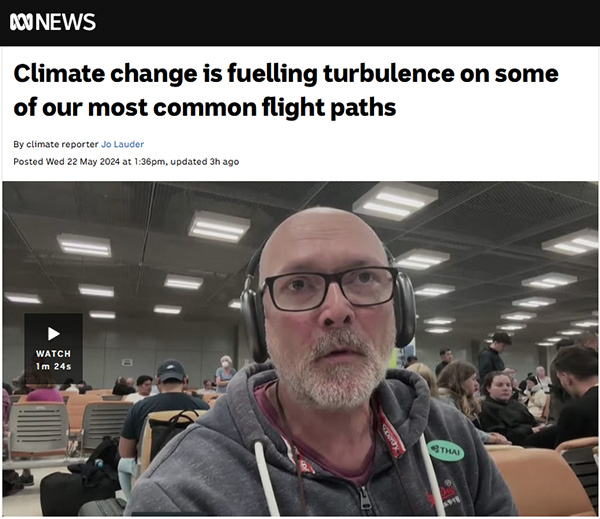
Climate change is fuelling turbulence on some of our most common flight paths

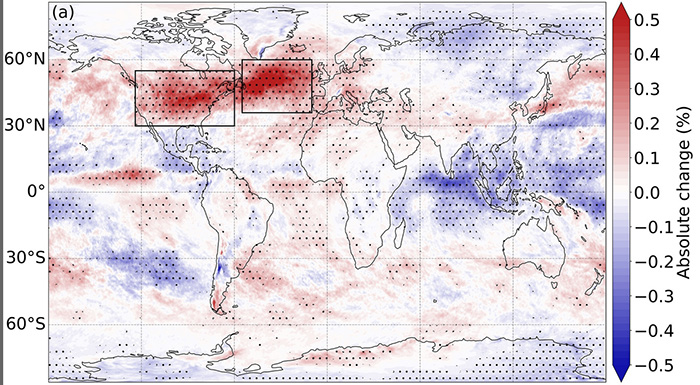
They found a Professor Troy Lane at Melbourne Uni who talks about studies which come from Reading University. One found more clear air turbulence over the North Atlantic in the last 40 years. But it also found less turbulence over South East Asia (see the figure from Prosser el al below). Using Believer-Correlation-Science —  if climate change causes more turbulence, then it also causes less. Looks like extra emissions of CO2 saved lives on the Singapore Airlines flight. By the same reasoning, burn oil and protect planes in South East Asia? Clearly the ABC team didn’t look at the paper, and also clearly, they didn’t ask Prof Lane any difficult questions. What do we pay them or him for — witchcraft? “See the tea-leaves on the map…”

Furthermore, when the ABC says “our most common flight paths” (headlined above) they’re not talking about our Australian flights. Who is this “our”?

It’s like there is no world outside the North Atlantic.

Turbulence changing in the skies

The change in ERA5’s 197 hPa annual-mean diagnostic-mean moderate-or-greater (MOG) clear-air turbulence (CAT) probability over 1979–2020, showing (a) the absolute change and (b) the relative change. The changes are diagnosed from the linear trend. Stippling indicates statistical significance at the p = 0.05 level, according to a two-sided Wald test (Fahrmeir et al., 2022) applied to the absolute change. | Prosser et al


The Prosser et al paper was deceptively headlined “Evidence for Large Increases in Clear-Air Turbulence Over the Past Four Decades” but it could as easily have said the opposite.  They dismissed the pilot reports with barely one line:

Pilot reports (PIREPs) have a longer record, but are not quantitative, and the geographical distribution of CAT based on PIREPs is limited in spatial and temporal extent (Wolff & Sharman, 2008). — Prosser et al 2023

Supposedly the point of the Prosser paper was to help aircraft and passengers, but actual reports from pilots: “who cares?”

The other paper quoted by the ABC was a 2017 study also from the University of Reading, and it was nothing but climate modeling and magical unverified, unvalidated, fiction:

A 2017 study predicted that severe turbulence will become two to three times more common over the North Atlantic by 2050-2080 because of climate change. However, the same study predicted a smaller increase of 50 per cent for severe turbulence over Australia.

Right there in the abstract, the 2017 paper admits its all games with calculators — no data needed

It’s pure fantasy extracted from models we know can’t predict cloud formation at all, or water vapor at the heights that planes fly at. Their universal predictions of increasing humidity in the upper troposphere are legendary failures.  The missing hot spot was called “a fingerprint” of man-made climate change right up until 28 million weatherballoons showed it didn’t happen.

Reading Uni has a lot to answer for. One of the most prominent scientists pushing predictions of turbulent doom is Paul Williams, who wrote the 2017 paper and at least two further ones. He predicted a 55% rise in air turbulence over the North Atlantic.  But Rupa Subramanya in The Free Press, writes that extra data wiped out the trend:

In 2017, he co-authored a study that received a lot of attention, because it predicted that a rise in atmospheric CO2 could double, or even triple, incidences of severe clear air turbulence. He also published a much-publicized paper in 2022 arguing that wind speed changes over the North Atlantic had increased in the last few decades—the basis for arguing that clear air turbulence will get worse. And in another widely reported paper, published in 2023, Williams predicted a 55 percent increase in clear air turbulence over the North Atlantic.

But how solid is his link between clear air turbulence and climate change? Earlier this year, Williams co-authored a letter to the Quarterly Journal of the Royal Meteorological Society, which walked back the findings of his 2022 paper. If we include new data, the letter explained, the increase in wind speeds above the North Atlantic ceases to be “statistically significant.”

Where were the headlines New data shows the professor was wrong?

Climate models will be useful when they figure out convection, clouds, rain, humidity, storms…

Professor Lane says most of the turbulence in the tropical regions comes from thunderstorms, which are intensely more intense I tell you.

He lives by a kindergarten climate rule where “energy = catastrophe”, thus:

“With a warmer atmosphere, the atmosphere can hold more water, which can lead to those most intense thunderstorms being more intense with climate change. As those thunderstorms become more intense, they can also generate more intense turbulence.”

Except that the biggest-storms-of-all are not more intense. Since the Tropical Cyclone Accumulated Energy Index started in 1970 CO2 has risen from an ideal 325ppm to an apocalytic 425ppm and the global population has doubled. Fifty years of reckless “pollution” have been and gone and yet cyclones are still the same?

Prof Lane doesn’t appear to realize the water vapor hasn’t made it to the upper troposphere and even if it had, “more energy” is not always a disaster. There’s not as much energy in Antarctica, but no one wants to live there, and we hear they still have storms.

Details matter. The lower troposphere has gained water vapor from the ocean as the system warmed, but it hasn’t increased in the upper troposphere where the modelers desperately need it to rise (and where those planes fly). The extra water vapor means the amount of energy held in the air is larger, but does that mean convection has increased or become more stable? After all, it’s not the total energy that creates instability, it’s the difference between two regions that causes the chaos.

REFERENCE

Prosser et al (2023) Evidence for Large Increases in Clear-Air Turbulence Over the Past Four Decades, 08 June 2023, https://doi.org/10.1029/2023GL103814

Williams, P.D. Increased light, moderate, and severe clear-air turbulence in response to climate change. Adv. Atmos. Sci. 34, 576–586 (2017). https://ift.tt/DP9lHst


10 out of 10 based on 1 rating

via JoNova

https://ift.tt/exgJrBE

May 30, 2024 at 01:21PM

Reduced Sulphur Content In Shipping Fuel Has Caused Most Of Recent Ocean Warming

By Paul Homewood


h/t Tallbloke 

This was always the main suspect, but you won’t see this on the BBC:


image

Human activities affect the Earth’s climate through modifying the composition of the atmosphere, which then creates radiative forcing that drives climate change. The warming effect of anthropogenic greenhouse gases has been partially balanced by the cooling effect of anthropogenic aerosols. In 2020, fuel regulations abruptly reduced the emission of sulfur dioxide from international shipping by about 80% and created an inadvertent geoengineering termination shock with global impact. Here we estimate the regulation leads to a radiative forcing of

Wm−2 averaged over the global ocean. The amount of radiative forcing could lead to a doubling (or more) of the warming rate in the 2020 s compared with the rate since 1980 with strong spatiotemporal heterogeneity. The warming effect is consistent with the recent observed strong warming in 2023 and expected to make the 2020 s anomalously warm. The forcing is equivalent in magnitude to 80% of the measured increase in planetary heat uptake since 2020. The radiative forcing also has strong hemispheric contrast, which has important implications for precipitation pattern changes. Our result suggests marine cloud brightening may be a viable geoengineering method in temporarily cooling the climate that has its unique challenges due to inherent spatiotemporal heterogeneity.

Fig. 3

image.

https://www.nature.com/articles/s43247-024-01442-3

We can ignore the exact calculations here.

But it has long been recognised that the 1970s cooldown was in part due to industrial aerosols, which thanks to clean air acts have reduced considerably since then. This reduction has undoubtedly contributed to warming in recent decades.

So why the surprise when the same thing happens at sea?

via NOT A LOT OF PEOPLE KNOW THAT

https://ift.tt/Y3fD97j

May 30, 2024 at 01:06PM