Month: May 2024

Drax To Build Wood Power Cargo Ship

By Paul Homewood


h/t Philip Bratby


 image

British power company Drax has drawn up plans for the world’s first wood-powered cargo ship, claiming that the controversial power source can help to cut greenhouse gas emissions from sea freight.

Drax, which operates a tree-burning power station in the UK, has signed a deal with three Japanese shipping companies to develop a “bioship” fuelled by wood chips instead of marine diesel. It hopes to see the first wood-fuelled cargo ship set sail by 2029.

The vessel would itself be used to ferry woodchips harvested by Drax from North American forests to new markets in Japan.

Drax and its Japanese partners said such ships would open the way to zero-emission shipping for many other cargoes.

However, the plan will infuriate many environmental groups who argue that cutting down forests for fuel is the wrong way to reach net zero.

Drax is best-known in the UK for its giant power station in Yorkshire, which last year generated around 6pc of the country’s electricity by burning 6.4m tonnes of wood – equivalent to 27 million trees – mostly imported from North America.

For comparison, the New Forest in Hampshire has around 46 million trees.

Drax and its supporters argue that wood is a sustainable energy source as trees can be grown to replace those cut down for fuel and the plants capture carbon while they are developing.

However, critics point out that trees grow much more slowly than the time it takes to use them for fuel, raising questions as to how sustainable they really are.

The UK Government supports the use of wood as a fuel and has given Drax subsidies for producing green energy, which amounted to £617m in 2022 and £587m in 2023.

In February, Drax chief executive Will Gardiner said he wanted to build more wood pellet plants in the US, doubling production to 8m tonnes by 2030.

Green campaigners said the plan was designed to exploit loopholes in carbon accounting rather than to save the planet.

Merry Dickinson of Axe Drax, which campaigns against the company’s plans to expand wood burning, said: “Burning wood pellets emits as much carbon as coal. This latest move is nothing more than another greenwashed scam from Drax.”

Sally Clark from Biofuelwatch said: “Using wood pellets to power ships will only lead to more climate-wrecking emissions, harm to wildlife and pollution of communities. If we are to avoid the worst impacts of climate breakdown, we need to protect and restore the world’s forests, not allow big polluters like Drax to send our futures up in smoke.”

https://www.telegraph.co.uk/business/2024/05/14/drax-power-ships-controversial-biomass-fuel-trees/

Drax is already burning the equivalent of half the New Forest every year. Heaven knows how many more forests will be cut down to satisfy Will Gardiner’s lust for more wood pellets.

And as we already know, burning trees adds far more CO2 into the atmosphere than any other fossil fuel, in terms of the energy produced. The theory that trees will eventually grow back to replace them is highly dubious, as many come from virgin forests which may never regrow. Even if they do, it will take decades to offset the CO2 emitted from burning, by which time billions of other trees will also have been burnt.

Burning wood was of course man’s main source of energy for millennia; now we seem to be intent to regress to those days.

As for Drax, they are in a bit of a hole, being totally reliant on government subsidies. If these are stopped, they don’t have a viable business; hence their desperation to expand operations, regardless of the environmental destruction they will wrought.

via NOT A LOT OF PEOPLE KNOW THAT

https://ift.tt/Dx8QjeK

May 15, 2024 at 03:28AM

Business Freeze: Germany’s Last Solar Panel Manufacturers Finally Crushed

Germany’s costly and chaotic wind and solar transition has served up plenty of casualties. Large numbers of energy intensive manufacturers have already bailed out – chasing cheap power prices in places like the US and Singapore.

Now, in a rather ironic twist, its solar panel manufacturing industry has all but thrown in the towel.

Notwithstanding very generous subsidies for those willing to purchase German made panels, its solar industry has been swamped by cheap Chinese imports, while local manufacturers are being crushed by Europe’s highest power prices; just like every other German industry, as the team from Jo Nova outline below.

German solar industry collapsing: unable to make solar panels from solar power
Jo Nova Blog
Jo Nova
1 May 2024

About 90% of solar panels installed in Germany come from China, and earlier this year one of the last solar panel manufacturers closed in Germany. Last week, what was left of the industry begged for mercy (and subsidies) which they didn’t get. Now another German solar panel manufacturer has closed down.

For some cruel reason German factories which are close to their customers, can’t compete with distant foreign factories which have access to slave labour, fossil fueled shipping and cheap coal fired electricity?

The bigger question, seemingly, is how did the country that invented the printing press, diesel engines, and the theory-of-relativity get fooled by such a stupid ploy? Someone told them they could save the world with unreliable energy, so they converted their generators to unreliable ones, only to discover that they can’t afford to use unreliable generators to make the unreliable generators they need to keep saving the world?

The only government stupider than Germany is the one that has already seen how badly this worked out and announces they’re going to do the same thing. Australia is not only ten years too late, but China has flooded the market to the point where people are using solar panels as garden fences, and we have our own glut of solar power at midday.

The last hope of the German solar industry was a government mandated “bonus” for people who bought German solar panels.

April 23rd:

German solar industry warns “last chance” for sector’s renaissance could be missed

Benjamin Wehrmann CleanEnergyWire

Carsten Körnig, head of solar power lobby group BSW,  …added that the solar industry was disappointed by the decision to leave out a “resilience bonus” for installations made in Europe. Given the stiff competition between producers in the U.S. and Asia for securing a share of the market in solar panel production, Körnig said including the bonus in the package would allow Germany to achieve greater supply security for the important future technology, adding that it is “perhaps the last chance for a renaissance of Germany’s solar industry”.

April 30:

Solarwatt becomes second solar PV producer to halt production in Germany in 2024

 Carolina Kyllmann CleanEnergyWire

Solar panel manufacturer Solarwatt is set to halt production of solar photovoltaic (PV) modules in its factory in Dresden, business daily Handelsblatt reported. “Under the current circumstances, running a production facility here in Germany is extremely difficult economically, and we cannot justify this,” Solarwatt head Detlef Neuhaus told the newspaper. The plant with an annual production capacity of 300 megawatts (MW) will close “for the time being” at the end of August, with 190 jobs directly affected by the shutdown.

China generates 60% of its electricity with coal, while Germany uses 32% coal, and 30% solar-and-wind power. What should Germany do, bring back coal, or get some slaves?

Solar panels are now in the “top five” worst slave industries in the world, yet still barely any of the morality-police care. They’re apparently too busy atoning for slavery they didn’t cause that doesn’t exist anymore to worry about slaves that are alive today.
Jo Nova Blog

via STOP THESE THINGS

https://ift.tt/4T2UXgJ

May 15, 2024 at 02:30AM

C40 CITIES WORKING TO CONTROL THEIR RESIDENTS

Geoff Buys Cars is a popular Youtuber who represents a large number of ordinary people. In the linked video he looks at a shadowy organisation called C40 cities, which is fixated on reducing their residents ability to choose what they eat, the clothes they buy and the cars they drive, plus many other restrictions in order to reach the mythical net zero.

What is ‘C40 Cities’ about and how does it link ULEZ Expansion with The Clinton Foundation? (youtube.com)

via climate science

https://ift.tt/gSHV95m

May 15, 2024 at 01:34AM

Winter Without Your Gasoline Car?

“In addition to the poor driving range and higher purchase price that comes with an EV, owners of cars in northern states will soon be forced to contend with poor performance in cold weather. Federal and state officials should reconsider their efforts to ban gasoline vehicles.”

January of this year brought near-zero temperatures to Chicago and other northern cites, producing an electric vehicle (EV) charging nightmare. National media showed images of owners pushing dead EVs around charging stations and waiting for hours to try to charge their vehicle. Drivers lucky enough to connect to a charger sat in their freezing-cold automobile, unable to run the heater while the car tried to charge. Nevertheless, the federal government and many states continue to push to eliminate gasoline vehicles.

On March 20, 2024, the Environmental Protection Agency announced a final rule, Multi-Pollution Emissions Standards for light vehicles sold in model years 2027 to 2032. The rule includes restrictions on the amount of carbon dioxide that can be emitted per mile, restrictions which most gasoline cars will be unable to meet. The goal of the rule is to force manufacturers to produce EVs for up to 56% of new light vehicle purchases by 2032.

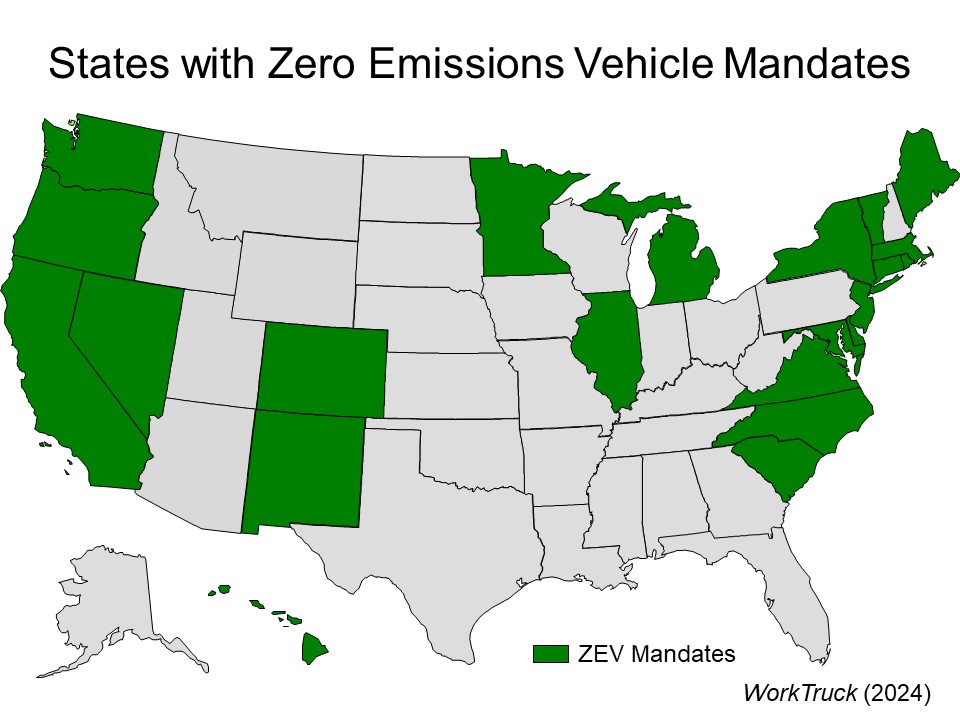
Twenty-two states have adopted zero emissions vehicle (ZEV) mandates. California regulations call for 100% ZEV sales by 2035. Seventeen states have adopted the California ZEV regulations. Many of these are northern states with cold winters.

“Zero-emissions vehicle” effectively means electric vehicle. Hydrogen fuel-cell cars are failing to penetrate the US market. California has 55 public hydrogen fueling stations, but that number has been declining. Hawaii has a single hydrogen fueling station, the only other station in the US. Battery electric vehicles and plug-in hybrid EVs are the only vehicles that can meet the mandates at this time.

I recently met a guy from Cleveland at a conference whose wife had a Tesla. Two years ago, winter temperatures dropped to 10 degrees Fahrenheit at their home in Cleveland and her vehicle would not charge. She complained to the manufacturer to no avail.

In cold weather, electric vehicles lose driving range and take longer to charge. A 2020 study by the Norwegian Automobile Federation found an average loss of 18.5% in driving range during winter temperatures of 21─37 degrees Fahrenheit. Cold weather charging times increased up to 50 percent longer, depending upon car model. And as the woman in Cleveland found out, EVs will not charge at temperatures near zero degrees Fahrenheit.

A solution might be a heated garage or heated charging facility. But all US charging companies are losing money today, even without building heated public charging garages. About 30 percent of the US population lives in multi-unit housing, without a garage. Stretching a charging cable across a public walkway in the snow is a poor solution. And many homeowners with a garage do not park their car in their garage or cannot heat it.

Minnesota was the first midwestern state to adopt California’s ZEV regulations. The average high and low temperatures in St. Paul, Minnesota in January are 26oF and 7oF, poor conditions for EV charging.  Montpelier, Vermont’s January average temperatures are the same as in St. Paul, with a 100% ZEV mandate in 2035 as well.

Maine’s mandate will require 43% of new vehicles sold by 2027 to be ZEV and 82% by 2032. But Augusta Maine’s average high and low January temperatures are 28oF and 11oF, not much warmer than Minnesota. Don’t state political leaders realize that gasoline car bans will force winter hardship on their citizens?

Last December, Canada mandated that all light-duty vehicles must be 100% zero emissions by 2035. Unless you have a heated garage in Canada, you soon won’t be able to charge your new EV for most of three months of the year.

In addition to the poor driving range and higher purchase price that comes with an EV, owners of cars in northern states will soon be forced to contend with poor performance in cold weather. Federal and state officials should reconsider their efforts to ban gasoline vehicles.

——————

Steve Goreham is a speaker on energy, the environment, and public policy and the author of the bestseller (and increasingly prescient) Green Breakdown: the Coming Renewable Energy Failure. His previous posts at MasterResource can be found here.

The post Winter Without Your Gasoline Car? appeared first on Master Resource.

via Master Resource

https://ift.tt/TakvxEw

May 15, 2024 at 01:04AM